 |
 Pulled out my dummy load tonight
 24 April 2014 | by
  |
| Press image for a better view of the dummy load |
Testing a transmitter means the use of a dummy load. Trying to be considerate, I don’t want to cause unnecessary interference with my signals. So when I want to test my Ultimate 3 QRSS/WSPR kit I also pull out one of my dummy loads.
It measures just 9-10 mm across and is the size of a BNC connector. It is simply one of the many Ethernet terminations that I have lying around. Its built-in 50 ohm resistor is rated at something like 0.25 W. Considering that the kit outputs something like 200 mW that should mean that there is enough margin and no forced air cooling or liquid cooling is required.
These terminators were used with 10BASE2 or 10BASE5 ethernet. They are not so common anymore so the terminators are not that easy to find any longer. But they are still very handy for testing QRPP transmitters.
The size of these dummy loads should point out in a very vivid way how tiny the power levels of these transmitters are. Despite that, when running with the effective WSPR code, they can still be decoded on the other side of the globe.
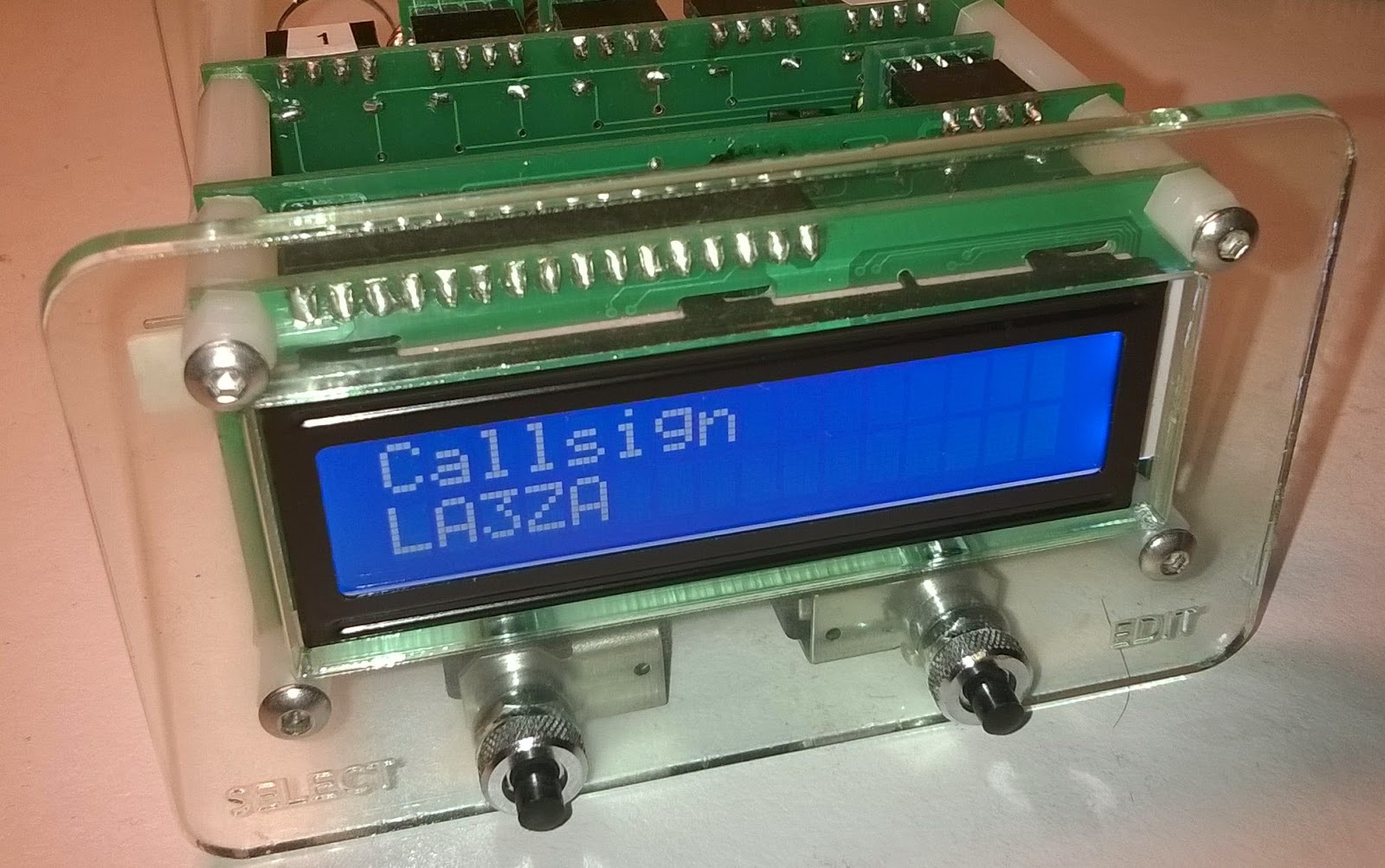
Showing just the back of a piece of equipment is contrary to my bragging instincts, so for completeness, the front of the Ultimate 3 QRSS/WSPR kit is also shown. It is housed in the minimalistic, but beatifully crafted acrylic enclosure from M0ION.
Sverre Holm, LA3ZA, is a regular contributor to AmateurRadio.com and writes from Norway. Contact him at [email protected].
Doing the math
I’ve been doing some investigating with my computerized logbook. In the over 11,000 entries that I have in it, I took the time to tally the numbers for CW QSOs vs. Non-CW (Digital, Phone) QSOs. CW makes up for 98.7% of my operating.
Speaking of computerized logbooks, I am playing around more and more with Log4OM and am taking a liking to it. It may soon become my full time computer logging software. I still have a few issues to work out – such as why the distances displayed are in kilometers even though I have the “display distances in miles” checkbox checked. Also, I have to get the program to hook up with LoTW and eQSL. I think those are minor issues, especially after watching the YouTube videos on the subject by Terry G4POP.
Additionally, Ham Radio Deluxe has developed a glitch which has me puzzled. When I have the Cluster display open, if I click on a DX station that is on a band other than what I am currently on, the KX3 will go to that station and then immediately back to where I am/was.
Let’s say I just worked W1AW/1 on 7.038 MHz, and I see on the Cluster that EM7XX is on 14.004 MHz. If I use my mouse to click on EM7XX, the KX3 will go to 14.004 MHz, but then will immediately go back to 7.038 MHz. It never used to do that. In the past, it would have gone to 14.004 MHz and would have stayed there. I have de-installed and re-installed HRD, but for whatever reason, it doesn’t want to behave properly anymore. And while I’m trying to save up for the PX3, I really don’t want to pop a hundred bucks for the new version of HRD. Log4OM is not behaving that way, it’s acting like it should and it’s free, so …………… I think you can see where I’m headed.
I have played around with the DX Lab Suite and for some reason it would not import about a 1,000 of my QSOs via ADIF import. The same thing happened with Logger32. Log4OM imported every single QSO that I had in HRD. I was looking at nGenLog and kind of liked it, but for some reason after the initial session, it hangs up and freezes my computer when trying start up the next session. It’s so bad that I have to hit CTRL-ALT-DELETE to access the Task Manager in order to stop the program and get the computer running again.
Maybe it’s also time for a new computing platform in the shack.
72 de Larry W2LJ
QRP – When you care to send the very least!
Larry Makoski, W2LJ, is a regular contributor to AmateurRadio.com and writes from New Jersey, USA. Contact him at [email protected].
W1AW/Ø Change in Schedule
I posted my planned intentions of operating W1AW/Ø from Colorado last week. Unfortunately I’ve had to make a slight change to my on-air schedule to accommodate a scheduling conflict which will allow me to speak to a local amateur radio club about SOTA or Summits on the Air.
As it stands today, I will operate W1AW/Ø on the following dates/times/bands/modes:
23 May 0000z – 0300z – 20m – phone
25 May 1500z – 1800z – 20m – phone
I may sign up for additional time slots if needed. I’ll post an update the week before Colorado will be on the air. In the mean time, I’m getting on the air as much as possible and working as many stations as I can for the ARRL Centennial QSO Party. I hope to work you either during my time operating W1AW/Ø or as KDØBIK. Either way, ain’t this hobby great?
Until next time…
73 de KDØBIK
Jerry Taylor, KD0BIK, is a regular contributor to AmateurRadio.com and writes from Colorado, USA. He is the host of the Practical Amateur Radio Podcast. Contact him at [email protected].
LHS Episode #127: Dirty Catfish
 In this episode, your intrepid hosts discuss several ham-radio related stories including operators interfering with jail communications, getting lost in strange valleys, and transmitting through a hammock. But that’s only the beginning. Thanks for tuning, and for being a valued listener of our show.
73 de The LHS Guys
Russ Woodman, K5TUX, co-hosts the Linux in the Ham Shack podcast which is available for download in both MP3 and OGG audio format. Contact him at [email protected].
20 m in a good shape
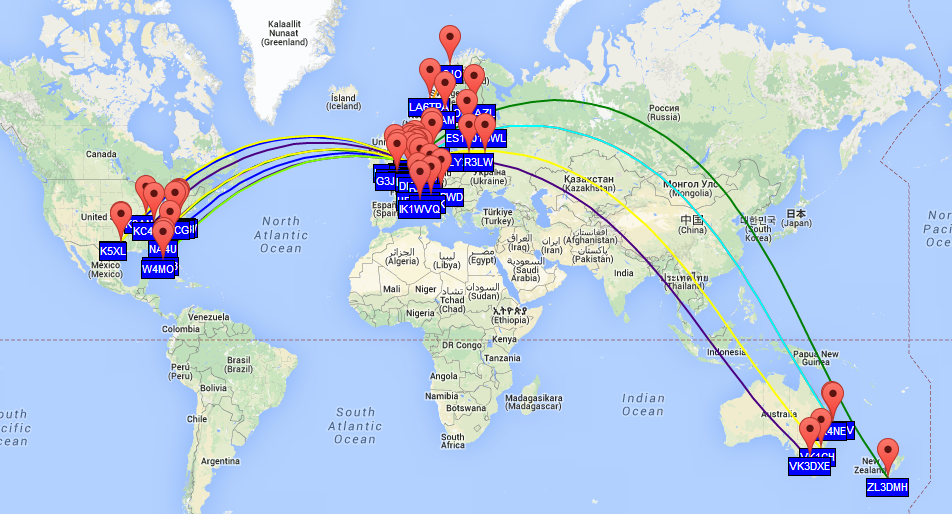
Propagation on 20 meter was very good this morning. Best DX was ZL3DMH 18668 km with WSPR 5 watts. Also a lot of short skip in Europe.
Paul Stam, PC4T, is a regular contributor to AmateurRadio.com and writes from the Netherlands. Contact him at [email protected].
This Spewed Out of the Internet #27
 More important things spewing forth from the interwebz:
The Ham Hijinks guys have been at it again, with this article: New Drug Aims To Get More Hams On The Air
Warning: Do Not Take These Guys Seriously, It Only Encourages Them
Chiming in on April 1st, Dan KB6NU reported that the FCC is going to reinstate the Morse Code test.
I posted an article about using UTC over at HamRadioSchool.com: Does Anybody Really Know What Time It Is?
KB9VBR has a nice article that explains the common types of antenna connectors used with ham radio.
Elliot KB0RFC has been writing some interesting stuff about D-STAR, DMR and other things digital on his blog. See his latest article: Developing a DMR / D-STAR radio
James R. Winstead, KD5OZY, of Coleman, Texas found out that sometimes the FCC does show up and bust radio amateurs that are causing problems on the air. See the ARRL article here. It always cracks me up when the FCC Engineer reports that during their station inspection, the offender’s radio is still tuned to the frequency where the problems were occurring.
Serious DXers all over the world are in severe depression after finding out that Crimea is Not a New DXCC Entity. Conspiracy Theory: the whole thing was instigated by a group of hams that believed Crimea would be a new one.
73, Bob K0NR
Bob Witte, KØNR, is a regular contributor to AmateurRadio.com and writes from Colorado, USA. Contact him at [email protected].
LHS Episode #126: We Blinded Ourselves with Science
 In this episode, we get all science crazy. Lots of fun science topics to tickle the brain are in store. Along with that, we pursue the new LTS release of Ubuntu, the disappearance of Maylasia Airlines flight MH370, and some pretty cool tunes. There’s even some ham radio content thrown in, ’cause that’s how we roll.
73 de The LHS Guys
Russ Woodman, K5TUX, co-hosts the Linux in the Ham Shack podcast which is available for download in both MP3 and OGG audio format. Contact him at [email protected].
 Ham Radio Deluxe |
 W5SWL Electronics |
 Ham Radio Prep |
 KB3IFH QSL Cards  Hip Ham Shirts  HamRadioAuctions HamRadioAuctions Reliance Antennas Reliance Antennas Enigma Shop Enigma Shop |  morseDX  Ni4L Antennas  R&L Electronics R&L Electronics antennas.us antennas.us QRV QRV |
- Matt W1MST, Managing Editor
