 |
 Practical Wireless with the LM386 unleashed
 2 May 2014 | by
“Improving the LM386 Audio Amplifier” is the title of always inspiring Rev. George Dobbs G3RJV’s column in this month’s Practical Wireless. George talks about the basic amplifier with a voltage gain of 20 (26 dB) and how it is straight forward to increase gain to any value up to 200 (46 dB). The article then shows how it can be built dead-bug style.
Then he goes on to talk about various ways to improve the circuit such as for hiss reduction and even higher gain. In that connection he also mentions my article “Unleashing the LM386” from SPRAT in the Autumn of 2003. That circuit was an enhanced version of the high-gain circuit of Kazuhiro Sunamura JF1OZL. Basically it increases the gain to up to more than 70 dB, enough for it to drive a loudspeaker. My circuit also adds bandpass filtering. All this is achieved by adding only 5 passive components to the basic amplifier. The circuit was recently revisited in SPRAT by Johnny Appel SM7UCZ. He added a 40 dB Darlington pair preamplifier for even further gain.
The bandpass filtering (not low pass as the article says) is due to the series resonance of 100 uF and 1 mH which happens at about 500 Hz making it a nice CW filter.
It was good to see my article revisited as I think the idea deserves to be better known and to be considered in more LM386 amplifier circuits. The same goes for the improved muting circuit of the LM386 using pin 7. I developed both in the period when I was interested in minimal transceivers like the Pixie 2 and in true QRP spirit was interested in how to achieve much with as few as possible components.
One thing which is not mentioned in Practical Wireless is that the circuit may be used in such a way that it really squeezes out every grain of amplification of the poor little LM386, so the warning I wrote when I wrote an introduction to “Unleashing the LM386” for the blog (see link below) is worth repeating:
One word of warning is prudent here. As the 200 ohm pot approaches zero ohms, the amplification becomes so large that the series resistance of the 1 mH inductor and the ESR (equivalent series resistance) of the 100 uF capacitor in combination with the open loop gain of the LM386 will determine gain. Some of these values are unspecified for standard components and may vary a lot. Therefore such a setting is not recommended for use in mass-produced circuits. However for a hobbyist’s one-of-kind circuit it should be fine.
A poor copy of the last of the three pages of the Practical Wireless article, where the high gain options are discussed, is shown.
See also:
- Unleashing the LM386, introduction to article in SPRAT, No 116 (Autumn 2003)
- Using pin 7 of the LM386 to reduce BCI and add side tone to Pixie 2, based on article in SPRAT, No 113 (Winter 2002)
Sverre Holm, LA3ZA, is a regular contributor to AmateurRadio.com and writes from Norway. Contact him at [email protected].
FabLab first
After some cautious first steps my first laser cut parts have been made. The case for the clubs upcoming WSPR kit build prototype has been, well, lasered.

There’s a couple of minor points to address but for a first effort I’m pretty pleased.
The idea was to cut for a single sheet a ‘desktop’ case for the U3 WSPR transmitter that could display a callsign or something similar on the front as a customisation as well as being simple and space efficient. Yep, you can buy a case but its quite nice to be able to make one in Cumbria rather than China. I should be able to get 4 and a half of them out of a single 300mmx600mm sheet.
All I have to do now is fix the faults and make it right next time.
Alex Hill, G7KSE, is a regular contributor to AmateurRadio.com and writes from Cumbria, UK. Contact him at [email protected].
KX3 Heat Sink
If you operate your Elecraft KX3 in a portable environment (and perhaps even if you don’t) there are a few must-have add-ons which really help protect your KX3. You are probably already aware of the popular KX3 KX Endplates and KX Cover available from Scott, AK6Q and his Gems Products website. I received both as a Christmas present from my darling wife and love what they do for my KX3.
In addition to operating SSB phone via my KX3 on SOTA activations, I also enjoy grabbing my Buddipole a battery and heading outdoors for some picnic table portable operations in a park or really just about anywhere. In this setting I typically bring along my laptop and operate PSK-31 or JT-65. However, one thing I’ve noticed (and have been concerned about) is how the KX3 has the potential to heat up when running these digital modes (even at 5w or less). This is especially evident in the warmer months of the year.
A few weeks ago I was browsing the KX3 Facebook page and learned about an add-on heat sink designed, built and sold by a fellow ham in Canada. This OM’s name is Fred Meier, VE7fmn. I contacted Fred via email and he quickly provided a detailed response on how he designed his KX3 heat sink and provided cost and availability information. While I did find one other heat sink being marketed for the KX3, I believe Fred’s version is more effective at dissipating the heat from the KX3 and it looks great while doing it.
Here’s what Fred’s KX3 heat sink looks like installed on my KX3.


Fred’s KX3 heat sink is well built and designed to be durable. The fins on the heat sink are not going to bend or break off and only adds an additional 8 ounces of weight to the KX3.
I’ve conducted a few tests while in the shack and had the KX3 running PSK-31 and JT-65 at 10w and never received the overheat warning. I couldn’t run above 5 watts inside or outside the shack without the heat sink installed. I’ve yet to test the KX3 with heat sink installed outside in a portable setting, but I’m confident I will not have any issues. If you would care to read another review of VE7fmn’s heat sink, please go here.
As I’ve stated, I love operating portable with my KX3 and I’m Happy, Happy, Happy to have this wonderful add-on to help keep my KX3 Cool, Cool, Cool.
Until next time…
73,
Jerry
Jerry Taylor, KD0BIK, is a regular contributor to AmateurRadio.com and writes from Colorado, USA. He is the host of the Practical Amateur Radio Podcast. Contact him at [email protected].
Amateur Radio Newsline Report 1916 May 2 2014
- Coconino County Arizona bans mobile ham radio
- UK regulator Ofcom proposes new CB rules and more
- Hams in India help with recent elections
- Florida man hit with a $48,000 NAL for alleged cellphone jamming
- Ham Nation to go live from the Dayton Hamvention
- Time to select USA's team for the World ARDF Championships
Paddle project
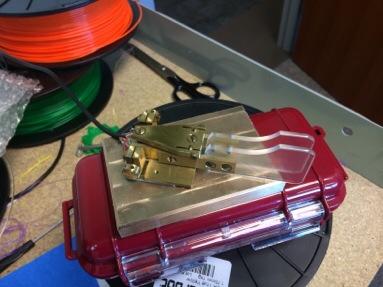
Over the years, I’ve fancifully imagined that I would build a set of keyer paddles. I even went so far as designing a couple concepts and collecting materials…but, inevitably I moved on from the institution with the machine shop and sucker machinist who was showing me the ropes. About a week ago, Mike, W3MC, posted a bunch of goodies for sale, including a Schurr Einbau key mechanism. Since I love my Profi 2, I snapped it up, recalling also that I had a nice hunk of brass for a base. Today, I cut and milled a little base for it. Lots of finishing and some acrylic work remain, but for now, there’s something special about a freshly-milled hunk of metal.
Ethan Miller, K8GU, is a regular contributor to AmateurRadio.com and writes from Maryland, USA. Contact him at [email protected].
Caught my first 50MHz Es opening of the year
Although I’ve been aware of some Es happening on 50MHz for the last few days, inevitably, the openings have been when I have been busy or engaging in good works (cleaning the village church, springs to mind!).
This evening after supper, I popped up to the shack to see what satellite passes might be of interest and I decided to check 50MHz. To my delight there was an S9 CW signal around 50.097. A quick listen and a call and IS0GQX was in the log for the first Es QSO of the season.
I heard him work a few others around this area, but no other stations from the Med were heard, and within 5 minutes, the band was quiet again. Love those early season Es openings!
Tim Kirby, G4VXE, is a regular contributor to AmateurRadio.com and writes from Oxfordshire, England. Contact him at [email protected].
April is in the books
Another month is in the books and the QSO a day goal for 2014 continues. April was successful in many different ways. First, it moves me one month closer to ending the year with a QSO each and every day. I also added two new DX entities to my DX list (Crete and Saint Kitts & Nevis) and I managed to get one state closer to WAS on a few different categories. Finally, I beat my monthly total QSO record of 393 (set in November 2013) with a grand total of 599 total QSO’s.
The surge in QSO’s for April is primarily due to my wanting to be better prepared in working contest pileup situations when it’s my turn to operate W1AW/Ø later in May. I’ve been getting on the air and operating the ARRL Centennial QSO Party as much as possible and as much as band conditions have allowed. It’s been fun. I’d love to work you and give you my 5 points as a VE.
I’ve also been successful at chasing (and catching) all the W1AW portable stations. I will need to make sure I catch a few states on their second time around later in the year. But my goal is to work them all.

The QSO breakdown for April is as follows:
Mode Number QSO’s
JT65 149
JT9 3
SSB 441
PSK31 5
RTTY 1
2m FM 0
Additional notes of interest:
DX Stations Worked in March – 46
New DX Entities in March – 2
Total QSO’s for March – 599
Total QSO’s for 2014 – 818
Total consecutive QSO days – 120
Days left in 2014 – 245
Until next time…
73 de KDØBIK
Jerry Taylor, KD0BIK, is a regular contributor to AmateurRadio.com and writes from Colorado, USA. He is the host of the Practical Amateur Radio Podcast. Contact him at [email protected].
 Ham Radio Deluxe |
 W5SWL Electronics |
 Ham Radio Prep |
 KB3IFH QSL Cards  Hip Ham Shirts  HamRadioAuctions HamRadioAuctions Reliance Antennas Reliance Antennas Enigma Shop Enigma Shop |  morseDX  Ni4L Antennas  R&L Electronics R&L Electronics antennas.us antennas.us QRV QRV |
- Matt W1MST, Managing Editor
