 |
 Portable Station Build – Part 2
 11 May 2014 | by
 Today I made more progress. I was able to paint the rack. I decided on a camo pattern since the box was sort of camouflaged. Not that I need it to be hidden, it was just for fun. I also mounted the top shelf.
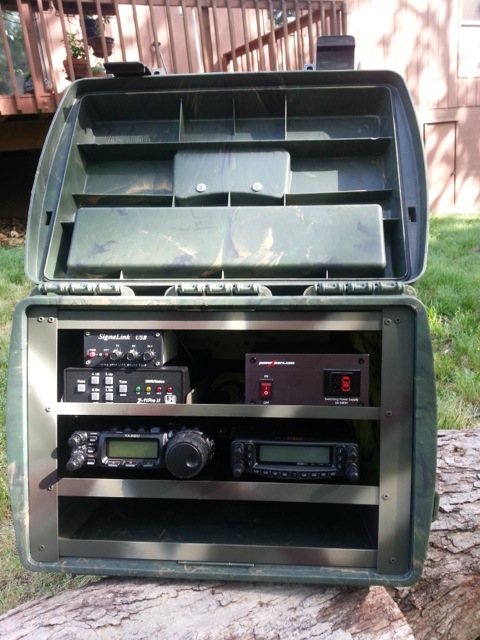
Here is the rack with the radios and other things mounted.

A side view . . .

Top view . . .

View from the back . . .

The box with the rack inserted. The rack won’t be fastened into the box. I am going to be able to slide it in and out as needed. This will make working on things easier. It would also allow me to provide more airflow if it gets warm in the box during operation. I am thinking about putting a small fan in there somewhere. Not quite sure yet . . .
The box with the lid closed. The lid has an “O” ring around the top, making it water-resistant.

I don’t have anything wired up or connected yet. The space on the lower front portion will have a plate with antenna connectors and other things. That will be a project in itself. I’ll post again when I get more done.


Wayne Patton, K5UNX, is a regular contributor to AmateurRadio.com and writes from Arkansas, USA. Contact him at [email protected].
I’ve Got a Golden Ticket

Well, actually it’s red…

Anthony, K3NG, is a regular contributor to AmateurRadio.com.
Portable Station Build – Part 1
I have been working on putting my radios and gear into a portable box. My goal is a single station that is portable which I can use at home or outside the home. I wanted this setup to be able to be used at things like: Field Day, Communications volunteering for local events, or simply operating at a local park. I don’t want portable gear and fixed station gear at home. I think for me, having a single station that I know inside and out, that could be used in multiple locations suits me just fine. A few guys in our club have talked about doing an informal get together at a fellow member’s farm and spend the afternoon operating. An informal “Field Day” just for fun. I finally have enough done to put up the first post describing my efforts.
For the box that will old the radio gear, I chose a MTM Sportsmen Dry Box called the Spud 7.

Inside the box, I am building an aluminum frame to hold the gear. I am using 3/4″ aluminum angle from my local bog box home store. Also used is some flat aluminum pieces where I did not feel the angle would work well.
Here is the outer portion of the frame.

There will be two shelves. The bottom one will hold both radios, a Yaesu FT-857D and a Paesu FT-8800R. Here is the frame with the radio shelf installed.

The frame is assembled with 1/8″ aluminum pop rivets. I find these easy to work with and they can be easily drilled out if I have to remove and replace something. Some joints have two rivets and other places have one.
The upper of the two shelves, will hold a LDG tuner, a SignaLink USB device and a PowerWerx power supply. Here is the upper shelf. I had it installed but had to take it out to drill the holes for mounting the power supply. The radios will be installed with the mobile mounting brackets that same with them. I ordered the optional mounting brackets for the power supply. So all these things will be held in bolts, nuts, and lock washers. The tuner will be held in with double-sided tape and plastic tie wraps. The tuner is lightweight enough to not move when I tested that solution.
Here is the upper shelf not installed . . . .

The tuner will be on the left, and the power supply on the right.
Once I get the upper shelf in, I plan on painting the frame with a black hammered spray paint. But that’s subject to change . .
The lower part of the frame will be covered with a plate. Mounted on the lower opening, will be a face plate which will have antenna connectors for each radio, power connectors, a power meter and a few other things. I am finalizing the plans for that now. I have it drawn out and designed, I just have to review it again and start ordering the electrical and antenna components.
I will write a Part 2 as I make more progress. I am also going to work on a solar solution for power in the field. That will come later as well.


Wayne Patton, K5UNX, is a regular contributor to AmateurRadio.com and writes from Arkansas, USA. Contact him at [email protected].
Five GREAT Reasons to Party
State QSO Parties come in all shapes and sizes but the intent is always the same — to stir up activity on the air and to have fun in the process! Approach these as serious contest activities or as a casual event punctuated by a little scorekeeping. Your choice. There are plenty of reasons to participate, but if you need more convincing, allow me to share with you five GREAT reasons why you should get in the party line!
- It’s good practice for big contests. You get a chance to see how your station performs, and identify your weakest link. You can stress test that new paddle or audio chain, make certain your logging program is working properly with your equipment. In other words, a State QSO Party provides an excellent trial run for your budding contest station — if that’s your cup of tea.
- Finish off your WAS basic award by snagging that State that you just never seem able to confirm. When dozens of operators are calling ‘CQ’ in their own QSO Party, from whatever state you might still need, chances are good that you will log a bunch of them, increasing your odds that at least one will confirm your QSO. Same goes for band and mode slots. Say you have the basic WAS award, but now you want to confirm all of them on RTTY. Or 80M CW. The State QSO Party’s will turbocharge your efforts to reach those goals.
- County hunters lick their chops over QSO Party activity. And with good reason. Those who organize a QSO party usually go out of their way to make certain that every county in their state is activated. Even if that requires engaging multiple “rover” stations who drive to and operate from counties that may have a zero ham population and are never active. And bonus, some of these rover station operators find their mobile/portable adventure so enjoyable, it becomes the primary focus of the hobby for them. It’s just another of the many facets of amateur radio.
- It’s a stress-free way to collect wallpaper, plaques, and bragging rights. Most QSO Party’s offer awards and plaques for top scores. And in many cases, you don’t need the biggest gun in the hunt to bag one. Do a little research and consider focusing on specialty entries. Enter as ‘QRP CW’ for example, and you will compete in a smaller pool while the plaque for taking first place in that category is even sweeter.
- Participation will make you radioactive! It’s no coincidence that those who rarely make use of their radio are often the most vocal critics of – well – almost everything about the hobby. Meanwhile, those who are frequently active on the air are too busy enjoying the hobby to waste time picking nits.
Operating in State QSO Parties couldn’t be easier, especially for those outside the state where the exchange is usually just signal report, your state or province, and sometimes a sequential number that begins with one and increments each time you make a contact. Inside the state, operators will also include their county. You can submit your log electronically (usually Cabrillo format) or send in paper, the old-fashioned way.
Read the rules, sketch out a plan, put in the effort, and then watch your logbook fill to overflowing.
(adapted from a recent issue of Quintessence, a weekly, personal letter about amateur radio)
Jeff Davis, KE9V, is a regular contributor to AmateurRadio.com and writes from Indiana, USA.
VP8ORK 2011 ebook available, free!
Although I’m not a huge fan of chasing Dxpeditions these days, I still think it’s fascinating and magical to travel to a remote part of the planet, set up a radio station and be able to make contacts all over the world.
Nodir Tursoon-Zadeh EY8MM has produced several eBooks based on his photographs from various high profile Dxpeditions which are available for free.
If you are an iPad/iPhone user, simply go to the iBooks store and search for VP8ORK 2011 and you should be able to download and view the book, which makes excellent reading. Nodir has taken some wonderful photographs which really capture what it is like.
It looks like Nodir has published an eBook on the FT5ZM trip to Amsterdam Island, which is available in the Blurb store but I can’t see it in the iBooks store just yet. I suspect you can get it onto your iDevice from Blurb, but I haven’t tried that yet!
Tim Kirby, G4VXE, is a regular contributor to AmateurRadio.com and writes from Oxfordshire, England. Contact him at [email protected].
Science Fair time!
“Hey, Dad …… do you have a meter that will read really small voltages and tiny amounts of current?”, my son Joseph asked the other week.
“Joey, I’d better! I’m an Amateur Radio operator, and I was an electronics technician for 22 years.”, I replied.
And so began the 2014 8th grade Science Fair project. My son decided to see how the pH of a fruit or vegetable would affect its ability to generate electricity. His hypothesis – the more acidic the fruit/vegetable, the more power would be generated.
The materials were an apple, a lemon, a pear and a potato. A head of red cabbage was procured to act as a pH indicator. Zinc screws and 3 inch pieces of #10 gauge copper wire served as electrodes.
Before we began generating electricity, my wife boiled some leaves from the cabbage in a pot of water. The resulting liquid would act as our litmus paper.
I stuck a screw and a piece of the copper wire into each piece of produce. The positive lead from the meter went to the copper wire and the negative lead was attached to the zinc screw. We measured both voltage and current, to be able to calculate Watts.
A teaspoon of the cabbage water was put into four glasses. Juice from each piece of produce went into the purple cabbage water. If the cabbage water turned blue, it would indicate a base. If the water stayed purple, the pH would be neutral. An acidic pH would turn the cabbage juice pink.
From lowest output to highest were – potato, pear, apple, lemon.
And in turn, the potato had the lowest pH, while the lemon had the highest. The voltage and current readings followed the pH indications. It seems my son’s hypothesis was correct!
Now all Joey has to do is make a graph, print out the pictures we took and write up an explanation of what was observed. The really neat thing was that he had a good time and really enjoyed himself. I’m not sure what he wants to be, someday; but something in the scientific or electronics field would not be so bad.
72 de Larry W2LJ
QRP – When you care to send the very least!
Larry Makoski, W2LJ, is a regular contributor to AmateurRadio.com and writes from New Jersey, USA. Contact him at [email protected].
Hello world!
Welcome to WordPress. This is your first post. Edit or delete it, then start blogging!
Alex Hill, G7KSE, is a regular contributor to AmateurRadio.com and writes from Cumbria, UK. Contact him at [email protected].
 Ham Radio Deluxe |
 W5SWL Electronics |
 Ham Radio Prep |
 KB3IFH QSL Cards  Hip Ham Shirts  HamRadioAuctions HamRadioAuctions Reliance Antennas Reliance Antennas Enigma Shop Enigma Shop |  morseDX  Ni4L Antennas  R&L Electronics R&L Electronics antennas.us antennas.us QRV QRV |
- Matt W1MST, Managing Editor
