 |
 LHS Episode #129: Don’t Penetrate Me
 28 May 2014 | by
  In this episode of Linux in the Ham Shack, your mild mannered hosts discuss ham radio self-education, elmering and Hamvention. On the Linux side of things, we look at installing drivers for a Yaesu radio, and take a live look at a Debian-based distribution known as SolydX. There’s also lots of feedback, and a surprise visit by our ol’ pal Richard. Chaos ensues!
73 de The LHS Guys
Russ Woodman, K5TUX, co-hosts the Linux in the Ham Shack podcast which is available for download in both MP3 and OGG audio format. Contact him at [email protected].
Hoot Owl Sprint After Action Report
Disappointingly, there was not a lot of activity last night in the QRP ARCI Hoot Owl Sprint. My guess would be that between the CQ WWPX Contest and Holiday weekend BBQs and other activities, that most folks were probably too pooped to pop.
I was on for approximately 2 and 1/2 hours, from 8:30 PM local time to 11:30 PM local time (0030 – 0300 UTC). I worked a total of 17 stations – mostly up and down the East coast. I did work John N0EVH in Missouri and I did have a nice little QSO with Rumi LZ2R who was calling CQ USA from his QTH in Bulgaria. He was running his K3 at 5 Watts and we were 569 both ways. I think he was looking for counties, but I got the exchange needed for the Sprint, so as far as I’m concerned, it counts and it was by far my best DX for the night.
The last 1/2 hour, from 0230 to 0300 UTC was just me calling CW with no takers. That’s when I decided to pack it in for the night. The KX3 was plugging away calling CQ and I started nodding off a little bit. I’m sure if there was more activity, I would have stayed on until the allotted time was up, which would have been local Midnight (0400 UTC). But the rig automatically calling CQ over and over is kind of like driving down a long highway in the rain with the windshield wipers on. The constant rhythm of CQ with no breaks can kind of lull yout to sleep.
According to Reverse Beacon Network, there is how I was being heard last night.
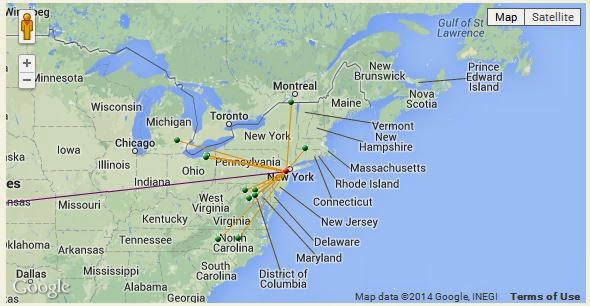
I spent just about all of my time on 40 Meters. I did make one QSO on 80 Meters and three on 20 Meters, featuring the one with LZ2RS. Other than that, everyone seemed to be concentrating on 40 Meters in the 7.030 MHz neighborhood. As far as antennas go, I was using mostly my 88′ EDZ on 40 meters and for my very brief foray into 80 Meters. On 20 Meters, I used the Butternut HF9V.
72 de Larry W2LJ
QRP – When you care to send the very least!
Larry Makoski, W2LJ, is a regular contributor to AmateurRadio.com and writes from New Jersey, USA. Contact him at [email protected].
Win a Free Wouxun KG-UV8D HT
AmateurRadio.com and BuyTwoWayRadios.com
have teamed up to give away a free Wouxun KG-UV8D!
Leave a comment to enter!
This 2M/440 transceiver features 999 programmable channels, a large LCD screen, full duplex, cross-band repeat, and much more!
 Prize Package
Wouxun KG-UV8D Dual-Band HT
136-174 MHz / 400-480 MHz
999 Memories / 2.5K step / Crossband repeat / Part 90 approved
FREE 2600 mAh upgrade!
A $159.99 value
XLT Painless Programming Cable
Genuine FTDI chip
A $19.99 value
Eligibility
All licensed amateur radio operators worldwide
(Free worldwide shipping included!)
How To Enter
It’s simple!
Leave a comment to this post.
Giveaway Duration
1 week only!
You may enter only once until
Tuesday, 3 June 2014 20:00 UTC
Winner Announcement
Tuesday, 3 June 2014
We will announce the winner on AmateurRadio.com.
You can get the winner announcement by
subscribing to our free Amateur Radio Newsletter via e-mail,
following our posts via RSS feed, or via Twitter (@amatradio).
Sign up so you won’t miss our next prize drawing!
Please tell your friends about this giveaway!
 Thank you to BuyTwoWayRadios.com
for supplying this fantastic prize!
Learn more about the Wouxun KG-UV8D!
The winner will be chosen at random (using random.org) from all valid comment entries to this post received by the contest deadline. Entries will be deemed valid at the sole discretion of AmateurRadio.com and may be rejected for any reason, including inappropriate comments. Entries received after the deadline will not be considered. The prize may not be transferred. The prize may not be exchanged for cash. Winner agrees to allow AmateurRadio.com to use their name and callsign to announce them as a winner on our site, and to share their contact information with the sponsor for the purposes of awarding the prize. E-mail addresses of all other entrants will not be shared with any third party, including the sponsor, unless required by law. No purchase necessary to win. Odds of winning dependent on total number of entries received. Winner is responsible for any applicable taxes or fees imposed by their jurisdiction. Void where prohibited by law.
Matt Thomas, W1MST, is the managing editor of AmateurRadio.com. Contact him at [email protected].
An interesting afternoon’s 50MHz WSPR; propagation near and far
I mentioned yesterday that I had got WSPR-X running and tried it out on 50MHz.
Despite it not being the most active of 50MHz days, it actually proved to be very interesting. Later on in the afternoon there was some Es around and I was pleased to spot and be spotted by CN8LI at a distance of just over 2000km. Not bad for 5W or so.
But actually, the most interesting signals were from Roger, G3XBM over in Cambridgeshire at a distance of around 140km. Roger runs 1W to a vertical, like mine. Pretty much every transmit period he made, I could see his signals, although often insufficient strength to decode. Another challenge was that owing to the amount of aircraft in the skies between us, the signals were often heavily doppler shifted, which is a problem for WSPR.
To our delight, Roger was able to decode my 5W signals several times and I was able to decode his 1W signals on several occasions. Our suspicion was that tropo came up a little and that there might have been some assistance from aircraft, perhaps flying on such a path that there was limited doppler shift.
I did also note that on the couple of times that we exchanged signals, Es had bubbled up a little. Clearly there is no suggestion that the propagation was via Es. However, I did wonder whether there was some benefit from some sort of scatter associated with the Es. At such low powers, I’m doubtful, but will look to see if it happens again.
Tim Kirby, G4VXE, is a regular contributor to AmateurRadio.com and writes from Oxfordshire, England. Contact him at [email protected].
First play with WSPR-X on 50MHz (DirectX strikes again!)
Inspired by Roger, G3XBM’s 50MHz WSPR experiments, I decided that a wet bank holiday was just the time to see what I could do. Es has been quiet today, so I thought some WSPR would be fun to see if any weak signals would make it through.
A few days ago, I noticed a post mentioning a new version of WSPR, WSPR-X which can be downloaded at K1JT’s site Realistically, as the main improvement seems to be the addition of WSPR-15, mainly for VLF, I wasn’t sure whether there would be any major changes.
As it turns out, the user interface is a bit more modern, folllowing the WSJT-X design.
I downloaded it and installed it and could see noise being received. I set it up to transmit and was surprised when G8JNJ and G8JNJ/A, 80km away or so did not copy my transmission. I tried again, still no. Then I remembered that when I first played with WSJT-X, I couldn’t get anyone to copy me, until I switched the output audio device driver to Direct X. I did that and immediately, I was spotted! Not really sure why – but pleased that it works ok.
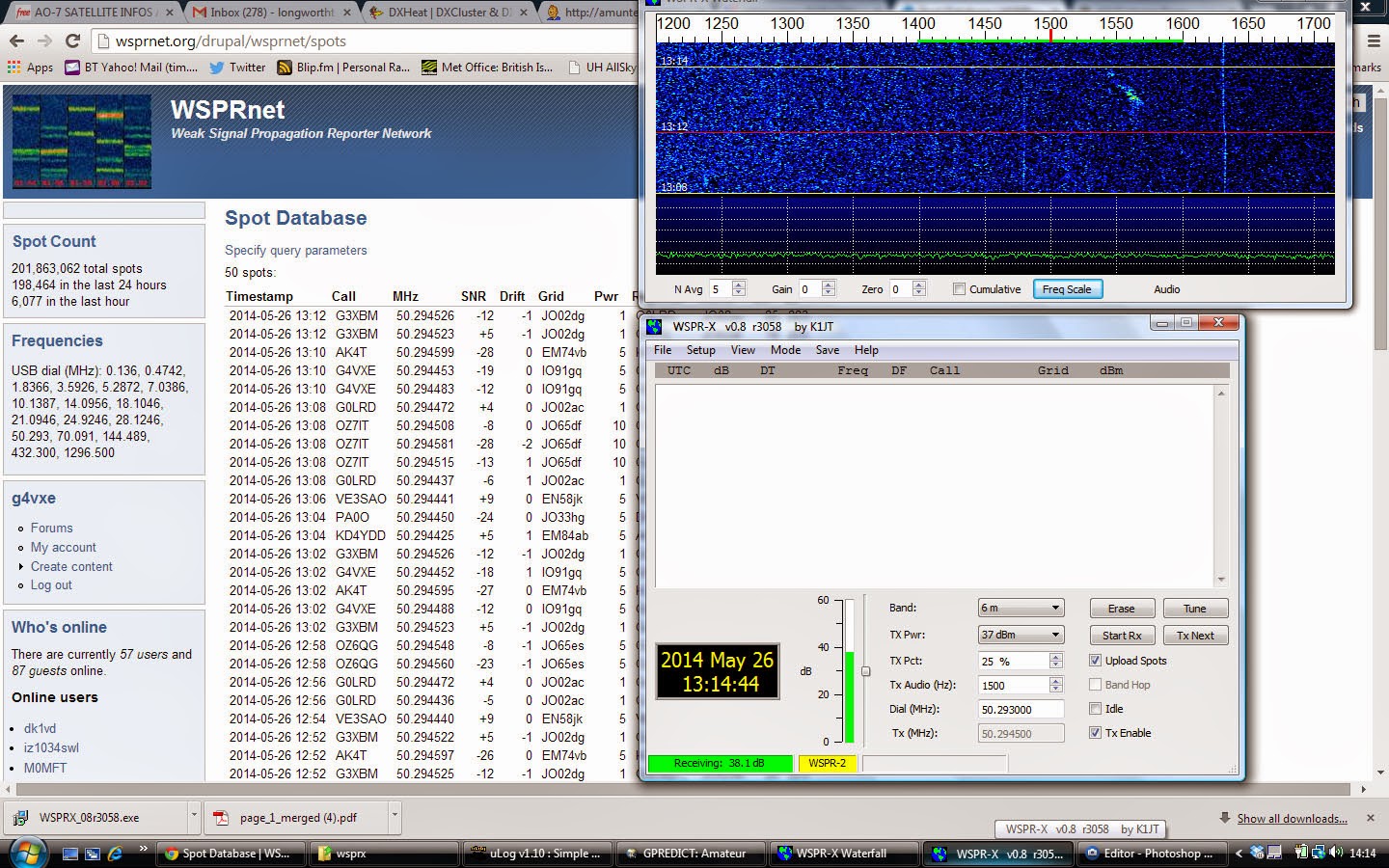
So far, nothing decoded – although actually, I am seeing G3XBM and G0LRD’s transmissions. The screenshot shows one of Roger’s transmissions, with a huge amount of Doppler from a passing aircraft.
.
Tim Kirby, G4VXE, is a regular contributor to AmateurRadio.com and writes from Oxfordshire, England. Contact him at [email protected].
Dayton! (Part 2)
(Continued from the previous article)
 Where Da Hamfest At?
The AMSAT forum was overflowing with information. At first I was hesitant to go to a three hour session. While I could sit through long lectures in high school and college, as an adult I get impatient and restless anytime I’m forced to sit for extended periods of time. But the AMSAT forum held my interest the whole time and afterwards I found my way to the AMSAT booth and became a member.
Another forum I attended was the Balloon Satellite / High Altitude Balloon (HAB) forum. Many attendees were from organizations across the country who regularly launch balloons and there were many stories and words of wisdom. I was a sponge soaking it up and came out of the session with dreams of launching a balloon.
As I mentioned in the first part of this article, I think the forums are a real gem at Dayton and well worth the admission price and travel costs. They cultivate thought and interest in amateur radio. The forums definitely recharged my amateur radio mojo.
The theme of the Dayton Hamvention this year was amateur radio operators as Makers. Makers is a modern day term for those who build or homebrew stuff. Some very visible Maker initiatives include Arduinos, Raspberry Pi, and 3D printing.

Busy Folks at a Booth Selling Arduinos and Piece Parts
The Maker theme was a good idea, well intended and timely, however the execution of the theme was lacking. There was only one stand selling Arduino items and another selling Raspberry Pis. I saw only one 3D printer on display. I think there should have been an area dedicated to Maker oriented booths, much like the audio area. A friend commented that a Maker Space would have been a good addition to the hamfest. The vendor selling Arduino items and parts has their booth swamped with people and most of them were noticeably younger folks. Overall I think there needed to be more vendors that were identifiably Maker oriented and some bridge drawn between amateur radio and Maker initiatives.
I remember in the late 80s and early 90s when some amateurs scoffed at the invasion of computers into hamfests, as some regional hamfests were combination hamfests and computerfests. Today you don’t really see this distinction and computers are just an integral part of amateur radio and hamfests. Online I’ve seen some amateurs criticizing the Maker theme at the Hamvention. I see a lot of parallels between the PC era and the Maker movement in progress right now. I think we should embrace Makers in our hamfests. We’ve already seen Arduinos and Raspberry Pis become useful tools, and 3D printers are probably close behind. We need to make a bridge between Making and amateur radio. As we’ve seen with computers and the Internet, communications takes things to new levels. Radio communications equipment and know how are a valuable asset for aspiring Makers and we can draw new people into the hobby with this.
As far as toys that I acquired, besides various piece parts and cable I bought a new Rigol 100 Mhz digital oscilloscope. At the Begali booth I fell in love with the Sculpture Mono paddle. I reached for my credit card and was informed by the salesguy that they only accept cash or checks. I was really put off by this. Later that night I ordered the paddle on the web, at a cost $45 more than the hamfest price and some unknown amount of delivery time. Luckily Begali was shipping recent paddle orders from Ohio so I didn’t wait long.

Dayton Bounty: Rigol Digital Storage Oscilloscope

The BMW of CW Keys

My New Begali Paddle
If I had to do this trip over again, I would have spent much less time in the flea market and would have attended many more forums. While the flea market was huge and had a lot of interested stuff, after awhile each stand and row began to look like the last one. Unless you’re looking for some specific rare item, walking the flea market becomes tedious. I also would have attended the DX dinner and perhaps hit some FDIM events.

Special Entrance for Golf Players
Midway through the hamfest I commented that I wouldn’t attend in 2015 and perhaps might attend again in two or three years. But towards the end and after taking the whole experience in, I decided I would make the pilgrimage again next year if possible. Once you accept Hara Arena for what it is and the oddities and annoyances of many of the attendees, it’s truly a phenomenal event for radio artisans everywhere. As one of my friends I met aptly summed it up, you have to come out, it’s the Dayton Experience!

Anthony, K3NG, is a regular contributor to AmateurRadio.com.
Cuban Five Letter Stations

Are there new changes in ham radio from Cuba now? I was under the impression their operators were limited to 10 watts of power and a simple wire antenna. To my surprise when I worked CO8RRM on 40 meters a few evenings ago, he said his power was 50 watts. He sounded great all along the east coast with his vertical dipole antenna.
Perhaps the extra letter in the call-sign is a designation for higher power and extra privileges? This is my first contact with a Cuban station with five letters……
License requirements in Cuba today resemble the challenges of early ham radio in the United States. My congratulations to Rafael from Baracoa, GITMO for his accomplishment and the great signal into West Virginia. Keep up the great work and I’ll be listening for more of those five letter call-signs.
John Smithson, Jr., N8ZYA, is a regular contributor to AmateurRadio.com and writes from West Virginia, USA. Contact him at [email protected].
 Ham Radio Deluxe |
 W5SWL Electronics |
 Ham Radio Prep |
 KB3IFH QSL Cards  Hip Ham Shirts  HamRadioAuctions HamRadioAuctions Reliance Antennas Reliance Antennas Enigma Shop Enigma Shop |  morseDX  Ni4L Antennas  R&L Electronics R&L Electronics antennas.us antennas.us QRV QRV |
- Matt W1MST, Managing Editor
