Field Day stuff
Marv K2VHW and I met this afternoon to scope out the two parks we have in mind for Field Day. As I had mentioned before, our first choice is Spring Lake Park, which is the property of Middlesex County. That gazebo is huge! It can easily accommodate two large tables for operating, as well as supply space for observers and guests. In addition, there are trees that are close enough to support a full sized G5RV and another to support the EARCHI end fed (more about that later).
The other venue possibility, Putnam Street Park, is another excellent site. There is plenty of space, it has high visibility and plenty of traffic. Trees are plentiful and there are restroom facilities on hand. There’s only one drawback – a lack of shelter. We would have to borrow or rent a multi-person tent, to have a place to operate in the case of inclement weather.
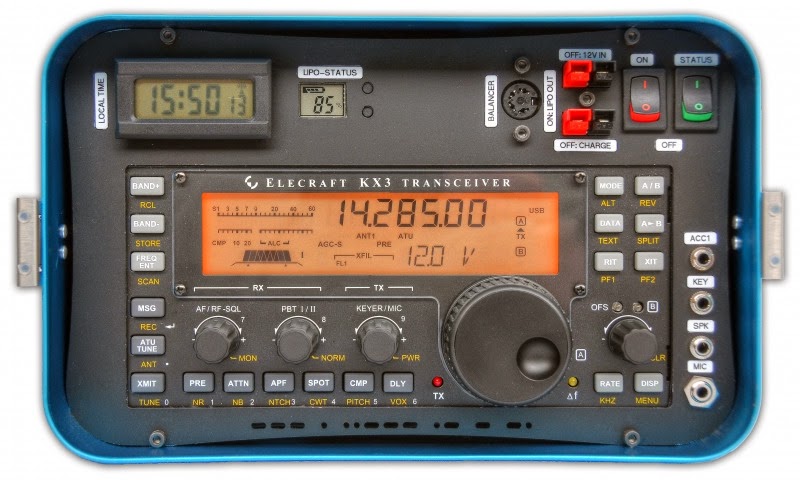
After I got home from our scouting trip, I decided to play for a bit, and try out that 53 foot radiator for the EARCHI antenna. I was hoping that if all worked out, this would be our CW Field Day antenna, as well as what I would use for FOBB and the Skeeter Hunt.
My experience today shows that that chart published by Balun Designs was spot on! I quickly got excellent matches with the KX3’s auotuner on all the bands almost instantly. 17 Meters was the hardest band to match and that only took about two seconds to accomplish.
I made contact with Josh 6Y5WJ and CO0SS on 15 Meters and a PY2 station on 10 Meters. These were made with the antenna at a less than optimal height too, as I used my Jackite pole as the support. Once I get this baby up properly in a tree, it should perform even better.
After that, I worked on a design for a banner that we will use on Field Day. This is what I have come up with so far:
This is an 8 X 3 foot banner made from heavy outdoor vinyl, with grommets and wind slits. If I get approval from the rest of the Field Day Committee, I will place the order tomorrow evening.
72 de Larry W2LJ
QRP – When you care to send the very least!
Larry Makoski, W2LJ, is a regular contributor to AmateurRadio.com and writes from New Jersey, USA. Contact him at [email protected].

Learning Morse code? Want to increase your skill?
Are you looking for some aids on learning Morse code, or to increase speed and skill? Let’s look at some great information and some software aimed at making your efforts successful.
(Note: I am not associated with any of the software. I just want to help you…)
I encourage you to look at the time-proven Koch method of learning Morse code. Below, we’ll look a little closer at this method of learning and honing your Morse code skill. In the meantime, if you just wish to skip the details, here are some software links for learning tools using the Koch method:
+ For the PC, I prefer the G4FON Morse code ‘Koch Trainer‘. It is a slick program that is set up to help you learn and enhance your skills with Morse code: http://nw7us.us/g4fontrainer – and his web site is at: http://www.g4fon.net/
+ For the iPad and iPhone: On these devices, I use the ‘Koch Trainer’ by Nick / N3WG, found in the store here: https://itunes.apple.com/us/app/koch-trainer/id405137883?mt=8
+ For the Android: I use the same software as for the iPad and iPhone, the ‘Koch Trainer’ by Nick / N3WG, here: https://play.google.com/store/apps/details?id=com.n3wg.kochtrainer – however, note that it is not compatible on the S4.
+ Some other Android possibilities that I have not tried:
- https://play.google.com/store/apps/details?id=net.iz2uuf.cwkoch
- https://play.google.com/store/apps/details?id=uk.co.bitninja.kmtpro
Again, I have not tried those last few.
Now, let’s talk about the Koch Method of Morse code training!
From my page on the Koch method (text was used by permission from the author):
Koch’s method is a simple, direct way of building reflexes. However, it requires either a computer and Morse software or a personal trainer. That’s why it was overlooked for so many years. Now that computers are commonplace, it should become the standard Morse training method. Here’s how it works:
You start out by setting up your computer (or a microprocessor-based code tutor machine) to send you Morse characters at 20 wpm and at an overall sending speed of at least 15 wpm. You then get out your paper and pencil and have the machine start sending — but only two characters. That’s right, for your first sessions, you’ll only have two choices. Copy on paper for five minutes, then stop the machine and compare what you copied with what the machine sent. Count characters and calculate your percentage of correct copy.
If your score is 90 percent or better — congratulations! You just learned your first two characters, and, importantly, you learned them at full speed. You’ll never have to learn them over again. If you didn’t make 90 percent, practice some more. As soon as you can copy the first two characters with 90 percent accuracy, add a third character to your practice. Your accuracy will drop as you work on assimilating the new character, but it will rise again to 90 percent or better. Then you add the fourth character, and so on.
This method does not allow you to build that lookup table in your brain. To copy at full speed, you must build the reflexes in order to achieve 90 percent accuracy. And that’s what you’re spending your time doing — building reflexes. Think of it as a parallel to perfecting a tennis swing or mastering a gymnastic routine; you’re practicing until you get it right. The Koch method of building code proficiency character-by-character is similar to standard methods of teaching touch typing, another skill that must be reflexive.
…
While the Koch method is the fastest method of Morse training, speed alone is not its principal advantage. Its principal advantage, and a major difference from other methods, is that it provides you with constant positive reinforcement. This begins with your realization, after mastering the first two characters, that you can copy code at 15 or 20 wpm, because you just did it. After that, each new character mastered is further proof of your progress. Contrast that to slowly trying to build speed up from 4 or 5 wpm, then hitting the plateau at 10 wpm and seeing no progress for a long time. With the Koch method, frustration is at a minimum.
Constant testing is necessary to ensure that you maximize the effectiveness of the Koch method. You must copy on paper, so you can grade yourself. Remember, if you score 90 percent accuracy or better, add another character. If you score any less than that, try again. By constantly testing yourself on continuous copying of at least five minutes, you know exactly how you’re doing and exactly when you should add another character. This results in the fastest progress possible.
…
As you proceed toward your goal, remember that some days are just going to be better than others and some characters will take longer to assimilate than others.
(Read the entire article: the Koch method).
Again, here’s the PC software link: http://nw7us.us/g4fontrainer
And, here’s a web-based way to learn Morse code.
Good luck! If you have questions, please share them – I’m @NW7US
Visit, subscribe: NW7US Radio Communications and Propagation YouTube Channel
There’s a new radio hobby magazine in town!
Recently, a number of hobby radio magazines have either retired, or have merged into a digital mix of several. Filling that void is the new The Spectrum Monitor, a creation of Ken Reitz KS4ZR, managing editor for Monitoring Times since 2012, features editor since 2009, columnist and feature writer for the MT magazine since 1988. Ken offers this digital, radio communications magazine monthly. The web site is at http://www.thespectrummonitor.com/
Ken, a former feature writer and columnist for Satellite Times, Satellite Entertainment Guide, Satellite Orbit magazine, Dish Entertainment Guide and Direct Guide, is also contributing editor on personal electronics for Consumers Digest (2007 to present). He is the author of the Kindle e-books “How to Listen to the World” and “Profiles in Amateur Radio.”
The Spectrum Monitor Writers’ Group consists of former columnists, editors and writers for Monitoring Times, a monthly print and electronic magazine which ceases publication with the December, 2013 issue. Below, in alphabetical order, are the columnists, their amateur radio call signs, the name of their column in The Spectrum Monitor, a brief bio and their websites:
Keith Baker KB1SF/VA3KSF, “Amateur Radio Satellites”
Past president and currently treasurer of the Radio Amateur Satellite Corporation (AMSAT). Freelance writer and photographer on amateur space telecommunications since 1993. Columnist and feature writer for Monitoring Times, The Canadian Amateur and the AMSAT Journal. Web site: www.kb1sf.com
Kevin O’Hern Carey WB2QMY, “The Longwave Zone”
Reporting on radio’s lower extremes, where wavelengths can be measured in miles, and extending up to the start of the AM broadcast band. Since 1991, editor of “Below 500 kHz” column forMonitoring Times. Author of Listening to Longwave (http://www.universal-radio.com/catalog/books/0024u.html). This link also includes information for ordering his CD, VLF RADIO!, a narrated tour of the longwave band from 0 to 530 kHz, with actual recordings of LW stations.
Mike Chace-Ortiz AB1TZ/G6DHU “Digital HF: Intercept and Analyze”
Author of the Monitoring Times “Digital Digest” column since 1997, which follows the habits of embassies, aid organizations, intelligence and military HF users, the digital data systems they use, and how to decode, breakdown and identify their traffic. Web site: www.chace-ortiz.org/umc
Marc Ellis N9EWJ, “Adventures in Radio Restoration”
Authored a regular monthly column about radio restoration and history since 1986. Originally writing for Gernsback Publications (Hands-On Electronics, Popular Electronics, Electronics Now), he moved his column to Monitoring Times in January 2000. Editor of two publications for the Antique Wireless Association (www.antiquewireless.org): The AWA Journal and the AWA Gateway. The latter is a free on-line magazine targeted at newcomers to the radio collecting and restoration hobbies.
Dan Farber ACØLW, “Antenna Connections”
Monitoring Times antenna columnist 2009-2013. Building ham and SWL antennas for over 40 years.
Tomas Hood NW7US, “Understanding Propagation”
Tomas first discovered radio propagation in the early 1970s as a shortwave listener and, as a member of the Army Signal Corps in 1985, honed his skills in communications, operating and training fellow soldiers. An amateur Extra Class operator, licensed since 1990, you’ll find Tomas on CW (see http://cw.hfradio.org ), digital, and voice modes on any of the HF bands. He is a contributing editor for CQ Amateur Radio (and the late Popular Communications, and CQ VHF magazines), and a contributor to an ARRL publication on QRP communications. He also wrote for Monitoring Times and runs the Space Weather and Radio Propagation Center at http://SunSpotWatch.com. Web site: http://nw7us.us/ Twitter: @NW7US YouTube: https://YouTube.com/NW7US
Kirk Kleinschmidt NTØZ, “Amateur Radio Insight”
Amateur radio operator since 1977 at age 15. Author of Stealth Amateur Radio. Former editor,ARRL Handbook, former QST magazine assistant managing editor, columnist and feature writer for several radio-related magazines, technical editor for Ham Radio for Dummies, wrote “On the Ham Bands” column and numerous feature articles for Monitoring Times since 2009. Web site: www.stealthamateur.com.
Cory Koral K2WV, “Aeronautical Monitoring”
Lifelong air-band monitor, a private pilot since 1968 and a commercial pilot licensee since 1983, amateur radio licensee for more than 40 years. Air-band feature writer for Monitoring Times since 2010.
Stan Nelson KB5VL, “Amateur Radio Astronomy”
Amateur radio operator since 1960. Retired after 40-plus years involved in mobile communications/electronics/computers/automation. Active in radio astronomy for over twenty years, specializing in meteor monitoring. Wrote the “Amateur Radio Astronomy” column for Monitoring Timessince 2010. A member of the Society of Amateur Radio Astronomers (SARA). Web site: www.RoswellMeteor.com.
Chris Parris, “Federal Wavelengths”
Broadcast television engineer, avid scanner and shortwave listener, freelance writer on federal radio communications since 2004, wrote the “Fed Files” column for Monitoring Times.http://thefedfiles.com http://mt-fedfiles.blogspot.com Twitter: @TheFedFiles
Doug Smith W9WI, “The Broadcast Tower”
Broadcast television engineer, casual cyclist and long distance reception enthusiast. “Broadcast Bandscan” columnist for Monitoring Times since 1991. Blog:http://americanbandscan.blogspot.com Web site: http://w9wi.com
Hugh Stegman NV6H, “Utility Planet”
Longtime DXer and writer on non-broadcast shortwave utility radio. Former “Utility World” columnist for Monitoring Times magazine for more than ten years. Web site: www.ominous-valve.com/uteworld.html Blog: http://mt-utility.blogspot.com/ Twitter: @UtilityPlanet YouTube: www.youtube.com/user/UtilityWorld
Dan Veeneman, “Scanning America”
Software developer and satellite communications engineer writing about scanners and public service radio reception for Monitoring Times for 17 years. Web site: www.signalharbor.com
Ron Walsh VE3GO, “Maritime Monitoring”
Retired career teacher, former president of the Canadian Amateur Radio Federation (now the Radio Amateurs of Canada), retired ship’s officer, licensed captain, “Boats” columnist and maritime feature writer for Monitoring Times for eight years. Avid photographer of ships and race cars.
Fred Waterer, “The Shortwave Listener”
Former “Programming Spotlight” columnist for Monitoring Times. Radio addict since 1969, freelance columnist since 1986. Fascinated by radio programming and history. Website: http://www.doghousecharlie.com/
Thomas Witherspoon K4SWL, “World of Shortwave Listening”
Founder and director of the charity Ears To Our World (http://earstoourworld.org), curator of the Shortwave Radio Archive http://shortwavearchive.com and actively blogs about shortwave radio on the SWLing Post (http://swling.com/blog). Former feature writer for Monitoring Times.
Visit, subscribe: NW7US Radio Communications and Propagation YouTube Channel
New toy.
Another new toy arrived this week. This time it’s a hand made straight morse key from John Wellings. Although it looks just like a Kent key, I can assure you it isn’t. The brass is highly polished and the wood is finished off to a fantastic finish. in my opinion a more refined look and better quality machine work too.
John builds everything here by hand and this very key can be seen on YouTube being built through the various steps. Im sure John missed out a large portion of tasks on these videos, but his attention to details and superb craftsmanship are really quite extraordinary.
You too can purchase a JW key from John directly. Have a look at his website for more information, and why not have a look at the quick video I made of this key.
Dan Trudgian, MØTGN, is a regular contributor to AmateurRadio.com and writes from Wiltshire, England. He's a radio nut, IT guru, general good guy and an all round good egg. Contact him him here.
Svalbard
An annually-recurring professional meeting has started to put me in interesting DX locales. This year was no different: the meeting was held at UNIS (University Centre in Svalbard) in Longyearbyen, Svalbard. My friend and colleague, Nathaniel, W2NAF, did a semester of his graduate studies at UNIS and was excited to return for the meeting. He suggested that the JW5E clubstation “hut” (depicted below) might be both an attractive lodging option for cost, location, and of course, radio. The hut is a bit rustic with no running water but we did manage to maintain a nearly professional level of appearance and personal hygene due to Nathaniel’s insider knowledge.
As is typical for the kind of travel I do, there was no straightforward way to get from A to B. Nathaniel and my flight schedules put us into Longyearbyen (via London, Oslo, and Tromso, in my case) on Friday and Saturday, respectively, giving us a shot at the CQ WPX CW contest. We elected to operate this under our own callsigns, which proved to be a bit of a limitation since for much of the contest 20 meters was the only band that produced rates. So, we had to share 20m. Nathaniel operated high power using the JW5E FT-1000MP mkV and Icom IC-2KL amplifier connected to the JW5E antenna system. I operated low power with my K2/100 and the JW5E antennas. He came out a little bit ahead on QSOs and pretty far ahead on points, mostly due to the day of head start and effectively exploiting 20m. I also worked a lot of empty-calorie EU stations while he focused on 3-pt DX stations. Despite our initial optimism, neither of us were particularly dedicated to a full effort in the contest. We both had a bit of trouble adapting to polar day and slept through prime openings on Sunday.
40 meters and lower frequency bands were useless, as were 10 and 12 meters. Nathaniel and I did work each other on 160 with the power turned all the way down. And, of course we worked each other in the contest for an easy prefix multiplier. The 12m situation was a little disappointing since I know a lot of people needed JW there. Had we been there in March, it probably would have been open. I worked two CTs and that’s it.
During the week of the meetings, I only managed 1-2 of hours operating each day, and Nathaniel maybe a little more. We developed a protocol of uploading to LoTW first thing in the morning when we got to the meeting (where we had free network access, versus roaming 3G on my phone at JW5E). Since I don’t use ClubLog, this is a good way for DXers to see if they’re in the log and get a quick confirmation. As I told a DXer who thanked me profusely for doing it, my employment covers the largest costs of my DX travel and my operating is secondary to my work. Therefore, I feel no need to extract or solicit donations from DXers. I am ordering cards today and they will be ready to mail in a week or two.
On the last night, I put in a solid 6 hours of operating, making about 600 QSOs in one sitting. 30m was always a struggle with most signals right near the noise level. The other bands (15/17/20) produced big signals and were pretty easy to work. I’m always a bit slow to operate split because I don’t want to use more bandwidth than necessary. With an amp, I could probably have operated simplex most of the time. Usually once people stop coming back to my 599s or they start duping me mercilessly, I know it’s time to split the pile.
The pileups were generally very responsive to my instructions with only one station really raising my blood pressure to the point that I QRT’ed to cool off. Based on his QRZ.com profile and how loud he was compared to all the stations he was obliterating, he was running as much as 4 kW on 30m. Good show.
I heard that someone on a DX club e-mail list suggested that I go next to Jan Mayen (JX). Please negotiate that with my wife and we can work something out. Don’t forget to include that Jan Mayen has one flight per month. My Norwegian colleagues were amused by this and asked also about Bouvet (3Y). Only scientists and hams know about Bouvet and Jan Mayen. Seriously, if I didn’t have a young family, I would consider doing that sort of thing, but I miss them too much when I travel. The next DX trip will be someplace warmer with regular commercial air service.
I’m still sort of converging on the best equipment for portable DX operating. While I like the K3 a lot, the K2 is a bit smaller. In its flight case, it fits under all airliner seats and not just some of them like the K3. Although it is a stupendous performer, the K2 has some idiosyncrasies occasionally cause me to notice that it’s not as well integrated as the K3 and modern JA radios. The diminutive size and negligible RF emissions from the MRF-4125 switching power supply are big pros, but I noticed the fan making a particularly awful noise on this trip. Need to look into that. The K1EL WKUSB continues to be a star performer for computer and hand keying. While I love the action of the Palm Mini paddle, the lack of a solid base can be frustrating. I brought the recently-mounted Schurr Einbau and it sang. Although, it produces the best reactions from security screeners: “What is it? Is it an antique?” And, my favorite from a screener in Longyearbyen: “Is that the new iPhone?”
The real stars of this operation were the Etymotic Research MC5 in-ear monitor earphones. Wow. I’ve been using them for a couple of months now at the recommendation of someone on the Elecraft reflector and they are my new favorite headphones for travel. They do excellent with noise isolation on long-haul flights and in noisy QTHs; they reproduce music flawlessly; you don’t have to turn the volume up to 11 to hear with them; and they fit in a tiny little pouch that’s smaller than a deck of playing cards. And the best part? They only cost 60 USD.
The GU Special came along on this trip but was not needed since I had access to an OptiBeam for 20/17/15 meters, dipoles for 30/40/80, and a Cushcraft R7 vertical for 40-10 meters. I was tempted to take my gear on the 8-hr boat trip we took up another fjord. However, I decided against it for a variety of reasons including the desire to do some birdwatching and look for polar bears—we saw some seals and an artic fox but no bears. The seals and the fox amounted to no more than a couple of pixels in the photos I tried to shoot of them, even with a modest 200mm telephoto lens. OK, that’s a short lens by wildlife photo standards. Please accept this puffin photo in place of a bear photo.
And the Tempelfjorden glacier and sea ice shot from my phone…
This photo is looking back up Adventfjorden toward Longyearbyen and shows the JW5E tower right near the water in the center. (The heftier one on the right.) Also in the background are the dishes for the EISCAT Svalbard incoherent scatter radar.

And a photo from our visit to EISCAT in tracked vehicles. It was practically June and there was a lot of snow on the ground.
Finally, here are two YouTube videos related to our operation. The first was shot by W2NAF and has a tour of the JW5E station. The second was shot by KB9UWU during the WPX contest and shows pretty much what 15m was like for me: the band was obviously open but I didn’t have many callers.
Thanks to everybody who stopped by to say hi. I worked lots of friends on the air from all over the world and received SWL reports from a few more.
Ethan Miller, K8GU, is a regular contributor to AmateurRadio.com and writes from Maryland, USA. Contact him at [email protected].
Series Seven Episode Eleven – RSGB and More (1 June 2014)
Series Seven Episode Eleven of the ICQ Amateur / Ham Radio Podcast has been released. The latest news, Martin (M1MRB) and Colin (M6BOY) discuss Satellites as Firearms and Martin (M1MRB) interviews Stewart Bryant (G3YSX) about the RSGB and More.
- ITAR restrictions on US radio amateurs to be eased
- Ham Radio operators train National Guardsmen
- BBC: 'Pocket spacecrafts' to become a reality
- New Ham Radio Digital Mode
- Introducing SmartMic Ham Radio Digital Voice
- Wi-Fly
- Connecticut ham uses radio to save girl's life
- Four new ARRL Section Managers elected
- Neighbour unhappy with Radio Ham's mast
- World Cup Football 2014 - Brazilian Special Callsigns
- Cuba begins issuing 60m licences
- International Museums Weekend (IMW)
- IRTS CW Field Day
- New Amateur Radio Public Service Announcements
Colin Butler, M6BOY, is the host of the ICQ Podcast, a weekly radio show about Amateur Radio. Contact him at [email protected].
We PASSED!
It was an exciting morning in the Jones household! This morning my 16 year old son, Nick, passed his Technician test! He is pumped!
Burke Jones, NØHYD, is a regular contributor to AmateurRadio.com and writes from Kansas, USA. Contact him at [email protected].