 |
 Always keep twiddlin’ that dial
 2 June 2014 | by
 even when it seems like there’s nothing out there. You never know what might come up!
It’s a beautiful sunny day here in Central NJ, so as per my custom, I headed out to the Jeep, the KX3 and the Buddistick at lunchtime. From the get go, it seemed very disappointing. There wasn’t a whole heckuva a lot of DX activity. What I was hearing were stations I have worked before and you don’t want to keep pestering guys on the same bands, just to get a contact in the log.
I started calling CQ at the 20, 17 and 15 Meter QRP watering holes with no takers. I was slightly discouraged (Momma said there’d be days like this), and was ready to pack it in and head on back to my desk, slightly early. That’s when I decided to give 17 Meters just one extra twiddle before coming in.
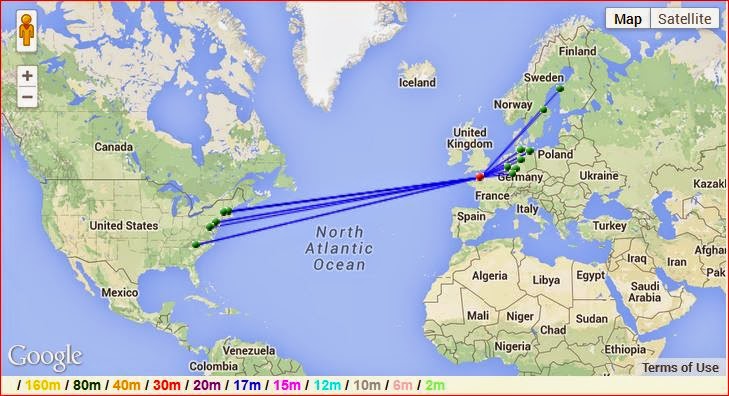
Bam! There was TM70UTAH loud as all get out! This is a Special Event station, commemorating the 70th anniversary of the Allied landing at Utah Beach on D-Day in 1944. First call and they were in the books! I have to admit, I was so excited when I heard them that I had to send my call a few extra times as I fumbled it in my eagerness to work them. I did hear a confirmation of W2LJ come back to me and I was smiling ear to ear. Next, just a few KHz down, I heard SP3DOF calling “CQ DX”. One call and I was in Jerzy’s logbook.
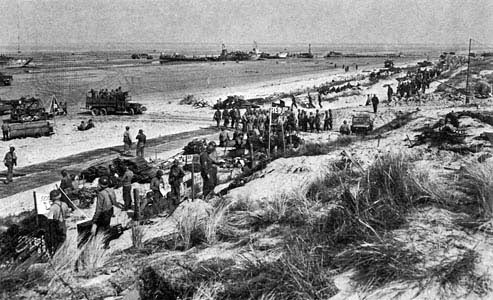
Wow! A WWII Special Event station and a Polish DX station worked within a few minutes of each other – a red letter day as far as I’m concerned. And all this was after I was tempted to throw in the towel for the day. So it’s a good reminder (to myself included) to keep throwing that fishing line back into the water. You never know what’s going to land on the hook.

The funny thing is, that TM70UTAH wasn’t even mentioned in that ARRL article on D-Day Special Event stations that I posted from the ARRL just a few days ago. So in addition to TM70JUN, keep an ear open for TM70UTAH. I would like to work both of them!
72 de Larry W2LJ
QRP – When you care to send the very least!
Larry Makoski, W2LJ, is a regular contributor to AmateurRadio.com and writes from New Jersey, USA. Contact him at [email protected].
Yeah, right

Paul Stam, PC4T, is a regular contributor to AmateurRadio.com and writes from the Netherlands. Contact him at [email protected].
Direct QSL cards

Dan Trudgian, MØTGN, is a regular contributor to AmateurRadio.com and writes from Wiltshire, England. He's a radio nut, IT guru, general good guy and an all round good egg. Contact him him here.
6 meter opening
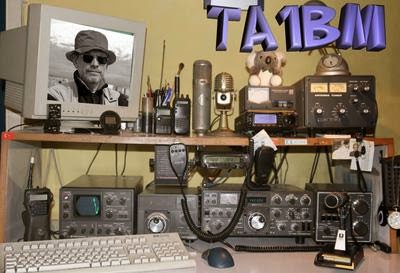
Between 10 and 12 o'clock UTC there was a great opening on 6 meter. I worked TA1BM with JT65 on 50.276 MHz. 2233 km. It was my 28th DXCC on 6 meter. Also worked LZ2FP.
Paul Stam, PC4T, is a regular contributor to AmateurRadio.com and writes from the Netherlands. Contact him at [email protected].
Canoeing on the Pemigewasset River
This afternoon Tim W3ATB and I went canoeing on the Pemi. It was a perfectly stunning day. I worked Brazil, Italy and France from a small island in the river.

We started out at Profile Falls, a little south of Bristol in my aluminum Grumman canoe. We had a little less than eight miles to go to reach our take-out at Shaw Cove in Sanbornton.

The sounds of red wing black birds clucking from the marshy shore filled the air as we rounded the bend near Hill Village. A pair of ducks took off as we approached and flew south several inches above the water. The old bridge abutment came into view soon after.

The bridge led from Sanbornton to Hill before it was torn down in the 1940s to make way for a flood control area. We started looking for a suitable place to operate. We needed trees, and a breezy place where the mosquitoes couldn’t feed on us. We found it on an island around the next turn in the river.
We pulled the canoe up to the shore and tied it to a log. After jumping out, I tossed a line over an arching maple branch and pulled up a half wave wire for 20 meters.

I sat down on a log, which no doubt landed on the island during spring flooding, and set up the KX3. We had left an hour late and were a bit rushed. At first the band seemed dead, but I found a few strong stations. The first one I called was PV8ADI in Brazil. There was a pileup, and I was surprised when he answered me. We exchanged 599s and I tuned around some more. Here’s my log:
1 Jun-14 2208 14.026 PV8ADI CW 599 599 Brazil
1 Jun-14 2215 14.017 F6FZG CW 579 599 France
1 Jun-14 2222 14.012 IZ4BEZ CW 599 599 Italy
1 Jun-14 2223 14.001 I8GMG CW 559 579 Italy

We clambered back into the canoe and headed downstream for the final leg. The saturated colors of the early evening were dazzling. We started looking for Shaw Cove. It’s just around the next bend, I would say… but it wasn’t.

We found it finally… honestly we were relieved and a bit sad at the same time. We were both long overdue at home… but it was an adventure that will stay with us for a lifetime.
Jim Cluett, W1PID, is a regular contributor to AmateurRadio.com and writes from New Hampshire, USA. Contact him at [email protected].
Field Day stuff
Marv K2VHW and I met this afternoon to scope out the two parks we have in mind for Field Day. As I had mentioned before, our first choice is Spring Lake Park, which is the property of Middlesex County. That gazebo is huge! It can easily accommodate two large tables for operating, as well as supply space for observers and guests. In addition, there are trees that are close enough to support a full sized G5RV and another to support the EARCHI end fed (more about that later).
The other venue possibility, Putnam Street Park, is another excellent site. There is plenty of space, it has high visibility and plenty of traffic. Trees are plentiful and there are restroom facilities on hand. There’s only one drawback – a lack of shelter. We would have to borrow or rent a multi-person tent, to have a place to operate in the case of inclement weather.
After I got home from our scouting trip, I decided to play for a bit, and try out that 53 foot radiator for the EARCHI antenna. I was hoping that if all worked out, this would be our CW Field Day antenna, as well as what I would use for FOBB and the Skeeter Hunt.
My experience today shows that that chart published by Balun Designs was spot on! I quickly got excellent matches with the KX3’s auotuner on all the bands almost instantly. 17 Meters was the hardest band to match and that only took about two seconds to accomplish.
I made contact with Josh 6Y5WJ and CO0SS on 15 Meters and a PY2 station on 10 Meters. These were made with the antenna at a less than optimal height too, as I used my Jackite pole as the support. Once I get this baby up properly in a tree, it should perform even better.
After that, I worked on a design for a banner that we will use on Field Day. This is what I have come up with so far:

This is an 8 X 3 foot banner made from heavy outdoor vinyl, with grommets and wind slits. If I get approval from the rest of the Field Day Committee, I will place the order tomorrow evening.
72 de Larry W2LJ
QRP – When you care to send the very least!
Larry Makoski, W2LJ, is a regular contributor to AmateurRadio.com and writes from New Jersey, USA. Contact him at [email protected].
Learning Morse code? Want to increase your skill?
Are you looking for some aids on learning Morse code, or to increase speed and skill? Let’s look at some great information and some software aimed at making your efforts successful.
(Note: I am not associated with any of the software. I just want to help you…)
I encourage you to look at the time-proven Koch method of learning Morse code. Below, we’ll look a little closer at this method of learning and honing your Morse code skill. In the meantime, if you just wish to skip the details, here are some software links for learning tools using the Koch method:
+ For the PC, I prefer the G4FON Morse code ‘Koch Trainer‘. It is a slick program that is set up to help you learn and enhance your skills with Morse code: http://nw7us.us/g4fontrainer – and his web site is at: http://www.g4fon.net/

G4FON Koch Trainer – Morse code learning on the PC
+ For the iPad and iPhone: On these devices, I use the ‘Koch Trainer’ by Nick / N3WG, found in the store here: https://itunes.apple.com/us/app/koch-trainer/id405137883?mt=8
+ For the Android: I use the same software as for the iPad and iPhone, the ‘Koch Trainer’ by Nick / N3WG, here: https://play.google.com/store/apps/details?id=com.n3wg.kochtrainer – however, note that it is not compatible on the S4.
+ Some other Android possibilities that I have not tried:
- https://play.google.com/store/apps/details?id=net.iz2uuf.cwkoch
- https://play.google.com/store/apps/details?id=uk.co.bitninja.kmtpro
Again, I have not tried those last few.
Now, let’s talk about the Koch Method of Morse code training!
From my page on the Koch method (text was used by permission from the author):
Koch’s method is a simple, direct way of building reflexes. However, it requires either a computer and Morse software or a personal trainer. That’s why it was overlooked for so many years. Now that computers are commonplace, it should become the standard Morse training method. Here’s how it works:
You start out by setting up your computer (or a microprocessor-based code tutor machine) to send you Morse characters at 20 wpm and at an overall sending speed of at least 15 wpm. You then get out your paper and pencil and have the machine start sending — but only two characters. That’s right, for your first sessions, you’ll only have two choices. Copy on paper for five minutes, then stop the machine and compare what you copied with what the machine sent. Count characters and calculate your percentage of correct copy.
If your score is 90 percent or better — congratulations! You just learned your first two characters, and, importantly, you learned them at full speed. You’ll never have to learn them over again. If you didn’t make 90 percent, practice some more. As soon as you can copy the first two characters with 90 percent accuracy, add a third character to your practice. Your accuracy will drop as you work on assimilating the new character, but it will rise again to 90 percent or better. Then you add the fourth character, and so on.
This method does not allow you to build that lookup table in your brain. To copy at full speed, you must build the reflexes in order to achieve 90 percent accuracy. And that’s what you’re spending your time doing — building reflexes. Think of it as a parallel to perfecting a tennis swing or mastering a gymnastic routine; you’re practicing until you get it right. The Koch method of building code proficiency character-by-character is similar to standard methods of teaching touch typing, another skill that must be reflexive.
…
While the Koch method is the fastest method of Morse training, speed alone is not its principal advantage. Its principal advantage, and a major difference from other methods, is that it provides you with constant positive reinforcement. This begins with your realization, after mastering the first two characters, that you can copy code at 15 or 20 wpm, because you just did it. After that, each new character mastered is further proof of your progress. Contrast that to slowly trying to build speed up from 4 or 5 wpm, then hitting the plateau at 10 wpm and seeing no progress for a long time. With the Koch method, frustration is at a minimum.
Constant testing is necessary to ensure that you maximize the effectiveness of the Koch method. You must copy on paper, so you can grade yourself. Remember, if you score 90 percent accuracy or better, add another character. If you score any less than that, try again. By constantly testing yourself on continuous copying of at least five minutes, you know exactly how you’re doing and exactly when you should add another character. This results in the fastest progress possible.
…
As you proceed toward your goal, remember that some days are just going to be better than others and some characters will take longer to assimilate than others.
(Read the entire article: the Koch method).
Again, here’s the PC software link: http://nw7us.us/g4fontrainer
And, here’s a web-based way to learn Morse code.
Good luck! If you have questions, please share them – I’m @NW7US
Visit, subscribe: NW7US Radio Communications and Propagation YouTube Channel
 Ham Radio Deluxe |
 W5SWL Electronics |
 Ham Radio Prep |
 KB3IFH QSL Cards  Hip Ham Shirts  HamRadioAuctions HamRadioAuctions Reliance Antennas Reliance Antennas Enigma Shop Enigma Shop |  morseDX  Ni4L Antennas  R&L Electronics R&L Electronics antennas.us antennas.us QRV QRV |
- Matt W1MST, Managing Editor
