 |
 Finished work on the TYT TH-9800 quadbander review for Practical Wireless
 18 June 2014 | by
 I’ve had a review model of the TYT TH-9800 quadbander (28/50/144/433MHz) around for a little while, to do a review for Practical Wireless and over the last few days, I’ve wrapped the review up.
Clearly, I can’t give too much away here – the review will be in the next issue of PW – but it’s fair to say that the rig worked out well. As regular readers will know, I’ve had a Yaesu FT-8900 for a few years now. The TH-9800 follows that pattern very closely and works well (though is not identical). Well worth a look if you’re in the market for an FM quadbander. I’ll be sorry to send it back!
Tim Kirby, G4VXE, is a regular contributor to AmateurRadio.com and writes from Oxfordshire, England. Contact him at [email protected].
The One Frequency You Should Never Use on Field Day
 “Based on Actual Events”
At the local radio club meeting, I encouraged everyone to get on the air during Field Day, which led to this conversation:
New Tech: I just have a 2 meter fm radio. Can I still make Field Day contacts?
Me: Sure, VHF contacts are encouraged during Field Day.
New Tech: So I just call on 146.52 MHz and see who’s out there?
Me: Well, no, the 2m fm calling frequency is not allowed for Field Day.
New Tech: Really? We can’t use any of the calling frequencies we learned during our license class?
Me: Well, no, all of the other standard calling frequencies are fine, just 146.52 MHz is prohibited.
New Tech: That seems really dumb.
Me: No comment.
Complete Field Day information is here : http://www.arrl.org/field-day
73, Bob K0NR
Bob Witte, KØNR, is a regular contributor to AmateurRadio.com and writes from Colorado, USA. Contact him at [email protected].
Ten-Tec Argonaut VI
See http://www.tentec.com/argonaut-vi-qrp-1-10-watt-transceiver/
Despite missing some key bands, all reports are this is a very good QRP radio from Ten-Tec. However at $995 in the USA (similar in £ in the UK with import duty and VAT tax) it is simply too expensive to ever consider.
All I can say is are Ten-Tec in financial trouble? The true market price here in the UK must be less than £700, so they are about £300 adrift in my estimation.
Even in the USA $995 for a rig with no 60m, no 12m and no 6m is way over the top. Just compare with the FT817ND for example. Even the Elecraft KX3 is much better value, in my view.
Views?

Roger Lapthorn, G3XBM, is a regular contributor to AmateurRadio.com and writes from Cambridge, England.
Does it get any better?
I suppose it can. I suppose one could make DXCC Honor Roll, or perhaps get elected to the QRP Hall of Fame, or perhaps invent some cool, new piece of QRP equipment that the world will beat a path to your door for (and make you some $$$ in the process!).
But for a Ham an’ Egger like me, the best is just getting on the air making contacts – ANY kind of contacts. DX quickies, ragchews – whatever. It’s all good. And today was another comparatively good lunchtime QRP session. I worked RZ1OA, Vlad in Russia, and I worked XE1XR, David in Mexico. Two good, solid DX contacts.
The best QSO was the last one, and it was not a DX contact. In fact, the miles covered were only about 650. But it was exciting, fun and satisfying nonetheless.
After working the two DX stations, I decided to go to on down to 20 Meters to listen perhaps for some SOTA stations. That’s when I heard a weak, but very copyable KC8JNL calling CQ right at the QRP Watering Hole. I answered and hooked up with Pat who lives in Rothbury, MI. Not as distant as Russia or Mexico – definitely. But this QSO was exciting in and of itself, because Pat was using a Rockmite at QRPp power levels. There was some vicious QSB, and I didn’t quite copy Pat’s power output level. Having my own 20 Meter Rockmite, I knew it had to be under 1 Watt. Pat gave me a 559 and I gave him a 459 in turn. The QSO would have been Q5 copy both ways if it weren’t for the QSB. But even with the fading, I knew what Pat was saying to me, and from his answers, I had a good idea that he was making me out just as well.
QRP to QRP, or QRP to QRPp, or even QRPp to QRPp QSOs get my wonderment juices all fired up. That we can effectively hold a conversation using such little power is still an amazement to me after 36 years in this hobby. It’s truly like …. can it get ANY better than this? (My apologies for speaking like a teen – having two, it tends to rub off). I talked with Pat and Vlad and David today, all while enjoying the sunshine and the 80F (27C) temperatures that we are having here today. No wires, no cell towers, no infrastructure of any real sort ….. not much more than two guys shooting a bunch of electrons out of some wire or aluminum – hoping that they’ll bounce around to and fro, and eventually be picked up by a like minded enthusiast – somewhere.
Magic. Pure magic.
72 de Larry W2LJ
QRP – When you care to send the very least!
Larry Makoski, W2LJ, is a regular contributor to AmateurRadio.com and writes from New Jersey, USA. Contact him at [email protected].
Just get on the air!
So after my complaining in my post yesterday, I had a chance last night at about 11:00 pm local (0400 Z) to get to the shack and spin the dial on 40 meters.
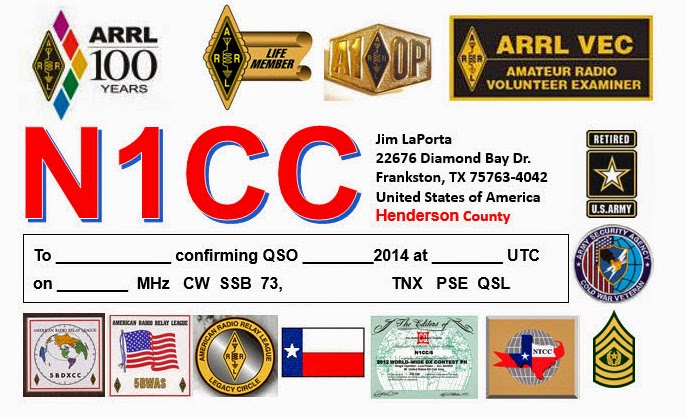
I heard several QSO’s going on – including N1CC calling CQ. He was a bit faster than I like, but I could at least copy his call and CQ CENT. I heard a couple guys work him and when he called CQ again, I threw out my call.
He came right back to me for a quick contest style exchange. Jim is down in Texas and is VERY ACTIVE! H says on his QRZ page he has had over 16,000 QSO’s in 2014.
He is also offering a special QSL card for the centennial year. I might have to take him up on that.
He also does a Christmas Carol special event station at Christmas. Very interesting guy, and a fun contact.
I also heard a few 4 zone stations in QSO’s as I tuned around 40 meters.
Burke Jones, NØHYD, is a regular contributor to AmateurRadio.com and writes from Kansas, USA. Contact him at [email protected].
It was the coax!
After being stuck inside during lunchtime last week, due to workload and/or weather, I was finally able to get out today. This was the first opportunity (if you don’t count the weekend) that I had to try out the tri-magmount with the Buddistick since changing out the coax. Well, it was the coax that was giving me fits. With the new coax, the KX3 tuned the antenna in mere seconds and once it tuned, it stayed tuned. No phantom jumping SWR values, everything behaved nicely.
For my efforts, I was able to work W1AW/5 in Arkansas on a different band, Don K2DSV who is a fellow K2ETS Club member, as well as XE2ST, Fernando in Nogales, Mexico. So I am considering the surgery that I performed on the antenna base to be an unqualified success.
I also spent a lot of time thinking about a posting on KB6NU’s blog about how “New Hams are Different” and the responses that Dan has received. I think that times have greatly changed, or maybe that’s just my perception. When I was a Novice back in the late 70s, and joined a local club (which is no longer in existence – and this may be the reason why) there was a kind of a “keep your mouth shut if you’re a Newbie” mentality going on. New callsigns appearing at meetings or on the repeaters weren’t welcomed all that enthusiastically (as a result, that may be why I’m not real big into VHF/UHF to this very day). I guess there was kind of a “pay your dues” mentality, back then. For better or worse, that was the way it was. But guess what? I survived, more or less. 😉
I really believe that I saw that change in the mid 90s, though. I joined a couple new clubs and was welcomed. Even though I was licensed for quite a while by then, I was still a neophyte compared to the established “Old Timers” who were a large part of the membership, and I was a comparative stranger, to boot. But in both cases, I was welcomed warmly – I was not shunned, I was not looked down upon, I was accepted into the groups without question.
And that’s the way it should be. I currently belong to three active local clubs – the K2ETS Electronic Testing Society of NJ, the W2QW Raritan Valley Radio Club as well as the NJ2SP South Plainfield Amateur Radio Club (which I helped to establish). Since SPARC is so new, I am going to leave it out of the mix for this discussion, but the same philosophy holds there, as well. In both K2ETS and W2QW, newcomers are welcomed enthusiastically and with open arms. There’s no “we vs. they” mentality when it comes to new members. Everyone is encouraged to participate, and everyone is listened to. Your age, your gender, your level of experience is really of no matter.
I really don’t see any wide gulfs when it comes to “new” vs. “old” technologies, either. Those who primarily operate HF only seem to peacefully co-exist with those who like to experiment and build and toy around with Arduinos, Raspeberry Pi’s and the digital voice and data modes. In fact, I see a lot of the groups co-mingling and getting pointers, answers to questions and operating tips from each other. Just the way it should be.
Newcomers are welcomed for their new ideas and enthusiasm while “Old Timers” are respected for their experience and built up wealth of tribal knowledge – again, just as it should be. Guess I’ve been very fortunate to not be involved with “cliquey” organizations. Hopefully, that is becoming everyone else’s experience as well.
72 de Larry W2LJ
QRP – When you care to send the very least!
Larry Makoski, W2LJ, is a regular contributor to AmateurRadio.com and writes from New Jersey, USA. Contact him at [email protected].
Sunday radio time.
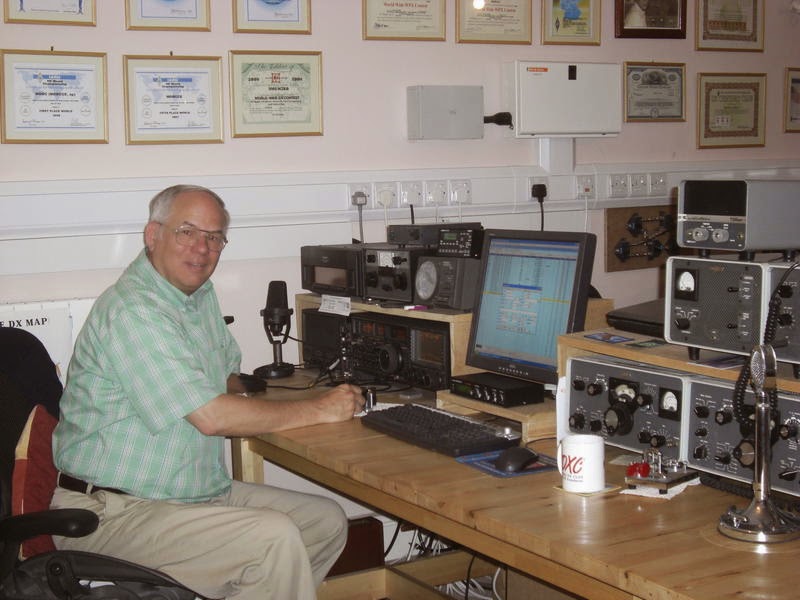 |
| MX0CCE Bob |
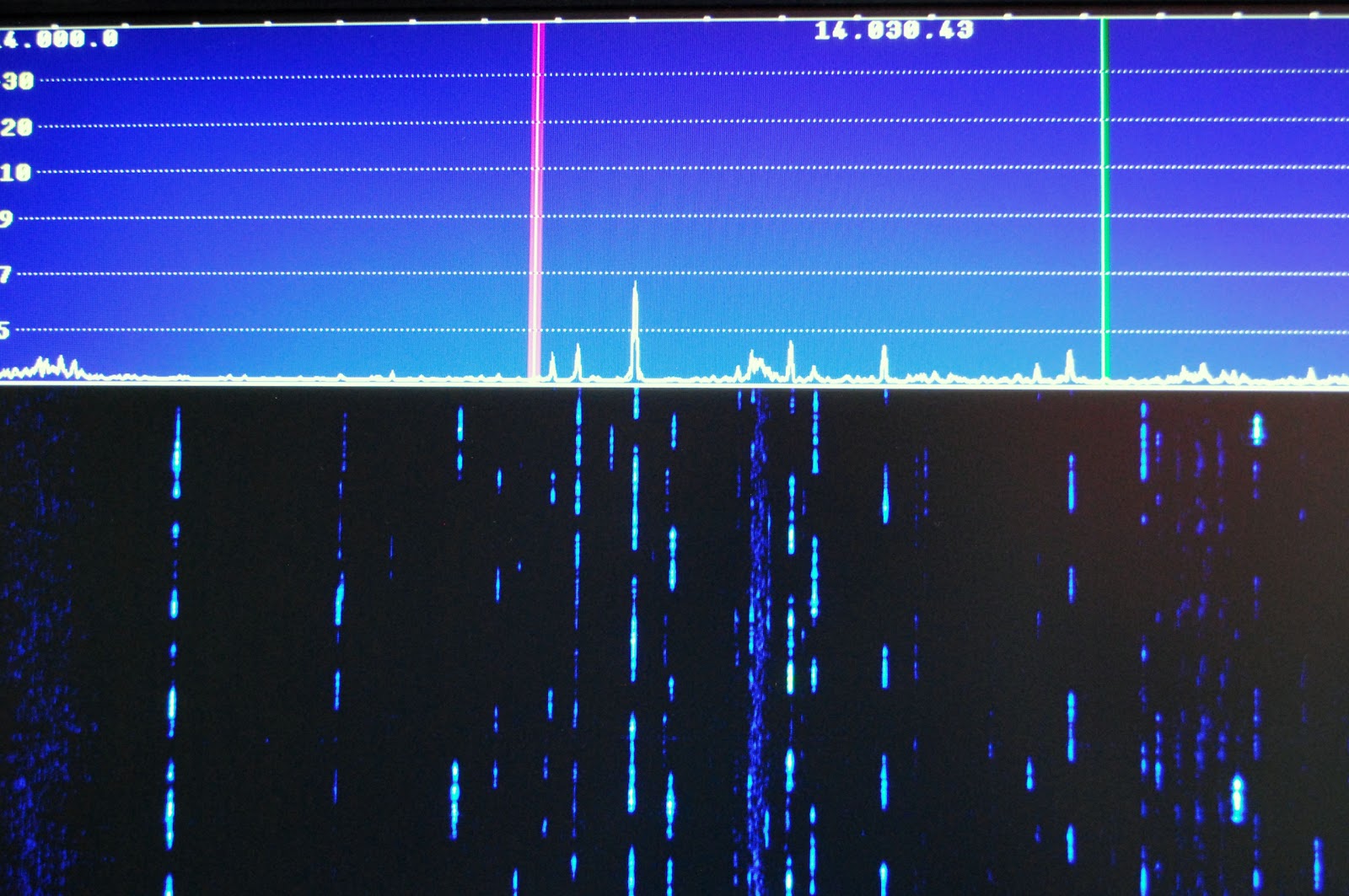 |
| Not much going on |
Mike Weir, VE9KK, is a regular contributor to AmateurRadio.com and writes from New Brunswick, Canada. Contact him at [email protected].
 Ham Radio Deluxe |
 W5SWL Electronics |
 Ham Radio Prep |
 KB3IFH QSL Cards  Hip Ham Shirts  HamRadioAuctions HamRadioAuctions Reliance Antennas Reliance Antennas Enigma Shop Enigma Shop |  morseDX  Ni4L Antennas  R&L Electronics R&L Electronics antennas.us antennas.us QRV QRV |
- Matt W1MST, Managing Editor
