 |
 My European Vacation
 26 June 2014 | by
 Next weekend is the 50th Anniversary of the IOTA Program. A celebration and conference will be held at the Beaumont Estates in Windsor, near London. I have participated in IOTA for over 20 years and will see a lot of old friends there.
I also want to activate a few summits as time allows, which brings me today's highlight. Even though I am jet lagged, I managed to activate Altberg, HB/ZH-015, which is worth 1 point. This summit has been activated 613 time counting my activation today. When I saw that, I thought this must be a drive up and an easy one at that. While this is not a difficult summit, it does require a 2 mile +/- roundtrip and 300 feet elevation gain. Very nice trail and a nice walk.
We had an interesting encounter with three elderly guys on the trail. None of them spoke a word of English and the only German I know it Guten Tag and no spreichten Duetsche. So imagine me trying to explain what I was doing on their mountain. I did finally get the concept across that I was a ham. I'll mispell this but is something like amateurfunk. We had all heard that word. The next obstacle was to explain my morse key. The term "morse code' met with blank stares, but when I said, "you know dit dit a di di dit". Ah, "morse' ya. They were having as much fun with it as I was.
My XYL, but with her camera, so we can't download them to iPads, but I did take a picture of my travel right. An MTR, 13' telescoping pole, 9V battery, ear buds and a micro key. I managed 12 QSO's and activated my first EU summit and my first HB9 summit.
I can't figure out how to get a picture from my iPad to the blog, so pictures will have to wait untill later.
I will try to post regularly during my trip.
Mike Crownover, AD5A, is a regular contributor to AmateurRadio.com and writes from Texas, USA. Contact him at [email protected].
This is Amateur Radio Week
in South Plainfield!
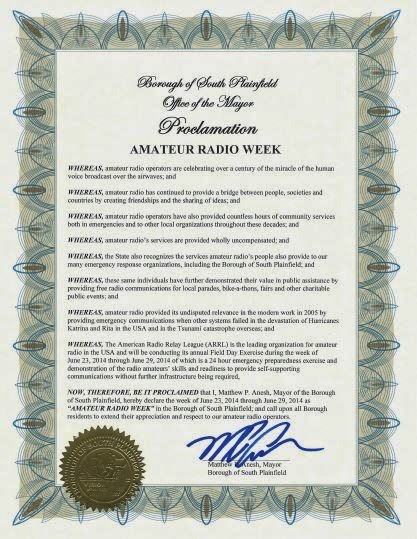
Field Day is two days away and the weather here is supposed to be gorgeous! Psyched!
72 de Larry W2LJ
QRP – When you care to send the very least!
Larry Makoski, W2LJ, is a regular contributor to AmateurRadio.com and writes from New Jersey, USA. Contact him at [email protected].
Chinese X108 QRP transceiver can now be ordered
G1KQH has told me that the 9-band multmode transceiver, the X108 from China, can now be ordered on-line.
http://www.wouxun.us/item.php?
Personally, I’d prefer the FT817 but, even with shipping to the UK, taxes and duty , the price is attractive, even if the product looks rather ugly (to me). It still looks “back shed” design to me. Personally I’d rather wait until the Chinese are really there with their designs. Others may disagree, but the industrial design of this product certainly lets it down.
Also, this is a kit, but with very little soldering.

Roger Lapthorn, G3XBM, is a regular contributor to AmateurRadio.com and writes from Cambridge, England.
Hello Kuwait

Atlas 210X
After living here in the new house since January, I haven’t had a lot of chances to use the radios, even though I now have a room for my hobby (shared, of course with KD2CHE’s sewing). The shack has been piled with things to sort through, requiring some digging and re-arranging to get to the Atlas 210X. A few days ago, I finally went through the pile and did some major organizing. I now have a nice work surface, and all of the radios set up and working (including a recent flea-market find, a snazzy FRG-7). Tonight after tuning around on 20 meters I answered a couple of calls. The second call was from 9K2UU in Kuwait. This contact is now my second-best distance since I got my license (about 6800 miles), and the best from home (the no 1 was Namibia from my 10 meter mobile here at the beach). Barrak gave me a 5-7, and he got a 5-9 from me. All of this with an old Atlas 210X, and a 35 foot end-fed sloper into a 9:1 UnUn. I’m happy with that.
Neil Goldstein, W2NDG, is a regular contributor to AmateurRadio.com and writes from New York, USA. Contact him at [email protected].
QSO with a princess

From Jeff, N2LXM:
On Friday June 20th, 2014 at 18:45 Zulu radio communications was established on 7.150 Mhz Upper sideband between the Marconi Wireless, Wellfleet station site in Cape Cod Massachusetts and the Marconi Wireless, Belmar Receiving Station, Wall Township New Jersey. Amateur Radio Station KM1CC had as a guest operator Princess Elettra Marconi, who was touring the Wellfleet site. This Forty Meter contact had been scheduled in advance to allow two former Marconi Wireless sites to make contact with Princess Marconi. Princess Marconi is in the United States touring sites which were owned and operated by her father, Guglielmo Marconi, and his wireless company.
Using the call sign WA2GM of the Marconi Chapter 128, of the Quarter Century Wireless Association the Ocean – Monmouth Amateur Radio Club made the contact. OMARC President Jeff Harshman, N2LXM was the control operator, with Steve Rosen KB2PGA, Quarter Century Wireless Association representative in attendance also in attendance were OMARC Members Bob KA8SAF and Alan KB2RR as witnesses.
Matt Thomas, W1MST, is the managing editor of AmateurRadio.com. Contact him at [email protected].
SAQ – historic 17.2kHz CW transmission this Sunday.
A reminder that the historic alternator TX on 17.2kHz VLF will be sending a message this Sunday twice. They usually QSL via the amateur QSL bureaus. See http://alexander.n.se/in-english/saq-transmission/ for more details of this and other transmissions.
Some years ago I copied the transmission, QSLed and am the proud owner of one of their QSL cards. It is not hard to copy in Europe unless you have local noise problems. A small tuned loop is all the antenna needed. There are even a software receiver available free on the net capable of receiving the transmissions with a suitable antenna connected to the PC. The SM6LKM software receiver is excellent and covers 0-22kHz. It makes a very useful VLF receiver. I describe it on my YouTube Channel G3XBM. See https://www.youtube.com/watch?v=TDxRhQYg7lQ.

Roger Lapthorn, G3XBM, is a regular contributor to AmateurRadio.com and writes from Cambridge, England.
KC5HWB reviews the Wouxun KG-UV8D
This review has been a long time coming, I wish I had posted it before now, but better late than never, I guess. When I first started this review, there was only 1 version of the Wouxun KG-UV8D radio out, but now there are two. All radios with firmware 1.02 (1.01 was the old number) include the 2.5KHz step when tuning/scanning. As far as I know, that is the only difference between the 2 firmwares. There is no way to upgrade the 1.01 to 1.02, as far as I know. This is how they come from the factory.
Of course I bought one of these radios for myself and have been tinkering with it for the last couple of month. This is a really neat little radio. It has several features that other Chinese radios have yet to implement, but to me the best one is the 999 memory channels. This is unheard-of for an HT, especially a Chinese HT, most of which only support 128 memory channels. But this ultra-huge memory capacity enables me to enter all of my Ham Radio repeaters and simplex frequencies, along with all the FRS/GMRS frequencies, plus some locally used Red Cross frequencies. Even with all of those programmed in, I still have plenty of memory channels left to use. My plan is to create a bank of frequencies for the Galveston, TX area, to which we travel 1-2 times per year. Perhaps I will add some other repeaters also, in other areas.
Yes, this radio also does cross-band repeat. Honestly, I’ve not used it – I don’t really have a situation in which I would need a cross-band repeating HT. I have cross-band repeat setup on my Kenwood TM-741a in my shack at home, so that I can hit the Hurst repeater from an HT inside of my house (I key up a 440 simplex frequency, which keys my TM-741a, and it cross-band repeats to the Hurst repeater). This way I can talk on the repeater from inside my house without always having to walk out to the shack. I suppose cross-band repeating would be useful if you would out in the field somewhere. Maybe assisting on a bike/foot race, or perhaps on a camping trip. Setup the KG-UV8D with an external antenna and use it as a portable repeater. I have not had the need to do this yet, so I haven’t played with that feature.
The backlit LCD screen is certainly a plus. The screen goes off while you are monitoring, but comes back on again when a signal is received. This is to save the battery, I suspect, because the larger screens on today’s smartphones are usually the largest battery draw.
This radio, just like the Anytone AT-3318UV HT, will allow you to move each band independently between VFO and Memory modes. If the top band in is VFO, you can move the bottom band to a memory channel, without changing the top band, and vice-versa. There is a VFO/MR key on the front of this radio, so switching between the 2 options is very easy, unlike some other Chinese HTs. In reality, the VFO/MR button has 4 settings: VFO frequency, Memory channel number, Memory channel name, and Memory Channel Frequency. So when you are programming your repeater settings, it allows you to set a name for each repeater, then page through with the VFO/MR button so the repeater name can be displayed on the LCD instead of the frequency. This is useful if you are looking for a repeater in a certain area or city. And with 999 memory channels, you will probably want to know which repeater is where!
The radio comes with a great extended range antenna, just like the Anytone AT-3318UV.
There is also an extended battery available for this radio. The standard battery that comes with the radio is 1700mAh, and the extended battery is 2600mAh. The extended battery is a bit thicker than the stock battery, so expect the radio to be a bit heavier and bulkier than the stock configuration. However, rest assured that the stock belt clip and stock desktop battery charger are both build in such a way that they will accommodate either battery. No separate charger or belt clip is needed for the 2600mAh battery.
From the factory, the radio only does 400-470 TX range, but with the Frequency Expansion software you can extend the range up to 519MHz. I have not loaded this software yet myself, but I plan to do so next week. This software came from Wouxun, and isn’t a “hack”, it just extends the range of the radio to its maximum capacity.
I love this little HT and have carried it almost exclusively since it arrived. It is a fantastic addition to anyone’s radio collection.
Jason Johnston, KC5HWB, is a regular contributor to AmateurRadio.com and writes from Texas, USA. Contact him at [email protected].
 Ham Radio Deluxe |
 W5SWL Electronics |
 Ham Radio Prep |
 KB3IFH QSL Cards  Hip Ham Shirts  HamRadioAuctions HamRadioAuctions Reliance Antennas Reliance Antennas Enigma Shop Enigma Shop |  morseDX  Ni4L Antennas  R&L Electronics R&L Electronics antennas.us antennas.us QRV QRV |
- Matt W1MST, Managing Editor
