 |
 A contigious 60m band?
 27 June 2014 | by
 OFCOM is consulting on the agenda items for the World Radio Conference WRC2015 which takes place November 2015. See http://stakeholders.ofcom.org.uk/consultations/wrc15/ .
The proposal is to support moves to allocate 5250-5450kHz to the Amateur Service on a secondary basis. This would replace the messy channels currently available. I recommend you write to OFCOM to support this move, which would give us a new ham band at 60m – ideal as the current sunspot cycle declines.
If allocated, it could be a few years before available.

Roger Lapthorn, G3XBM, is a regular contributor to AmateurRadio.com and writes from Cambridge, England.
A day of variety: Legal AM/SSB CB, patchy 50MHz Es and fun on VO-52
Some would say it was 30 years too late, but here in the UK, today was the day that AM and SSB CB was made legal on the CEPT ‘mid’ band, with an output power of 4W AM and 12W SSB. Good news as far as I am concerned and it will give me the opportunity to make contact with various friends who are active on CB and not amateur radio.
Not much about in the way of Es today, although I did manage a late afternoon QSO with HA8IB on 50MHz. Pretty quiet apart from that.
Late in the afternoon, I caught a couple of VO-52 satellite passes. The first was a very low angle one, around 2 degrees over Russia. I had a nice snappy CW QSO with Imre HA1SE. I was pleased to find I could work a pass at that distance and elevation, as I’d love to try working UA9CS and potentially even UA0SUN.
The second pass was a bit higher and I had a sketchy exchange – I’m not going to call it a QSO with 4X1AJ, but we heard each other before some noise kicked in here and that was that. As we’re both reasonably regularly active, I’m hopeful of making a QSO before long.
Tim Kirby, G4VXE, is a regular contributor to AmateurRadio.com and writes from Oxfordshire, England. Contact him at [email protected].
New Chapter
There’s no way to sugar coat this. My marriage of nearly 21 years is over and my XYL and I are separating. It’s been a rough past two months leading up to this (actually, come to think of it, maybe it’s been a rough few years), to the point where I’ve been physically ill thinking about everything from family to how will the grass at the house get mowed. The emotions involved are overwhelming…. sadness, hurt, anger, hate, bitterness, uncertainty….relief…. But with every chapter that ends, a new one begins.
I’ve been house and building lot hunting, and getting an education on home owners’ associations, the bane of many a radio artisan. I have a few good real estate prospects, one house in particular is ideal for an amateur radio QTH as it has a relatively high elevation, is wooded, has few other houses around, and I have information from a good source that the HOA is rather loosey-goosey. It will be quite awhile until I can get a tower up again, so it’s back to basics with dipoles strung in trees. Basics and simplicity appeal to me at this point in my life. Now that I’m in my 40s and my daughter is heading to college next year I don’t need much of a house. It seems most nice houses on the market here are just too big for me. I’m looking at house plans in case I need to construct a home, as a “Plan B” option. In any case I’ll probably settle on something that would normally be classified as a vacation cottage.
Despite the gut-wrenching situation with the marriage and my family, I’m looking forward to this transition and journey. Outside of the mundane legal and administrative tasks that need to be completed and the grieving process with myself and the family, I’m somewhat excited about the transition. While I’m losing a lot I’m gaining freedom and the opportunity to retool my life, simplify, be true to myself, and be happy. Freedom and happiness have a lot of value, more value than material items. My bucket list has expanded significantly and I plan to accomplish everything on the list these next 40 years. I’m sure there will be a significant-other YL in my future after things settle down. I hope to chronicle my journey here in the coming weeks and months.
Today I’m off from work, getting stuff done around the house and preparing for Field Day, one of my most favorite events of the year. See you on the air this weekend!

Anthony, K3NG, is a regular contributor to AmateurRadio.com.
10m, then 6m, WSPR
Overnight, I remained on 10m but the only spots were by Es were from Norway, France, Spain and Germany plus G4KPX( local). No Es “super DX” here sadly!
At around 0904z I moved back up to 6m WSPR. with 1W ERP. G0OQK (98km) was spotted 3 times (so far) with moderate drift or Doppler , G4IKZ (18km) was spotting me at good strength and OH7AI (2000km) spotting me by Es at 0928z at -21dB S/N for the best DX so far today.
Sunspot count is 72 and 20-30MHz propagation “normal” so I’d expect F2 DX N-S today on 10m.

Roger Lapthorn, G3XBM, is a regular contributor to AmateurRadio.com and writes from Cambridge, England.
Amateur Radio Newsline Report 1924 June 27 2014
- A possible new challenge to ham radio at 5 Gigahertz
- Revised Part 97 FCC rules take effect July 21st
- Solar researchers once again discuss our current cycle 24
- VK hams set new microwave record down-under
- Fhe FCC says no to use of ham radio gear on GMRS frequencies
Field Day 2014 – June 28-29th

It’s almost the fourth weekend in June and you know what that means — Field Day 2014 is just around the corner!
Download: Field Day 2014 Information Packet
Are you planning to participate? If so, tell us about your operating plans in the comments below.
(And good luck!)
Matt Thomas, W1MST, is the managing editor of AmateurRadio.com. Contact him at [email protected].
Using The KØLR ‘Antenna Meter’ on 630m
One of the most useful pieces of gear for me has been a simple 'antenna meter' designed by Lyle Koehler, KØLR, who was very active at one time on the 185KHz 'lowfer' band. Although the original circuit was designed to cover a lower frequency range, it can easily be modified to cover the 2200m and 630m bands.
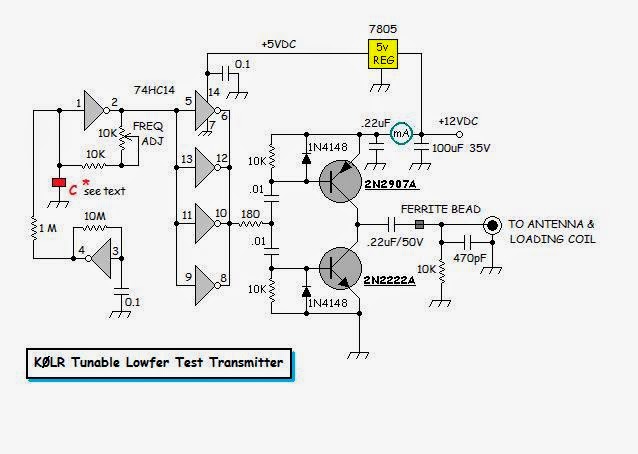 |
| The KØLR LF Transmitter |
The device is actually a low power (~1/2w) VFO-controlled transmitter designed to look into a 50 ohm antenna system. Since most LF antennas are matched to 50 ohms, either through a separate matching transformer or by tapping up from the bottom of the antenna's loading coil, the 50 ohm feedline from the antenna system is simply connected to the antenna meter's output and the VFO tuned for maximum deflection of the meter. The resonant frequency is then directly read from the calibrated scale of the antenna meter's dial. With most backyard LF antennas having a very narrow bandwidth along with a high-Q, the meter peak is quite sharp and easy to find. Look for a peak meter reading between 50-70ma as you sweep the VFO across the antenna. Normal current values will be very low until resonance is hit.
KØLR's original article gives more details and can be found here.
The 470pf capacitor (C in my diagram) determines the basic frequency range. To modify the circuit for dual range (both 2200m and 630m), I added a SPDT switch at pin 1 of the IC so that I could switch the value of "C". For coverage down to and below 136KHz, I used ~ 725pf (a 680pf + 47pf in parallel) while high end coverage up past 500KHz required just 250pf (220pf + 27pf in parallel). These values should get you very close to the required ranges and once installed it is an easy task to calibrate the tuning scale by listening to the signal on a receiver or measuring it with a frequency counter. I also chose to install the 1M 'modulation' resistor that gives the signal a distinctive FSK note.
The meter will quickly tell you if your antenna is too high in frequency (capacitive) or if it is too low (inductive) so that the proper corrective measures may be taken to resonate it within the 630m band. Once resonant, attention can then be paid to bringing the impedance match as close as possible to 50 ohms and a 1:1 match. Depending on your method of impedance matching, there may be some interaction between tuning for resonance and impedance matching but a perfectly resonant 50 ohm system can be achieved with a little juggling.
Although not updated for several years, KØLR's website contains much good information regarding simple backyard LF antenna systems (both transmitting and receiving), preamps and weak signal receiving techniques. It is well worth a close look if you are designing a new 630m station.
Steve McDonald, VE7SL, is a regular contributor to AmateurRadio.com and writes from British Columbia, Canada. Contact him at [email protected].
 Ham Radio Deluxe |
 W5SWL Electronics |
 Ham Radio Prep |
 KB3IFH QSL Cards  Hip Ham Shirts  HamRadioAuctions HamRadioAuctions Reliance Antennas Reliance Antennas Enigma Shop Enigma Shop |  morseDX  Ni4L Antennas  R&L Electronics R&L Electronics antennas.us antennas.us QRV QRV |
- Matt W1MST, Managing Editor
