 |
 A 1935 Style QSL
 23 June 2014 | by
  |
| '29 Style Card |
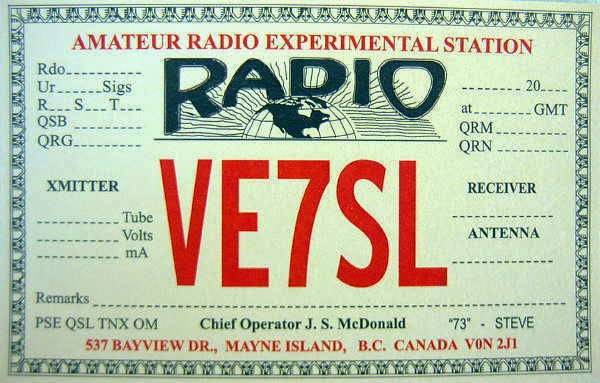
When I next became interested in mid-30's style construction, I decided it was time for another 'era-appropriate' card to match the transmitters. I began searching the web for vintage cards from the mid-30's and soon zeroed in on a card that I found particularly attractive...and from Canada as well.
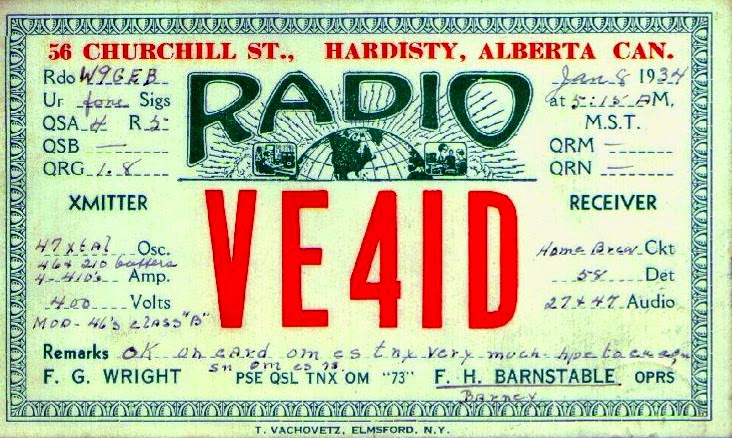
Once again, Dennis came to the rescue and worked enthusiastically with me to try and duplicate the features and look of the VE4 card that I wanted.
 |
| '35 Style Card |
I think he did a super job once again and this past winter the new cards have gone out at a furious pace as I worked many new stations, all on 10m CW with my 6L6 Tri-Tet-Ten.
 |
| 6L6 Tri-Tet-Ten |
If you or anyone you know might be interested in a vintage style card (or any type of card) please get in touch with Dennis. I cannot speak highly enough about him and the quality of his work. You won't be disappointed.
Steve McDonald, VE7SL, is a regular contributor to AmateurRadio.com and writes from British Columbia, Canada. Contact him at [email protected].
Lightning maps
If you missed G0LRD‘s comment in an earlier post you may want this link that shows lightning activity:
http://www.lightningmaps.org/realtime?lang=en
There are storms in Eastern England and very many over the Alps. Interestingly the CN8 to OZ path has been open on 6m Es today. Some believe there is a correlation between Es and thunderstorms.
UPDATE 1720z: At the moment, the storms have ended but the lightning map shows a further storm is due to come through. At present it is over the Peterborough area and moving SE. I think it is best to NOT reconnect the antennas today.
UPDATE 1751z: The storm over Peterborough seems to be moving in an easterly direction and may miss our village with luck, although I can now hear distant thunder to the north.
UPDATE 1812z: The storm is definitely tracking east over the Bedford Levels in the Fens, towards Littleport, so should miss us. Even so, I’ll stay off air tonight.
UPDATE 2016z: According to the lightning map, all thunder storms have now died out in the UK. I’ll reconnect antennas in the morning.

Roger Lapthorn, G3XBM, is a regular contributor to AmateurRadio.com and writes from Cambridge, England.
Radio Shack stock trading below a dollar

Realistic HTX-100 10-meter transceiver
It’s so sad to me to see this once great retailer continue its downward trend. I have so many fond childhood memories stopping by the local Radio Shack (there were actually three in my town) to pick up batteries and other parts.
This morning its stock price is down to $0.82 a share from a high this year of over $4.00. Both of these numbers are a far cry from Radio Shack’s high of nearly $80 a share in December of 1999.
It seems like Radio Shack really had a chance to position itself as the leader in the new “maker” movement, but instead chose to be a second-rate retailer of cell phones and (overpriced) consumer crap.
Matt Thomas, W1MST, is the managing editor of AmateurRadio.com. Contact him at [email protected].
SOTA Therapy: Five Summits, Two Days
On day one, Saturday, we activated three summits, Don Fernando (W5N/SS-024), 10900 (W5N/SS-019) and Greenie Peak (W5N/SS-015). These are all 10 point summits. My XYL, Cris, was also along to provide support and take few pictures.The equipment for the day was an FT-817, 20/40m EFHW for me and Doc had a KX3 with a 43 ft. random wire and a 9 to 1 balun. The weather was nice, clear to partly cloudy skies with 30 mph winds. The windy conditions put a haze in the air which dimmed the views a bit, but still not a bad day to be in the mountains.
The first two summits are east of Taos, NM. Doc and I had done these summits before and with the coordinates where to park, getting these summits activated was a matter of course. Each requires relative short hikes to the top, but bushwhacking is the order of the day, with the ascent of Summit 10900 being the most diffiicult of the two. There are lots of downed trees that have to be navigated.
The main obstacle of the day was a recently fallen tree that blocked the road to Summit 10900. Not worry, my Jeep was able to get around the tree with a little off roading. A longer wheel base vehicle would have had trouble getting around. BTW, the jeep came in handy all day long, the roads we travelled had sections that the 4WD and high clearance came in handy.
We did see some wildlife during these activation, including several Elk, Whitetail Deer and some turkey.
Getting to Greenie Peak was more of challenge than we expected. Greenie Peak is near Red River, NM, which is an hour plus drive from Summit 10900. I had done the peak in the past, but a friend had taken me there on a Razor, a two passenger ATV, and I didn't pay much attention. Consequently when the GPS sent us up the wrong road I willingly followed. This road was a 4WD only road, with warnings, and a sign that said "Exploration Road". Well, we were in search of Goat status, so onward and upward. The road was a one lane, rock filled, steep, hairpin switchbacks to a small summit only big enough to turn the Jeep around on. Sorry Doc, but this is not Greenie Peak. Back down we went. Finally found the road, made the Greenie Peak summit. To expedite the activation we only set up one rig and Doc and I alternated contacts. We worked the pile untill CQ's went unanswered and called it a day.
I had left my house at 7:30 am that morning to drive north to pick up Doc and finally got home that night at 10:30 pm. A 15 hour day of SOTA therapy. I was tired, but I did feel good about getting 30 activator points for the day.
Sunday was a new day, with two summits on the agenda. Barrillas Peak (W5N/PW-022) and Bear Benchmark (W5N/PW-014). Doc was using this KX3 set-up again, but I swithed the the AT4-S, KD1JV designed CW only radio. The weather was a duplicate of the day before, but the wind had diminished considerably.
The hope was to get these two done and get a home alittle earlier. Barillas went off without a hitch. There is a firetower on top, with nice views. Propagation was good, but it was Father's Day, so I think a few of the chasers were occupied with other activities.
Getting to Bear Benchmark proved a little more challenging. My GPS is set-up for the shortest route which is good most of the time, but not for this day. We followed a road for several miles only to come to a locked gate with "No Trepassing" signs all over it. Bummer. It was getting late in the day and I felt that we wouldn't make the summit in time. We turned around, somewhat disappointed and headed back down. However, when we got back to the main road, I wanted to find the right road at least. We reentered coordinates and the GPS point us a different direction, which to make a long story short, was the right direction. Once on the right road, we decided to go for it and when finally reached the firetower atop Bear Benchmark, the determination was rewarded. We, again, only set-up one station, and took turns calling CQ until we had worked down the pile.
I made it home just in time to watch my favorite basketball team, the San Antonio Spurs put a beat down on the Miami Heat and win the NBA Championship. A good day indeed.
Below is a brief video of our adventure. I must give credit to Cris who gets credit for putting this together.
Mike Crownover, AD5A, is a regular contributor to AmateurRadio.com and writes from Texas, USA. Contact him at [email protected].
Using the Ultimate3
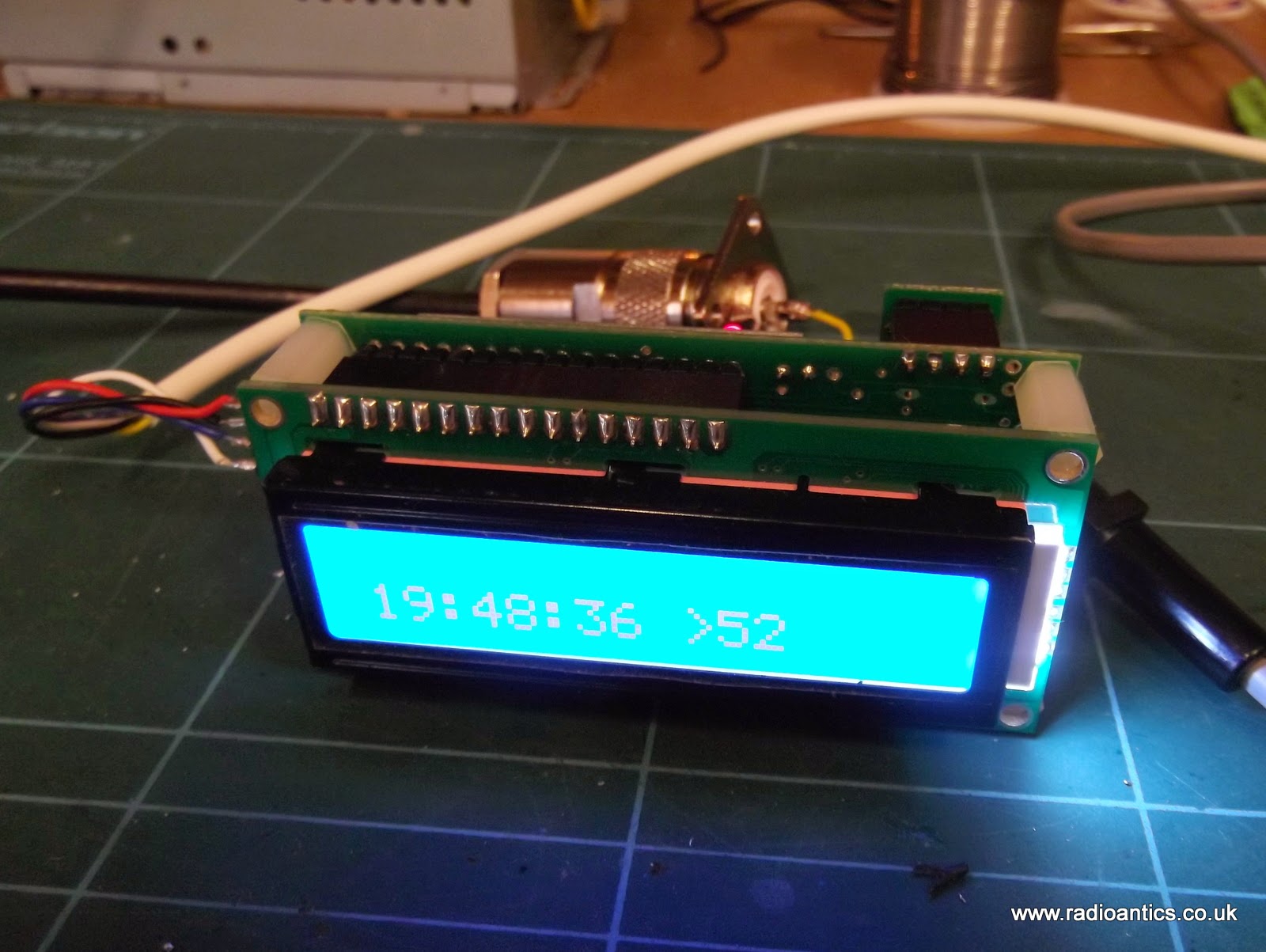
Until now it has been attached it to a dummy load with the FUNCube Dongle Pro+ SDR in close proximity as a receiver for experimental purposes.
One unresolved issue was it being consistently off frequency. The DDS modules used are prone to temperature fluctuations and component variances so the Ultimate 3 has the option of using a GPS module to provide both an accurate time source and an accurate 1PPS input which can be used to self calibrate. Except in my case it had proved to be unreliable.
I am using one of the inexpensive GY-GPS6MV2 modules containing the U-Blox chipset I posted about previously with the additional tap off to provide the 1PPS TTL signal.
Initially the GPS module was connected in close proximity to the Ultimate3 but struggled to maintain lock probably due to interference from the DDS module. Even when lock was achieved the calibration never seemed to work. I posted a question on the yahoo support group and from the answers I verified the calibration setting were correct so the only likely culprit was the quality of the 1PPS signal.
The serial NMEA sentences and the 1PPS signal from the GPS are likely to be required in other planned projects, such as an 'shack clock' and a GPS disciplined frequency standard. So I decided to put the GPS module into a waterproof housing that can fitted on the shack roof in clear view of the sky and away from any potential interference. A multi-cored cable supplies power and the TTL RX/1PPS signals being fed back to the bench.
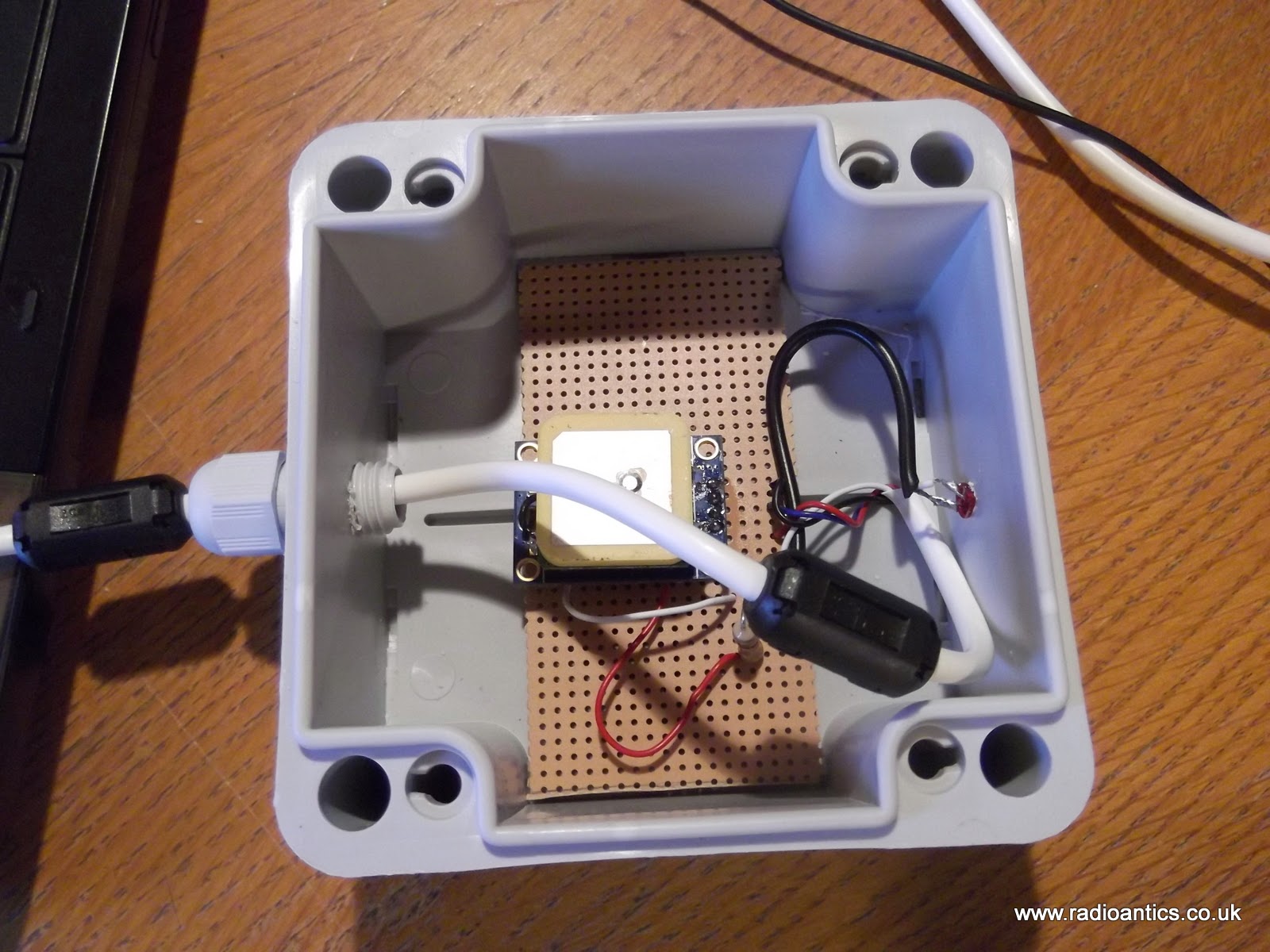
Sourcing an inexpensive weatherproof enclosure (£2) and waterproof cable gland were straightforward enough. I mounted the GPS module on a piece of strip board and replaced the on board LED with one mounted in the enclosure so I easily determine if the GPS had achieved lock, since it only flashes when it has. The LED is sealed with epoxy resin. It should be noted that the outputs of the U-BLOX chip are only rated at 10mA so bear it mind when selecting an LED and calculating the current limiting resistor. The connecting cable is some surplus unscreened alarm cable fitted with a couple of ferrite clamps.
The GPS now has no trouble achieving lock and quickly sets the Ultimate3 clock. Researching the 1PPS problem I hadn't come up with anything definite, as the signal looked okay on the oscilloscope. But I decided to fit a 10K resistor pull up resistor between the 1PPS output and the 3.3V supply on the GPS module. If this actually made the difference I have no idea but the Ulimate3 now successfully calibrates the DDS using the GPS.
At the moment I have configured the beacon to run WSPR and I have been spotted by other operators. Initially I wasn't getting much RF out of the device and it turned out to be a combination of poor connection caused by me not removing the enamel properly on a toroid winding and an iffy antenna connector. Both have been corrected and now get a measurable deflection on the SWR/Power meter. With the additional of a second power amplifier FET it is around 200-250mW.
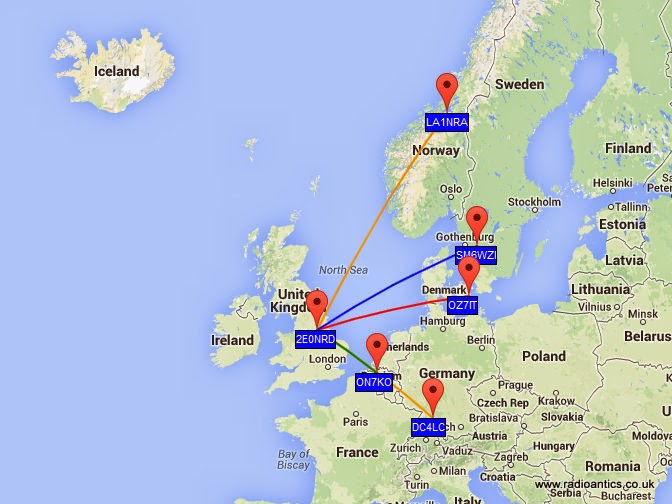
I purchased the Ultimate3 with a low pass filter for the 40M band and while I have had some European spots the results have been a little disappointing. 40M has turned out to be almost unusable at my QTH due to QRN/M so not sure if that is having an effect, also the antenna I have isn't naturally resonant on 40M so is going through a tuner which will certainly be introducing some losses, without the tuner the FETs get very warm!
With this in mind I have purchased some additional LPFs for the 30M and 20M bands and the LPF relay switching board for the Ultimate 3 so can try/run multiple bands.
Andrew Garratt, MØNRD, is a regular contributor to AmateurRadio.com and writes from East Midlands, England. Contact him at [email protected].
VC1T plans Transatlantic 144MHz attempt

Over the years, there have been plenty of attempts to bridge the Atlantic on 144MHz, via tropo or meteor scatter. Up to now, it hasn’t been done. There’s no doubt at all in my mind that it’s possible – it’s just a question of try, try and try again.
A North America group, operating as VC1T plan to try from July 5th to 12th this year. They plan to use good power to a 43 element yagi (yes, 43 elements) and concentrate on FSK441 and JT65b modes.
You can read more about their plans here
Will this be the year it’s done? Wouldn’t it be great if the answer was yes!
Tim Kirby, G4VXE, is a regular contributor to AmateurRadio.com and writes from Oxfordshire, England. Contact him at [email protected].
Not bad!
36 intrepid souls have signed up for the 2014 NJQRP Skeeter hunt since the opening bell rang early yesterday morning. And I am proud to say that one of our Skeeters this year is Mr. NJQRP himself. George N2APB sent an e-mail and was assigned Skeeter #29.
I also see that several of my fellow QRP Polar Bears have signed up for numbers, too. These guys are fantastic and are never ones to miss the opportunity for an outdoor QRP adventure. Thank you fellow Polar Bears – grrrrrrrrrrr. Will be looking to join you in swatting Skeeters from bear hide this August.
I’d like to take this opportunity to “borrow” and old New Jersey slogan. This was an advertisement that ran back in the days when Tom Kean was governor and it was designed to increase tourism in NJ. It went like this, “New Jersey and you ….. prefect together.”
If I may, this kind of sums up the whole idea and intent behind the NJQRP Skeeter Hunt.
“QRP and the great outdoors ….. perfect together!”
Join us and see for yourself.
72 de Larry W2LJ
QRP – When you care to send the very least!
2014 Skeeter #13
MONDAY MORNING IMPORTANT UPDATE: Argggghhhhh! I went to my spam file this morning and found about 20 Skeeter Number requests that were sent over the weekend. I didn’t know they were there, and I didn’t even think to check there until this morning! So if you sent me an e-mail request over the weekend and still haven’t heard from me …..you will tonight. I promise!
Larry Makoski, W2LJ, is a regular contributor to AmateurRadio.com and writes from New Jersey, USA. Contact him at [email protected].
 Ham Radio Deluxe |
 W5SWL Electronics |
 Ham Radio Prep |
 KB3IFH QSL Cards  Hip Ham Shirts  HamRadioAuctions HamRadioAuctions Reliance Antennas Reliance Antennas Enigma Shop Enigma Shop |  morseDX  Ni4L Antennas  R&L Electronics R&L Electronics antennas.us antennas.us QRV QRV |
- Matt W1MST, Managing Editor
