 |
 Field Day 2014 in Texas
 1 July 2014 | by
This past weekend was the ARRL Field Day, and was my first time to attend one of these events. I just upgraded my license to General last November, so I never had much interest in HF before now. Lots of hams would cringe to hear me say that, but I always enjoyed the VHF/UHF operations and building relationships with local hams who I could talk to on a normal basis.
However, I am very glad that I attended the Field Day Event this year. I was able to learn some good information about band limits, what times of day each band is better, etc. I was also able to try some digital contacts on PSK31 and RTTY, which I had never done before.
I spent this Field Day with the Hurst ARC out at Chisolm Park in Hurst. Our class was 3A and our section was NTX. The 3 stations we had setup were a Icom IC-7000 running 15-meters on a homebrew Buddistick Vertical; a Kenwood TS-2000 on a Fan Dipole, which could jump between 20-40-80-meters, and a Icom IC-7200 attached to a 3-half-wave (1.5 waves total, 102′) for 20-meters.
I must say, above all else, the 15-meter station on the vertical antenna made the most contacts, which also impressed me the most. I was expecting the 20-meter dipole to out-perform everything, and its performance was fantastic, but the 15-meter vertical station made more contacts than any station. Most of that was probably due to the operator, KE5SBP. He is quite good at finding contacts on HF, and is very experienced. But the performance of the vertical antenna astounded me.
I was a bit disappointed that 40-meters and 80-meters didn’t open up more-so during the night. We made several contacts on each of those bands, and 40-meters continued well into the next morning, but I was expecting more. Maybe that is just my lack of experience with these bands, though.
The farthest contact that I personally made was on 20-meters to the U.S. Virgin Islands. I also made 1 or 2 contacts into Puerto Rico, and several into Canada. I heard some DX stations on 20-meters, but I was never able to get back to them, due to the pile-ups. Hawaii was also a popular location, and while several others at our location made those contacts, I did not.
Next year, W5HRC is already talking about upgrading to 4 or 5 stations. I’d like to see a 6-meter station, as well as maybe 10 and 12 meters. If 10 and 12 are like 15, they should do well during the daytime.
Jason Johnston, KC5HWB, is a regular contributor to AmateurRadio.com and writes from Texas, USA. Contact him at [email protected].
Keep it simple: A creative case for the Ham It Up upconverter

KK4JDO’s son made a Lego enclosure for the Ham It Up upconverter
Richard, KK4JDO, shared a proud dad moment on Reddit. His son created a Lego enclosure for his Ham It Up upconverter board.
The lesson? Sometimes the simplest solutions are right in front of you (or at least in your kid’s toy box)! 🙂
Matt Thomas, W1MST, is the managing editor of AmateurRadio.com. Contact him at [email protected].
6m Action
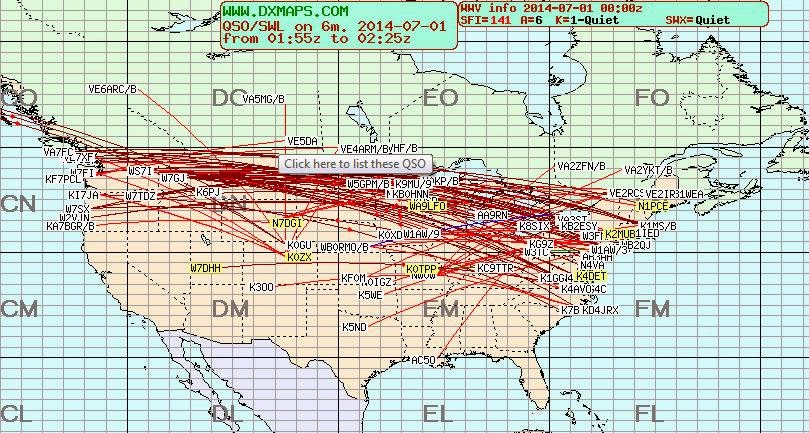 |
| Courtesy: DXMAPS.COM |
Steve McDonald, VE7SL, is a regular contributor to AmateurRadio.com and writes from British Columbia, Canada. Contact him at [email protected].
Gaining interest in radio
A big friendly welcome to my new readers who will be reading my blog entries via AmateurRadio.com – I hope my articles will provide insightful reading.
If you are not already “in the know” im based in the UK and provide distant learning course for UK amateurs alongside Steve (G0FUW) and Lewis (G4YTN) along with home based learning we also provide in class education as well.
 |
| PSK Receiver No. 001 with Raspberry Pi |
The education element of the hobby really interests me and not content with the 3 tier license, we also provide buildathons for anyone who is interested in electronics, radio or construction.
Our very successful PSK receiver kit (Instructions here) has now been used up and down the UK and orders are still coming in for the kit via the RSGB all over the world. Its a perfect kit for newcomers or students wanting to build a radio related project for their intermediate practical assesment.
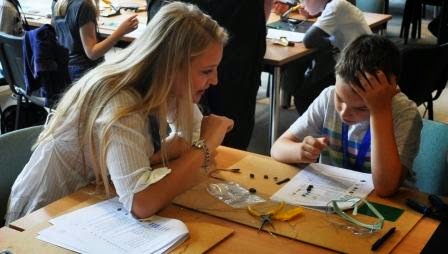
A couple of weeks ago we were asked to provide a buildathon for 21 young scientists at the BRLSI in Bath. And when I say young I really mean 8 – 14 years of age.
All but 3 kits went away working that afternoon and one of the first was a young 8yr old girl who had never held a soldering iron or had any clue what was really going on. But by the end of the day not only had she completed a build of the receiver but was decoding PSK signals on 20m in less than perfect conditions.
That was a particular highlight of mine on that day, seconded only by persuading her father to pop along to some of the in-class lessons and see what it was all about. It seems that there is a little bit of curiosity in radio in all of us. even today !!
Whereas we are keen to knock ourselves for not connecting with the youngsters, and gaining interest in the hobby, it actually seems to be that we are not that great at following up and converting the curious mind into a radio hobbyist.
Dan Trudgian, MØTGN, is a regular contributor to AmateurRadio.com and writes from Wiltshire, England. He's a radio nut, IT guru, general good guy and an all round good egg. Contact him him here.
First JT-65A Contacts!
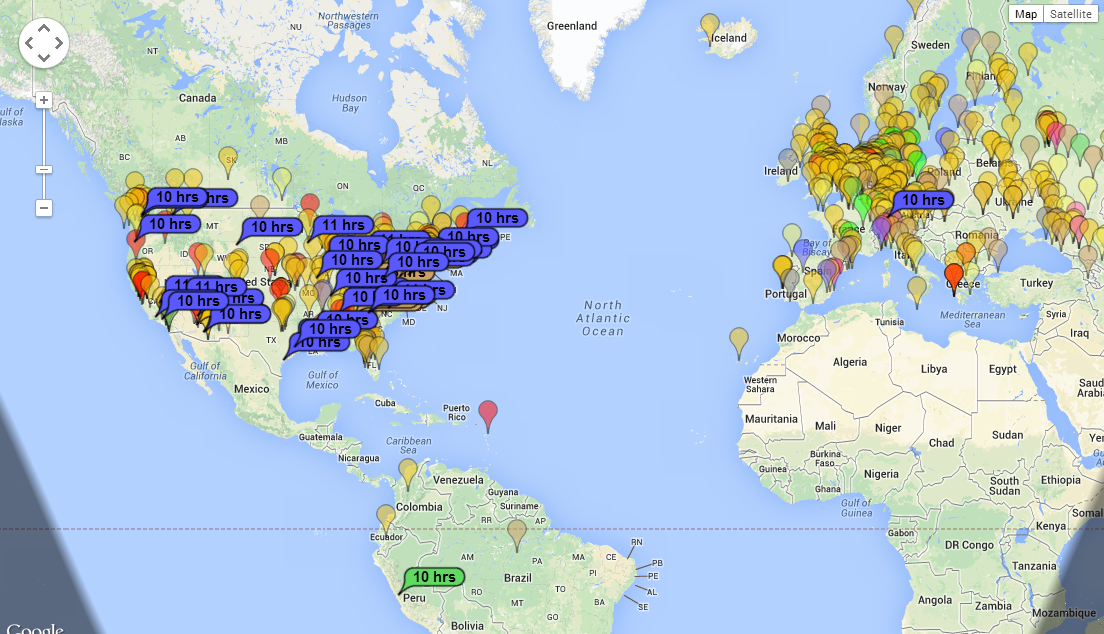 |
| JT-65 Spots on 40 Meter with 2 Watts |
Over the weekend I setup WSJT-X on my old XP computer. I let it do some decoding off and on over the weekend on several bands – and I was decoding well!
Burke Jones, NØHYD, is a regular contributor to AmateurRadio.com and writes from Kansas, USA. Contact him at [email protected].
Field Day on Mt. Kearsarge
Dave Benson K1SWL and I did Field Day at Winslow State Park part way up Mt. Kearsarge. We only operated for 3 hours, but we had a fantastic time and worked stations in Washington, Oregon, California and New Mexico among many others.
Our view was the best!

We met at 11:00 am at the gas station in Wilmot Flats. Then we headed up the Kearsarge Valley Road toward the mountain. We weren’t sure what to expect… but we really lucked out. We had a spot all to ourselves at the end of a small field. We had suitable antenna trees on all sides, and hardly any bugs. A slight breeze kept us cool most of the time.

I put up an inverted L with 65 feet of wire. It went up about 30 feet and then over. I used the earchi.org 9:1 unun. The KX3 tuned perfectly on 15 meters.
Dave used a K2 with a resonant 20 meter dipole up about 35 feet. He fed it with coax and didn’t need a tuner.
We operated with solar charged batteries using Dave’s call (K1SWL) as 2B battery. Remarkably, we didn’t interfere with each other at all. A few keying remnants was all I could hear. Dave got a very slight bit of hash now and then.
Here’s Dave testing his setup before the 2:00 pm gun.

We feasted on freshly picked strawberries and cookies in between contacts. (thanks Judy!) It seemed to us that activity was down this year, but maybe it was just band conditions.
I started out using 9 AA cells with the KX3 at three watts. I didn’t have any trouble making QSOs with this setup. I just wanted to see how it would work in a competitive environment. After 30 Qs, I switched up to five watts and a LiPo battery.
The park closes at 6:00 pm and we started packing up shortly after 5:00. (We’d had enough… How do these kids go all day and half the night?) Thanks for all the Qs… see you next year.
Jim Cluett, W1PID, is a regular contributor to AmateurRadio.com and writes from New Hampshire, USA. Contact him at [email protected].
Hans Summers kit: Ultimate 3 beacon
Today I unpacked this kit which I’ve had a couple of months. I have been waiting until I feel a bit better (less wobbly and clumsy) but now feel well enough to start the build.
 |
| Ultimate 3 beacon kit – received from Japan |
I’ll build the TX low pass filter for 10m first as this looks “do-able”. The other parts may have to wait a few weeks. I want the kit building but want to do it when I am fit enough. The big issue will be boxing it. My brain bleed makes drilling cases a nightmare for me.
I was surprised to find no enclosed instructions. Guess one is meant to look on the net. Only unpacked the LPF module so far. Being very careful.

Roger Lapthorn, G3XBM, is a regular contributor to AmateurRadio.com and writes from Cambridge, England.
 Ham Radio Deluxe |
 W5SWL Electronics |
 Ham Radio Prep |
 KB3IFH QSL Cards  Hip Ham Shirts  HamRadioAuctions HamRadioAuctions Reliance Antennas Reliance Antennas Enigma Shop Enigma Shop |  morseDX  Ni4L Antennas  R&L Electronics R&L Electronics antennas.us antennas.us QRV QRV |
- Matt W1MST, Managing Editor
