 |
 CALLING ALL RADIO AMATEURS – THIS IS W1AW IN NEWINGTON, CT
 11 July 2014 | by
 I would suspect that if you have done even a bit of tuning around the HF dial in the last few months, you have probably heard W1AW/0-9 making contacts. This week W1AW, the ARRL mothership in Newington, CT, has been on the air as W100AW in celebration of the ARRL anniversary.
As busy as that sounds, W1AW is consistently on the air with a great variety of activities. Yesterday I took the opportunity to copy their digital modes broadcast. http://www.arrl.org/digital-transmissions
ARRL has various means of promulgating a great deal of information. The primary way I usually receive a good portion of it is via email. I thought it would be interesting if I could try and copy their digital transmission of their bulletin, which I was able to do yesterday.
Every weekday, W1AW sends out a bulletin twice a day on multiple bands while rotating through three different digital modes: Baudot (RTTY), PSK31, MFSK16. The first broadcast kicked off at 5pm (local) which I was able to copy of 17M (18.105 MHz). It appears to be ARRL’s propagation bulletin. Here is what I copied:

Please find my full copy here.
Later in the evening (8pm local), I copied the next broadcast which looks like their DX bulletin:

…. and the complete text is here.
During the 8pm transmission, I was able to copy the bulletin on 10M, 15M, 17M, and 20M. I could not find it on 40M or 80M.
Although these bulletins are easily obtainable via email or from ARRL’s website, I enjoyed copying the broadcast from here in eastern Kansas.
Scott Hedberg, NØZB, is a regular contributor to AmateurRadio.com and writes from Kansas, USA. Contact him at [email protected].
500KHz Lives Again – 2014 Night of Nights
 |
| Courtesy: Maritime Radio Historical Society |
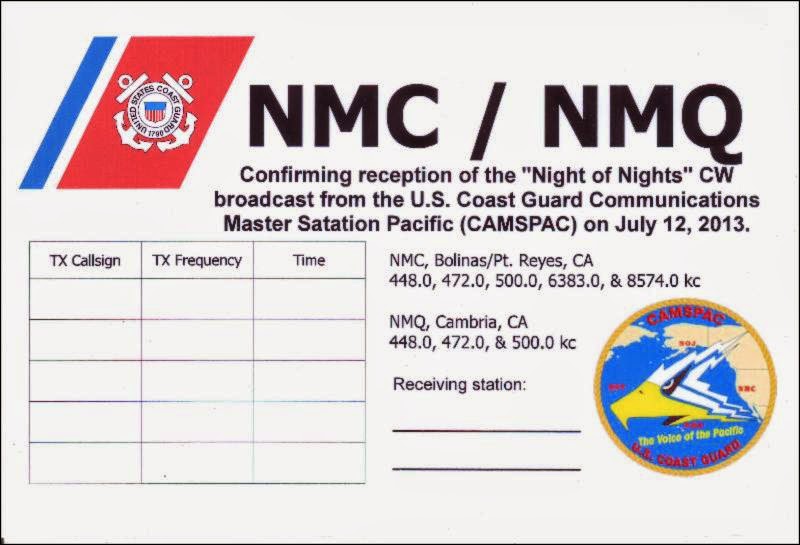
This year's annual Maritime Radio Historical Society's event, to mark the anniversary of the end of maritime CW in 1999, will take place Sunday, July 13, from 0001Z until 0700Z (Saturday, July 12, from 1701 until midnight PDT). This year's event may be historic in itself in that it will likely be the final year for any of the U.S. Coast Guard stations to ever be heard again on CW, as the equipment and wiring for this mode is now being dismantled.
 |
| Courtesy: Maritime Radio Historical Society |
Commercial CW land station transmitters from WLO (Mobile, AL), KLB (Seattle, WA), KFS (San Francisco, CA), KPH (Bolinas, CA) and KSM (Pt. Reyes, CA) should be active near 500KHz as well as on HF.
(late update: due to operator illness, KLB will not be participating)
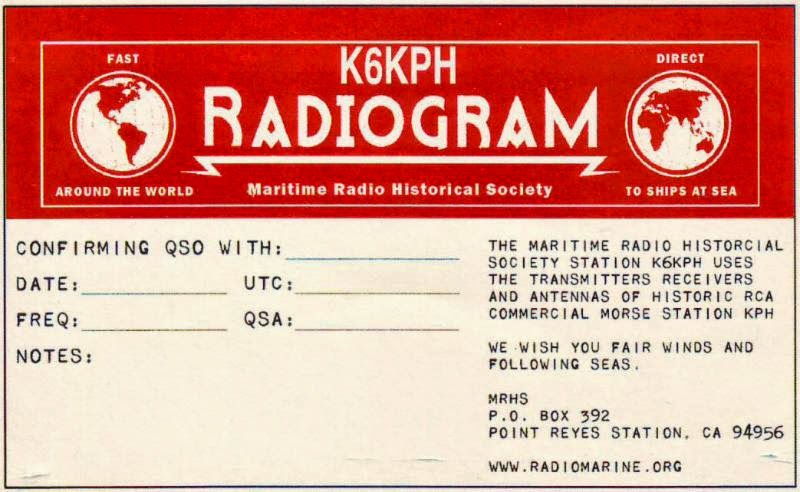
USCG stations NMC (Bolinas/Pt. Reyes), NMQ (Cambria /Pt. Reyes) and NMW (Astoria / Pt. Reyes) will also be transmitting below 500KHz as well as on HF. QSL's confirming reception of CG stations as well as for K6KPH and KSM will be available following the event.
K6KPH, the MRHS's amateur radio station located at the Pt. Reyes, CA site, will also be active on the HF bands during the event.
For a nice historical 'look back', the MRHS has some great stories associated with HF and MF maritime operations. Further details of the event detailing times and exact frequencies are available from MRHS newsletter #45.
Lastly, if you never had the opportunity to listen to '500' back in its heyday then you will surely enjoy this recording made by K2NP in March,1966 and presented with thanks to N1EA. Listening to this 500KHz action reminds me of 20m CW during the annual DX contest! What land stations can you identify in the pileups? Hopefully, when all North American amateurs gain access to the band, it will sound like this once again.
Steve McDonald, VE7SL, is a regular contributor to AmateurRadio.com and writes from British Columbia, Canada. Contact him at [email protected].
Amateur Radio Newsline Report 1926 July 11 2014
- Hawaii to mainland US opens on VHF just after July 4th weekend
- UKube-1 ham radio satellite successfully launched
- New amateur radio regulations to be introduced in Thailand
- Hurricane Watch nets activate for Hurricane Arthur
- United States lightship is the 300th registrant for ILLW
- A look at the recent HAM RADIO convention in Germany
On the Road With D-STAR (part 2)
Part 2 of 2
If you purchase the DHAP with the Raspberry Pi, it includes a factory image of the OS and software. Configuration is easy enough. The DVAP software is set to auto-boot so you need only configure it once. If you connect the device to a wired network connection the Pi will boot up and obtain a connection. If you want to use the device with Wi-Fi, then you have to launch the WiFi configuration tool and set up the connection.
This is only slightly tricky because it would be handy to plug in a keyboard, mouse, and the network dongle — three USB connections while the Pi only offers two. A USB hub handles the multiple connections and you’re underway. After setting it all up once, there’s no need for reconfiguration as it all just boots up and obtains a network connection without the need for additional interface.
In other words, connection to a monitor, mouse and keyboard is only required for the initial configuration. After that, the DHAP can be operated “headless”.
Unless of course you’re thinking of taking this on the road with you and would like to connect it to a hotel’s Wi-Fi. Then you’re going to need to carry the input peripherals and a monitor, or use the TV in your hotel room if that’s possible.
This is all much more than I like to carry on out of town trips which is why I tether the DHAP to my cellphone. Carrying Wi-Fi in my pocket simplifies things considerably though this brings me to a tip I’d like to pass along when using it this way.
Wi-Fi and Tethering
If you set your home Wi-Fi and your tethered connection to have the same SSID, password, and encryption method, then there is never a need to reconfigure the Raspberry Pi. One of my home wireless networks (WPA PSK2) is called ‘GUEST’ and the password is ‘lemonade’ and I’ve made those settings identical on my phone.
When I’m away from home, I tether to my phone. When I’m home, the Pi auto connects to my home Wi-Fi. Simple. Easy. Clean.
It takes about 15-20 seconds for the Pi to boot up and another 20-30 seconds for the networking to kick-in, negotiate a connection, and begin working. When you power up the DHAP, give yourself a full minute before trying to connect to it with your radio.
Powering the DHAP
The DHAP comes with a brick charger that has an LED indicator. When it’s red, the batteries are charging and when it’s green the charge cycle is complete. Silly me. I plugged it in and started using it right away. The charger went through the cycle, the LED turned green and the voltage began to drop. Though I wasn’t paying attention and several hours later my D-STAR connection was dead. When I checked on the DHAP the voltage display showed 2.2 volts — not enough to keep the Pi or the DVAP alive.
This seemed odd. The battery voltage was low but the charger LED was green. There was no charging going on for some reason and I thought I had a defective unit.
Then I discovered that the charger is fairly “dumb”. It provides one charge cycle then stops. Removing power resets it for the next charge. This works well if you charge the DHAP, then unhook it and take it in the field. If, on the other hand, you want it to just sit on the shelf at home and provide a hot-spot, you should provide power via the USB Power socket on the front panel.
This bypasses the batteries altogether and directly powers the Raspberry Pi and the DVAP. By the way, *don’t turn the unit on in this mode* — and the voltage display will show the power being supplied via a USB power supply — probably something a little less than 5 volts.
A one amp USB power supply should do the trick nicely.
Odds and Ends
It makes sense to get things working with your DVAP connected to your desktop (or laptop) computer before installing it in the DHAP. It will operate exactly the same once it’s tucked away in the enclosure.
There is a small slot in the top of the DHAP that permits you to see the activity LED’s on the DVAP. You will find this quite useful.
The tiny antenna on the DVAP works well enough but it can be replaced with a more efficient “ducky” style antenna. The DHAP comes equipped with a built-in cable that can “remote” the antenna connection to the back panel. Don’t be tempted to try and interface the DVAP to a full-sized, outdoor antenna. Internet Labs has reported hardware failures that they attribute to doing just that.
Have Fun
D-STAR is not worth the bits it’s built upon if you don’t enjoy it. If you’re considering joining the growing crowd in this unique mode of operation let me first ask you one simple question: do you enjoy repeater operation?
Because at its core, that’s what D-STAR is. A global collection of repeaters and individual users who have the ability to communicate with each other using this digital technology. If you’re answer is “YES” and you enjoy rapid learning, then you will no doubt enjoy digging in and exploring this evolving mode of operation.
But if you’re answer is “NO”, well, then this facet of amateur radio is probably not for you. Don’t waste your time — or your treasure. Move on and find something you really enjoy. After all, amateur radio is a hobby with endless things to do, people to meet, and fun to be had.
Filed under: Ham Radio Tagged: dhap, dstar, dvap, hr, icom, id51a


Jeff Davis, KE9V, is a regular contributor to AmateurRadio.com and writes from Indiana, USA.
6m Polar Madness
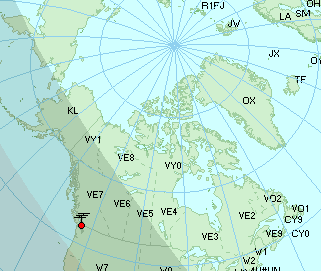
Looking at the path on DX Atlas shows an almost all-daylight path from VE7 to Europe, but for the first short hop out of the summer twilight.
 |
| VE7 - EU at 1100Z |
I was soon joined by John, VE7DAY, and we both began to CQ towards the sunlight after alerting several of the European operators via the ON4KST chat page. No 49MHz eastern Europe video signals were heard at all but this is often not a deal breaker. One beacon that always seems to be present when hearing Europe, the VA5MG/b in central Saskatchewan, was not heard either. After 90 minutes of no other indicators I headed back to bed.
In view of the high levels of summer Es in the sunlight-bathed Arctic / northern Canada regions, this crazy night time path might be worth exploring more closely during the last week of June and the first week of July. In view of the ungodly hour however, I fear that it may be some time before 6m reveals more of her secrets.
Steve McDonald, VE7SL, is a regular contributor to AmateurRadio.com and writes from British Columbia, Canada. Contact him at [email protected].
Build a Zork Teletype Machine
I thought this linux teletype project was pretty amazing. If you have not heard of Zork, read up here.
Are there any amateurs still running old teletype equipment for regular RTTY QSOs?
Scott Hedberg, NØZB, is a regular contributor to AmateurRadio.com and writes from Kansas, USA. Contact him at [email protected].
University of Liverpool on-line courses
Very many years ago (1967-1970) I was an undergraduate student studying Electronics at the University of Liverpool. Since those days, the Department has become heavily involved with on-line learning as reported by the Southgate Amateur Radio News page. This course could suit someone needing a grounding in electronics. I think there is some (easy-ish) maths. To do the honours degree course we had to do maths to degree level. I found this very hard.
Proving how small the world is, one of our close friends in the village is the brother of my personal tutor at university. The brother is now a visiting professor at Liverpool. I believe my old tutor still works at the university as an emeritus professor.
A new Massive Open On-line Course (MOOC) covers Analogue/Digital Electronics, AC/DC Circuits, Electromechanics and an introduction to C programming.
Over the last few months here at Liverpool we have been putting together a MOOC (Massive Open On-line Course) which introduces aspects of electrical engineering. The course starts in September, but you can sign up now. It’s free and there are no gimmicks.
The link to the MOOC info is here: https://www.futurelearn.com/courses/electrify
Any ideas on how to make this course better are welcome.
Matt O’Rourke
MOOC developer
Liverpool University On-line Electrical Engineering Course

Roger Lapthorn, G3XBM, is a regular contributor to AmateurRadio.com and writes from Cambridge, England.
 Ham Radio Deluxe |
 W5SWL Electronics |
 Ham Radio Prep |
 KB3IFH QSL Cards  Hip Ham Shirts  HamRadioAuctions HamRadioAuctions Reliance Antennas Reliance Antennas Enigma Shop Enigma Shop |  morseDX  Ni4L Antennas  R&L Electronics R&L Electronics antennas.us antennas.us QRV QRV |
- Matt W1MST, Managing Editor
