 |
 Maidenhead Locators
 14 July 2014 | by
 Locators, or as us Brits call them, Maidenhead locators. Named after a town in Berkshire that isn’t close to the meridian but held a meeting by a bunch of VHF chaps in the early 80’s. In fact the now de facto method for looking something up (Google & Wikipedia) give us:
‘The Maidenhead Locator System is a geographic co-ordinate system used by amateur radio operators. Dr. John Morris, G4ANB, originally devised the system, and a group of VHF managers, meeting in Maidenhead, England in 1980, adopted it. The Maidenhead Locator System replaces the older QRA locator system with one that is usable outside Europe.[1]
Maidenhead locators are also commonly referred to as QTH Locator, grid locators or grid squares, despite having a non-square shape on any non-equirectangular cartographic projection. Use of the terms QTH locator and QRA locator was initially discouraged, as it caused confusion with the older QRA locator system. The only abbreviation recommended to indicate a Maidenhead reference in Morse code and radio teleprinter transmission was “LOC”, as in “LOC KN28LH”’
But more to the point how do you calculate one? Easy if you know Perl (apparently – thanks again Wikipedia)
#!/usr/bin/perl -w
# (c) 2012 Chris Ruvolo.  Licensed under a 2-clause BSD license.
if($#ARGV < 1){
  printf("Usage: $0 <lat> <long>n");
  exit(1);
}

my $lat = $ARGV[0];
my $lon = $ARGV[1];
my $grid = "";

$lon = $lon + 180;
$lat = $lat + 90;

$grid .= chr(ord('A') + int($lon / 20));
$grid .= chr(ord('A') + int($lat / 10));
$grid .= chr(ord('0') + int(($lon % 20)/2));
$grid .= chr(ord('0') + int(($lat % 10)/1));
$grid .= chr(ord('a') + int(($lon - (int($lon/2)*2)) / (5/60)));
$grid .= chr(ord('a') + int(($lat - (int($lat/1)*1)) / (2.5/60)));

print "$gridn";
But what happens if its all Dutch to you (It is to me)?
Well I put together a simple spread sheet that does the calculation. Its nothing special but deciphering what several different people have put into explanations that include adding your birthday, taking away your dogs maiden name and that kind of thing. Hopefully it’ll help you understand where those numbers come from and how to calculate them. So help yourself and if it doesn’t work then fix it and share it ( I tested it with 3 locators and lats / longs and it seemed to work). I also learnt a few more things about Excel so its all handy.
Alex Hill, G7KSE, is a regular contributor to AmateurRadio.com and writes from Cumbria, UK. Contact him at [email protected].
AmateurLogic 68: Field Day 2014

AmateurLogic.TV Episode 68 is now available for download.
It’s been three years since the ALTV team did Field Day in the wood. We disturb the peace and quiet of Shrock, MS this episode for another Field Day adventure. Listen to the roar of generators and crickets. Learn a little about the history of the site. Take a look at the location, tent and our choice of antennas. Check Wayne’s coax cables with the Megger(we were surprised what we found). Peter joins us to chat about Field Day and a report on his KN-Q7A transceiver kit. Witness the great Quadcopter mishap, plus much more.
1:35:04 of good outdoor Ham fun.
George Thomas, W5JDX, is co-host of AmateurLogic.TV, an original amateur radio video program hosted by George Thomas (W5JDX), Tommy Martin (N5ZNO), Peter Berrett (VK3PB), and Emile Diodene (KE5QKR). Contact him at [email protected].
VE7 630m CW Beacons Report
 Saturday night's CW beaconing by myself and VE7BDQ on 630m CW produced a number of interesting heard reports from various directions. It seems as though most receiving stations were bothered by the high level of thunderstorm QRN, very common at this time of the year and usually the limiting factor in reception. The Vaisala lightning map indicated various pockets of lighting in the PNW and a solid wall further to the east. Being located near any of these cells would make it difficult to hear anything at all and all but impossible nearer the wall.
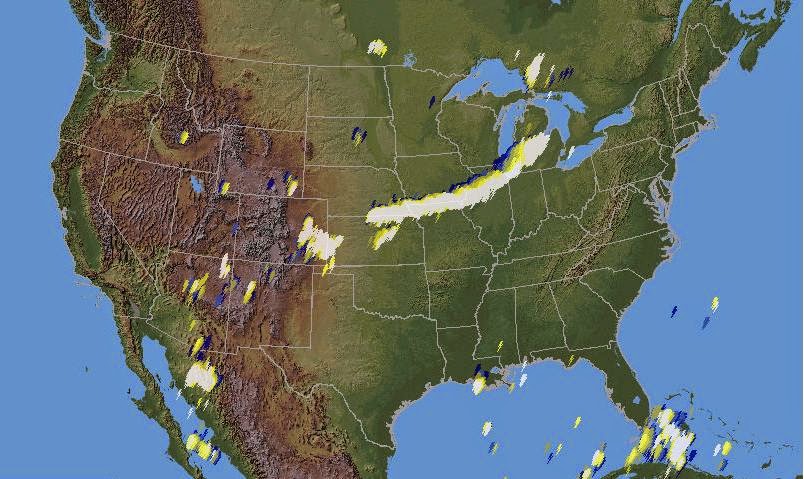 |
| Courtesy: vaisala.com |
Nevertheless, reception reports, often of both beacons, were received from Washington, Oregon, Utah, British Columbia, Alberta and as far east as Saskatoon, SK. It seemed like stronger signals were reported from the east rather than from the south or south-east which is more often the case. I suspect that the lower level of lightning in this direction, rather than enhanced E-W propagation, was the main reason for the nice 'over the Rockies' reception.
Thanks to the following enthusiasts who were kind enough to listen and to report on Saturday night's activities, hopefully I haven't missed anyone:
It appears that even under fairly severe conditions (mid-summer QRN), small backyard antenna systems and 100W can propagate well enough for CW contacts on the 630m band. The band is certainly much more prop-friendly than 2200m and quiet winter conditions will be even better. In the meantime I hope to make some crossband contacts with anyone that might like to try that mode.
Steve McDonald, VE7SL, is a regular contributor to AmateurRadio.com and writes from British Columbia, Canada. Contact him at [email protected].
How to use an oscilloscope
Alan Wolke, W2AEW, posted a great video yesterday of a presentation on oscilloscope basics at the Ocean-Monmouth Amateur Radio Club in Wall Township, New Jersey. Thanks, Alan!
Matt Thomas, W1MST, is the managing editor of AmateurRadio.com. Contact him at [email protected].
IARU HF 2014
Call: K8GU
Operator(s): K8GU
Station: K8GU

Class: SO CW LP
QTH: FM19li
Operating Time (hrs): 5
Radios: SO2R

Summary:
 Band  CW Qs  Ph Qs  Zones  HQ Mults
-------------------------------------
  160:    0     0       0       0
   80:   50     0       3       4
   40:   87     0      11      12
   20:   47     0       7      15
   15:   16     0       7       9
   10:    0     0       0       0
-------------------------------------
Total:  200     0      28      40  Total Score = 25,092

Club: Potomac Valley Radio Club
Since the birth of our second child, I’ve had to become a little more creative in my approach to operating contests. There are rare days when both children are in phase with their eating and sleeping needs and we can accomplish some things, and then there are the other days. With the coincidence of the quadrennial World Radiosport Team Championship (WRTC) and IARU HF World Championship contests this year, I thought I would make a game of trying to contact all 59 of the competitors rather than maximizing contest score. The motivation for this is that WRTC was in New England this year, which is a stone’s throw away from me and middle-of-the-night operation would yield QSOs with the WRTC stations on 40 and 80.
I did end up working all 59 of the WRTC stations with their distinctive 1×1 callsigns by furiously searching and pouncing on both radios on 40 and 80. In fact, I worked most of them twice before I finally found K1T. I’m going to do an analysis of the standings of the teams versus when I worked them to test if any of the teams were better at “marketing” than others. Should be fun! Anyhow, all of these operators were really outstanding but a special congratulations to N6MJ and KL9A who seem to have run away with the whole thing operating as K1A.
In the lead up to the contest, I finally managed to get the station fully SO2R (single operator, two radio—essentially the ability to operate interference-free duplex on any pair of HF bands) again. And, in the process, I have automatic band switching again, so I don’t have to run across the basement to switch antennas. Thank goodness for small conveniences.
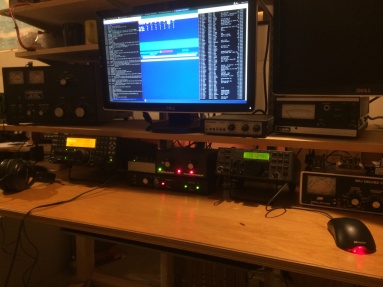
Here’s the mess for low-power (100 watts and less): KK1L 6×2 switch to connect two radios to any of six antennas, W3NQN single-band 200-watt transmitting filters for each band (10-80 meters shown here since I still don’t have a 160 antenna yet), and the K6KV-K8GU triplexer that allows me to share the feedline to the G3TXQ broadband hexagonal beam with both radios. All this stuff was homebrewed by me but it is all available in commercial form as well.
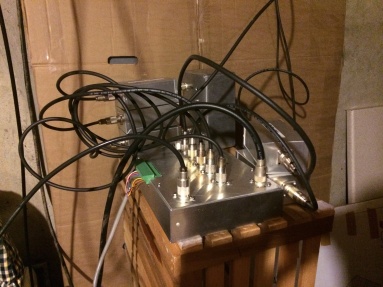
I’ve described the W3NQN filters considerably in the past, but the triplexer is new (built in March 2014) and since I’ve had some e-mail traffic from a couple of people who know I built one, I’ll probably write something up on it in the next few weeks. I mention it here because WRTC is actually one of the events that popularized the use of triplexers, which are downright freaky when you think about plugging two 100-watt class radios into a box that separates/combines the signals. Electrical engineering for the win on this one. Anyhow, I based my triplexer off the K6KV QST article from June 2010, finding some beautiful Johnson capacitors in a flea market for $5 each and using leftover toroids from the W3NQN filter project instead of the solenoid coils used by K6KV. The whole thing set me back about $30 total and it works great with the W3NQN filters, to say the least.
This was the second contest with TRLinux contest software by N6TR and W9CF. It has some idiosyncrasies, such as the effect of CAPS LOCK on the shortcut keys. For example, did you know that ALT-r is not the same as ALT-R? The great thing about it is that TRLinux talks natively with the YCCC SO2R+ box that I use to handle keying and audio switching for both radios. And, the band data is handled by the YCCC SO2R+ with TRLinux, so I didn’t have to buy a band decoder for the K2. That whole process of setting up the band decoding was another midnight oil project Friday night before the contest started. Fun and games. But, it worked flawlessly.
And my three-year-old son, future SO2R CW operator, rocking the Bencher and Palm paddles…”I’m doin’ lots of Morse code!”
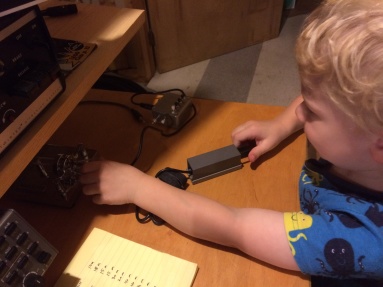
Ethan Miller, K8GU, is a regular contributor to AmateurRadio.com and writes from Maryland, USA. Contact him at [email protected].
Bees and Skeeters, oh my!
The bugs is among us!
As of Friday, if you aren’t already aware, Rich Fisher KI6SN announced that he is accepting requests for Bee numbers for the Annual Flight of the Bumble Bees. which will occur on Sunday July 27th. The sign up procedures for both Sprints remain the same as last year – however each Sprint has a different sign up procedure.
To become a Bee, the first thing you have to do is visit http://bit.ly/15aGgN1. Once you’re there, you can see what numbers have been requested and assigned. When you have in mind the number you would like to be assigned, you send Rich an e-mail with your request and two alternate choices to: [email protected].
In your e-mail, you send Rich the following information:
Your Callsign
Your First Name
The field location you anticipate to be operating from
Your Top 3 Choices for FOBB Number
Then, go back and check the database after a bit of time, as Rich will not be sending individual confirmation e-mails. I saw my name and number appear just a few hours after I had sent Rich my request.
As I’ve stated before, the procedure for getting a Skeeter number for the NJQRP Skeeter Hunt is a tad different. Just send an e-mail to [email protected], and I will send you a sequential number in a confirming e-mail. I just sent out a bunch of Skeeter numbers to people who sent me requests last week while I was on vacation. If you have sent me a request, and didn’t get a reply or you don’t see your name on the roster, then I apologize. Send me another e-mail and I’ll get a number out to you, lickety-split.
Both Sprints are on Sundays from 1700 – 2100 UTC and both are designed to get you and your gear out in the fresh air to enjoy the Great Outdoors. Personally, I hope to work you in both events!
72 de Larry W2LJ
QRP – When you care to send the very least!
Larry Makoski, W2LJ, is a regular contributor to AmateurRadio.com and writes from New Jersey, USA. Contact him at [email protected].
2014 QSO A Day Challenge–50% Complete
I’m late in getting this update published. I was on vacation (staycation at home) as June ended and July began. This past week was my first week back and I was swamped at work. But all is on track and I’ve completed at least one QSO each and every day in 2014 and the challenge is well over 50% complete.
In addition, to keeping my QSO per day streak alive…I’ve also managed to add at least one new DX entity each month in 2014. June was no exception with the addition of Saint Lucia. This makes 10 new DX entities added to my log this year.
As I started with my May update, my progress in the 2014 ARRL Centennial QSO Party continues to progress. The numbers below are as of mid July.
Centennial Points Score: 9,049
Total QSO’s: 1,539
Rank (All): 1,230
Rank (Colorado): 14th

The QSO breakdown for June is as follows:
Mode Number QSO’s
JT65 20
JT9 32
SSB 538
PSK31 0
MFSK16 0
RTTY 0
2m FM 0
Additional notes of interest:
DX Stations Worked in June – 44
New DX Entities in June – 1
New DX Entities for 2014 – 10
Total QSO’s for June – 590
Total QSO’s for 2014 – 2,234
Total consecutive QSO days – 181
Days left in 2014 – 184
Until next time…
73 de KDØBIK
Jerry Taylor, KD0BIK, is a regular contributor to AmateurRadio.com and writes from Colorado, USA. He is the host of the Practical Amateur Radio Podcast. Contact him at [email protected].
 Ham Radio Deluxe |
 W5SWL Electronics |
 Ham Radio Prep |
 KB3IFH QSL Cards  Hip Ham Shirts  HamRadioAuctions HamRadioAuctions Reliance Antennas Reliance Antennas Enigma Shop Enigma Shop |  morseDX  Ni4L Antennas  R&L Electronics R&L Electronics antennas.us antennas.us QRV QRV |
- Matt W1MST, Managing Editor
