 |
 Wonderwand loop on HF
 18 July 2014 | by
http://www.wonder-wand.co.uk/WonderWand/WW_Photos_files/TCL-ad01.jpg
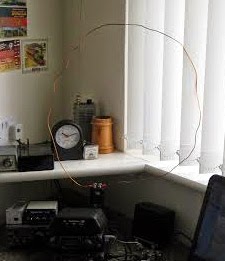
Rather than go QRT because of the approaching storms, I decided to try my Wonder Wand Tunable Compact Loop antenna indoors on 20m WSPR. The loop is about 0.5m diameter. In my case, more for convenience, it goes to the rig via my Z817 ATU. SWR is perfect 1:1 on the tuned frequency. No TX spots seen yet at 2W, but no shortage of RX spots across Europe so far. The loop is just above the rigs in a far from ideal, indoors location.
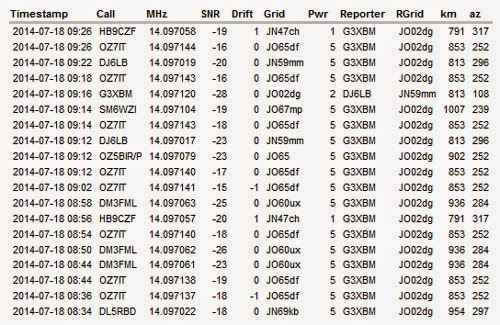 |
| WSPR spots so far today on 20m with the indoor Wonder Wand Compact Loop |
UPDATE 0916z: My first TX spot on the indoor Wander Wand Compact Loop came from DJ6LB at -28dB S/N.
UPDATE 0944z: Second TX spot was by DJ7KA at -26dB S/N.
UPDATE 1010z: I QSYed to 15m and am getting lots of spots on TX at just 2W. Best DX report on 15m is from SM6WZI (1007km) at -6dB/-9dB S/N (i.e. strong) – it is amazing this tiny indoor antenna works so nicely. So far 6 TX spots of my 2W in just 8 minutes on 15m. Incredible. Sorry about the poor photo of the loop, but you get an idea of the set-up. It will work even better on 10m and 6m as the loop is larger electrically. Set-up is totally un-optimised: the loop just happens to be where it is.
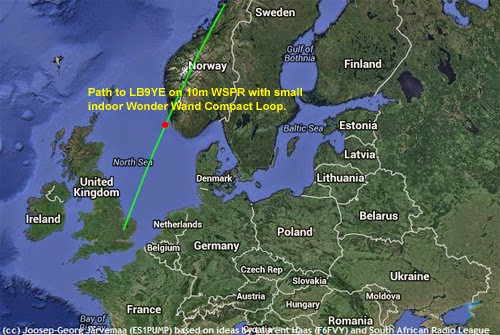
UPDATE 1230z: Now QSYed to 10m and the best DX on the Wonder Wand Compact Loop indoors is now LB9YE (1489km) at -25dB S/N with 2W.
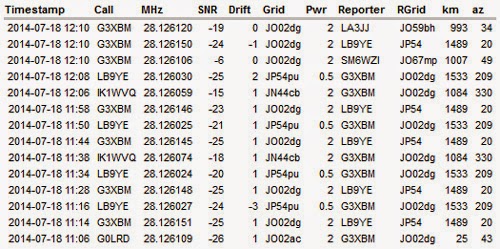 | |
| 10m WSPR spots with 2W today with indoor loop |

Roger Lapthorn, G3XBM, is a regular contributor to AmateurRadio.com and writes from Cambridge, England.
When All Else Failed
Tonight is the fourth and final night of this week’s road trip and I’ll be back home tomorrow evening. The weather has been outstanding these last few days with below average temperatures and low humidity. I’ve taken advantage of it by spending a lot of time on long walks in the neighborhoods around the hotel. Tonight, I wanted to do something a little different so I decided to take in a movie.
It’s at this point that I should back up a little, and tell you that a few days ago a friend and co-worker who knows I’m a radio amateur, told me about seeing Dawn of the Planet of the Apes and he made a point of telling me that ham radio plays a small role in the movie.
That was a good enough for me, so after work I headed directly to the Regal 16, a mammoth “cave” of sixteen theaters with enough entertainment and air conditioning under one roof to qualify as one of the many wonders of the world. Tickets for the non-3D early show at 5pm were $10.50 a pop although flashing my AARP card got me in the door for eight bucks.
It pays to get old and I’ve started taking advantage every chance I get.
The movie was a little better than just “okay” and I enjoyed it though, this isn’t a review or a spoiler. What I found most interesting was watching, and waiting, for that part that included ham radio. As the movie portrayed civilization descending into a dystopian nightmare, it wasn’t hard to see what was probably coming – ham radio as the only communications link with the “outside” world. And sure enough, that’s precisely how it played out.
In case you’re wondering, we briefly saw what appeared to be an older Kenwood transceiver, maybe a TS-820, setting on a shelf with a lot of other gear, all somehow magically connected to a computer with a display that looked like it might be running some sort of digital communication – though every call for help in the movie was done via phone.
Ham radio finds itself wrapped up in mainstream productions and attractions more often than you might think. But almost every time it’s in this same vein. Total breakdown of society that creates a world that suddenly needs ham radio. And often, though not in this particular movie, the radio operator is portrayed as some oddball nerd who couldn’t get laid with a fistful of pardons in a women’s prison.
Hollywood’s view of us is rarely, if ever, accurate. But let’s face it, we’ve spent the last several decades vociferously proclaiming ourselves to be the last link in a breaking chain when things come unglued. “When all else fails” is our mantra but I’m convinced that every time we say that, the rest of the world hears “hams are pathetic nerds who only have value in the event of Armageddon”.
If we want to be portrayed in a better light, perhaps it’s time we modify our message?
Filed under: Ham Radio Tagged: aarp, hr, movies


Jeff Davis, KE9V, is a regular contributor to AmateurRadio.com and writes from Indiana, USA.
DX from Cannon Mountain
I made a quick trip to Cannon Mountain in Franconia Notch with the family today. I only operated for 10 minutes, but worked two German stations. The view was extraordinary.

We took the tramway to the top with my daughter who is visiting from Hawaii. Judy made a picnic lunch for us and we sat on the east side of the mountain. I put up a 14 foot crappie pole that supported 15 feet of wire. I ran the KX3 at five watts.

DL2DX, Joe was calling CQ on 17M and I answered him. He was 599 and gave me a 569. I told him I was QRP and he sent, “FB with 5W.” We signed, and I was thrilled.

Next I switched to 15 meters and I heard another strong German station. DL5ANT, Ben was just finishing up a QSO and I called him. My signal wasn’t quite as strong to him, but he gave me a 559 and he was 579.

A large black cloud appeared, and we were sure it was about to rain. We packed up and got ready to leave, but the cloud passed to our north. We had a leisurely walk back to the cable car. I’m definitely coming back this summer. It’s a gorgeous spot to operate.

Jim Cluett, W1PID, is a regular contributor to AmateurRadio.com and writes from New Hampshire, USA. Contact him at [email protected].
Amateur Radio Newsline Report 1927 July 18 2014
- Ham radio responders activate as a typhoon hits the Philippines
- The United States takes home the gold at WRTC2014
- German hams get limited time access to the 4 meter band
- Spain gives more time to its 60 meter ham band evaluation
- The government of Brazil chases paraglider pilots off 2 meters
- A cubesat with a solar sail to launch before years end
- A very happy 100th birthday convention to the ARRL
SOTA
I worked three stations this lunchtime. It takes me a little bit longer (about a minute or two) to get out to the car in the parking lot wearing this orthopedic boot on my foot. Common sense tells me that I should stay inside and go find a quiet place to sit down and read, rather than walking on this. But I was never accused of having an overabundance of common sense, so ……… out to the parking area I went.
I worked two stations on 17 Meters and one on 20 Meters. DL2DX, Joe was coming in like gangbusters on 17 Meters. He was calling CQ over and over with no takers. I just couldn’t let him think that he wasn’t being heard. I told Joe that he was 599+ and got a 569 back in return.
I also worked W1AW/4 in South Carolina. That took a bit of doing as there was quite the pileup and my 5 Watts was being drowned out by European stations. But I stuck with it and got in the log after I figured out their “listening pattern” and conveniently plopped myself down in the middle of it.
The coolest QSO of the session was on 20 Meters with George WB5USB who was on SOTA peak W5N/PW-019 in the Pecos Wilderness of New Mexico. (Turns out that was probably a 2X KX3 QSO, to boot!)
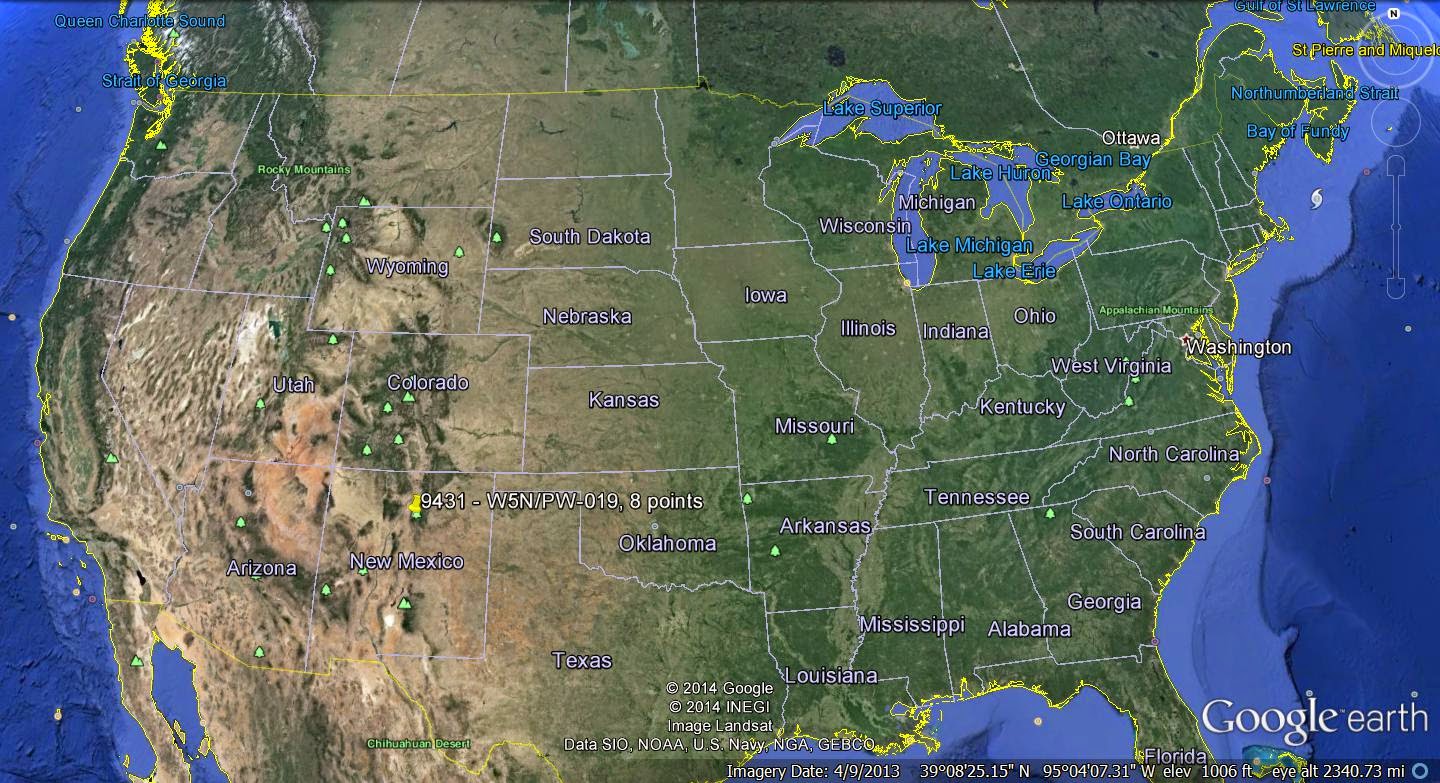
I gave George a 449, which he was when QSB was at a minimum. When the fading was the worst, George was about 339. I got a 529 in return.
I am fascinated by SOTA and the process of going to activate a mountain. Maybe it’s because of growing up here in New Jersey and not really having a lot of mountains in the area to go to. I have always lived on the Piedmont. What we do have of bonafide mountains lay in the northwest corner of the state, where the Appalachians run through New Jersey. They’re about an hour or so from my house, by car.
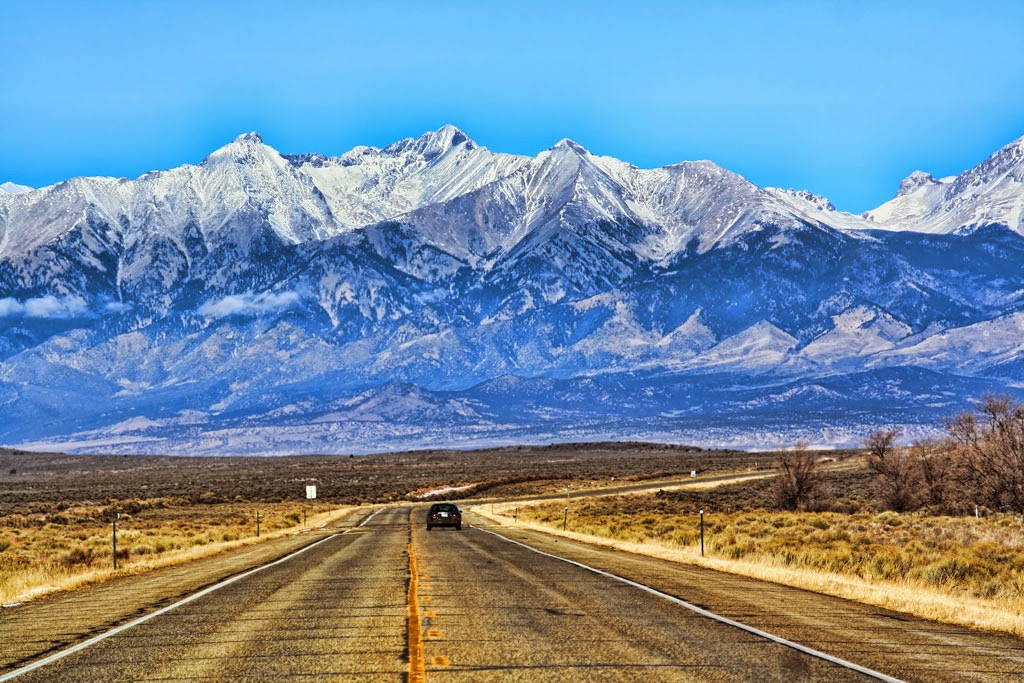
Years ago when I worked for Sinar Bron, I had the opportunity to visit the Art Center College of Design in Denver to do some maintenance on their view cameras and studio strobes. While we were there, we took a ride out into the surrounding countryside and the mountains. Now the Rockies are what you would call REAL mountains – to the folks out there, the Appalachians would really be just huge, gigantic hills by comparison. Having seen both, I’d have to agree. That doesn’t take anything away from the grandeur of the Appalachians, but they’re just different from the Rockies. The Appalachians are a lot older, from a geophysical standpoint, and they’ve had lots more time to erode into a smaller (altitude-wise) mountain range. To illustrate my point, Mount Mitchell in North Carolina is the tallest Appalachian Mountain. At it’s peak, you are at an altitude of 6,684 feet (2,037 Meters). The mountain that George was on today? 9,431 feet (2,875 Meters) – and that’s nowhere near the highest Rocky Mountain.
I’ve been fortunate to have seen the Alps while in Switzerland, they’re a whole different story and they just take your breath away!
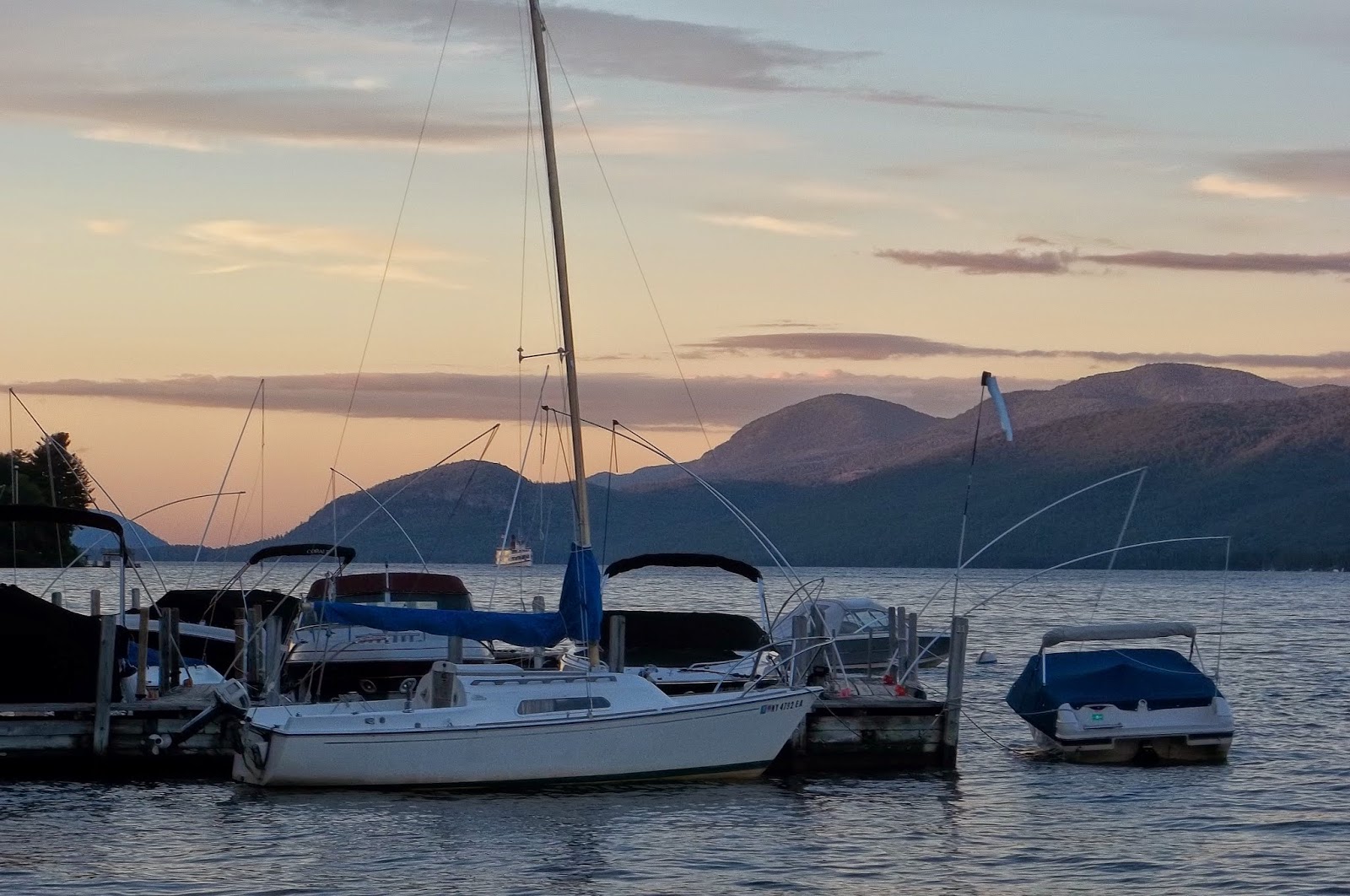
Someday, when I’m through with this rat race we call the work world, I would really love to operate from a SOTA peak (out West), even if it’s just one time.
72 de Larry W2LJ
QRP – When you care to send the very least!
Larry Makoski, W2LJ, is a regular contributor to AmateurRadio.com and writes from New Jersey, USA. Contact him at [email protected].
Article on the Sunspot Cycle
Seems the general public is beginning to learn about stuff we have been observing and talking about for the past few years.
72 de Larry W2LJ
QRP – When you care to send the very least!
Larry Makoski, W2LJ, is a regular contributor to AmateurRadio.com and writes from New Jersey, USA. Contact him at [email protected].
Tuning ‘Ten’
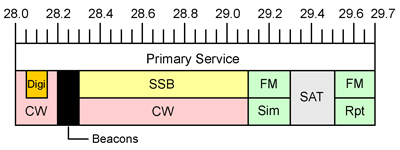 |
| Courtesy: VK6YSF |
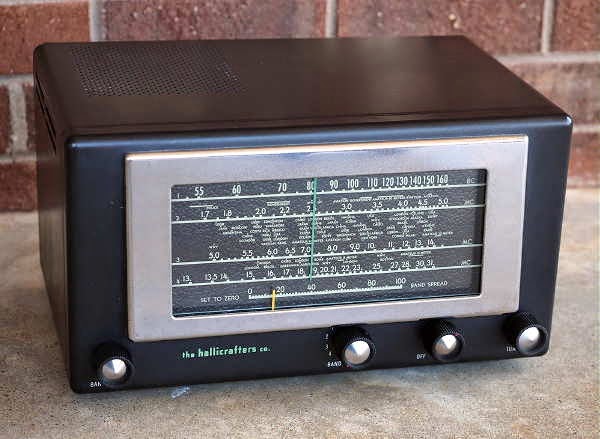
....yet, S9 + AM signals bombarded the band, from one end to the other (all 1/4" of it) late into the night, demonstrating just how good the propagation really was. Heterodynes battled for domination everywhere as if the nearly 2MHz wide band was not fat enough to accommodate all of the frenzied action.
Even today, in the heat of a mid-summer morning, 'ten' continues to amaze me, but in different ways. Tuning across the band earlier this week yielded a bounty of beacons, all diligently doing as instructed and proclaiming 'ten' still open for business.
OA4BB
W6XV (CA)
VE4TEN
LU8XW
PY2WFG
PT2SSB
N4PAL (FL)
K6FRC/B4 (CA)
K5GJR (TX)
KC5MO (TX)
AL7FS (AK)
WA6APQ (CA)
K8NDB (AZ)
K6FRC/B2 (CA)
PT9BCN
W3HH (FL)
PY4MAB
AC4DJ (FL)
XE2WK
K5AB (TX)
WA4ROX (FL)
K5TLL (MS)
K6FRC/B (CA)
I've always wondered if these mid-summer signals are all sporadic-E, multi-hop Es or a mixture of Es and F2. My propagation-gut feeling supports the latter mode since so many of the South American signals are strong and with little QSB. I think in all likelihood, the SA beacons are arriving via an F2 link into an Es link back to VE7, but the absence of any first-hop Es signal between here and Florida makes me wonder if that is really the case. If this is all F2, save for the Californian, Alaskan and Manitoban signals, it is really astounding considering the time of year.
No matter what the season, tuning 10m is always a delight and a reminder of my initial fascination with the magic of radio and just how truly amazing the band can be when at its best. Hopefully, it looks as though we may enjoy at least one more good winter out of this cycle on my 'other magicband'.
Steve McDonald, VE7SL, is a regular contributor to AmateurRadio.com and writes from British Columbia, Canada. Contact him at [email protected].
 Ham Radio Deluxe |
 W5SWL Electronics |
 Ham Radio Prep |
 KB3IFH QSL Cards  Hip Ham Shirts  HamRadioAuctions HamRadioAuctions Reliance Antennas Reliance Antennas Enigma Shop Enigma Shop |  morseDX  Ni4L Antennas  R&L Electronics R&L Electronics antennas.us antennas.us QRV QRV |
- Matt W1MST, Managing Editor
