 |
 On the Road With D-STAR
 9 July 2014 | by
 Part 1 of 2
I’m traveling this week with a DHAP and the Icom ID-51A dual-band handheld. This combination of hardware permits me to stay connected with my friends on the D-STAR network from wherever I happen to roam – no local digital repeater required. The DHAP is a custom-built enclosure and battery supply for a Raspberry Pi and DV Access Point – a DVAP.
If all this sounds like too much alphabet soup (it is!) let’s first break it down in pieces.
The DVAP is a small USB powered D-STAR transceiver that runs about 10mW of power on UHF. VHF is also available. It’s manufactured by Internet Labs. The concept here is that you plug the DVAP into a USB port on your Windows, Mac or Linux computer, running the proper software and connected to the Internet, and it looks a lot like a D-STAR repeater to your radio — albeit a micro-repeater with only about 100 yards of coverage.
With this arrangement, a user can connect to other repeaters and reflectors on the network. While it’s an effective solution, it’s not elegant or efficient to keep a desktop or laptop computer running all the time just to maintain that connection.
Enter the Raspberry Pi, a single board computer that’s smaller than a pack of cigarettes, costs $35, supports networking, and runs Linux. It didn’t take long for users to see the advantages of this arrangement over the desktop PC and the rapid migration was underway.
You can put all this together for the price of the DVAP and another $50-100 for a Raspberry Pi, memory, associated cables, power brick, and all that jazz. It will work perfectly well setting on your desk or workbench like that, but if you want to take it outside with you, an enclosure to house and organize it all is a really good idea.
Which gets us to the DHAP. Manufactured by Hardened Power Systems, this contraption is a robust enclosure for the DVAP and the Pi that conveniently brings all of the on-board connections out to the front and back panels. NiMH batteries run the show for several hours between charges while a front panel display shows the battery level.
It’s not waterproof, and I suppose you could break it if you tried. But it is a hardened, machined case that’s slightly smaller than a football. Once it’s configured and charged, you just pick it up and carry it with you wherever you go.
Of course, it requires a network connection that can be provided from a hardwired Ethernet cable or via a Wi-Fi network. That Wi-Fi link means it can be easily tethered to your cell phone, which is how I use it on the road, when I bring it home, it automatically connects to my home Wi-Fi.
It’s the ultimate in convenience and portability for the D-STAR enthusiast though it’s not cheap. $300 [US] for the unit with a Raspberry Pi, a little less if you’re bringing your own Pi. And that doesn’t include the DVAP…
More about how I use all this on the road, and a few tips about the DHAP in the next post.
Filed under: Ham Radio Tagged: dhap, dstar, dvap, hr, icom, id51a


Jeff Davis, KE9V, is a regular contributor to AmateurRadio.com and writes from Indiana, USA.
VC1T copied in the UK on 144MHz
I’m indebted to Roger, G3XBM for pointing me at the news that the VC1T expedition was heard in the UK on 144MHz by G4SWX, but unfortunately no 2 way QSO was made, despite trying for 4 hours to make a two way contact. It is also reported that a station in Ireland heard portions of the VC1T transmission.
See the news from the ARRL site
See a screenshot from G4SWX at G4CQM’s site
Tim Kirby, G4VXE, is a regular contributor to AmateurRadio.com and writes from Oxfordshire, England. Contact him at [email protected].
UKube-1 satellite heard on first pass….
The UKube-1 satellite was launched this evening with the first pass due over the UK at 2014 local time.
Coincidentally, supper had finished around 2013 local time, so I sped upstairs and switched on the FT-847 with the V2000 vertical connected. The UKube-1 CW beacon on 145.840 plus minus doppler was the first target. It doesn’t transmit continuously, but I was pleased to hear it around 2018 local up on 846. Shortly after that, I heard the telemetry on 145.915 coming through at very good strength.
Congrats to the UK team responsible for the satellite!
Tim Kirby, G4VXE, is a regular contributor to AmateurRadio.com and writes from Oxfordshire, England. Contact him at [email protected].
Ultimate 3 kit build
I thought my hands and eyes were good enough to make a start on this kit, which I have only just unpacked, having had it for months. I was waiting until I was less clumsy. When built, this will make a really useful WSPR beacon.
The packing is wrong as I had asked for a GPS module, which is missing, but there is a surplus relay board in the box. I was very careful unpacking the kit. and have left in packets those parts not yet needed. Some are anti-static.
Sadly, my eyes and hands are not really good enough: I started on the 10m LPF PCB and, frankly, this was a real struggle both for my eyes and hands. Tomorrow I shall test this with my generator and 50 ohm load.
Two people have very kindly offered their help building the kit. I fear I shall have to admit defeat and ask them to help me. This is a great pity as I was so hoping I’d be fit enough to build this. Sadly, this seems unlikely any time soon. My stroke is taking its toll on my abilities. WSPR is OK, but I am struggling with building still. Talking in tonight’s contest will be hard.

Roger Lapthorn, G3XBM, is a regular contributor to AmateurRadio.com and writes from Cambridge, England.
Classic Radio Periodical Covers

Like others, I enjoy learning about the early history of radio. It gives me an idea of how far the hobby and technology has come as well as inspiring the imagination.
I found a great site, MagazineArt.org, which allows the viewer to peruse many of the covers from a variety of periodicals from the early days of the wireless.
Check out some of them here:
Popular Radio
Radio Age
Radio Craft
Radio News
The Wireless Age
Shortwave Craft
Scott Hedberg, NØZB, is a regular contributor to AmateurRadio.com and writes from Kansas, USA. Contact him at [email protected].
Another Pixie
Yet another variation on the Pixie arrived by email today from Sverre Holm in Norway who has LM386 mods to reduce BCI, provide mute and add sidetone.
See http://la3za.blogspot.no/2003/04/using-pin-7-of-lm386-to-reduce-bci-and.html .
This looks a very useful mod to this simplest of circuits. Sverre also added a much wider tuning range that helps to get contacts. Low power does not seem to be the main handicap.

Roger Lapthorn, G3XBM, is a regular contributor to AmateurRadio.com and writes from Cambridge, England.
Great 6m Es Conditions Continue!
 |
| 6m July 08 Courtesy: ON4KST.org |
Six meter operators in the western part of the continent exchanged signals with Japan, Taiwan, China and South Korea beginning at around sunset on the west coast and continuing until 0230 the next morning! Many stations on both ends of the path filled their logs during the heyday event.
To add to the fun, BV2DQ (Ran) in Taiwan, was also active and gave several 6m ops a new country, working as far east as Colorado.
 |
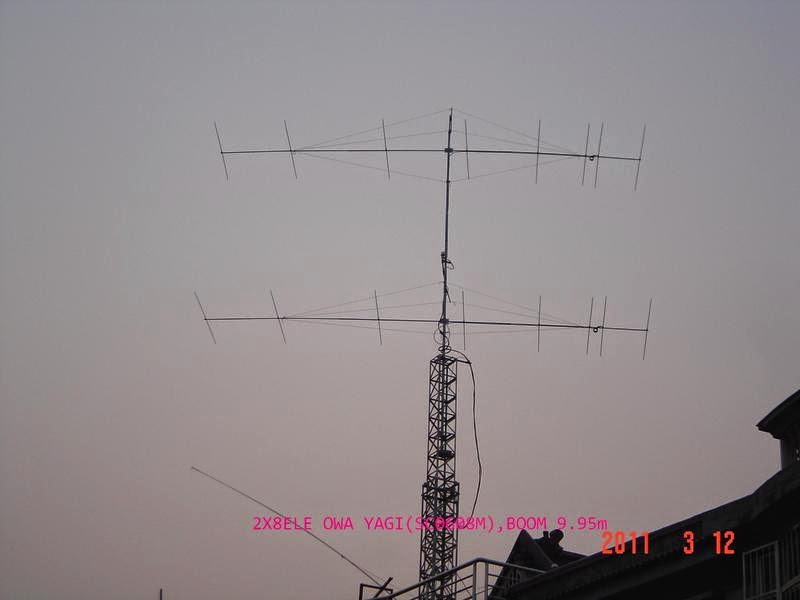 |
| BA4SI 6m stacked Yagis |
" W7FI Jim - That blows away my 113 JA last night, pile still calling when I qrt'd at 0800z. "
I was also present for the action, but worked only a few dozen of the strongest signals as I have been plagued with exceptionally high power line noise this summer, directly in line with Asia. Additionally, a new source of QRM has cropped-up in the form of an S9+ 49MHz wireless headset that has drifted up into the band. As the days get warmer, it has now drifted from below 50MHz up into the working part of the band and last night had settled itself smack on 50.090. Being a wide band FM signal, it effectively destroys any reception for about 50KHz of the band. As Murphy would have it, the crud is coming from the exact same direction as my beam heading to Asia. Yesterday I was able to roughly determine its location with a handheld Icom scanner and today I will use a quickly-built 6m dipole to zero-in on the offending source. Hopefully I can eliminate the problem soon.
Steve McDonald, VE7SL, is a regular contributor to AmateurRadio.com and writes from British Columbia, Canada. Contact him at [email protected].
 Ham Radio Deluxe |
 W5SWL Electronics |
 Ham Radio Prep |
 KB3IFH QSL Cards  Hip Ham Shirts  HamRadioAuctions HamRadioAuctions Reliance Antennas Reliance Antennas Enigma Shop Enigma Shop |  morseDX  Ni4L Antennas  R&L Electronics R&L Electronics antennas.us antennas.us QRV QRV |
- Matt W1MST, Managing Editor
