 |
 The Old Man
 23 July 2014 | by
  The several times I’ve read the writings of the Hiram Percy Maxim, I get the feeling I would have really liked this guy in real life. I think a lot of his writings could be republished today with some minor editing of language and figures of speech that are no longer around, and the content and arguments would easily apply to current modern day situations and problems within amateur radio. It’s amazing that as much as things change, things are still the same.
This article, Rotten Damped Spark Stuff, is a Maxim gem. Considering Maxim’s feelings at the time about damped spark, I think Maxim would have been equally vocal during the AM versus SSB and code versus no-code test battles in favor of more progressive trends and technology in amateur radio.
Something interesting to note about the article, Maxim ends it with “So long and 73’s to the gang. “[emphasis added]. Any time a boob on the two US ham moron forums wants to argue about the inappropriate use of 73’s, quote this article and tell him to go away.

Anthony, K3NG, is a regular contributor to AmateurRadio.com.
Random Antenna Musings and Power Line Noise
As I have shared in the past I have a 66′ dipole in the attic fed with ladder line. I live in a HOA controlled neighborhood so my antenna options are pretty limited.
Last night I set WSPR up running 2 watts on 20 meters. Started about 2200 UTC. Wow it really seemed open. My 2 watts was spotted multiple times into Europe, Alaska and all over the USA. This antenna does not have a problem getting out.
The problem with my antenna setup is on receive. I have minimum S5 noise on 40 and 30 meters. Typically S7 on 20 meters. Interestingly enough 15 is quieter and 10 meters is typically S2 or so. The noise is static with some noticeable “crackling”.
Last night on WSPR was a great example. I was getting heard ALL over, but I was only decoding about 2 or 3 stations – all in the USA. Also on PSK31 or JT-65 I see guys working DX that I can’t even here or see on the waterfall – my noise level is just too high.
Sometime soon I am going to cut all the power to my QTH and see what the noise level is. If significantly reduced, I will see what I identify as noise sources in my QTH.
Beyond that, less than a 1/4 mile as the crow flies I have identified some very noisy power lines. They are so noisy that it they will completely blank the AM radio in your car when you drive past them.
Here is a picture of where my house sits in relation to the power lines (my dipole runs parallel to the power lines):
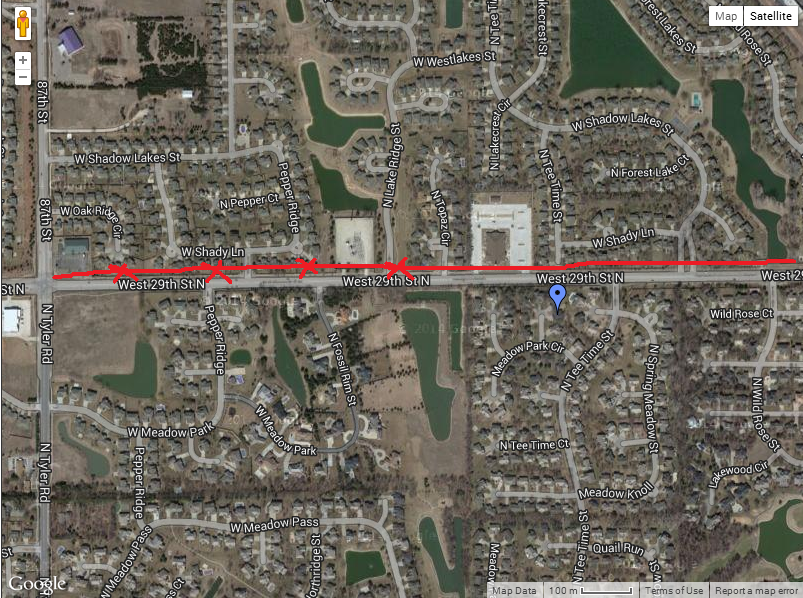 |
| Blue marker is my QTH – Red line is power line (X’s are noisy poles) |
I will be contacting the utility company at some point, but first I want to see how much of the noise is coming from my own QTH.
 |
| Red markers are trees – red line would be horizontal leg of inverted L |
Burke Jones, NØHYD, is a regular contributor to AmateurRadio.com and writes from Kansas, USA. Contact him at [email protected].
Wellbrook Loop Plans
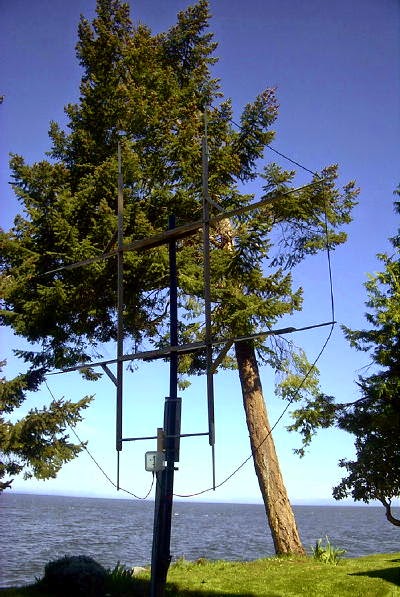 |
| My present 9.5' active loop |
During last winter's DX season I built and played with a number of different preamps for use with my (almost) 10' diameter shielded loop. I had been hoping to get the Burhans Preamp to play-nice above 500KHz so that I might use it for DXing the broadcast band with my new Perseus SDR radio. By bypassing the preamp's LPF, the level of BCB signal delivered by the 10' loop was just too much for the preamp's JFET front end to handle with the consequence being various strong intermod products showing up at several places inside the band. Several different toroidal input transformers produced varied results but none were satisfactory. Although I didn't try it, a smaller aperture loop might do just fine with the LPF removed and even better if there were no blowtorch BCB signals in the vicinity. My particular location, on the east coast of Mayne Island, looks directly across Georgia Strait to several 50KW BCB transmitter sites near the points of nearest landfall. Luckily, this direction is usually in the loop's null when pointing in my favorite target direction of SE/NW for the central U.S. Even so, it would be nice to not have to worry about loop orientation in order to guarantee intermod-free performance.
I did have much better success on the BCB using a version of the PA0RDT active antenna preamp, modified with transformer input to match the shielded loop's low impedance to the JFET amplifier input.
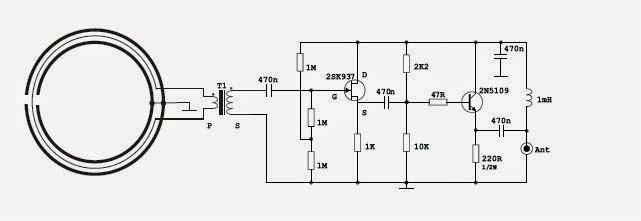 |
| Courtesy: Aldo Moroni |
Gain of the system was adjusted by swamping the transformer's output with various levels of 'R' until there were no signs of intermod products with the loop pointing away from the Vancouver blowtorch signals. The end result was a preamp that had good performance throughout the BCB, even with the big loop, as this recording of French language station, CJBC (860KHz) in Toronto(identifying as 'Radio Canada') demonstrates.
....but unless the loop was oriented in my favored SE/NW direction for most North American targets of interest, there were still a few frequencies that produced some very low-level intermod products. Again, had the loop been just slightly smaller, I think this preamp would do a great job as a wideband loop amplifier for the BCB and above. Although still usable down at 540KHz, performance dropped off rapidly as I went lower in frequency and was not considered usable for the LF NDB band. Perhaps more inductance in the input transformer as well as higher value coupling capacitors would improve LF performance. There is still room for further development of this circuit for LF use with a medium-sized shielded loop.
I recently ordered and received a Wellbrook ALA-100LN loop preamp, which I am anxious to install for the upcoming DX season. With its front-end of 8 JFETS in push-pull parallel, the Wellbrook boasts extremely good strong-signal handling capability within the BCB and below.
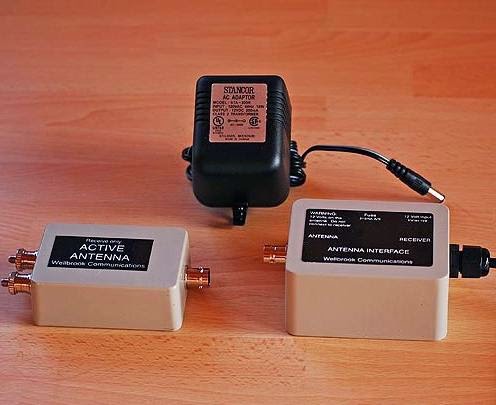 |
| Please visit: http://www.wellbrook.uk.com/ |
My present plans call for a new and lighter loop frame, this time using PVC tubing in some sort of H-frame. I will aim to make the loop as large as possible while keeping within the Wellbrook's circumference limit of about 21m. Mid-summer doodling has produced one possible front-runner but no final decisions have been made.
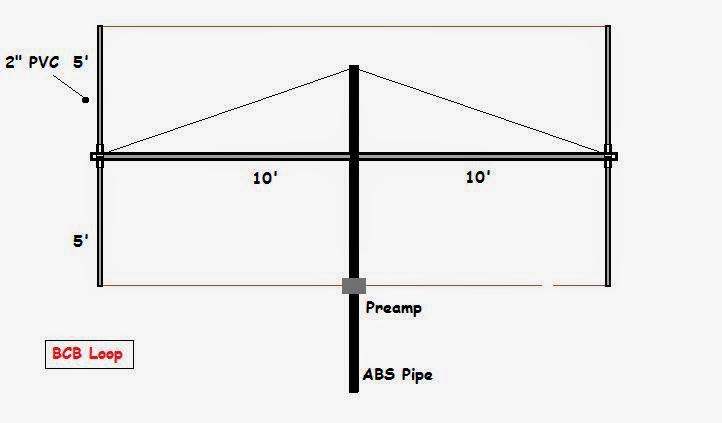 |
| 10' x 20' LF / BCB Loop |
I always savour the design and 'what-if' phase of any new project and the new loop is no exception. Any other ideas for possible frame configurations would be most appreciated.
Steve McDonald, VE7SL, is a regular contributor to AmateurRadio.com and writes from British Columbia, Canada. Contact him at [email protected].
One way to see the windmill
There was a man dangling from a rope painting the cap of our local windmill. I felt like telling him there are easier ways of seeing the windmill! Rather him than me.

Someone suggested I string a long wire to the top of the mill from my bungalow next door. But what happens when the cap turns and the sails go around?

Roger Lapthorn, G3XBM, is a regular contributor to AmateurRadio.com and writes from Cambridge, England.
Uploading ADIF logs from fldigi to LOTW
 I’ve been attempting to get my arms around my various logs from different callsigns. Previously I have had mixed luck with LOTW. Then I pretty much abandoned it. This time I read and re-read the instructions. Today I got my TQ6 file and was off an running.
I exported my current log from fldigi as an ADIF file and then used the TQSL application to upload it. Error, error, error. What was this? I hit Google and started researching:
ARRL’s tqsl messes with fldigi saved QSO_OFF time
I learned more than I wanted to know this morning about what the ARRL¹s tqsl application for LoTW does when it signs your saved fldigi newlog.adif file. It does more than just applying your digital signature. I had a busted QSO with Jeff, N8NOE, on LoTW and spent some time trying to understand what happened. The problem was with the time of the QSO. Both of us log the time at the the end of the QSO; however for there was a disconnect because my QSO time at LoTW showed up as Time ON, rather than Time OFF. Fldigi logs both TIME_ON and TIME_OFF; however, when you ask the ARRL tqsl application to apply your digital signature, it ignores the fldigi saved Time_OFF and converts the TIME_ON to a nonstandard ADIF format called QSO_Time. If you want your fldigi logs uploaded to LoTW to reflect QSO OFF time, you have two options. You can manually edit your On and Off times in Logbook-newlog.adif panel read the same. Another workaround is to use the fldigi File/Export ADIF with the option for Time ON unchecked. Then use a text editor to search and replace TIME_OFF with TIME_ON. This will fool the ARRL tqsl application to log the correct correct QSO time. Another option for someone to think about could be a new macro command that would reset the QSO times (ON and OFF) to be the same when you click on log. If you don¹t believe tqsl changes your fldigi logged QSO TIME_OFF, open one of your last .tq8 files with text editor (I use BBEdit) and scroll down and you will note the nonstandard QSO_TIME time that matches your your ADIF TIME_ON rather than TIME_OFF. 73 Dick AA5VU
… and that is what I did. And it worked! Although the issue Dick describes and the issue I was having were different, the solution still worked.
Now I am trying to add the logs for both my YI9MI and HL9MI operations. We will see how that goes.
Scott Hedberg, NØZB, is a regular contributor to AmateurRadio.com and writes from Kansas, USA. Contact him at [email protected].
Elecraft – my personal opinion
I have been involved in the Service Industry for all of my adult working life. I have worked in photo studios, photo laboratories, photo retail, professional photographic equipment distribution and service, and most recently in the IT field through inventory control and logistics.
Throughout that period, there was one Prime Directive (to borrow the term from Star Trek), and that is that Customer Service is, was, and always will be #1. Coming up close to 40 years in the field now, I can attest to how that’s not always the easiest philosophy to live up to; but it is paramount. For truly, years of hard work to build up a solid reputation can be squandered in mere seconds by an instance of lousy customer service. And once you have squandered your reputation and credibility, even with one person and in one instance, word can get around so quickly that it can take years to get back to where you started from.
“What has this to do with Amateur Radio?”, you are probably asking yourself.
There are many service and product providers in the Amateur Radio market, as small as this niche is. We have many places where we can spend our heard earned dollars. There are many very good companies out there that will bend over backward to make sure that your experience with them is the best possible one that you can have. On the other hand, there are also companies out there who quite literally (excuse my language) don’t give a damn what you care about or want. All they want is your dollars and once they have them, you are pretty much dead to them. Thankfully, thankfully, thankfully these companies are the smallest minority and they usually die a pretty quick death, going out of business rather quickly.
On the other end of the spectrum are the companies that go out of their way to ensure that you are happy and satisfied. In my experience, Elecraft has done an exemplary job in that department. I have been a happy Elecraft owner since 2003, when I first bought my K1. Since then, I have purchased and built a K2, a K3 and a KX3, along with numerous sub-kits and accessories. In each instance, I had a great experience. The manuals are extremely well thought out, leaving (at least in my case) no doubt as to how things are supposed to go together. In the two instances where my kits were missing parts, or had a wrong part shipped – a quick e-mail to Elecraft got me the needed pieces in literally a day or two.
I have been fortunate that my radios worked right off my assembly line. However, I do know of instances where that has not been the case for other Hams, for one reason or another. In those cases, it seems that the help that was received from Elecraft via the telephone from their outstanding staff, or from the Elecraft e-mail reflector(s) where other Elecraft enthusiasts congregate got them up and running quickly. I also personally know of instances where “stuff has happened” and telephone calls to Elecraft brought timely solutions, even though the equipment in question would have been considered out of warranty by any other manufacturer.
All that being said, the clincher came for me just prior to Field Day, this year. On QRP-L, many of the guys were beginning to list where their QRP Field Day efforts were going to be held. I chimed in with information about where the South Plainfield Amateur Radio Club’s effort was going to be, and I also mentioned that we were going to be all QRP, using my KX3s as our HF transmitters. Out of the blue, that night I received a private e-mail from Wayne Burdick N6KR, one of the principal owners of the company. In the e-mail he informed me that he read my posting to QRP-L and saw that we were going to be using my KX3s. So from there, Wayne proceeded to tell me how to set up the KX3s so that they would cause minimal interference to each other in close quarters. And that information, which he also posted to the KX3 and general Elecraft e-mail reflectors, turned out to be a life saver. After we first got going, it turned out that the SSB station was just swamping me out, and I was basically doing the same to them. When that became apparent, I whipped out the printed e-mail from my back pocket (it was next to my Swiss Army Knife), made the setting changes and from there we were in like Flynn. The two stations sat side-by-side and hummed along for the rest of Field Day – fat, dumb and happy!
This boggled my mind. One of the owners of Elecraft was keeping his eye on QRP-L, saw that one of his customers would be using their product and then graciously offered tips on how to make the radios work even better. That, my friends is ADVANCED customer service – the stuff upon which legends are born.
Now don’t get me wrong. No company in this world is perfect. Far from it. Heck, just go to the Elecraft reflectors and you’ll find lots of instances where people feel they haven’t been satisfied and take ample opportunity to vent. Some of it may be justified, and some of it is pure nonsense. But in my mind at least, Elecraft is a very bright spot in the Amateur Radio market, and I would recommend them highly to anyone. And aside from Amateur Radio, I think that they are a shining example to all industries on what great Customer Service is and should be.
72 de Larry W2LJ
QRP – When you care to send the very least!
Larry Makoski, W2LJ, is a regular contributor to AmateurRadio.com and writes from New Jersey, USA. Contact him at [email protected].
Reflections on the passing of VO-52
Unfortunately, our concerns were well-founded. Yesterday, on the AMSAT bulletin board, the official news of VO-52’s passing was announced.
The loss of VO-52 leaves quite a gap. What I enjoyed about it particularly, was that it was the one of the linear transponders that could be used with very simple antennas. My V2000 vertical worked very well for a variety of contacts. I just wish I had started using it earlier.
VO-52 had a great downlink signal and was always in transponder mode (AO-73 is great, but I rarely hear it in transponder mode, or if I do, it’s usually brief, as it switches over to telemetry). So, hopefully the new generation of satellites which will be coming on stream soon – some already in orbit doing other things, waiting to be activated into their amateur radio roles – others waiting to be launched.
A good time to remember to support AMSAT (a VO-52 lookalike would work very well, thank you…)
Tim Kirby, G4VXE, is a regular contributor to AmateurRadio.com and writes from Oxfordshire, England. Contact him at [email protected].
 Ham Radio Deluxe |
 W5SWL Electronics |
 Ham Radio Prep |
 KB3IFH QSL Cards  Hip Ham Shirts  HamRadioAuctions HamRadioAuctions Reliance Antennas Reliance Antennas Enigma Shop Enigma Shop |  morseDX  Ni4L Antennas  R&L Electronics R&L Electronics antennas.us antennas.us QRV QRV |
- Matt W1MST, Managing Editor
