 |
 What a blockhead!
 1 August 2014 | by
 I totally screwed up big time in the QRP Fox hunt tonight. After corresponding with Don NK6A, I agreed to be the lower Fox. So what did I do? I set up in the upper half.
And I didn’t realize it even when someone notified me that we were both in the same half – I went up even higher!
Rookie mistake – totally my fault. My apologies to anyone I messed up.
I am going to go find a hole to crawl into, I feel like a moron.
72 de Larry W2LJ
QRP – When you care to send the very least!
Larry Makoski, W2LJ, is a regular contributor to AmateurRadio.com and writes from New Jersey, USA. Contact him at [email protected].
Replacement rechargeable battery for Elecraft KX3
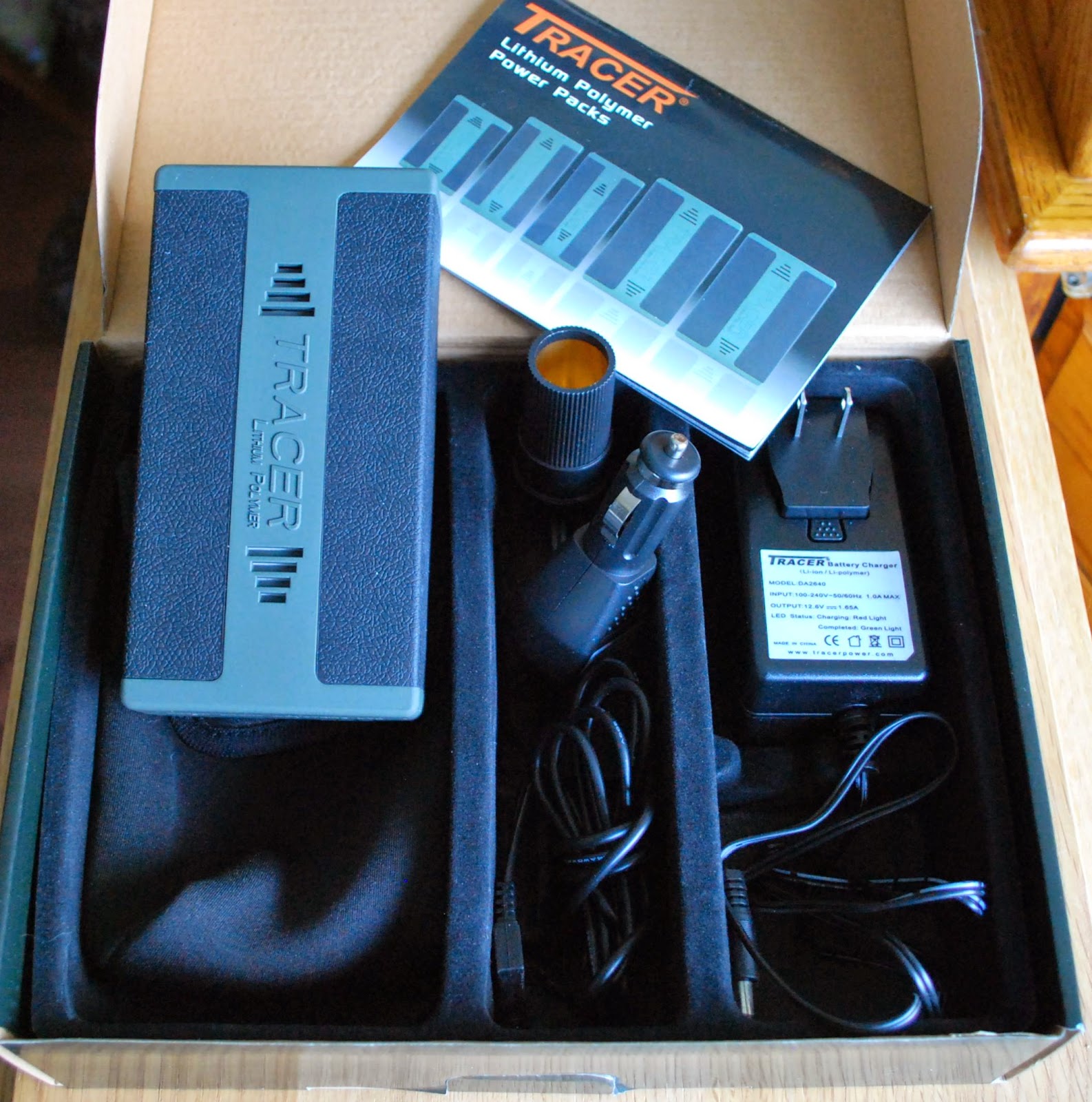 |
| Tracer Battery kit |
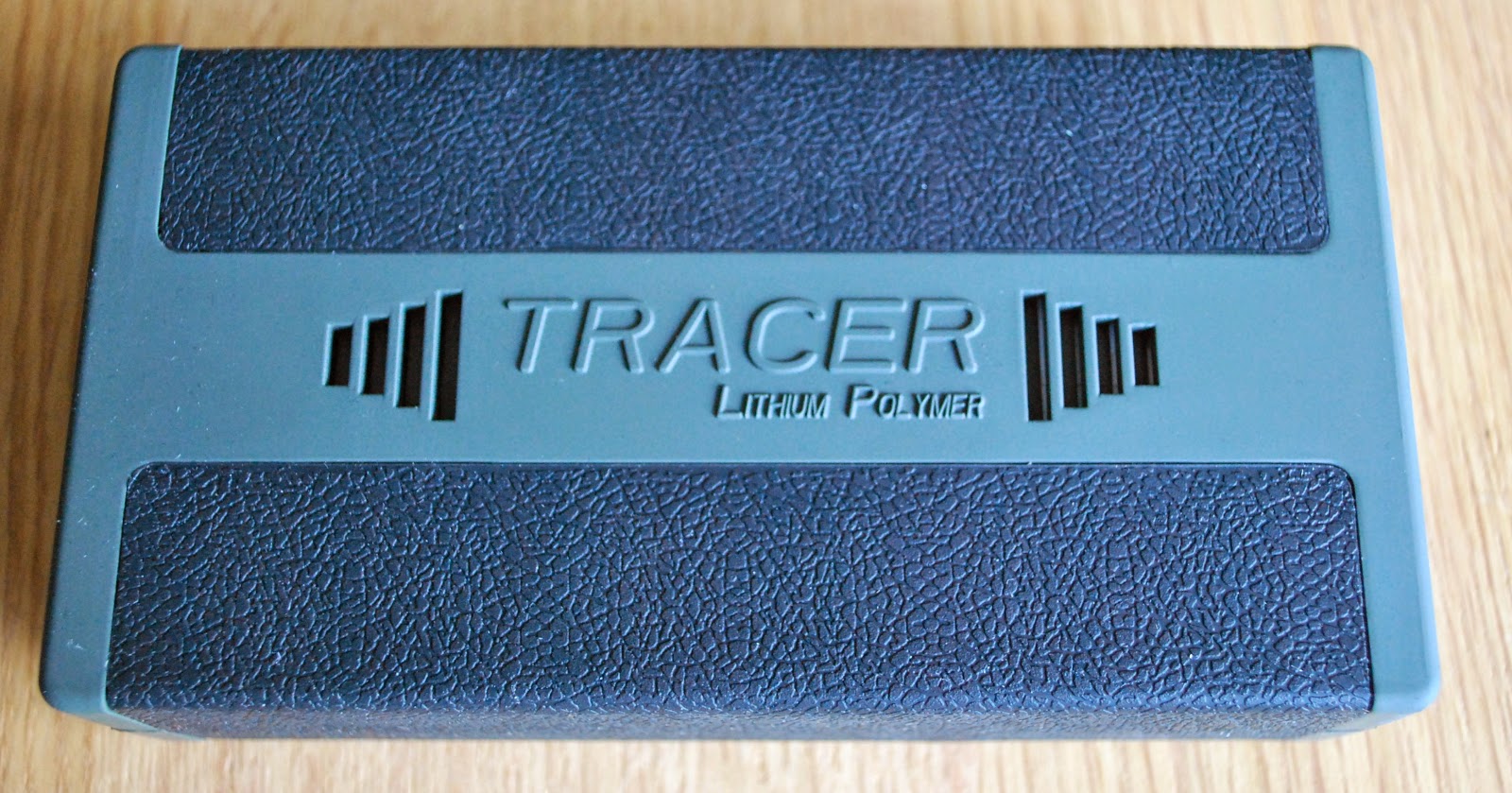 |
| Closer look at the battery |
 |
| Status indicator light |
Mike Weir, VE9KK, is a regular contributor to AmateurRadio.com and writes from New Brunswick, Canada. Contact him at [email protected].
The Spectrum Monitor – August, 2014

Here are the featured stories from our August, 2014 issue:
The Military Auxiliary Radio System: A Partner in the Nation’s Emergency Preparedness
by David J. Trachtenberg N4WWL, AFA3TR, AFN3PL (National Planning Coordinator), AFN3NE (Northeast Division MARS Director)
In an age where anyone with a cell phone can contact anyone else halfway around the world instantaneously, we seldom think of how we would communicate if traditional means were not available. The U.S. Department of Defense (DoD) understands this reality. For 89 years it has authorized and sponsored a group of volunteer amateur radio operators to provide a backup communications capability for the U.S. military and other agencies in the event of a natural or man-made disaster. But, with the military relying on satellites and digital Web-based communications, is MARS still useful today?
BBG and Technology Today: The Struggle for Global Relevance
by Ken Reitz KS4ZR
The Broadcasting Board of Governors (BBG) is a top-heavy, sprawling, federal bureaucracy, with an annual budget in excess of $700 million. It oversees the Voice of America, Radio Liberty/Radio Free Europe, Radio Free Asia and the Office of Cuba Broadcasting (OCB). But, times have changed and more listeners are tuning in via smartphone than shortwave radio. With an ever-decreasing budget, can BBG deliver its message and stay globally relevant?
Returning to the Carrier: The YE-ZB Radio System
by Rich Post KB8TAD
It was July 30, 1935. Navy Lieutenant Frank Akers had been given a unique and hazardous assignment. As the Flight Test and Project Officer for Instrument Flying Development at the Naval Air Station in San Diego, he had been told that the Navy’s first aircraft carrier, the USS Langley, was somewhere at sea about 150 miles from San Diego. He was to find the carrier and attempt to land on it while completely covered by a hood. This would be the ultimate test for an experimental, radio-based instrument landing system. With directional radio beacons, locating the carrier to the point of visual sighting was one thing, but a blind landing on that relatively small moving flat-top was another matter.
Putting the “Radio” in Radio Shack
by Mark Haverstock K8MSH
Radio Shack started in 1921 as a one-store retail and mail-order operation in downtown Boston run by brothers. Theodore and Milton Deutschmann. They chose the name Radio Shack, a term used to describe small wooden shelters that housed a ship’s radio equipment. By 1968 they were the “McDonalds of electronics,” the “Walmart of high tech.” When they moved into Mark Haverstock’s corner of the world—the north suburbs of Pittsburgh—opening what was to become one of more than 7,300 company and franchise stores worldwide, it didn’t matter that there was an already established Lafayette Radio store less than a mile away, or an Olson’s on the other side of town. There couldn’t be enough radio stores for him and his ham/hobbyist friends.
The Spectrum Monitor is available in PDF format which can be read on any desktop, laptop, iPad®, Kindle® Fire, or other device capable of opening a PDF file. Annual subscription (12 issues, beginning with the January 2014 issue) is $24. Individual monthly issues are available for $3 each.
Ken Reitz, KS4ZR, is publisher and managing editor of The Spectrum Monitor. Contact him at [email protected].
Feeling “Fox-ish”
Tonight is my turn to serve as one of the two Foxes in the 20 Meter QRP Fox hunt. If you have absolutely no idea what I’m talking about – they say a picture is worth a thousand words:


Larry Makoski, W2LJ, is a regular contributor to AmateurRadio.com and writes from New Jersey, USA. Contact him at [email protected].
Russian TV…6m’s Little Helpers
 |
| London's Crystal Palace TV Tower |
Parked conveniently close to 6m, the 49MHz multi-kilowatt transmitters combined with large high antennas to pump lots of ERP over the pole. Surprisingly, there are yet a few holdouts of the analog era that are still available as propagation indicators, with most of them being located in western Russia and the middle-east. Far eastern Russia also has a number of the analog relics in Siberia and in the Vladivostok / Kamchatka regions, all of which which make great indicators for possible openings to Japan, China and Taiwan. During good openings to Japan, it is not unusual to hear several different signals all on the same frequency but with different fade rates and tone / sync characteristics. During the past few strong solar cycle peak years, spurs from these Russian transmitters could often be heard at S9 levels well into the 6m band!
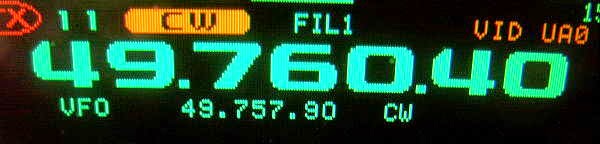
Although there are numerous others, from my own experience the best frequencies to monitor for both European and Asian transmitters have been:
- 49.750
- 49.757.8
- 49.760.4
During Sunday's VE6-Europe 6m opening, several of these signals were heard even though no Europeans were worked from the west coast. Video carriers on 49.750, 49.760 and 49.757 were heard for over an hour, peaking around 1800Z.
The two unique characteristics of these video markers has always been their rapid fade rate and their somewhat raspy video-sync pulses....both can be heard in this short video that I captured during Sunday morning's activity. The stronger 49.757 signal can be heard as well as the weaker 49.750 carrier, while the 49.760 signal has taken a deep fade. I suspect that the louder signal is coming from the Novosokolniki transmitter north of Moscow while the weaker ones may be further to the south. These locations are simply 'best guesses'.
This recording of eastern Russian video carriers, made by JM1SZY, provides a good idea of how these signals sound when they're much stronger. Note also, the number of different frequencies that the different transmitters are using.
It is very difficult to know exactly where the actual transmissions are coming from as there are dozens of transmitters assigned to the same frequency. Most signals do vary from their assigned frequency by measurable amounts and some avid DXers have tried to identify individual sites by accurate frequency measurements.
Since the digital switchover, interest in keeping track of the remaining signal data seems to be falling off and most frequency and location lists are now several years out of date. The most up-to-date lists can be found here on the GØCHE Website and on JB's DX Info site in Germany.
If you're anywhere east of the Great Lakes then you'll hear the European videos a lot more often than they are heard out west but it still astounds me that several times each summer, I am able to hear TV signals from Europe over the North Pole!
Steve McDonald, VE7SL, is a regular contributor to AmateurRadio.com and writes from British Columbia, Canada. Contact him at [email protected].
A QSL Card from Oman
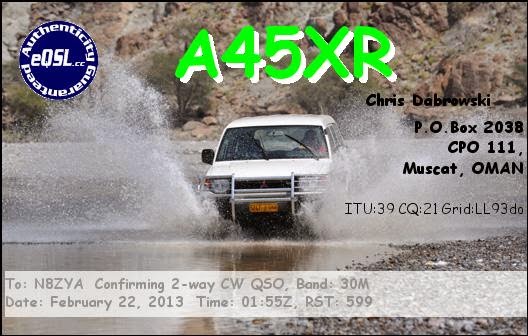
Oman has been one of my most “memorial” contacts; so I was happy to find this card in my electronic mail box last night. I’m sure Chis (A45XR) has made hundreds of contacts into the USA with his “double element” Delta Loop antenna. He has the best 5,000 mile signal I’ve ever heard from that part of the world. I worked him in February of 2013 with 3 watts of power into my indoor random wire antenna. As usual, with most DX stations, my signal was 599 (if you know what I mean). Surprisingly, his signal really was 599! Go figure….
This month has been terribly busy for me. I’ve been in Iowa for a 50th Wedding Anniversary, and also to New York where we visited with a new grand daughter. When we were in Iowa, on the bad side, we ended up being way too close to a tornado. On the good side, I bought a Ukulele, due to the inspiration of the relatives, and am quickly learning to play it. (it’s great for traveling) Also on the very good side, the grand daughter was beautiful and we enjoyed the visit very much.
There is nothing like New York City in the entire world!
John Smithson, Jr., N8ZYA, is a regular contributor to AmateurRadio.com and writes from West Virginia, USA. Contact him at [email protected].
Amateur Radio Newsline Report 1929 August 1 2014
- The Amateur Radio Parity Act gains several new co-sponsors
- The Internet of Things could impact United Kingdom hams
- VK hams forced to share the 70 cm band with commercial interests
- Hams respond to northern California wildfire
- Changes coming to the famed Pennsylvania QSO Party
 Ham Radio Deluxe |
 W5SWL Electronics |
 Ham Radio Prep |
 KB3IFH QSL Cards  Hip Ham Shirts  HamRadioAuctions HamRadioAuctions Reliance Antennas Reliance Antennas Enigma Shop Enigma Shop |  morseDX  Ni4L Antennas  R&L Electronics R&L Electronics antennas.us antennas.us QRV QRV |
- Matt W1MST, Managing Editor
