 |
 ILLW – three strong in Taiwan
 15 August 2014 | by
  I’m all prepared for the International Lighthouse and Lightship Weekend, starting Saturday. Today I paid another visit to the Baishajia lighthouse and they will give me the VIP pass this weekend. I’m allowed to use the employee-entrance so I can come early and leave late, and I can go up the tower to string longwires. Electricity is free, too! (With the electricity bill they have over there I guess my use of a couple of Ah won’t make much difference).
This year the Taiwanese entry to the ILLW is three strong. Apart from me being at BaiShaJia on both Saturday and Sunday, BV1EJ will use a special call sign BV0LH from the SanDiaoJiao lighthouse, on Saturday. SanDiaoJiao is where the Spanish first discovered Taiwan and its English name is Santiago or San Diego Lighthouse. It is the most eastern tip of Taiwan. On Sunday BM2LDT and BX2AI will be at FuGuiJiao Lighthouse, which is the most northern lighthouse in Taiwan. Not bad and I hope a bit of promotion will result in even more lighthouses being activated in 2015. Have fun and keep an eye on the clusters to see where we can be reached. I’ll be active as BX2ABT/LH from 0100 till 0930 UTC on both Saturday and Sunday.
Hans "Fong" van den Boogert, BX2ABT, is a regular contributor to AmateurRadio.com and writes from Taiwan. Contact him at [email protected].
Pelican 1200 for Elecraft KX3 Case
After I published my video of my portable operation, I have received several questions about the case that I use for my Elecraft KX3.
I did a bunch of research before I landed on what I use – which is the Pelican 1200. I bought this based on my specific needs – mostly it is used in my car to get from work to the park. But I have also taken it on numerous camping trips, etc.
As usual, let me know if you have any questions – I am happy to help!
Burke Jones, NØHYD, is a regular contributor to AmateurRadio.com and writes from Kansas, USA. Contact him at [email protected].
Pelican 1200 for Elecraft KX3 Case
After I published my video of my portable operation, I have received several questions about the case that I use for my Elecraft KX3.
I did a bunch of research before I landed on what I use – which is the Pelican 1200. I bought this based on my specific needs – mostly it is used in my car to get from work to the park. But I have also taken it on numerous camping trips, etc.
As usual, let me know if you have any questions – I am happy to help!
Burke Jones, NØHYD, is a regular contributor to AmateurRadio.com and writes from Kansas, USA. Contact him at [email protected].
All ok?
Website moved to a new server…seems all ok to me. This new server will give me more space and flexibilty as well as being far faster than the previous one.
update: A couple of issues need ironing out but these won’t be done for a bit. But things are back on the air at least.
Alex Hill, G7KSE, is a regular contributor to AmateurRadio.com and writes from Cumbria, UK. Contact him at [email protected].
On Making Nanowaves – Part 2
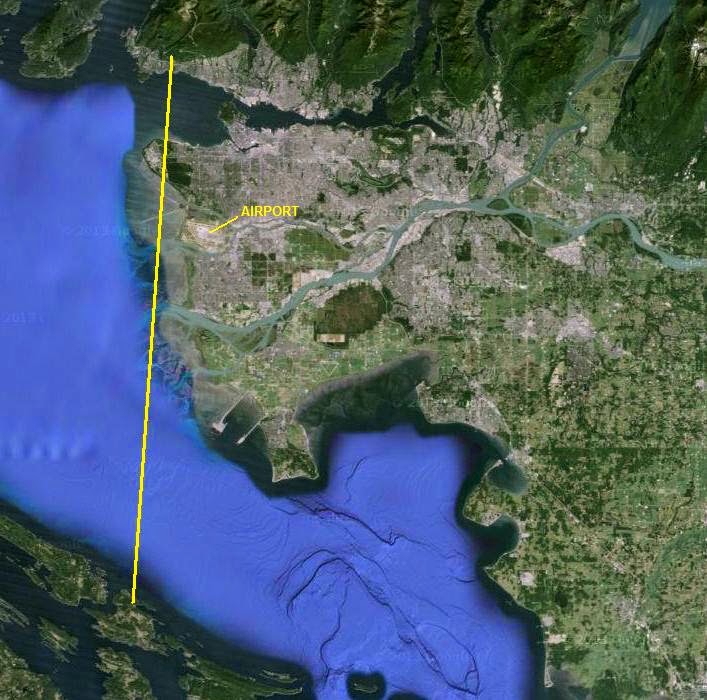
Shining just a low-powered laser across this region was not something that I felt even remotely comfortable about doing. I felt much better about the project the more I learnt about LED's and of the good results being had by other experimenters.
Another exceptionally good source of valuable information (and probably the best on the Internet) is the 'optical' page site of Clint Turner, KA7OEI. Clint is an exceptionally gifted engineer-experimenter and is extremely generous in sharing his knowledge with others. As our local project developed over the course of many weeks, we exchanged several e-mails. My numerous questions would always result in very long detailed answers...and precise explanations for the reasons behind the answer or suggestions.
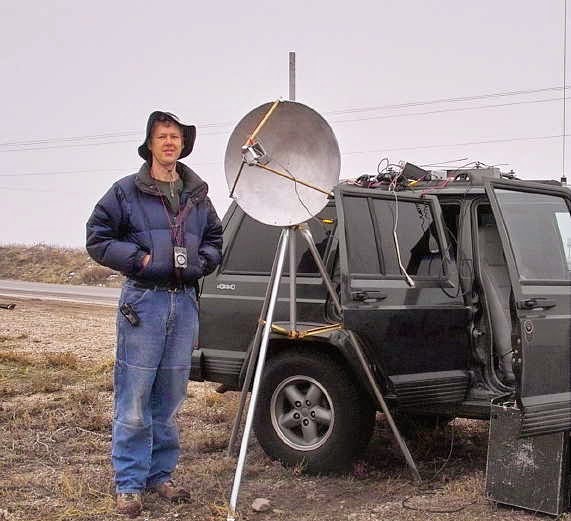 |
| Clint Turner, KA7OEI |
Just name any radio-related activity and Clint seems to be not only involved in it but has excelled in it. His willingness to share with others is just another example of why our hobby is so enjoyable!
While still deciding on receiver / transmitter designs, I built a small audio tone generator that would be needed, no matter what type of transmitter was eventually built. The plan was to have some method of making our signals stand out when searching for them in the noise. A distinctive two-tone FSK alert tone was decided upon as it could easily be built using a pair of 555's or a single 556. The final module allowed for three separate modes...an FSK 'beacon' mode, a keyed 'CW' mode and a short 'dash' mode (less annoying than the 'alert' tones).
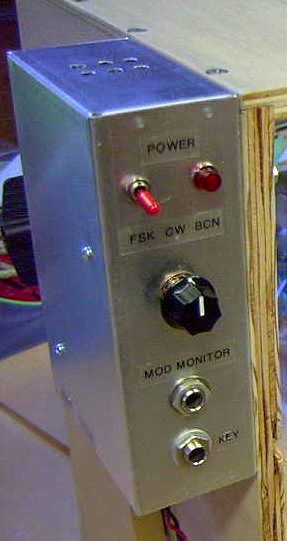 |
| Modulator mounted on TX |
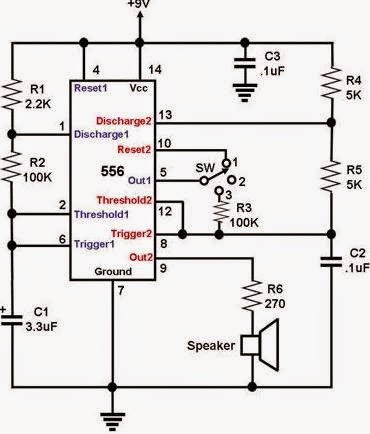 |
| Courtesy: http://electronic-projects.50webs.com/p1.htm |
No doubt there are other methods of building the FSK alert module but the 556 is simple and worked well.
For very weak-signal CW work, likely involving slow-speed (QRSS) modes in future 'non-line-of-sight' (NLOS) 'cloudbounce' trials, something with a bit more accuracy such as a crystal oscillator divided-down to audio frequencies would be better. Such a system would be very stable and provide a more precise modulation frequency... necessary for the narrow bandwidth viewing windows required for Argo or similar DSP audio viewers.
With the tone generator taken care of, the receiver was next on the list.
Steve McDonald, VE7SL, is a regular contributor to AmateurRadio.com and writes from British Columbia, Canada. Contact him at [email protected].
ERP calculation on 472kHz
In an attempt to establish my ERP on 472kHz, I have crunched some numbers. I think it is error free, but no doubt someone will soon tell me!
With a 1:46 step up toroid, I am measuring the DC volts rectified across a 470 ohm secondary load resistor using a small 50uA meter in series with 240k ohms (120k twice) and a series silicon diode. This circuit is straight out of the “LF Today” book available from the RSGB bookshop.
DC current = 30uA
DC voltage across 470ohm secondary load = 0.6 + (240 x 10E3 x 30 x 10E-6) = 7.8V
DC voltage (rms) across 470 ohm = 7.8/1.414 = 5.52Vrms
I secondary = 5.52 * 10E3/470 = 11.7mA
I primary = 46 * Is = 46 * 11.7mA = 0.54A
Rrad = 160 * pi^^2 * Heff^^2/lambda^^2 = 160 * 3.14 * 3.14 * 2 *2/(630 * 630) =0.0159 ohms
P(erp) = I^^2 * R = 0.54* 0.54 * 0.0159 W = 4.6mW
My original guesstimate of 5mW ERP is not far out!
Clearly getting the antenna much higher would help enormously as ERP is proportional to Heff^^2. All one can really be sure of is the order of magnitude. I am running low milliwatts.

Roger Lapthorn, G3XBM, is a regular contributor to AmateurRadio.com and writes from Cambridge, England.
My 5 Minutes of Fame!

I like listening to the podcast of Ham Nation – which is both in video format and audio format – during my commute to the office. Every other week they have a segment with user supplied videos.
Burke Jones, NØHYD, is a regular contributor to AmateurRadio.com and writes from Kansas, USA. Contact him at [email protected].
 Ham Radio Deluxe |
 W5SWL Electronics |
 Ham Radio Prep |
 KB3IFH QSL Cards  Hip Ham Shirts  HamRadioAuctions HamRadioAuctions Reliance Antennas Reliance Antennas Enigma Shop Enigma Shop |  morseDX  Ni4L Antennas  R&L Electronics R&L Electronics antennas.us antennas.us QRV QRV |
- Matt W1MST, Managing Editor
