 |
 Digital Signal Processing
 20 August 2014 | by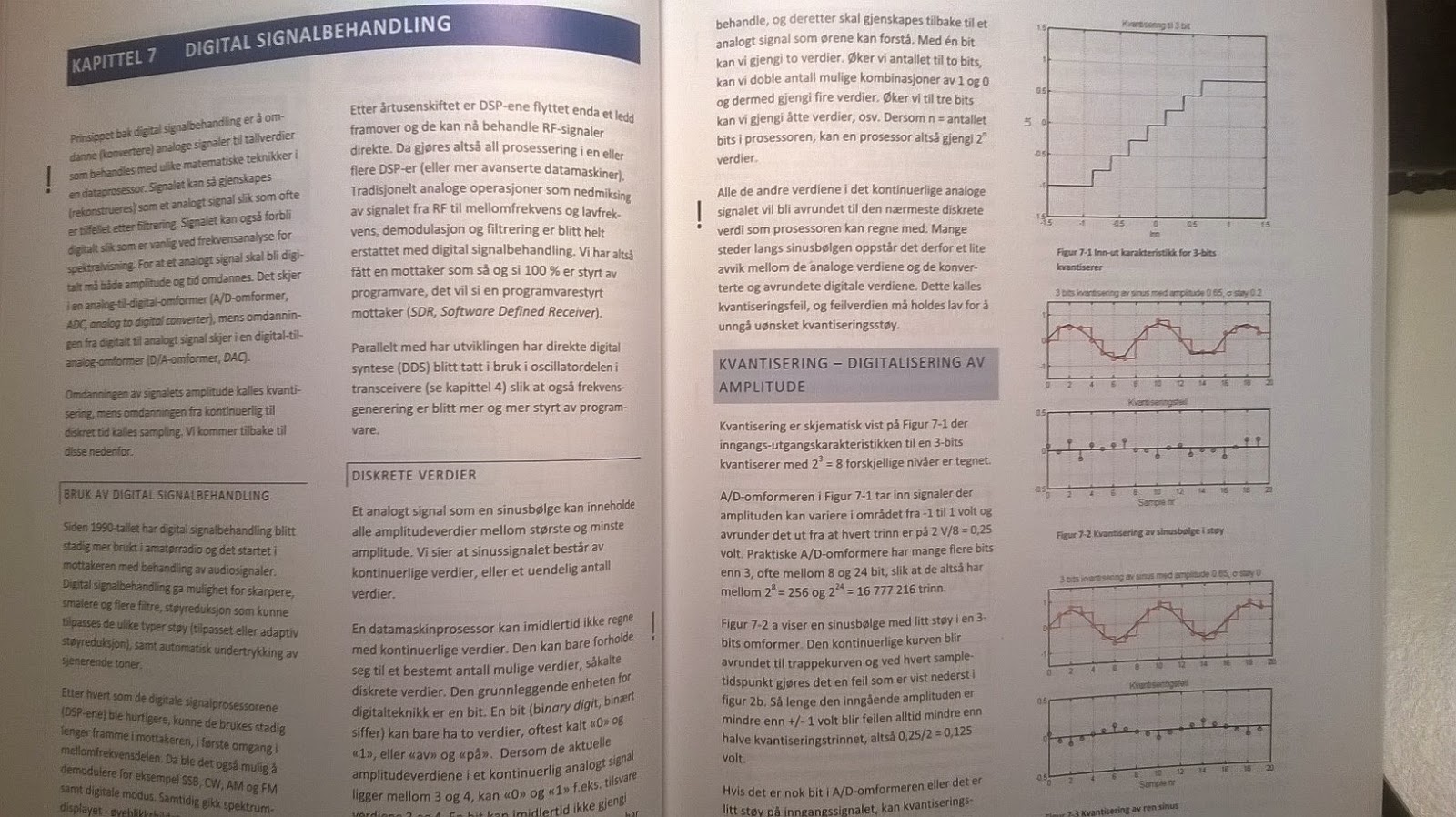
The Norwegian-language “The road to the international radio amateur license” came off the press this June. It is based on the RGSB International Amateur Radio Examination Manual from 2006, which RSGB graciously allowed us to use.
But the translation has been adapted on several topics. One example is the chapter on propagation due to the need in our country for more emphasis on propagation in polar regions and in mountainous terrain. Another is a completely new chapter on digital signal processing.
I got involved quite late in the project for this new chapter. The importance of digital signal processing in amateur radio has just kept on increasing as variable digital filters, adaptive noise reduction filters, adaptive notch filters, digital demodulation, and software defined receivers are everywhere.
The entire book project was handled by the Bergen group of the Assocation of Radio Amateurs in Norway. In fact it was done in order to celebrate their 90 year anniversary. The editor has been Frode Igland, LA6VQ.
My efforts resulted in a completely new chapter which was written during the first few months of this year. It was finalized with valuable input from the editor after a process of sending the manuscript back and forth lots of times. It was a fun project, where the challenge was to convey complex ideas with a minimum of equations.
The chapter has these headings:
- Applications of digital signal processing
- Discrete values
- Quantization – digitization of amplitude
- Sampling – digitization of time
- Aliasing
- Nyquist frequency
- Reconstruction filters
- The time domain
- The frequency domain
- The Fourier transform
- The Fast Fourier Transform (FFT)
- Digital Filters
- Moving average as an example of an FIR filter
- IIR filter equivalent of a low pass RC-filter
- IIR filter equivalent of a high pass CR-filter
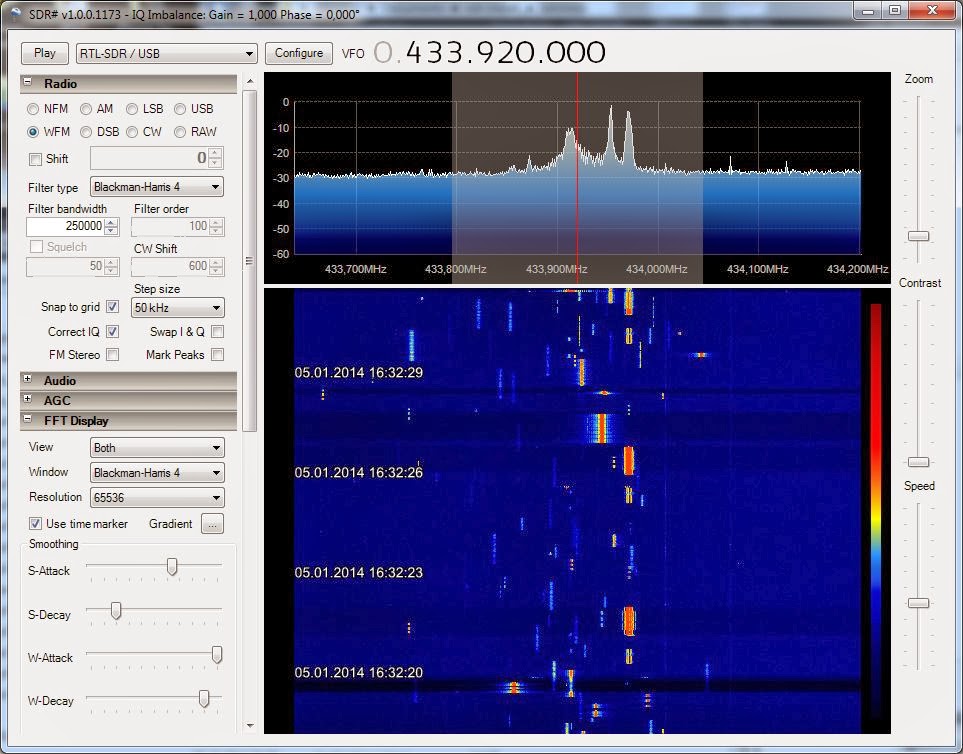
- Example of a software defined receiver with spectral display
Sverre Holm, LA3ZA, is a regular contributor to AmateurRadio.com and writes from Norway. Contact him at [email protected].
Why the XiOne SDR receiver is different (in a good way!)
We’ve talked a lot about the various Software Defined Radio (SDR) USB dongles that have popped up over the last couple of years. I own several and have often played around with them. They suffer a bit of a flaw in the fact that they connect directly to the computer via USB which isn’t ideal because my computer room isn’t the ideal RF environment.
The advantage of the XiOne is that it has the capability of connecting to your home network allowing you to use a computer/tablet/phone that network to operate it. You can locate it away from RF interference sources and either use the XiOne’s Wi-Fi or run ethernet to connect it back to your router. Very cool. That’s why I think the XiOne’s Indigogo campaign from a German company called XiVero is worth looking at.

As of this writing, they still have 35 out of 100 of their specially priced (US$139) slots left. If you’re interested, might be worth a look. If they can get enough funding momentum, this looks to possibly be a very popular little receiver.
Matt Thomas, W1MST, is the managing editor of AmateurRadio.com. Contact him at [email protected].
On Making Nanowaves – Part 4
It seemed that the present flavor-of-the-day in terms of LEDs was the Luxeon III, a 3W / 1.4A device being produced by Phillips.....or rather.....was being produced. Apparently our new found interest in lightwave communications had been coincidental with the retirement of this popular LED and all stock had been depleted! Although still available in some wavelengths, there were none in the desired 'deep red' portion of the spectrum that we had chosen for our system.
 |
| Courtesy: http://www.luxeonstar.com/luxeon-rebel-leds |
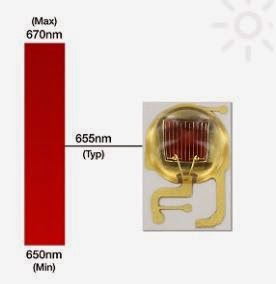
All was not lost however as a 'replacement', largely untested by the lightwave community, spec'd-out at a lower power but with a somewhat more efficient design. The new device was the Luxeon 'Red Rebel' and rated at 700ma. ....apparently no slouch at all.
I had also been watching the various offerings available on e-bay which provided a number of tantalizingly inexpensive options. Many of the LEDs from China appeared to offer good promise and may well be good performers, but most appeared to be lower-quality knock-offs of the name-brand models.
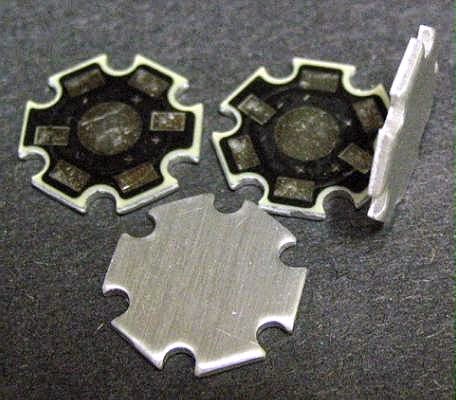
These higher-powered LEDs, on close examination, usually contained two or more separate LED die behind the lens. A single light source is required to achieve maximum focusing / lens illumination efficiency and although tempting, should probably be avoided. 'Safe' names to look for include Philips, Osram and Luminus and often, bargains can be found on e-bay when NOS is being disposed of.
 |
| Courtesy: http://www.luxeonstar.com |
Once adequately heat-sunk, voltage can be applied to the LED after taking measures to limit the current to safe levels. Although these LEDs are very small, they emit an exceptionally bright light and must be treated with care. The Rebel is shown here, shortly after first applying voltage. The current in this test was just 100ma. Although they are rated at 700ma, I have run this one up to 1A without failure but it is normally run at the rated current.
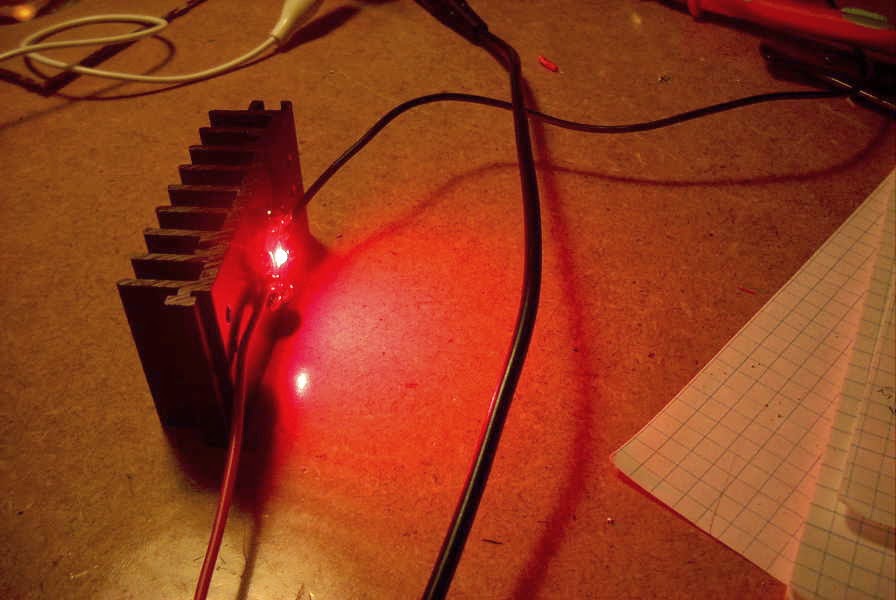 |
| Luxeon Red Rebel at 100ma. |
Like the large variety of both photodiode and LED selections, fresnels were no different. Once again there was a lot of information to digest while learning about the various types. Eventually, John, Markus and myself each purchased two plastic fresnel lenses from 3DLens in Taiwan. One would be used in the receiver box while the other was for the transmitter. These were 26cm square lenses, model A260.
Unfortunately I no longer see these particular lenses being offered....hopefully it is only a momentary depletion of stock. There are many different sizes and types of fresnels out there....some if them perfect for this type of use and others not so good, so think carefully before buying anything and know what you are getting. Studying Clint's pages regarding fresnels will help immensely.
Things to pay attention to are the focal length and groove 'pitch'. For a typical 10"-12" lens, look for something around 10-12" focal length, otherwise the mounting enclosure will get too deep and awkward to handle. Front surface 'groove pitch' should not be too fine...something around .5mm is good but our finer (.2mm) seemed to work well also.
Now that the LED had been mounted and the fresnel lenses were in hand, the next task would involve the focusing mechanism and alignment. Thankfully John had devised a smart method for mounting and adjusting focus a few weeks earlier, when we were still working on receivers.....
Steve McDonald, VE7SL, is a regular contributor to AmateurRadio.com and writes from British Columbia, Canada. Contact him at [email protected].
Ol’ Sol slowing down?
Looks like we’re headed directly for a period of minimal solar activity:
And here’s a related article from the Helsinki Times:
The video was brought to my attention by Don K2DSV. IF the hypothesis of the video is correct, lower ionospheric activity would be the least of our worries.
72 de Larry W2LJ
QRP – When you care to send the very least!
Larry Makoski, W2LJ, is a regular contributor to AmateurRadio.com and writes from New Jersey, USA. Contact him at [email protected].
Getting there
As opposed to probably a majority of you, I am SO far behind the times from a technological point of view. I still do a majority of my logging with paper and pencil before I manually enter the information to my logging software.
When it comes to QRP Sprints or the Fox Hunts, most of my compatriots use N1MM or some such program. Again, I still use paper and pencil. I feel that I am lucky to be able to walk and chew gum at the same time. Operating a radio and trying to computer log simultaneously during a Sprint or a Hunt used to send shivers up and down my spine.
But I am getting better. As long as I am not furiously trying to keep up with a pileup of QSOs in the midst of a frenzy during a Sprint or a Hunt, I have trained myself to log and operate at the same time (See? You CAN teach old dogs new tricks!). I recently purchased a small keyboard for my Nexus 7, so that I can log during casual portable ops without the need for pencil and paper. It cost me all of 8 smackers on eBay.
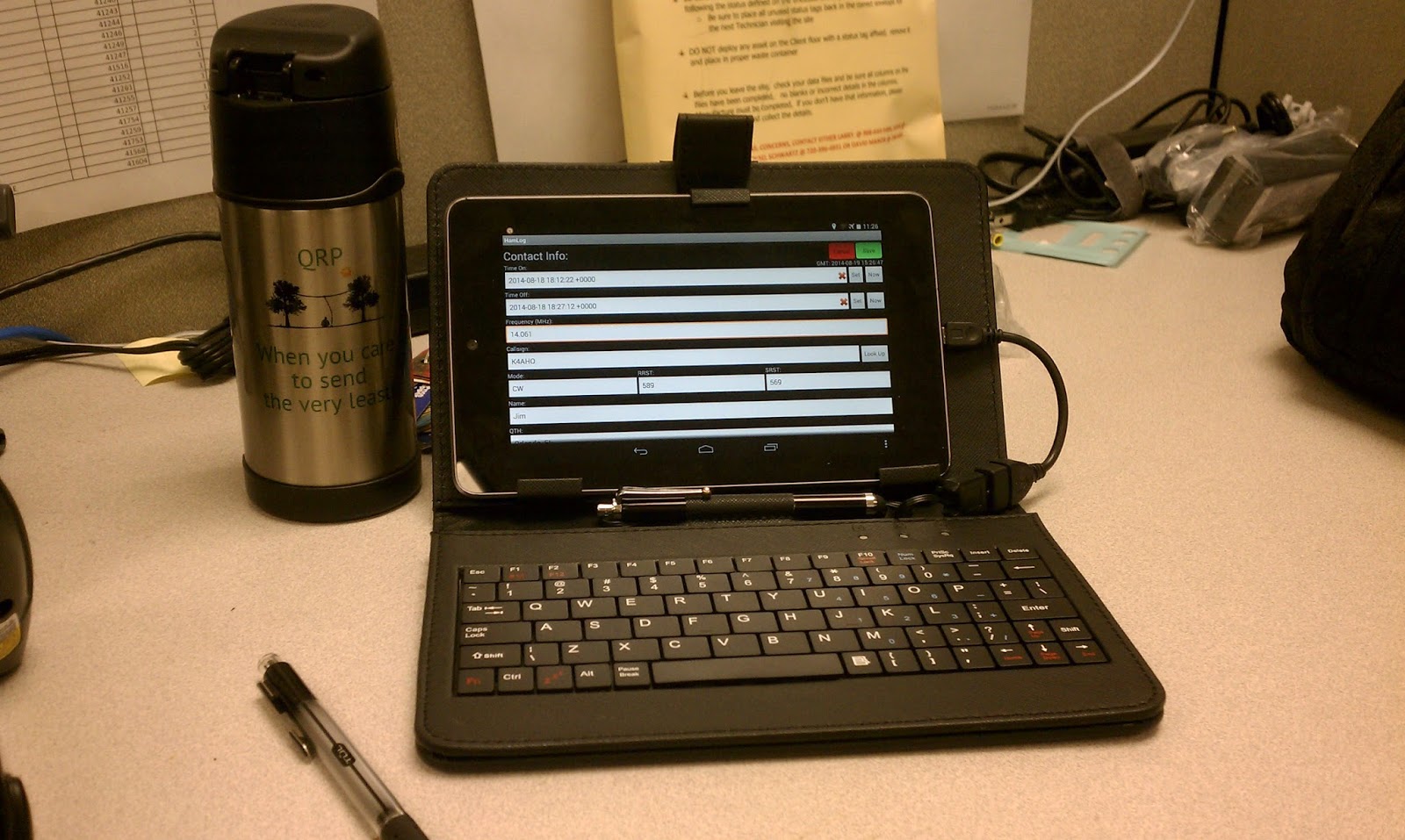
That’s Ham Log that I keep on there, which in and of itself is a great piece of logging software for Android. The problem was that it’s always been a pain in the butt to use the Nexus touchpad keyboard, which caused me to “one-finger” type, and slowed me down, holding me back. So for the longest time, I was doing the same thing – logging on paper and entering the data later, at my leisure (which makes no sense). This “tactile feel” keyboard brings a lot of familiarity and works a whole lot better for me, and now I am actually able to use the Nexus 7 for logging in real time (sometimes). I know that it’s pathetic, but while I am able to use this setup for general QSOing, the melee of contests or Fox Hunts drives me back to the security of “old technology”.
I guess the next step will be to install the KX3 Companion app. Boy, that will be like Star Trek for me!
72 de Larry W2LJ
QRP – When you care to send the very least!
Larry Makoski, W2LJ, is a regular contributor to AmateurRadio.com and writes from New Jersey, USA. Contact him at [email protected].
Think I will meet the deadline
I have imposed a deadline for myself with regards to Skeeter Hunt results. I want to have both the “scorecard” and the soapbox published to the Skeeter Hunt website this coming Sunday, after the log submissions deadline.
The “scorecard” itself is a piece of cake. It’s simply an Excel spreadsheet that I have composed, with formulas that do all the menial calculating chores for me. I simply plug in the values and the spreadsheet calculates the final score for me. I will upload the completed spreadsheet to Google Sheets and it will be available for all to see on the Web, once it’s completed. This was a good exercise for me, as I was very weak with regards to using formulas in Excel. I’m still no expert by any means, but I know a lot more than I used to, which was practically nil.
The soapbox page is another animal. That is “simple” HTML composition, but it’s more time intensive. I have about one half of the soapbox comments and pictures placed on the unpublished Web page. At the rate I am going, if I can add about 5 more soapbox comments to the page each evening, over the next 4 or 5 evenings, it will be ready for publishing on time.
All this leads me to a worrisome discovery. This year we had a record number of Skeeters sign up. But I am lagging behind in receiving log summaries. Last year I received a total of 71 summaries. As of this minute, I have only received 54. I guess a “Que Sera, Sera” attitude is in order, but I sure would love to see more log summaries submitted.
It’s very important to me that these results get published on time this coming Sunday. You folks are kind enough to participate, and I know how much you like to see results. I do myself! It’s not so important for me to see where I place, I want to see how my friends did, what their setup looked like, and I like to read about the fun they had. The results and soapbox are a crucial part of any of these “special” QRP events, in my most humble opinion. No one wants to make an effort and then wait months or more to see how things stacked up.
So, God willing and the creek don’t rise, you’ll see the finished results this Sunday at www.qsl.net/w2lj
I am just hoping I get a few more log summaries and soapbox comments before then.
And then the final phase will begin, which is the certificates. I have to give myself more time for those, but hopefully, everyone who will qualify for one will have it by the end of September.
72 de Larry W2LJ
QRP – When you care to send the very least!
Larry Makoski, W2LJ, is a regular contributor to AmateurRadio.com and writes from New Jersey, USA. Contact him at [email protected].
Conditions
It’s evident that we are now on the down side of the peak of Cycle 24. For the most part, I have had superb conditions for working DX during my lunch time QRP sessions for the past 17 months. DX has been plentiful, with good signals and decent RSTs on both ends. 17, 15 and sometimes even 12 Meters have been happy hunting grounds. There have even been smatterings of openings on 10 Meters, which is not often the case during the 1700-1800 UTC weekday time frame.
I still hear DX signals on 17 Meters, but they’re not as strong or as plentiful as they were. 15 Meters is nowhere near as nice as it was just a few months ago. It wasn’t so long ago that I was working three or four different DX stations during my lunch break – and it seemed like all areas of the world were open at the same time! I think that the days of working the world “with 5 Watts to a wet string” are just about over – as far as Cycle 24 is concerned, anyway.
With band conditions changing, it seems that lately, more and more of my lunch QSOs have been domestic – not that there’s anything wrong with that! Today, I was saved from being shut out at lunchtime by Jim K4AHO, who answered my CQ on 20 Meters. We had a nice chat that was not only 2X QRP, but was also 2X KX3. Jim was using a dipole and I was using the Buddistick, of course. QSB was a bit of a nuisance. At the fading’s worst, Jim was 459, and at best he was 579 (which he was for most of the QSO).
In addition to the declining ionospheric conditions, the weather here in New Jersey this Summer has been less “Summer-y” than I was looking forward to. Take this morning for instance. When I woke up this morning, the thermometer was displaying an outdoor temperature of 52F (11C). Very strange for August 18th. That’s almost unheard of, any other year. On the whole, it’s been an average to dry Summer and the temperatures have been down and the humidity has been way down compared to the past three or four Summers. The number of days that we have reached or have gone above 90F (32C), can be counted on both hands. There have not been many hazy, humid, hot days (The Dog Days of Summer) this year at all.
The weather people on TV have been saying that we are experiencing is an “average” Summer for this part of the country. The past few have been hotter than normal, so that’s why this one feels so strangly cool. After the Winter we had last year, I was really looking forward to the heat. I guess there’s still time for us to get some hot days, but I saw on the AccuWeather.com website that the Northeast and the upper Midwest are supposed to experience a Polar Vortex in mid September, bringing along temperatures closer to what we might expect in mid to late November. Brrrrrr.

The other day, while walking my beagle Harold, I noticed the oak trees in the neighborhood are already shedding their acorns. That’s not a great sign as the trees did the same thing around this time last year and we had a terrible Winter. Normally, the acorns don’t start falling until mid to late September around these parts. The squirrels will have extra time to store up food for the Winter, and we’ll probably have another long, cold one. Oh well, at least conditions on 160 and 80 Meters will probably be good. You always have to look for the silver lining and try not to think about the heating bill!
72 de Larry W2LJ
QRP – When you care to send the very least!
Larry Makoski, W2LJ, is a regular contributor to AmateurRadio.com and writes from New Jersey, USA. Contact him at [email protected].
 Ham Radio Deluxe |
 W5SWL Electronics |
 Ham Radio Prep |
 KB3IFH QSL Cards  Hip Ham Shirts  HamRadioAuctions HamRadioAuctions Reliance Antennas Reliance Antennas Enigma Shop Enigma Shop |  morseDX  Ni4L Antennas  R&L Electronics R&L Electronics antennas.us antennas.us QRV QRV |
- Matt W1MST, Managing Editor
