 |
 Icom 50th Anniversary Limited Edition IC-7850
 29 August 2014 | by
 Icom 50th Anniversary Limited Edition IC-7850
In the days of phones and tables getting smaller Icom goes big! The limited edition IC-7850 has gold color dials, buttons and strips. The front panel is finished in a clear black and special machined aluminum black and gold tuning tile. It will also carry a special 50th Anniversary number plaque on the top with Mr. Inoue’s signature.

More information: http://nicktoday.com/icom-50th-anniversary-limited-edition-ic-7850/
Nick Palomba, N1IC, is a regular contributor to AmateurRadio.com and writes from Florida, USA. Contact him at [email protected].
XiOne SDR – Software Defined Radio
Why do I need a Software Defined Radio?
You want to receive any kind of radio signals within a huge frequency range of 100 kHz up to 1.7 GHz?
You like to follow ships or airplanes operating around you?
You are an amateur radio operator who want to use SDR technology?
You even want to develop your own radio frequency applications?
You just want a plug-and-play solution?
The XiOne Software Defined Radio is the solution for you, extremely versatile and flexible in its possible applications because the magic happens completely in software.
http://nicktoday.com/xione-sdr-software-defined-radio/
Nick Palomba, N1IC, is a regular contributor to AmateurRadio.com and writes from Florida, USA. Contact him at [email protected].
Amateur Radio Newsline Report 1933 August 29 2014
- A ham radio floater balloon makes two trips around the world
- IARU Region One official says 23 centimeters is in jeopardy
- Moldavia joins the CEPT universal licensing system
- International Lighthouse and Lightship Weekend sets a new record
- Morse sprint will honor the memory of the late Nancy Kott, WZ8C
Alaska’s NDBs Awaken!
 |
| Courtesy: http://www.alaskacooling.com |
This past weekend saw another of the monthly "Co-ordinated Listening Event" (CLE) activities sponsored by the Yahoo ndblist Group and organized by Brian Keyte, G3SIA. This is a group of dedicated low frequency NDB DXers that enjoy hunting down new catches as well as keeping track of NDB activity in general. These low powered beacons make excellent propagation indicators and are always a good measure of one's LF receive capability.
As often happens, the monthly events seem to coincide with poor propagation periods for some unexplainable reason, as was the case once again. As well as the generally poor propagation, North America was plagued with high levels of lightning activity making any weak signals very difficult to hear through the steady din of QRN.
In spite of the poor conditions, two nice catches from Alaska (ELF and TNC) heralded the fast receding midnight-sun in the 49th state and the start of another Alaskan NDB DX season!
The NDB at Cold Bay is 'ELF' and transmits on 341kHz. Cold Bay is located on the Alaskan Peninsula, at the top of the Aleutian chain.
 |
| Courtesy: http://pics3.city-data.com |
Built as a military airfield in WWII, Cold Bay's traffic is now mostly cargo and its long runway serves as an emergency 'alternate' for flights in the north Pacific.
A search of Google Maps shows the NDB itself is located several miles north of the airport and appears to use a large vertical and an extensive ground system. With the transmitter power listed as 1000W, ELF makes an excellent target for DXers looking for their first Alaskan NDB.
 |
| Source: https://maps.google.ca |
 |
| Source: https://maps.google.ca |
Like 'ELF', the antenna appears to be a vertical but possibly of smaller size.
 |
| Source: https://maps.google.ca |
For ELF, listen on 342.030kHz or 339.968kHz. The carrier will be on 341.0kHz.
For TNC, listen on 348.034kHz or 345.968kHz. The carrier will be on 347.0kHz.
For a list of all active NDB's in Alaska, complete with accurate frequency-spotting information, visit the beacon-reporting RNA website. Put 'AK' in the 'States' window and pick 'All Results' in the 'Show' window. There are presently at least 60 or more NDBs known to be operational in Alaska.
As mentioned before, please exercise caution should you decide to jump-in...chasing NDBs can quickly become addictive as anyone in the 'ndblist' Yahoo Group will tell you.
On the other hand...Alaska is waiting!
Steve McDonald, VE7SL, is a regular contributor to AmateurRadio.com and writes from British Columbia, Canada. Contact him at [email protected].
10m – quiet here so far today on WSPR
Sunspot count is 82 (disturbed) today and 20-30MHz propagation is forecast to be “poor”. It seems unlikely I will see F2 propagation today on 10m, but you never can be sure on 10m. My PC stopped WSPR running around breakfast time (more updates?) and on restarting the software just G0LRD (25km) spotting me so far. Es is always possible.
I may return to 472kHz later today if things stay quiet on 10m.
UPDATE 1950z: Well, 10m is always a band of surprises! CX2ABP (11127km) was copied several times after tea by N-S F2 and CT1JTQ (1843km) by Es. The PC was off (being swapped) most of the afternoon so I may have missed some of the action on 10m.
UPDATE 2000z: Will be going QRT on 10m shortly. 472kHz (maybe) tomorrow night.

Roger Lapthorn, G3XBM, is a regular contributor to AmateurRadio.com and writes from Cambridge, England.
‘CQ Crossband’ – 630m
.jpg) |
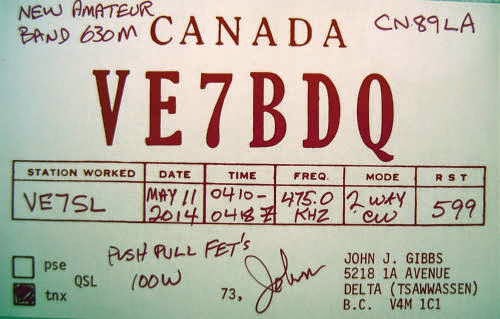
| First 630m contacts |
Hopefully there will be more stations active before the winter DX season gets underway!
In an attempt to keep my own interest level up as well as trying to get the word out to others about our new band, I've completed crossband contacts with three other VE stations. Two of the contacts were on Vancouver Island....VE7DAY (John) in Campbell River and VA7FC (Perry) in Courtenay. The third station was VE6TA (Grant), near Edmonton, Alberta. A fourth crossband contact was completed when I worked W7WKR (Dick) near Lake Chelan in Washington state. John, VE7BDQ, also completed crossband contacts with VE6TA and W7WKR giving those two stations a 'VE7 two-fer'.


.jpg)
Both John and I would love to do a lot more crossband work, especially with stations in the U.S.A. who presently cannot transmit on the band but may still be very much interested in 630m. A recent overnight beaconing session at 25 watts output clearly indicated that under fairly normal conditions and with a good receiving system on 630m, my normal speed CW signal can cover a wide geographic area during the hours of darkness. Having up to 500 watts of power available for CW, my signals should have good coverage to all of the western and central states at this time of the year.
Such crossband type contacts are perfectly legal between any and all stations in the "amateur radio service" and at one time, this was the only mode available between Europe and North America on the 50MHz band, as this tantalizing review of Cycle 19's amazing propagation explains.
If anyone, anywhere (both U.S. or VE), would be interested in attempting a crossband CW QSO, I would love to try! Please contact me via the comments section below or via e- mail.
I would also be interested in hearing from any Canadians who are planning to get on the new band as I am trying to keep track on my website's LF page.
Steve McDonald, VE7SL, is a regular contributor to AmateurRadio.com and writes from British Columbia, Canada. Contact him at [email protected].
Did you participate in Field Day 2014
You can check to make sure they received it, and if there were any discrepancies with the class/category that you claimed.
Go to: http://www.arrl.org/news/2014-arrl-field-day-logs-received-list-available-for-review
Scroll way down to the bottom of the page and download the PDF.
Even though we got an e-mail confirmation when our log was submitted, I double checked to see if the log for NJ2SP was there. You can call me paranoid, but I just wanted to make sure our inaugural Field Day effort gets counted amongst the masses.
It's there.
72 de Larry W2LJ
QRP - When you care to send the very least!
Larry Makoski, W2LJ, is a regular contributor to AmateurRadio.com and writes from New Jersey, USA. Contact him at [email protected].
 Ham Radio Deluxe |
 W5SWL Electronics |
 Ham Radio Prep |
 KB3IFH QSL Cards  Hip Ham Shirts  HamRadioAuctions HamRadioAuctions Reliance Antennas Reliance Antennas Enigma Shop Enigma Shop |  morseDX  Ni4L Antennas  R&L Electronics R&L Electronics antennas.us antennas.us QRV QRV |
- Matt W1MST, Managing Editor
