 |
 Mandatory Daily Repeater Testing
 30 August 2014 | by
Part humor, part friendly reminder from Reddit user hamfacts.
(There are 6 more “HamFacts” if you’re into self-deprecating ham humor….)
Matt Thomas, W1MST, is the managing editor of AmateurRadio.com. Contact him at [email protected].
630m Trans-Pacific WSPR
 |
| Courtesy: https://www.google.com/maps/ |
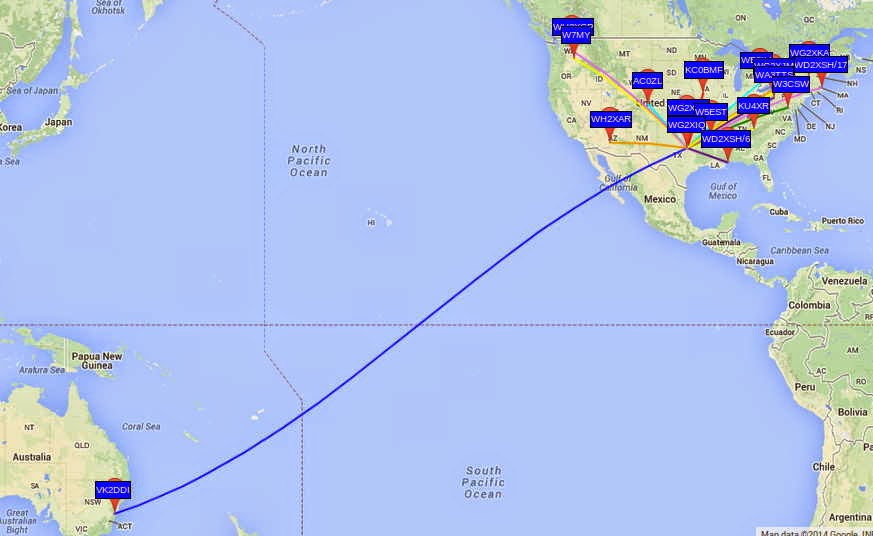
This is particularly noteworthy in view of the relatively low power used for John's beacon....around 200W. With the typical backyard antennas being used at these frequencies, efficiencies are very low and John's actual ERP is less than 5W. The transpacific reception of John's signal by VK2DDI confirms what most LF'ers already know....that small suburban lot amateur installations can have positive results on 630m without the need for huge antenna systems.
The WG2XIQ beacon was operating in the WSPR mode, which has become very popular amongst 630m experimenters as well as those just interested in listening-in. WSPR is not a QSO mode but strictly a one-way 'beacon' mode. Although two stations may each spot each other, it is not considered to be a valid two-way QSO. A check of evening WSPR activity will often reveal dozens of stations actively spotting what they are hearing.
Like most LF stations, John's is mostly homebrew.
 |
| WG2XIQ/KB5NJD |
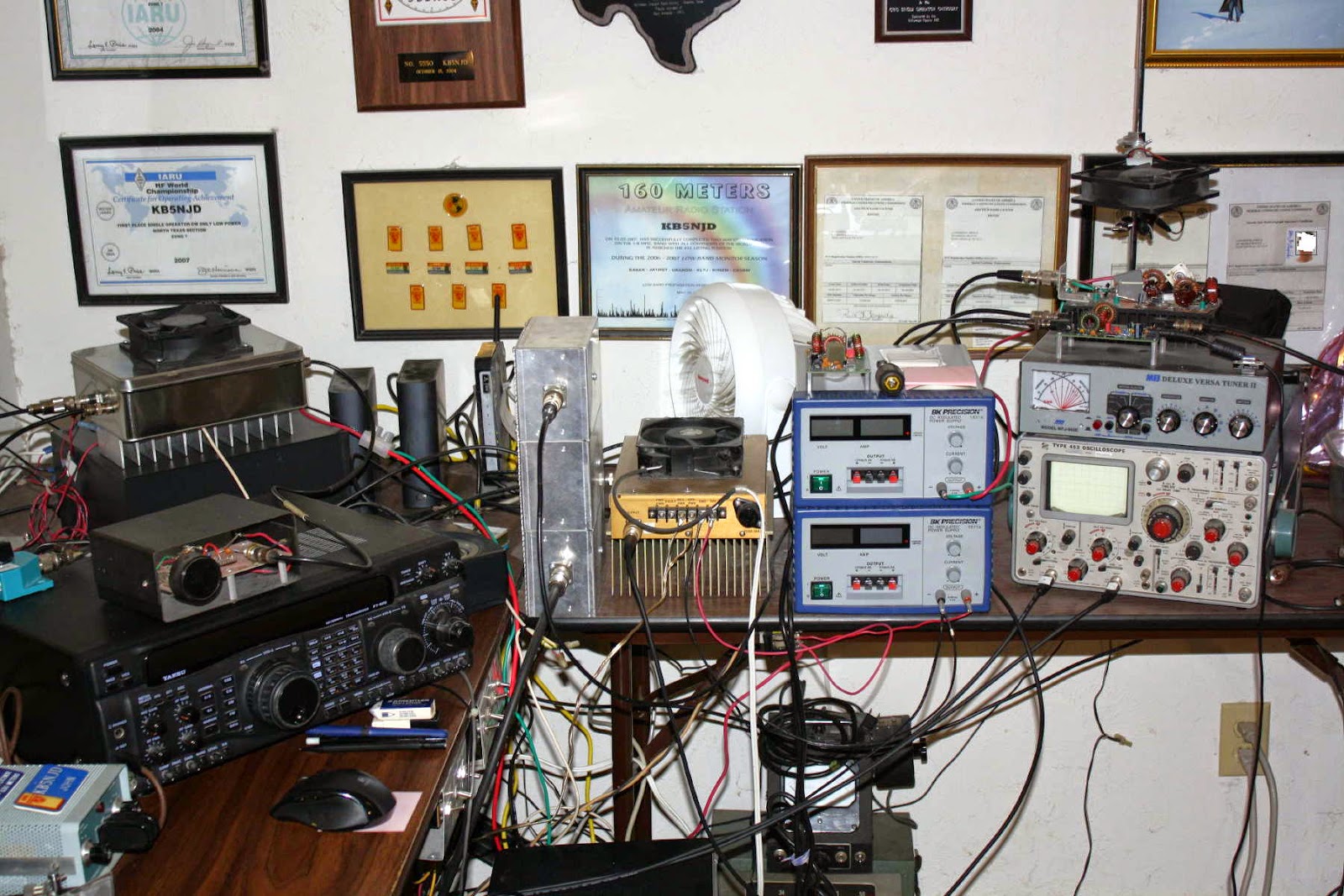
I'll let him describe the details:
"I have a few ways of making RF in the shack. I can do CW with a very nice waveform using the GW3UEP VFO/Driver coupled with a GW3UEP 100w amp with waveform shaping. The other way is via the MF Solutions transmit downconverter, developed by John Molnar, WA3ETD/WG2XKA. I have two of those boards, one is a backup. I use a GPSDO for the LO and use that signal to drive two parallel GW3UEP amps with max power at 125 watts each. The W1VD Ø degree hybrid combiner brings them together in phase for close to somewhere between 200 and 250 watts TPO depending on how hard I drive and how close I match the TX levels entering the combiner. I filter the output with the W1VD KW LPF that was built by Dave Robinson G4FRE (ex WW2R). I power the amps with a pair of BK Precision 30V 6Amp variable power supplies (variable current limit threshold also). Scope match is used to resonate and match the the impedance. IF Rig on 630m is typically a Yaesu FT920. These days RX antennas are the VE7SL multiturn loop or the TX vertical, both of which have their own merits depending on the conditions at the time."
 |
| John's 630m Vertical |
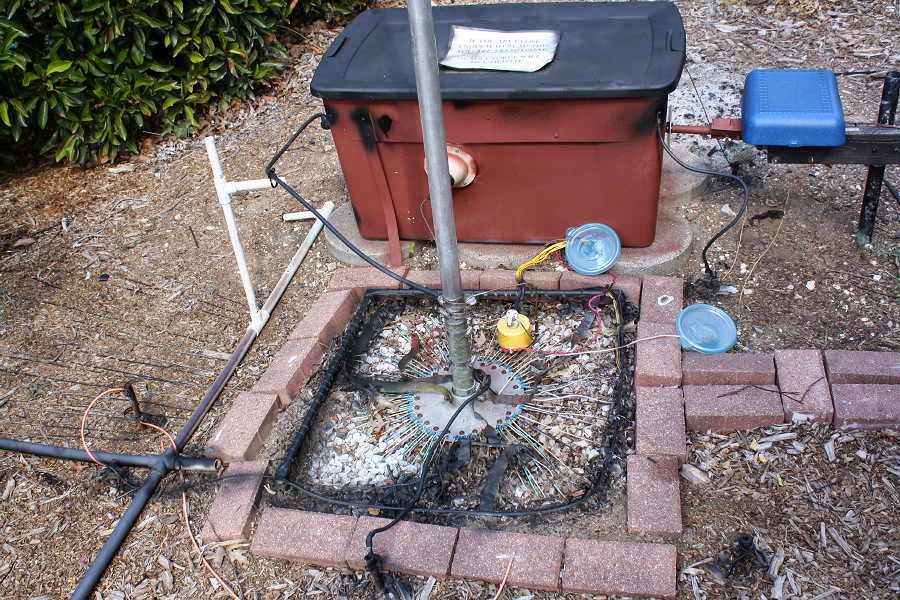
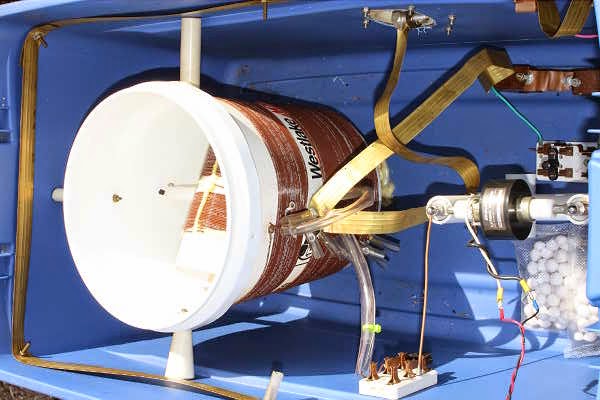
"Antenna is an 80 foot asymmetric T-top marconi with 100 foot and 200 foot legs....radial system is almost 3 miles of radials connected via various busses. 26 ground rods around the property. I monitor current in the shack and sample via a Bauer current transformer from an AM BC ATU."
 |
| 630m Radial System |
 |
| 630m Antenna Loading Coil & Variometer |
John's system does indeed work well...just last year at this time, his 630m signals were copied by KL7L near Anchorage, Alaska.
Of course, equal credit must be given to VK2DDI for having a system good enough to hear John's signal all the way down on Berry Mountain, New South Wales, Australia! It is there that David has set up a fine LF station, 500m above and overlooking the Tasman Sea...an ideal location for weak-signal LF work.
 | ||||
| VK2DDI - Berry Mountain, NSW |
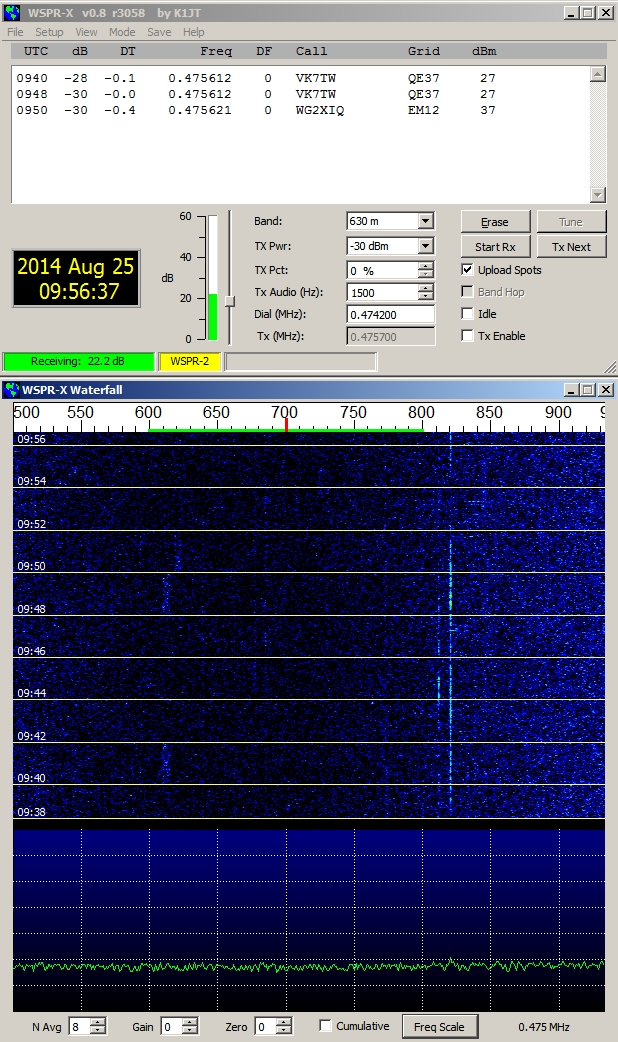 | ||
| WG2XIQ Signal As Heard in VK |
David also runs the Berry Mountain Grabber, providing other VK and ZL experimenters a handy way of checking their system progress or propagation conditions.
If you have been doing any WSPR work on HF, you might be surprised at what you can hear down on 630m, even without a dedicated antenna for that band. Surprisingly good results can often be had with a non-resonant antenna as the signal to noise ratio can often be better even though signals may sound weaker. Give it a try and spot what you hear!
If you are interested in learning how to receive WSPR, here is a nice tutorial by ZS6SGM.
Should you be interested in knowing more about obtaining a Part 5 licence to transmit on 630m, John will happily guide you through the process. He can be contacted via email or you can find him hanging-out most nights on the ON4KST kHz (2000-630m) chat page.
To keep on top of what is happening or who is on-the-air, most LF'ers rely on three sources:
- the RSGB LF Group reflector
- the Lowfer list
- the LWCA Message Board
Steve McDonald, VE7SL, is a regular contributor to AmateurRadio.com and writes from British Columbia, Canada. Contact him at [email protected].
The Spectrum Monitor — September, 2014

Here are the featured stories from our September, 2014 issue:
An Inexpensive VHF/UHF Spectrum Analyzer Dongle
By Mario Filippi, N2HUN
Commercial spectrum analyzers can run upwards of several thousand dollars in price, but for those on a limited budget, who don’t require the sophisticated features of high-end analyzers, the RF spectrum analyzer by Nuts About Nets fits the hobbyist’s bill nicely. It has opened up a new world of interest in the types of signals that inhabit the VHF/UHF bands, what they look like and where they appear. Regular contributor to TSM, Mario Filippi N2HUN, takes this spectrum analyzer dongle to the VHF and UHF bands, looking for signals. He notes, “Unquestionably, this is one of the most useful pieces of radio gear I have encountered as a hobbyist in many years!”
The Slow and Unsteady Course of HD Radio™
By Ken Reitz KS4ZR
In the days before Wi-Fi radio, Pandora™, and the many ways people digitally stream audio to their mobile devices, HD Radio was created to combat the first digital threat to over-the-air radio: XM and Sirius Satellite Radio. Six years ago the market was awash in tabletop HD Radio sets ranging in price from $100-600. Now, there’s only one such set: a $52 FM-only radio from Insignia. In the 13 years since its inception, iBiquity, the broadcast consortium behind the HD Radio brand, has seen its product go from “The Next Great Idea” to the question: “Whatever happened to HD Radio?”
Going Mobile Digitally; Connect Systems CS700 Review, and Nifty! Mini-Manuals
By Cory GB Sickles WA3UVV
In this month’s look at digital amateur radio operating, Cory Sickles WA3UVV, reviews Connect Systems’ CS700 portable UHF digital amateur radio transceiver that boasts 4 watts output, a keypad and more, for a direct retail price of $180. That price is what created the initial buzz, as even a basic Digital Mobile Radio, without any display or keypad, can cost $360 or more. Factor in that the CS700 is supplied with a drop-in charger and free, downloadable, programming software, and you’ll discover why this radio has been such a game changer. We all know that price alone, however, does not guarantee a winner. But Cory found that, with the CS700, the quality and attention to detail was evident from the moment he opened the box and placed the radio in his hand.
TSM Review:
Hardrock 50 Amplifier Kit: Giving QRP a Boost
By Mark Haverstock K8MSH
QRP rigs are simple to build and fun to operate. But, as band conditions deteriorate over the next few years, you may find some need for a boost of power to get those contacts, especially if you’re chasing DX. The Hardrock 50 amp is an economical way to satisfy your urge to build, along with your need for a few dB of added signal strength on all the popular HF bands plus 6 meters. Regular TSM contributor, Mark Haverstock K8MSH, details his experience as he tackled the job of building this amp and putting it to the test on his Elecraft KX-3, a popular all-band, all-mode, low-power transceiver.
The Spectrum Monitor is available in PDF format which can be read on any desktop, laptop, iPad®, Kindle® Fire, or other device capable of opening a PDF file. Annual subscription (12 issues, beginning with the January 2014 issue) is $24. Individual monthly issues are available for $3 each.
Ken Reitz, KS4ZR, is publisher and managing editor of The Spectrum Monitor. Contact him at [email protected].
Icom 50th Anniversary Limited Edition IC-7850
Icom 50th Anniversary Limited Edition IC-7850
In the days of phones and tables getting smaller Icom goes big! The limited edition IC-7850 has gold color dials, buttons and strips. The front panel is finished in a clear black and special machined aluminum black and gold tuning tile. It will also carry a special 50th Anniversary number plaque on the top with Mr. Inoue’s signature.

More information: http://nicktoday.com/icom-50th-anniversary-limited-edition-ic-7850/
Nick Palomba, N1IC, is a regular contributor to AmateurRadio.com and writes from Florida, USA. Contact him at [email protected].
XiOne SDR – Software Defined Radio
Why do I need a Software Defined Radio?
You want to receive any kind of radio signals within a huge frequency range of 100 kHz up to 1.7 GHz?
You like to follow ships or airplanes operating around you?
You are an amateur radio operator who want to use SDR technology?
You even want to develop your own radio frequency applications?
You just want a plug-and-play solution?
The XiOne Software Defined Radio is the solution for you, extremely versatile and flexible in its possible applications because the magic happens completely in software.
http://nicktoday.com/xione-sdr-software-defined-radio/
Nick Palomba, N1IC, is a regular contributor to AmateurRadio.com and writes from Florida, USA. Contact him at [email protected].
Amateur Radio Newsline Report 1933 August 29 2014
- A ham radio floater balloon makes two trips around the world
- IARU Region One official says 23 centimeters is in jeopardy
- Moldavia joins the CEPT universal licensing system
- International Lighthouse and Lightship Weekend sets a new record
- Morse sprint will honor the memory of the late Nancy Kott, WZ8C
Alaska’s NDBs Awaken!
 |
| Courtesy: http://www.alaskacooling.com |
This past weekend saw another of the monthly "Co-ordinated Listening Event" (CLE) activities sponsored by the Yahoo ndblist Group and organized by Brian Keyte, G3SIA. This is a group of dedicated low frequency NDB DXers that enjoy hunting down new catches as well as keeping track of NDB activity in general. These low powered beacons make excellent propagation indicators and are always a good measure of one's LF receive capability.
As often happens, the monthly events seem to coincide with poor propagation periods for some unexplainable reason, as was the case once again. As well as the generally poor propagation, North America was plagued with high levels of lightning activity making any weak signals very difficult to hear through the steady din of QRN.
In spite of the poor conditions, two nice catches from Alaska (ELF and TNC) heralded the fast receding midnight-sun in the 49th state and the start of another Alaskan NDB DX season!
The NDB at Cold Bay is 'ELF' and transmits on 341kHz. Cold Bay is located on the Alaskan Peninsula, at the top of the Aleutian chain.
 |
| Courtesy: http://pics3.city-data.com |
Built as a military airfield in WWII, Cold Bay's traffic is now mostly cargo and its long runway serves as an emergency 'alternate' for flights in the north Pacific.
A search of Google Maps shows the NDB itself is located several miles north of the airport and appears to use a large vertical and an extensive ground system. With the transmitter power listed as 1000W, ELF makes an excellent target for DXers looking for their first Alaskan NDB.
 |
| Source: https://maps.google.ca |
 |
| Source: https://maps.google.ca |
Like 'ELF', the antenna appears to be a vertical but possibly of smaller size.
 |
| Source: https://maps.google.ca |
For ELF, listen on 342.030kHz or 339.968kHz. The carrier will be on 341.0kHz.
For TNC, listen on 348.034kHz or 345.968kHz. The carrier will be on 347.0kHz.
For a list of all active NDB's in Alaska, complete with accurate frequency-spotting information, visit the beacon-reporting RNA website. Put 'AK' in the 'States' window and pick 'All Results' in the 'Show' window. There are presently at least 60 or more NDBs known to be operational in Alaska.
As mentioned before, please exercise caution should you decide to jump-in...chasing NDBs can quickly become addictive as anyone in the 'ndblist' Yahoo Group will tell you.
On the other hand...Alaska is waiting!
Steve McDonald, VE7SL, is a regular contributor to AmateurRadio.com and writes from British Columbia, Canada. Contact him at [email protected].
 Ham Radio Deluxe |
 W5SWL Electronics |
 Ham Radio Prep |
 KB3IFH QSL Cards  Hip Ham Shirts  HamRadioAuctions HamRadioAuctions Reliance Antennas Reliance Antennas Enigma Shop Enigma Shop |  morseDX  Ni4L Antennas  R&L Electronics R&L Electronics antennas.us antennas.us QRV QRV |
- Matt W1MST, Managing Editor
