 |
 Rectifying
 22 August 2014 | by
 As predicted, I have received some comments over at AmateurRadio.com, regarding the immediately preceding "Bug Fist" post. As I've stated there, and will state here again (for the record) that post was NOT intended to be about folks who are learning how to send Morse Code as a beginner. That post was supposed to be about people who know how to send good code - but don't, because they don't use a bug correctly.
But to answer a question posed over there. How does one learn to send good code in the first place?
Good question.
Back in the day - back in my day, the FCC had a very nice program in place. It was called the United States Amateur Radio Novice License. It was our gateway. We learned to receive Morse Code at 5 WPM. We were restricted to "Novice sub bands". You say that sounds like a curse? Heck no! It was heaven! Imagine trying to learn how to ride a bike with other kids on the playground zooming around on ten-speeds, mountain bikes, scooters and what have you. We had a little area, set aside for us, where we could zip around on our training wheels. As we rode and rode (made QSOs) we built up our confidence and eventually shed our training wheels, and we upgraded. Oh, in the process, we fell off our bikes, and got our knees and elbows bloodied along the way. But we learned!
But as they say, "Them days are gone forever." So what's a new Ham who wants to get on HF CW supposed to do?
Several things, actually.
I am going to assume you have learned the basic Morse Code character set and that you can receive at a speed of about 5 WPM. If you haven't, you need to do that. But here's an important point - if you've learned CW, whether it be from W1AW or whatever software program - you already know what good code sounds like! You will also know, conversely, what bad code sounds like. Your assignment is to send good code.
This is where code practice oscillators come in to play. They weren't invented just to teach people how to learn to receive Morse Code, they were also invented to teach people how to send Morse Code. If you have one, fine. If you don't - get one. Or ..... you can go to your rig, and turn off the VOX while in the CW mode. This should give you a nice, big, fancy and expensive code practice oscillator. Use it. Use it a lot until you are comfortable and can send Morse Code without really have to think about forming the characters too much. As I stated over at AmateurRadio.com - use a tape recorder, or the voice recorder on your cell phone and record your sending. If you can decode what you are sending, then other people will be able to, also. If you listen to your fist and find yourself going, "What?!?", then you probably aren't ready and need to practice more. It's OK to send slowly, but accurately. Personally, I would rather listen to someone sending slowly, but correctly, rather than listening someone trying way too hard, too fast, too soon, who leaves me scratching my head. (Pssst! This is why the FISTS motto is "Accuracy transcends speed.")
Once you are reasonably confident in your sending skills, you can get on the air. The Novice subbands don't really exist anymore, but you can find some slower folks hanging around together around 7.125 MHz. The FISTS and SKCC frequencies also good places to hang - from around .050 to .058. You can ply your newly discovered skills there among friends. Don't be intimidated! Relax, take a deep breath and enjoy the ride. Remember, we're not looking for a cure for cancer or cardiovascular disease here. We're supposed to be having fun. Don't obsess and don't put yourself down. We were all beginners once, and we all had to start somewhere.
I'm going to warn you. Your first half dozen or so QSOs will be a bit nerve wracking. Best thing to do is write down ahead of time a "canned QSO". Just follow the script and before you know it, you'll feel more and more comfortable and will no longer need the script. If you try to make a QSO every day, before you know it, you'll come to recognize the experience you have gained. Your speed will increase and you will really come to enjoy this new mode you have set out to learn.
Another word of caution. There will be jerks! Sorry ..... there's nothing I can do about that. Just as on the highway, there's always that idiot that has to zoom in and out of lanes at 75 MPH, you're also going to run into jerks that think 40 WPM is beneath them and will not slow down for anyone - God included. If I may get Biblical here without offending anyone ...."Just shake their dust from your feet and go onto the next village." The speed demons who won't QRS for anyone are not worth your time or effort. I've been in this game for 36 years now, and I run into my share, too. To this day, I have to ask myself why guys send at around 55 WPM in contests only to have to repeat their exchanges multiple times, because we mere mortals can't copy their "buzz saw" CW.
Conversely ..... should you answer a CQ, do not, under any circumstances, start sending faster than you are comfortable receiving! I know, we all have a tendency to do this, but it is going to get you into trouble. You are going to get yourself into a terrible experience that will make you want to run away from Morse Code forever. Any dedicated CW op worth his salt will slow down (QRS) for a newbie. Do not be afraid to ask someone to "QRS PSE?", either. We don't know for sure that your uncomfortable unless you tell us. Sometimes, we more experienced CW ops assume too much, too.
I think I covered everything and I hope this helps those of you who are newer out there and are struggling to learn the CW ropes. If you have any questions, pop something into the comments box or send me an e-mail. I will try to help in any way I can.
There's an old joke where a stranger asks a cabbie in NY how to get to Carnegie Hall. The cabbie replies "Practice!". If you want to get good at the Morse Code game, it's going to take lots of practice. No way around it, but it doesn't have to be a chore or unpleasant. Have fun and enjoy yourself!
72 de Larry W2LJ
QRP - When you care to send the very least!
Larry Makoski, W2LJ, is a regular contributor to AmateurRadio.com and writes from New Jersey, USA. Contact him at [email protected].
Getting My Radio Fix – QRP Portable Today!
I was finally able to sneak off at lunch time for some quick portable QRP op’s with the KX3 and my Portable QRP Antenna from the local park.
I did a quick scan of the bands when I got there, and made one quick contact with a mobile station…
N7IV/M 14.056 599 both ways. I am not exactly sure where he was, but had a little pileup going. (UPDATE: I found him on APRS – I appears he was in Wisconsin)
Then I decided to just plant myself on a frequency and call CQ to see what happened. I spotted myself on Twitter hoping to maybe make contact with a Twitter follower. VA3QV sent me a Tweet and said he was listening but could not hear me.
But I did manage to get some replies to my CQ on 14.057!
W4FO Pat in Florida
KD3CA Don in Pennsylvania
W9DCQ Doug in Wisconsin
WD9DWE Dennis in Indiana
Thanks for the QSO’s guys!
I then decided to spin the dial a bit. I heard W1AW/0 in ND, but could not break the pileup. It sounded like he was working some DX but I could not hear the DX.
Then I went to 17 meters and worked…
W1AW/8 in Ohio – it took a bit to bust the pileup, but I finally made it!
So a fun lunch hour on the radio today! Thanks to everyone that worked me, and to those on Twitter that tried to work me. It was a fun adventure.
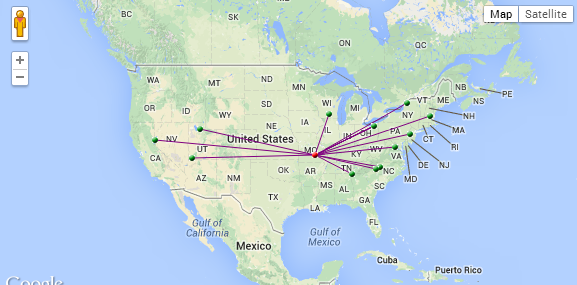
Here is where I was spotted by RBN:
Burke Jones, NØHYD, is a regular contributor to AmateurRadio.com and writes from Kansas, USA. Contact him at [email protected].
Getting My Radio Fix – QRP Portable Today!
I was finally able to sneak off at lunch time for some quick portable QRP op’s with the KX3 and my Portable QRP Antenna from the local park.
I did a quick scan of the bands when I got there, and made one quick contact with a mobile station…
N7IV/M 14.056 599 both ways. I am not exactly sure where he was, but had a little pileup going. (UPDATE: I found him on APRS – I appears he was in Wisconsin)
Then I decided to just plant myself on a frequency and call CQ to see what happened. I spotted myself on Twitter hoping to maybe make contact with a Twitter follower. VA3QV sent me a Tweet and said he was listening but could not hear me.
But I did manage to get some replies to my CQ on 14.057!
W4FO Pat in Florida
KD3CA Don in Pennsylvania
W9DCQ Doug in Wisconsin
WD9DWE Dennis in Indiana
Thanks for the QSO’s guys!
I then decided to spin the dial a bit. I heard W1AW/0 in ND, but could not break the pileup. It sounded like he was working some DX but I could not hear the DX.
Then I went to 17 meters and worked…
W1AW/8 in Ohio – it took a bit to bust the pileup, but I finally made it!
So a fun lunch hour on the radio today! Thanks to everyone that worked me, and to those on Twitter that tried to work me. It was a fun adventure.
Here is where I was spotted by RBN:
Burke Jones, NØHYD, is a regular contributor to AmateurRadio.com and writes from Kansas, USA. Contact him at [email protected].
The list of projects is huge!
I have been having serious radio withdrawal – I am really itching to get on the air and operate! Unfortunately, life is happening and I have had zero time to operate.
When this happens I usually watch a lot of videos and read blogs. This then leads a big list of “I wanna do that” type projects.
So I thought I would list the top 3 or 4 here and set a goal of getting them done by Christmas:
1. Get a long wire inverted L 9:1 UNUN antenna installed at the house. I have the UNUN built and I have the small gauge “stealthy” wire from the Wire Man – just need to get it up in the trees!
2. Rockmite 40 – I have had this kit along with the Mitybox for several years – just need to get it built.
3. DIY Powerpole Distribution Block – There are some great plans for this here: http://www.qsl.net/wd4bis/connect.htm
4. Magnetic loop antenna with automatic controller. I have the board, just need some components to get the board built up and working – I really want to get this going early this fall!
The list is much longer – but this is the top four I want to get done right now.
What is on your project list?
Burke Jones, NØHYD, is a regular contributor to AmateurRadio.com and writes from Kansas, USA. Contact him at [email protected].
The list of projects is huge!
I have been having serious radio withdrawal – I am really itching to get on the air and operate! Unfortunately, life is happening and I have had zero time to operate.
When this happens I usually watch a lot of videos and read blogs. This then leads a big list of “I wanna do that” type projects.
So I thought I would list the top 3 or 4 here and set a goal of getting them done by Christmas:
1. Get a long wire inverted L 9:1 UNUN antenna installed at the house. I have the UNUN built and I have the small gauge “stealthy” wire from the Wire Man – just need to get it up in the trees!
2. Rockmite 40 – I have had this kit along with the Mitybox for several years – just need to get it built.
3. DIY Powerpole Distribution Block – There are some great plans for this here: http://www.qsl.net/wd4bis/connect.htm
4. Magnetic loop antenna with automatic controller. I have the board, just need some components to get the board built up and working – I really want to get this going early this fall!
The list is much longer – but this is the top four I want to get done right now.
What is on your project list?
Burke Jones, NØHYD, is a regular contributor to AmateurRadio.com and writes from Kansas, USA. Contact him at [email protected].
On Making Nanowaves – Part 5

The next step was to use John's design to mount the receiver and transmitter modules so they could be locked into position once aligned properly. His system used the 1/4" split shaft locking mechanism removed from an old Allen-Bradley potentiometer to hold a short length of rod fastened to the module's case.

This allowed the shaft to be moved forward and backward for focus while the slot in the mounting plate allowed for vertical centering. The plate mounting mechanism itself allowed for lateral centering. This system allowed for the locking of the receiver's photodiode at the exact focal point of the fresnel lens.The same scheme was employed for the transmitter's LED as well, since accurate focusing was critical there also.
In order to focus as much of the LED's light onto the primary fresnel lens, a small inexpensive (secondary) collimating lens was required. This assured that the fresnel was properly illuminated out to its edges and no further. Any light spilling over the edges of the fresnel would just be wasted.
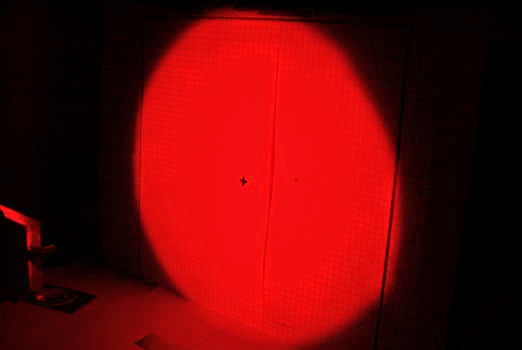
Our particular fresnel had an effective aperture of 260mm and a focal length of 200mm, producing an F-number (f/D ratio) of .76.... Clint suggested that our collimating lens should have an F-number of ~ 1 - 1.2 and be a PMN (Positive MeNiscus) type and that we hedge our bets by trying lenses above and below that value. Ideally the collimator should be at least 25mm in diameter for ease of mounting and, when perfectly illuminating the fresnel, be as close to the LED as possible, if not touching it. Just placing a less than ideal secondary too close to the LED would end up over-illuminating the fresnel, while having it too far away would under-illuminate it.
Accordingly, four small glass collimating lens of various F-numbers were purchased from Surplus Shed at around $4 each. Each lens was then mounted on a drilled-out piece of PCB material using 'JB Weld'.

Once cleaned-up, the lens board was then positioned directly over the center of the LED on a machine-screw carriage mount. The carriage allowed the lens to be locked into position once it was correctly positioned. All four lenses were tested to see which one would correctly illuminate the fresnel while still being as close to the LED as possible.

The eventual winning secondary lens was #L10016 (.9 f/D) which allowed for a sharp and fully-illuminated fresnel while being just a few millimeters above the LED.
The next step was to adjust the entire LED and secondary carriage for the sharpest focus on a distant flat surface. This was done over a distance of about 200' and was a fairly fine adjustment.
Once done, it was actually possible to see the two fine wires connecting to the LED die on the distant projected image.

With the final focusing taken care of, the tone modulator and MOSFET LED driver were installed. This used an IRF540 switching FET, driven by the digital tone signal to control the current through the LED.

All we could do now was patiently wait for a nice clear evening to put the system to work.
Steve McDonald, VE7SL, is a regular contributor to AmateurRadio.com and writes from British Columbia, Canada. Contact him at [email protected].
This post is going to get me into trouble!
"Seems when the bands are down every person with a ‘bug’ is out calling cq. Wish they would put code oscillators and dummie loads on sale. Dits at 20 wpm and dahs at 5 wpm."
I guess it's not directly related to band conditions, and I'm not sure that John's claim is 1,000,000% accurate, however - he makes an excellent point.
Not to dump on bug users, because I have a bug. I like using a bug. Using a straight key makes the arthritis in my hands go "Hey! Stop that!" But unless I've practiced with my bug (off the air) for a while .... my sending can be pretty bad. So I try to make it a point to take the KX3 "off the air" and practice sending with my bug on a regular basis. Not as regularly as I should, but I try to keep in decent practice.
I agree with John and I would posit that listening to someone use a bug (or even a straight key or paddles, for that matter), who doesn't know how to use it properly, is akin to listening to nails being scratched across a blackboard. NB: For any younger readers, a blackboard is what we used in school before the advent of whiteboards and smartboards. If you scrape your fingernails across the surface of a blackboard, it makes a sound unlike anything you've ever heard. It literally hurts to listen to it. It will make your teeth ache. There's something about human fingernails and slate that just don't mix. Listening to someone scratch a balloon is almost as bad. But .... I digress.
The phrase, "Dits at 20 wpm and dahs at 5 wpm" resonated with me. Morse Code sent like that is not only unreadable - even worse, it's unbearable. No one is asking that all Morse be sent so that it sounds like it's coming from a keyer or a computer - but for Pete's sake - at least make sure your sending is copyable!
I would suggest that anyone who is inclined to use a bug perform this little exercise. Send some Morse and record it, either with a tape recorder (do they still make those?), or, I believe most smartphones have a voice recorder feature. Do it off the air. Either send your RF into a dummy load or turn off your "VOX" - that usually will put your rig into code practice oscillator mode.
Send some Morse, listen to it, and copy what you sent. Be honest and critical with yourself. If you can honestly copy what you've sent, then you're probably good enough to go live. It might even be a good idea to wait a day or two between the sending part and the listening to yourself part - just in order to make it a bit more objective.
I can tell you for a fact, that I have done this - I have listened to my own bug fist - and have said, "Oh my!". It was a rude, but necessary awakening. I am totally glad that I did not subject my fellow Hams to what I had thought was decent sending.
72 de Larry W2LJ
QRP - When you care to send the very least!
Larry Makoski, W2LJ, is a regular contributor to AmateurRadio.com and writes from New Jersey, USA. Contact him at [email protected].
 Ham Radio Deluxe |
 W5SWL Electronics |
 Ham Radio Prep |
 KB3IFH QSL Cards  Hip Ham Shirts  HamRadioAuctions HamRadioAuctions Reliance Antennas Reliance Antennas Enigma Shop Enigma Shop |  morseDX  Ni4L Antennas  R&L Electronics R&L Electronics antennas.us antennas.us QRV QRV |
- Matt W1MST, Managing Editor
