630m Trans-Pacific Path Heats Up!

Courtesy: https://maps.google.ca/
It seems that the recent Trans-Pacific reception of WD2XIQ's Texan WSPR signal by VK2DDI has stirred up a lot of interest from the boys down under. Despite some recent geomagnetic disturbances, some of those that are taking the time to beacon or to listen are being justly rewarded. Sunday's overnight beaconing has produced four more confirmed reports of the U.S. Part 5 experimental stations being heard in both VK and in ZL.

Once again, John ("XIQ"), was heard on the other end....not in Australia but in New Zealand, by Con (ZL2AFP) listening in residential Wellington. Con also caught signals from Larry, W7IUV, in central Washington state, operating on 630m as WH2XGP. Not to be left out of the action, Rudy, N6LF, running as WD2XSH/20 made it down to both VK2XGJ and VK2DDI before the sun came up south of Eugene, Oregon.

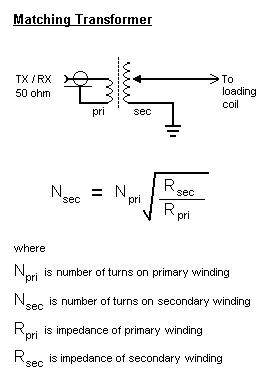
Larry, W7IUV ("XGP"), was running a true backyard-size antenna system...just a 34' loaded vertical with a sloping zig-zag top loading wire.  His small wire radial system covers a 16' x 25' patch. His homebrew amplifier, constructed almost exclusively from salvaged computer parts, uses 8 switching MOSFETs in push-pull / parallel running in the rare linear mode! The fascinating description of his amplifier's design and construction can be found at the W7IUV website. With the small vertical, estimated erp is  ~ 10 watts.
Larry's station should be inspirational for anyone who thinks they need huge antennas to be successful on 630m!

Rudy, N6LF ("XSH/20"), runs around 20Weirp to a large top-loaded vertical. The center (radiator) pole is almost 100' high while the top-loading support poles are 80'. Full details of Rudy's fine system, along with much more about 630m, may be found at the Antennas By N6LF website.

N6LF/WD2XSH/20 630m Top-Loaded Vertical
It wasn't just the U.S. Part 5'ers who were on the ball early Sunday morning. ZL2AFP, set up with just a small PAØRDT-style miniwhip at 28' feet and an IC-746PRO receiver, managed to snag two of the northerners. John Simon, VK2XGJ, also listening from a normal-sized suburban lot in Dapto (NSW), with lots of nearby powerlines, caught "XIQ"'s Texas-launched signals on his venerable FRG-100 tied to another small active miniwhip at 20'. Interestingly, the U.S. signals were detected about four hours after local sunset in both ZL and VK. 

LF RX Stack at VK2XGJ
It seems clear that 630m has much to offer in the way of some exciting propagation opportunities and that experimenters do not require large amounts of room to take advantage of this unique part of the spectrum.
Hopefully conditions will continue to provide more long-haul reports in the coming weeks.

In the meantime, remember that Canadian amateurs now have free access to the 630m band, but much more activity is needed...VE6, VE5, VE4, VE3, VE2...who will be the first on 630m in those provinces?  It's time to start melting solder and stringing antennas before winter arrives!


Steve McDonald, VE7SL, is a regular contributor to AmateurRadio.com and writes from British Columbia, Canada. Contact him at [email protected].

Logging and datamodes with PZTLog

Organisation isn’t one of my strengths and my logging of contacts has been pretty woeful. It consisted of a spiral bound note book full of various scrawls sometimes tabulated for contests but more often than not a free form mess. With good intentions I purchased a proper RSGB Deluxe log book months ago but that has remained pristine and has just become a handy band-plan look-up!

Until recently I had only made a small number of voice QSOs on HF and had entered those manually into the online eQSL, QRZ and HRDlog logbooks I maintain.  JT65 data mode logging was handled by the JT65HF program itself and for the UKAC and other VHF contests I have been using the MINOS logging program - all in all a bit of a mishmash.

Now my operating confidence has grown I am making more contacts and so I really need to computerise and centralise my logging. After  looking at a number of programs I opted to give Charlie Davy’s (M0PZT) freeware PZTLog a try and after using it for a couple of weeks I am very impressed.

http://m0pzt.com/?pztlog

The program has a multitude of features but at the moment I am using it to simply enter and log details of contacts, combined with the CAT interface to the FT857-D and the OMNIRIG control the mode, frequency, band and power settings are automatically populated.

The really nice selling point for me was the inbuilt data mode operation. I have tried PSK and RTTY before using other programs but I often found myself confused and intimidated by the interfaces and jargon.

PZTLog uses the MMVari engine to operate PSK/RTTY and it uses a familiar waterfall display. The TX/RX window and  QSO macros are easily accessible and I found the interface much more intuitive than other programs I have used. On installation, the macros are already populated and labelled sensibly and are easily editable. By double-clicking received text you can set Callsign, Locator, RST/Serial, Name/QTH quickly and with ease.

In a short time I have made a good number of PSK QSOs as well as a some RTTY contacts, even giving some points away in the fast paced SCC RTTY contest last weekend.

Importing and exporting of logs is very easy and it has inbuilt eQSL uploading, but at the moment I am having trouble making that work reliably but that I think is me rather than the program.

PSK is a great mode, running no more than 30W, often less I have made a number of nice DX contacts and countries including Argentina, Oman, Japan and the Dominican Republic.


Thanks to Charlie’s program I now have a better understanding of how the mode and QSO works so may try some of the more sophisticated programs, or I may just stick with PZTLog for a while. Check out Charlie's page for lots more interesting information as well as some very funny light hearted audio features poking fun at the hobby.

In other news the VHF UKAC contesting is improving. Last week I made a last minute decision to lower the pole and put up my homemade wooden 6m MOXON but glad I did. Conditions weren’t good but still made a respectable number of contacts but not a lot of distance. I’ve climbed to 30th place in the 50MHz low power AL section.
Last night was the 144MHz UKAC and what a great night it was, conditions were brilliant and it was very busy on the band. Still operating search and pounce mode I snagged just 32 contacts, but with 13 multipliers giving me by best score so far on that band.  Operating in the low power AL section as M6GTG it is hard work getting through the pile ups but it was great fun trying.
Finally I became a licensed ‘foundation level’ amateur a year ago this month (M6GTG), and have since become an ‘intermediate’ (2E0NRD) and have now taken the bold step of applying to take the ‘advanced’ examination next month. I say bold because I haven’t taken a course or studied for it per se but with my background and education I have covered most of the theory even if it was over 25 years ago – with a bit of serious reading, revision and dusting off of the memory banks over the next few weeks I hope to be ready!

Andrew Garratt, MØNRD, is a regular contributor to AmateurRadio.com and writes from East Midlands, England. Contact him at [email protected].

Antennas

At the moment, I can cover 6m, 2m and 70cm vertical with the V2000, 2m omni-horizontal with the 2m halo, 2m and 70cms SSB/CW/digital with the small, hand rotated beam (3el/5ele) and 10m, 20m and 40m with the end-fed PAR wire antenna strung up to a tree. I can get on 630m by loading up the coax cables to various antennas or using the earth electrodes in the ground. I can get on other bands too by tuning various coax feeders.

V2000, 2m halo, and 2m/70cm beam (hand-rotated).
PAR end-fed is not visible but goes to a tree.

I will probably take down the V2000 and 2m halo later and replace them with a 10m halo (Homebase-10) for the months until next spring. I think the 10m halo will be a more effective antenna for 10m than the PAR. It will certainly be higher. Main problem at present is my mobility: climbing ladders is not a good idea in my present state, so antenna work is all but impossible.

Despite the low  power (5W or less) and lowish elevation, I am able to work out to around 200km on 2m and 70cm SSB in contests.

UPDATE WEDS: 449km best DX (Scotland) on 2m in the UKAC last evening with 5W and 3el.


Roger Lapthorn, G3XBM, is a regular contributor to AmateurRadio.com and writes from Cambridge, England.

Big Soldering Irons & PL259’s

Like a lot of newer, more inexperienced hams, I have had a fair amount of trouble soldering PL259 connectors to coax. In my previous posts, about my portable station, I need some small coax jumpers to bring the antenna connectors down to the lower front of the box. That portion is not show in my posts yet, as I’ll write about that later when it’s done. I tried my 40 watt Weller thinking it would work, but it didn’t hold enough heat. I have come to realize that PL259’s are big heat sinks. They drain heat from the soldering iron tip, so you need something that can hold a lot of heat. Namely a larger tip on the iron.

In the above picture, are my three soldering irons. The center one is a 25 watt model. It has a pencil type tip. No good for PL259’s but it’s good for other things. The bottom one is a 40 watt model with a small chisel tip. While the tip is larger, it’s still much too small. I know on ham forums on the Internet, there will be someone who will claim they can use this iron and successfully put on a PL259, but for most of us mere mortals, it’s not what we need for the job.

The upper iron in the picture is my new soldering iron. It’s a Weller SP120. It’s 120 watts with a huge tip as soldering irons go. I was able to put two PL259’s on and make a jumper cable in about 10 minutes. Most of that time was spent stripping the coax carefully with my x-acto knife. The right tools are sometimes needed and for me and soldering PL259’s, the right tool is a nice larger soldering iron!

73


Wayne Patton, K5UNX, is a regular contributor to AmateurRadio.com and writes from Arkansas, USA. Contact him at [email protected].

Some radio but a lot of photograpy!

On Friday (since I had the day off) I felt it was about time to take the Elecraft KX3 and do some portable op's since the weather did not seem like it was going to co-operate once again I operated from the car. I used my mobile whip antennas again and if you remember from my last post I had an error message show up on my radio ERR TXG! Well I tested all the mobile coax and mount  all seemed fine. I did clean the antenna mount connections and this time out all seemed to be well with no error messages. I had about an hour and a half of radio time. I found 20m to be dead with little or no activity I ended staying on 30m but was skunked with regard to contacts. The propagation gods were just not smiling on me this time. The rest of the weekend Julie and I took in the Canadian International air show. On Saturday we were off to Toronto Island it's a short ferry ride into Lake Ontario and in the past this was a great place to get pictures of the air show. This time around it was a good day to sit on the beach and relax with only a few good shots! The Toronto Island for sure was not a good place for photographing the air show as many other would be shutter bugs found out as well. It seems the flight pattern had changed and as Julie pointed out looks like they are flying right over our condo which also is on the lake. On Sunday we went up to the roof top patio on our condo and waited to see what kind of shots we could get. below are the results the cameras used are the Nikon D810 with Nikkor 70-200mm F2.8 glass with a Nikon 2x tele converter I was using the Nikon D800 with Sigma 50-500mm F4.5 glass. The RAF SE5 was about 2 KM's away from us. The C-123 was buzzing a condo that is about 1/2 KM away from us. So not much ham radioing this weekend but I do have Tuesday off as well and you never know I could have the radio god's smiling on me!
RAF SE5 flying past CN Tower
Me on the Island telling Julie I think I see a plane finally

C-123 buzzing a condo about 1/2 KM away

Mike Weir, VE9KK, is a regular contributor to AmateurRadio.com and writes from New Brunswick, Canada. Contact him at [email protected].

High-Flying Hams


My 'wow-meter' was recently pegged when learning the details of some noteworthy amateur radio activities. Two of these events described the astounding results of "floater balloon" activity.

One such device was launched in mid-July from Victoria state, Australia, by VK3YT, Andy Nguyen. His balloon was given the callsign of VK3YT-8, as it carried amateur radio tracking gear capable of transmitting its location and other data via APRS packets.

The small balloon travelled across the South Pacific and reached the coast of South America in less than a week! From what I can determine, it was last heard from on July 21st....29,000' above central Brazil and heading for the Atlantic Ocean at 69MPH where, I presume, balloon #8 met its demise.


It looks like Andy has just launched VK3YT-12 whose predicted path may be viewed here.

Although Andy's systems are very sophisticated, they are based on small 'Party Foil' balloons carrying small antennas and around a 12 gram, 10mw electronic payload.

VK3YT-11 Last heard from off the Brisbane coast


Tracking is via VHF APRS packet dumps (some even going via the ISS) and telemetry data via THOR16 or OLIVIA digital modes. Some use rechargeable batteries while others seem to be completely solar powered. Unfortunately I am dreadfully ignorant when it comes to APRS and many of the new digital modes. There is very little detailed information on Andy's onboard hardware, all of which seems to be homebrew.


Many of the balloons appear to float in wide circles a few hundred miles from their release points while others are immediately pushed northwards and out to sea....some quickly reaching New Zealand. Balloon #8 has been the biggest success to date.

You can follow VK3YT's pico progress from balloon #1 to the present, via the VK3YT Blog....what a wonderful example of amateur radio experimental fun!

                                                       *****

On the other side of the world, another ardent pico-ballooner is Leo Bodnar, MØXER, who has been launching similar small balloons from near London.
Leo's first payload, B-1, was released in June, 2013 and reached an altitude of almost 36,000 before bursting and returning to earth where it was successfully recovered.

MØXER launches B-1
Ever since B-1, Leo's balloons have been going higher and further but what happened with B-64 must have even surprised him.


Launched July 12, 2013, the homemade plastic balloon took off like a rocket, circumnavigating the entire globe in 19 days and passing within 9km of the North Pole and almost overflying the launch site on it's second trip! A few minutes before today's posting, the balloon (at 40,000') has just overflown Murmansk and is now over the Barent Sea, heading northeast at 52MPH. Progress can be tracked from here. He has now had three balloons circumnavigate the globe, with the last two losing contact on their second round as they approached Japan.

Personally I find these results astounding and am so impressed with the sophisticated systems that these very knowledgeable amateurs have been able to pack into such a small payload.

You can follow the interesting progress of Leo's work at his Balloon Flights website.

One thing I am not totally clear about is the actual onboard hardware....is everything scratch-built or are they using readily available modules? I suspect the former in which case I would love to see details of the actual circuitry being employed. As well, there seems to be a variety of different telemetry systems being used with some preferring to store packets until within range of a suitable download link while others rely on amateurs around the world to track, record and decode the digital beacon information...all fascinating stuff.

Kudos to Leo and Andy and all of the others for such well-executed and interesting radio projects. There seems to be a growing worldwide interest in amateur radio balloon projects and a search of the web has provided enough bedtime-reading for weeks. One thing for certain is that all of these fellows are very...very...digital-savvy which likely lets me out of the picture.

Maybe there are some nice low-tech balloon ideas for folks like me, floating around out there!


Steve McDonald, VE7SL, is a regular contributor to AmateurRadio.com and writes from British Columbia, Canada. Contact him at [email protected].

A summer outside

During the week I took a trip with 3 other members of the Workington Amateur Radio Club (MX0WRC.org) to the Furness Amateur Radio Club. A short hours drive away courtesy of Barry, G0RZI. There was a 2 pronged attack on their club, firstly Glyn M0UXH gave the low legendary power supplies presentation (legendary as it has the dubious honour of being the most postponed talk at the club) and my chat about what we do as a club with a hot soldering iron.

What struck me is what might be a common theme for clubs, not just with amateur radio, but the fact that we can all get a bit stale. What also struck me was that we have a similar demographic. Some really talented, clever people who can design and build stuff without batting an eyelid. Some (and I include myself in this) enthusiastic but short on skills and experience, and those that just like to use stuff.

I shared our experiences with building the Radio Kits digital power and SWR meter, the Ultimate 3 kit from Hans Summers and my experiences with Arduino’s. The latter included the great stuff being done by K3NG (Radio Artisan bloke) and those that support his work in producing kits and PCB’s. I was pleased to see that I wasn’t the only one who has an interest in the ‘Maker’ fraternity and that tinkering is alive and well in Cumbria.

In between all this mucking about I do occasionally operate. But owing the excellent summer we’ve had I prefer to be outside, in fact I should be out on my MTB today but I’ve got a 10k race on Tuesday and don’t fancy doing it after an ‘off’. This weekend is the Cumbria Raynet support to the SBU 35 trail race from Bassenthwaite to St Bees over Honister. First one home in about 5hrs 30mins and the last around 12 hours. A long day for us but nothing compared to the competitors. Maybe I’ll do it next year. Maybe I’ll make use of Ennerdale Brewery instead, the summer ale was great.

After that it is most definitely heading for Autumn and time to bring out the mic, soldering iron and broken PCB’s. Looking forward to it already!


Alex Hill, G7KSE, is a regular contributor to AmateurRadio.com and writes from Cumbria, UK. Contact him at [email protected].

Subscribe FREE to AmateurRadio.com's
Amateur Radio Newsletter

 
We never share your e-mail address.


Do you like to write?
Interesting project to share?
Helpful tips and ideas for other hams?

Submit an article and we will review it for publication on AmateurRadio.com!

Have a ham radio product or service?
Consider advertising on our site.

Are you a reporter covering ham radio?
Find ham radio experts for your story.

How to Set Up a Ham Radio Blog
Get started in less than 15 minutes!


  • Matt W1MST, Managing Editor