 |
 AutoCAD files for Ultimate 3
 1 October 2014 | by
 I’ve used AutoCAD for a while (because I had a work licence) but since being promoted I didn’t need CAD software…boooo (I also had an inventor licence but that wasn’t used as much). Anyway, back to the point.

I made a couple of front and rear panels for the QRPLabs ultimate 3 WSPR transmitter and thought that someone else might like to make one. Well if you do the dxf files are below. You can modify them easily in Draftsight (A free 2D bit of CAD software) that accepts AutoCAD files. The file shows the parts embedded on a sheet that can be used for laser cutting and your local FabLab or similar.
Anyway enjoy
Alex Hill, G7KSE, is a regular contributor to AmateurRadio.com and writes from Cumbria, UK. Contact him at [email protected].
Noble Radio NR4SC update: strong signals
I had a few minutes to play in the RSGB 70MHz activity contest this evening. Although I was still only using the vertical antenna which is not ideal for such activity it proved a useful session.
Neil G4BRK my nearest 70MHz neighbour was on and going well. His signal was well over S9 and it is a compliment to his signal and to the NR4SC’s receiver than he was gone within about 4khz either side, which I was quite happy with. M1PRO, a little further off were also rattling the s-meter and easy to lose a few khz either side.
Most distant signal heard was from Keith G4ODA in IO92/Spalding.
A 70MHz HB9CV antenna arrived today, so I’ll put that together at the weekend and see what can be done.
Tim Kirby, G4VXE, is a regular contributor to AmateurRadio.com and writes from Oxfordshire, England. Contact him at [email protected].
Noble Radio NR4SC update: strong signals
I had a few minutes to play in the RSGB 70MHz activity contest this evening. Although I was still only using the vertical antenna which is not ideal for such activity it proved a useful session.
Neil G4BRK my nearest 70MHz neighbour was on and going well. His signal was well over S9 and it is a compliment to his signal and to the NR4SC’s receiver than he was gone within about 4khz either side, which I was quite happy with. M1PRO, a little further off were also rattling the s-meter and easy to lose a few khz either side.
Most distant signal heard was from Keith G4ODA in IO92/Spalding.
A 70MHz HB9CV antenna arrived today, so I’ll put that together at the weekend and see what can be done.
Tim Kirby, G4VXE, is a regular contributor to AmateurRadio.com and writes from Oxfordshire, England. Contact him at [email protected].
CLE186
With the temperature in the shack finally down to a more comfortable level I decided to get ready for the winter season and set up my medium/long wave outfit. The PA0RDT mini-whip was put in the mast, the Jackson Harbor Press long wave converter installed and all cables checked. I have been DXing NDBs on and off since my teenage years, and Steve’s (VE7SL) inviting announcement about the CLE186 made for a good excuse to check the whole setup with some NDB DXing.
Of course, there were a couple of snags. When I hooked up the mini-whip I remembered why I didn’t really like the original version: too much signal coming in resulting in some overloading and intermodulation products; LORAN C could be heard all over the place. Last year I made the alternative version of off PA0NHC’s hand, which performed much better. Alas, it fell a few storeys down from the balcony, which is not good for the health of electronics. I will have to build a new one these days. But after reviewing all the documentation on these whips I had my “duh” moment: I hadn’t filtered the coax and my ground connection was in the shack, not outside. Half a pound of ferrite clamps later and things sounded a lot better, although not perfect.
The other snag was the receiver. Originally I wanted to use my KX3 to free up my IC-7200. With both the mini-whip and the 12 meter vertical connected to the long wave converter reception was very disappointing. The IC-7200 did do a lot better, although not as good as what I remembered from using my TS-440S. The IC-7200 also did a good job without the converter, so I used both configurations.
But when Saturday came I was ready to do some serious listening and check out which NDBs could be heard. CLE186 focused on 350 to 369.9 kHz, but only a few stations were heard there. I found that conditions weren’t that great. Here is my entry:
0800 357.0 LU TWN Keelung S3
0802 362.0 HL TWN Houlong S5
0834 363.0 LA ? ? S4 1x ID then 7 sec pause
1139 369.0 ZF CHN Helou S3
I checked the whole long wave band and found plenty of other signals and I compared with my log of last year. Couple of new unidentified stations and two heard for the first time, the others being regulars. Our powerhouse NDB AP on 250 kHz was strong on Saturday, but off air on Sunday. I also heard TEST being keyed on 290 kHz instead of the regular BM from Makong, so I suspect there are some changes going on in the Taiwanese beacon scene.
Lots of fun and my focus for the coming weeks is clear: get better reception by building an improved mini-whip and improve my filtering. Who knows, maybe this season I will be able to receive some Japanese NDBs or radio amateurs on 2200 meters.
Hans "Fong" van den Boogert, BX2ABT, is a regular contributor to AmateurRadio.com and writes from Taiwan. Contact him at [email protected].
Back to basics with the IC740
For the last few weeks, the IC-740 which was sitting quietly under the bench had been niggling at me. I had no HF rig on the operating bench, other than the FT-847 which gets used on VHF mostly. I’d taken the FT1000MP off the bench a while ago and didn’t feel that excited about using it. In fact, I’d thought about selling it – though haven’t really thought that through yet.
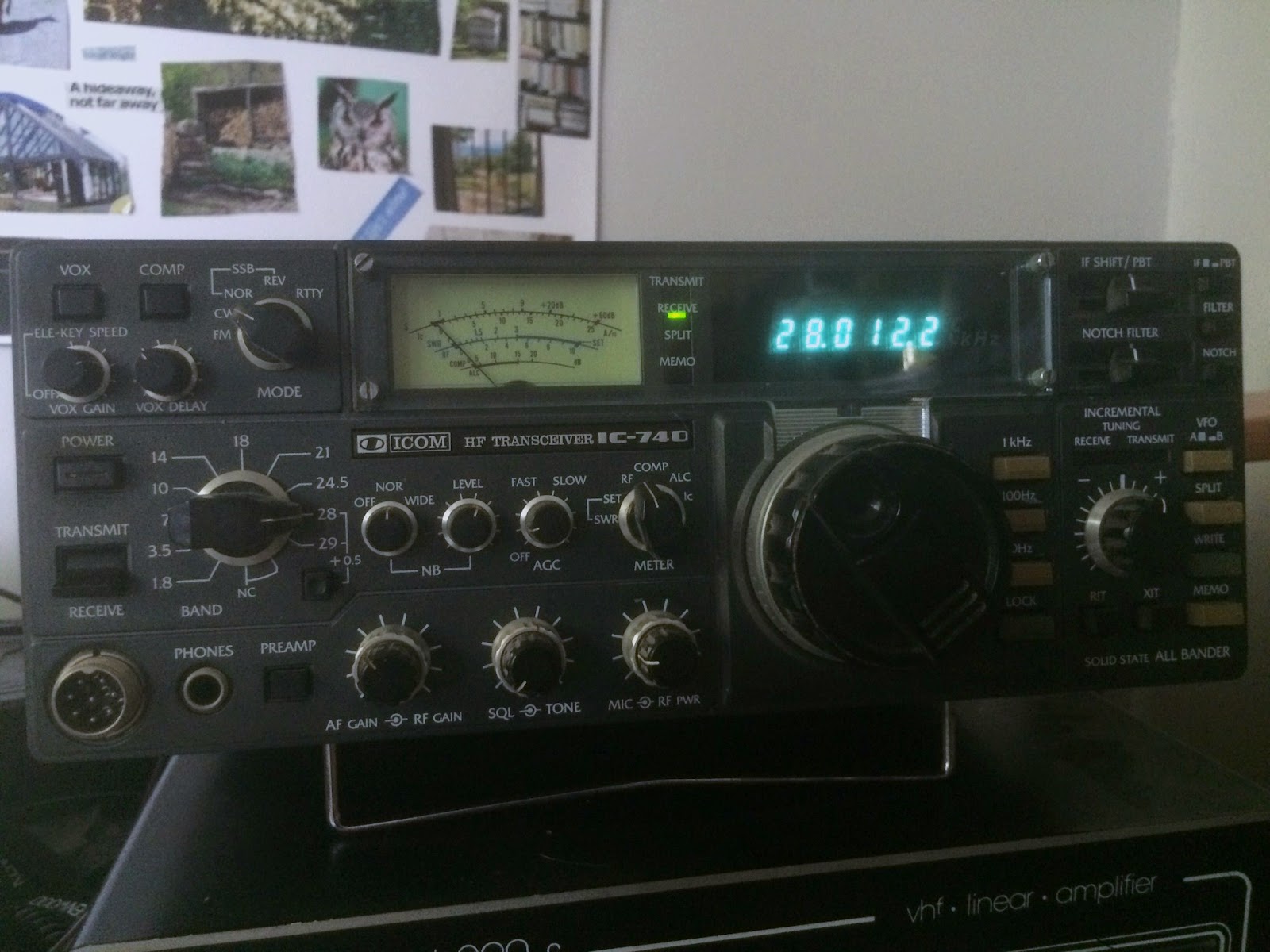
But the IC-740. There was an appeal to getting it out and going again. It was my HF rig when I first got on the air back in 1983. I knew it worked ok as I’d had a handful of contacts on it a few months back. Chasing DX, no, that wasn’t really wanted to do. Perhaps some CW – just run of the mill stuff – there have been times when I’ve found working around the UK on 7MHz CW good fun. Maybe something like that?
Finding a few minutes this afternoon, I hooked it up – plugged an aerial and a paddle in. It puts out the 85W or so that it always did. Tuned around 28MHz and quickly made a few QSOs across Europe, Asia, Africa and North America (not great conditions, but good). I listened to my old pal G3TXF doling out the QSOs as ZD9XF. Although it would be lovely to work Nigel, I don’t really feel the need to play pileups.
So maybe you’ll even hear me and the old IC740 (31 years old) around 7030 playing low power. Who knows! It’s nice to be reunited with my old friend!
Tim Kirby, G4VXE, is a regular contributor to AmateurRadio.com and writes from Oxfordshire, England. Contact him at [email protected].
Back to basics with the IC740
For the last few weeks, the IC-740 which was sitting quietly under the bench had been niggling at me. I had no HF rig on the operating bench, other than the FT-847 which gets used on VHF mostly. I’d taken the FT1000MP off the bench a while ago and didn’t feel that excited about using it. In fact, I’d thought about selling it – though haven’t really thought that through yet.
But the IC-740. There was an appeal to getting it out and going again. It was my HF rig when I first got on the air back in 1983. I knew it worked ok as I’d had a handful of contacts on it a few months back. Chasing DX, no, that wasn’t really wanted to do. Perhaps some CW – just run of the mill stuff – there have been times when I’ve found working around the UK on 7MHz CW good fun. Maybe something like that?
Finding a few minutes this afternoon, I hooked it up – plugged an aerial and a paddle in. It puts out the 85W or so that it always did. Tuned around 28MHz and quickly made a few QSOs across Europe, Asia, Africa and North America (not great conditions, but good). I listened to my old pal G3TXF doling out the QSOs as ZD9XF. Although it would be lovely to work Nigel, I don’t really feel the need to play pileups.
So maybe you’ll even hear me and the old IC740 (31 years old) around 7030 playing low power. Who knows! It’s nice to be reunited with my old friend!
Tim Kirby, G4VXE, is a regular contributor to AmateurRadio.com and writes from Oxfordshire, England. Contact him at [email protected].
The PAØRDT Active Whip….On LF
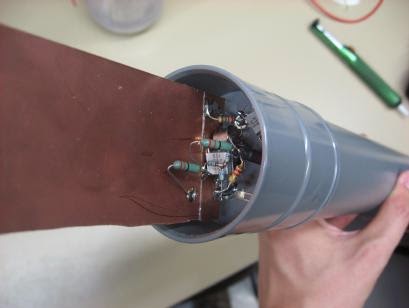 |
| The Mini-Whip at University of Twente's (Netherlands) Remote Receiver |
I think many hams believe that they need big antennas and lots of space to operate on 630m or even to listen on the band. I can assure you that big antennas are definitely not needed to listen or for that matter, even to transmit effectively.
You might be surprised at just how well you can hear on 630m using one of your low band antennas, such as an 80m or 40m dipole. Best results will be had with the coaxial feed's shield lifted from ground and connected to the center pin. This, in effect, allows your dipole to act as a top-loaded 'T', with the coaxial feedline now acting as the vertical element and the dipole section as a capacitive tophat. With a few ground radials, such an antenna can even be used for transmitting, if suitably resonated, but that's another topic altogether. Even untuned, this system will allow you to receive suitably on 630m providing your location is not inundated with high noise levels. High noise levels can often be overcome by using loops, either resonated or broadband. Loops can be very effective at nulling noise, particularly if it is coming from one direction, and vastly improving LF receive-capabilities.
Another popular solution and one that can be quite effective at lowering noise levels and improving overall signal-to-noise is the use of a short active (amplified) whip antenna. One very popular and proven design is that of Roeloff Bakker, PAØRDT. His simple-to-build active whip has been employed around the world and is being used by many LF'rs for dependable reception on the NDB band as well as on 630m. Roeloff himself operates from a noisy urban area yet manages to hear amazingly well on LF and MF with this simple antenna. Unlike a much larger wire antenna or large loop, the small active whip can be easily positioned in the quietest part of your backyard or rooftop. Often just moving such an antenna a few feet one way or the other can make a huge change in the noise level if you are operating from a typical city or suburb location....the PAØRDT whip may be all that you really need for long-term, reliable LF reception.
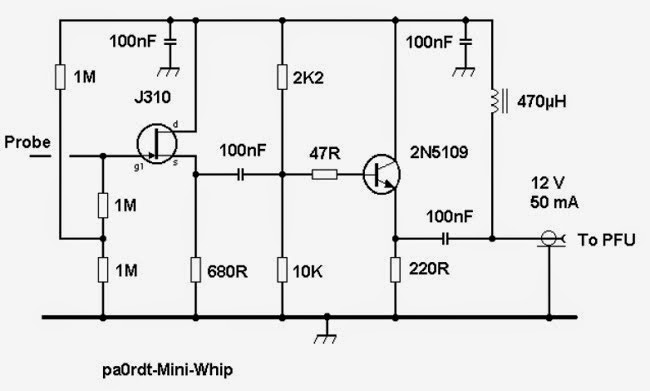 |
| Courtesy: PAØRDT |
Common practice is to mount the PCB inside a small weather-sealed PVC pipe and erect it atop a mast, after taking the time to "sniff-out" the quietest location for its placement.
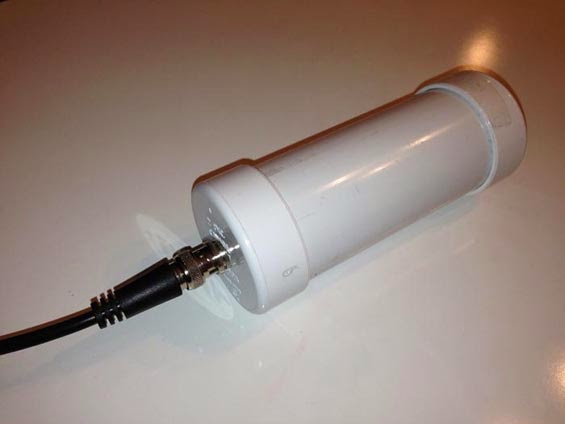 |
| Courtesy: http://www.leeszuba.com/projects/ |
With very few parts needed, the whip can be built for just a few dollars...even less with a good junkbox and the needed transistors.
 |
| Courtesy: http://www.leeszuba.com/ |
You can read Roeloff's own information on construction of the active whip here, with additional information here.
I even see the parts and PCB available on e-bay. As well, Roeloff himself, can provide finished units ready to mount in the air.
 |
| Courtesy: http://countingradios.blogspot.ca/2014_01_01_archive.html |
There are plenty of informative Mini Whip articles and construction stories on the web should you wish to learn more:
- Fundamentals of the Mini Whip by PA3FWM
- The PAØRDT Mini Whip by DL1DBC
- The Mini Whip Antenna by Lee Szuba
Steve McDonald, VE7SL, is a regular contributor to AmateurRadio.com and writes from British Columbia, Canada. Contact him at [email protected].
 Ham Radio Deluxe |
 W5SWL Electronics |
 Ham Radio Prep |
 KB3IFH QSL Cards  Hip Ham Shirts  HamRadioAuctions HamRadioAuctions Reliance Antennas Reliance Antennas Enigma Shop Enigma Shop |  morseDX  Ni4L Antennas  R&L Electronics R&L Electronics antennas.us antennas.us QRV QRV |
- Matt W1MST, Managing Editor
