 |
 Series Seven Episode Twenty – HMS Belfast (5 October 2014)
 5 October 2014 | by
 Series Seven Episode Twenty of the ICQ Amateur / Ham Radio Podcast has been released. The latest news, Martin (M1MRB & W9ICQ) and Colin (M6BOY) discuss the 2014 JOTA Event and Martin (M1MRB & W9ICQ) reviews a visit to the HMS Belfast Radio Club.
- WIA plans a submission on new VK operating conditions
- Beta release of WSJT-X v1.4
- Postage stamp features ham radio satellites
- Brazil proposes 5275 kHz to 5450 kHz allocation
- No Ham Radio 4 metre band for US
- SARL change beacon frequency
- Melbourne man guilty of Radiocommunications Act offences
Colin Butler, M6BOY, is the host of the ICQ Podcast, a weekly radio show about Amateur Radio. Contact him at [email protected].
Series Seven Episode Twenty – HMS Belfast (5 October 2014)
Series Seven Episode Twenty of the ICQ Amateur / Ham Radio Podcast has been released. The latest news, Martin (M1MRB & W9ICQ) and Colin (M6BOY) discuss the 2014 JOTA Event and Martin (M1MRB & W9ICQ) reviews a visit to the HMS Belfast Radio Club.
- WIA plans a submission on new VK operating conditions
- Beta release of WSJT-X v1.4
- Postage stamp features ham radio satellites
- Brazil proposes 5275 kHz to 5450 kHz allocation
- No Ham Radio 4 metre band for US
- SARL change beacon frequency
- Melbourne man guilty of Radiocommunications Act offences
Colin Butler, M6BOY, is the host of the ICQ Podcast, a weekly radio show about Amateur Radio. Contact him at [email protected].
Smoky Mountain SOTA Adventure
The bulk of the trip was spent on the Blue Ridge Parkway, which is a target rich environment from a SOTA perspective. The drive along the Parkway is beautiful all by itself, especially this time of year with the leaves starting to change. The Parkway is a winding road, with a speed limit of 45 mph, but because of the scenery you are tempted to drive slower. I highly recommend it.
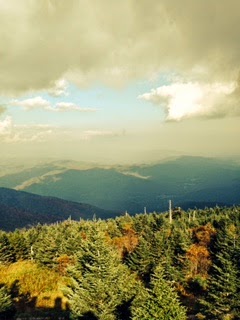
From a SOTA perspective I wanted to activate as many summits as I could in a 2 1/2 time frame. I had been wanting to do this trip for over a year and finally found a hole in my schedule and some decent weather to make the trip happen. I wanted to activate summits in both Tennessee and North Carolina as these would be new SOTA Associations for me to activate. I had some frequent flyer miles on Delta Airlines that needed to be used so we flew into Knoxville, TN. The Smoky Mountains are just a short drive south from there.
I was able to activate eight summits, seven of which were 10 pointers with the other being an 8 pointer. In order of activation they were:
Greentop W4T/SU-076
Clingmans Dome W4C/WM-001
Bunches Bald, W4C/WM-013
Waterrock Knob, W4C/WM-004
Black Balsam Knob W4C/CM-005
Mount Pisgah W4C/CM-011
Mount Mitchell W4C/CM-001
Richland Balsam W4C/WM-003
My XYL accompanied my on this trip. She is in great shape and is very helpful setting up and tearing down. Because she was with me and could carry the Alex Loop, my station consisted of Yaesu FT-817 with the 3000 MAh rechargeable battery, Pico Paddle and Alex Loop. The Alex Loop is easier to manage on crowded summits and worked well.
My operating strategy was simple, start on 20m and run the pile-up until I get several unanswered CQ's, move to 40m and get the local guys and then go to 15m to look for some DX. I had some decent DX on 15m. My typical activation takes around 25 - 30 minutes. Since these activations were during the week, I figured QSO counts would be down, however I would say they were better than I expected with 130 QSO's over 8 activations.
Greentop Mountain W4T/SU-076
This is a drive-up summit with radio towers on the top. I didn't have any trouble with RF in the radio however and had a nice activation, 16 QSOs including CU3AA and OE8SPW.
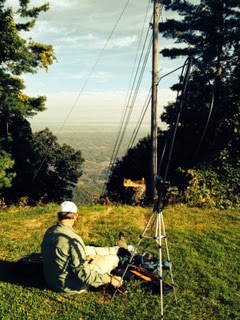 |
| Greentop Mountain |
Clingmans Dome W4C/WM-001
Clingman's Dome is a tourist attraction. While it is mostly a drive up, there is about a 1/2 mile hike to the top. Walking past all of the out of shape tourists, I felt rather fit. The trick for the operation is to avoid the crowds. I went to the left of the observation deck and down a path to a clearing next to a air monitoring station and some solar panels. Nice and quiet, away from the crowds and as you can see below, a very nice operating position. 14 QSO's from here.
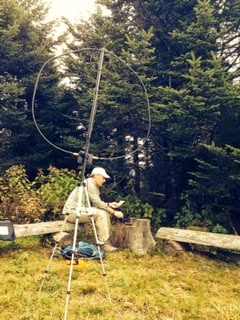 |
| Operating Position at Clingman's Dome |
Bunches Bald W4C/WM-013
As much as Clingman's Dome is a tourist attraction, Bunches Bald is not. It's off the beaten path on the backside of a campground. Got to SotaWatch for more details, but at the back of campsite #14 there is a faint trail to the summit. The hike is probably less that a 1/4 of a mile, but it is through some fairly dense woods/undergrowth, however the trail makes it easier. The summit is very small, so I wouldn't count on two different stations if you do it with someone. I made 27 QSO's from here including EA2LU and F5UBH.
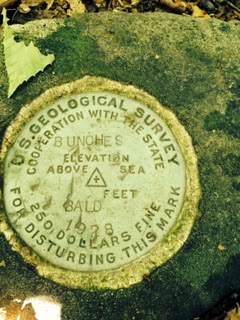 |
| Benchmark on Bunches Bald |
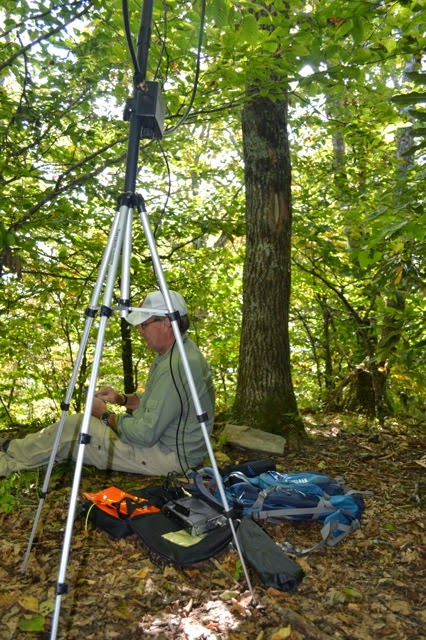 |
| Operating from Bunches Bald |
Waterrock Knob W4C/WM-004
Waterrock Knob has a visitor center, toilets and a nice trail to the summit. While the trail is nice its a challenging little hike, not too long, but steep in places. Wonderful views from here. 16 QSO's from here including EA2LU, EA2IF and CU3AA.
 |
| View from Waterrock Knob |
This finished off the first day. As you can see from the pictures, the weather was glorious and the scenery fantastic. The XYL and I finished off the with a nice pizza pie.
Black Balsam Knob W4C/CM-005
This is a unique summit for the area in that there are no trees on top. I'm sure there is some reasonable explanation but I didn't talk to anyone who knew. I would have guessed that this summit would have "bald" in the name since it has no trees, however, it's a "knob". Bunches Bald, is anything but bald as it has lots of trees and undergrowth on the summit. Go figure. From the trailhead this is probably a 2 mile roundtrip but not a bad hike at all. Because there are no trees on the summit you can see for miles and miles. Beautiful!! 22 QSO's from here including EA2LU and DJ5AV.
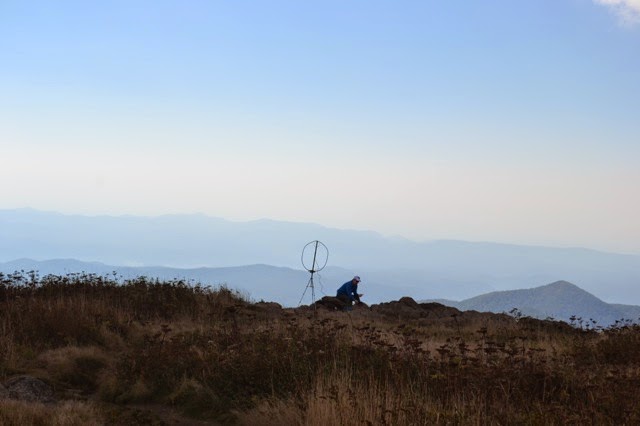 |
| Operating from Black Balsam Knob |
Mt. Pisgah W4C/CM-011
This is a classic hike in the region. It's 3 miles round trip and gains 750 vertical feet, however the first third of a mile is relatively flat, so most of the vertical gain comes over the last mile. The trail is well shaded, but the trail is rock laden, be sure to wear supportive shoes. Pisgah is a summit that will, at most any given time, have 5 -10 people on top. There is an observation deck, however, based on N1EU's recommendation, I crossed under the tower and operated from the other side of the tower opposite the observation deck. I made 15 QSO's from here including a couple of EA's.
 |
| Operating from Mt. Pisgah |
 |
| My XYL Cris on the trail to Mt. Pisgah |
Mt Mitchell W4C/CM-001
Mt. Mitchell is located in Mt. Mitchell State Park. The mountain is the tallest mountain east of the Mississippi. There is a nice road to just below the summit, which is just a short walk away. This is another summit with an observation deck and as before I walked to opposite side of the summit from the deck. I found a nice flat rock to operate from. I made 16 QSO's from here including CU3AA.
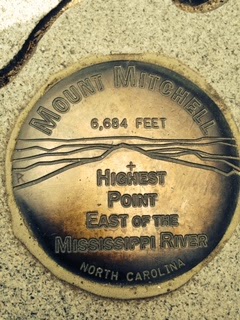 |
| Mt. Mitchel Benchmark |
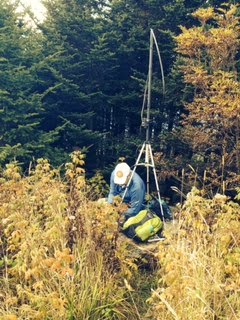 |
| Operating from Mt. Mitchell |
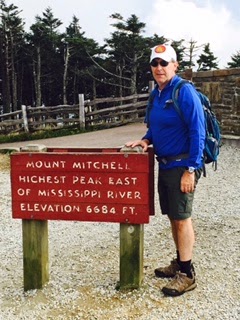 |
| Mt. Mitchell Summit |
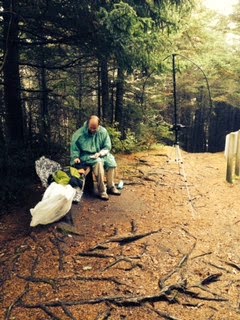 |
| Operating from Richland Balsam just before a rain |
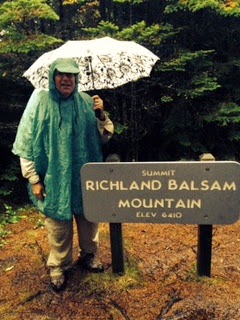 |
| Departing Richland Balsam in the rain |
Mike Crownover, AD5A, is a regular contributor to AmateurRadio.com and writes from Texas, USA. Contact him at [email protected].
Times have changed
Here's the sticky part. I made my message as brief as possible, but it still came to a check of 27. And I got to listen about it. Yes, I understand the ARRL message form has lines for 25 words, but c'mon, really?
These messages were local in scope and weren't bound for the Second Region Net or anything like that. And it was only two stinkin' words over. You're going to give me flack for that? I hate to sound like an old crotchety curmudgeon, but back in the day, we sometimes handled messages with checks as long as 30 or even sometimes 35 words. And if some evening, you're lucky enough to get a ton of check ins, you're not going to send a net report because it would be over 25 words?
Seems to me the NTS should be begging for traffic, not making remarks so that people couldn't be bothered.
72 de Larry W2LJ
QRP - When you care to send the very least!
Larry Makoski, W2LJ, is a regular contributor to AmateurRadio.com and writes from New Jersey, USA. Contact him at [email protected].
Echolink node update
Well the node is up and seems to be running reasonably well. The software is reporting distortion on the input but I think that is more to do with the close rf during testing. There are now some isolating transformers and a resistor in series to knock back a bit of signal and it seems to be ok when I connect through the web interface. Perhaps some other measures might help. Its still running on vox but until I can work out how to do the ptt easily I’ll stick with that.
I’ll leave it on for a while and see what I get back from the locals. Here’s a reminder of the details
Callsign – MB7IAH-L
Node number – 243350
Freq – 144.9625 Mhz
CTCSS – 103.5Hz
Power – 1.6w (hold onto your rf hats!)
Antenna – 1/2 wave dipole
All powered by a Raspberry Pi, Svxlink and a Baofeng UV-5R.
Enjoy
Alex Hill, G7KSE, is a regular contributor to AmateurRadio.com and writes from Cumbria, UK. Contact him at [email protected].
Alaska from Eagle Pond with 5 Watts
Judy and I rode our bikes from Andover to Wilmot on the old Northern Rail route. I worked Germany, Alaska, Grand Turk Island, and New Mexico. It was a gorgeous day.

We rode our bikes for about half an hour and settled down on the little beach at Eagle Pond. I tossed a line into an oak tree on the shore, pulled up a 33 foot wire, and set up the KX3. Judy lay down for some sun. I tuned up on 15 meters and found Frank DL1REM in Germany calling CQ. He was very strong and gave me a 579. “CONGRATS FOR UR QRP SIG,” he sent. “REAL FB SIG.” Then I switched to 12 meters and worked W1AW/KL7 in Alaska! Imagine working Alaska with 5 watts and a wire from the middle of nowhere. What a thrill. I gave a listen to 10 meters and there was Paul KW7D in New Mexico calling CQ. Paul also gave me a 579 and we had a quick chat. To finish up, I went to 17 meters and worked VP5/G3SWH on Grand Turk Island.

We rode back through woods and fields turning gold with fall colors. We couldn’t have had a nicer outing.
Jim Cluett, W1PID, is a regular contributor to AmateurRadio.com and writes from New Hampshire, USA. Contact him at [email protected].
This Spewed Out of the Internet #29
 More important
 information insight stuff spewing forth from the interwebz:
The actor Tim Allen, who’s character on the TV show Last Man Standing is a ham radio operator, recently received his Technician License. According to Wikipedia, Allen holds the callsign KK6OTD under the name Tim Dick.
The FCC says that Marriott has been interfering with their customers’ use of WiFi hotspots at the Gaylord Opryland Hotel and Convention Center in Nashville, Tennessee. It seems that they wanted to “encourage” customers to pay for WiFi service.
ICOM has made available some cool amateur radio guides on their web site, including a World Map, USA Band Plan Chart and a USA VHF Grid Map. Oh, ICOM, please note that those grid locators are not actually “squares.”
Those Ham Hijinks guys must have bought a new ribbon for their typewriter since they’ve cranked our these articles: Obama Signs Ham Radio Executive Order and Man Creates Multi-Purpose Rotator.
Over at HamRadioSchool.com, I added another Shack Talk article, this one about ham radio awards: Operating Awards: Chasing Wallpaper.
73, Bob K0NR
Bob Witte, KØNR, is a regular contributor to AmateurRadio.com and writes from Colorado, USA. Contact him at [email protected].
 Ham Radio Deluxe |
 W5SWL Electronics |
 Ham Radio Prep |
 KB3IFH QSL Cards  Hip Ham Shirts  HamRadioAuctions HamRadioAuctions Reliance Antennas Reliance Antennas Enigma Shop Enigma Shop |  morseDX  Ni4L Antennas  R&L Electronics R&L Electronics antennas.us antennas.us QRV QRV |
- Matt W1MST, Managing Editor
