 |
 ’29 Style Transmitters…What To Build? – Part 2
 24 October 2014 | by
When it comes to putting a transmitter together for the BK, there are a lot of choices! My advice for a first-build '29 rig would be either a simple TNT or a Hartley-style oscillator. Both are easy to get operating and, when correctly optimized, are capable of putting out a nice-sounding signal.
For a first-time build, with the main objective being to have something ready in time for the December BK, I would not be concerned about overall appearance or period-appropriate parts. For now, the only thing that must be period-appropriate is the tube...improvements can come later.
As well, I would not be overly-concerned about running the maximum power of 10W input. If you are able to get a type '10' or the equivalent VT-25, or a pair of 45's, then the legal-limit is easily within reach. Utilizing something smaller, at just a few watts output, should not be considered a deterrent, as BK-operators all seem to have very good ears. Just 2 or 3 watts will guarantee plenty of contacts no matter where you are located!

Shown above is a fine little TNT built by Kevin, WB2QMY, in New York. It uses a very affordable UX-201A triode, originally manufactured in 1925 for radio receivers. Although Kevin's TNT puts out barely 2 watts on 80m CW, we had no trouble working each other in a recent BK QSO Party. If you build it, they will come!
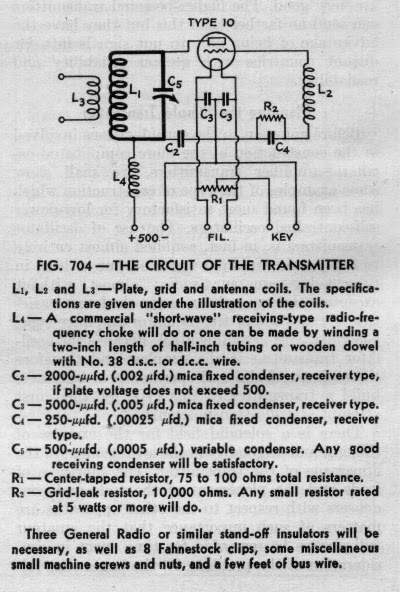
If you prefer to tackle a TNT, here is the information you will need. This circuit appeared for several years in the ARRL Handbook's transmitter-section. I suspect that it was probably built by thousands of young hams in the late 20's and early 30's and affordably introduced most of them to the magic of radio. For more building details, including how to keep high-voltage off of the main tank coil, see the information on my website describing the TNT project.
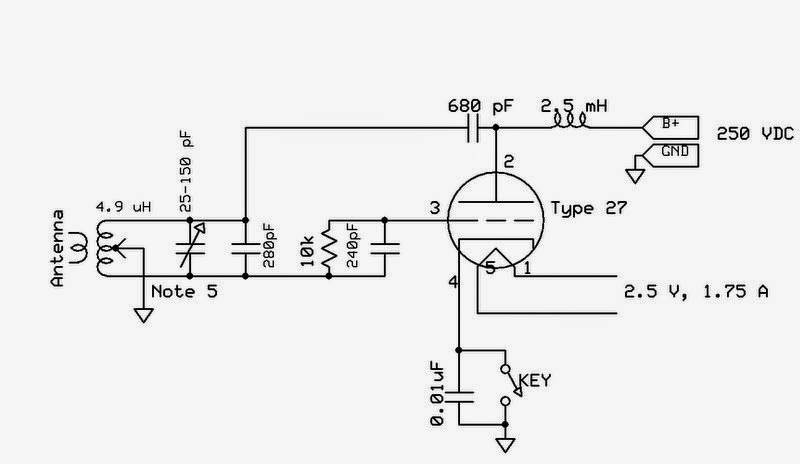
Should you be interested in tackling a Hartley, here is an interesting circuit described by Nick, WA5BDU.
 |
| Courtesy: WA5BDU |
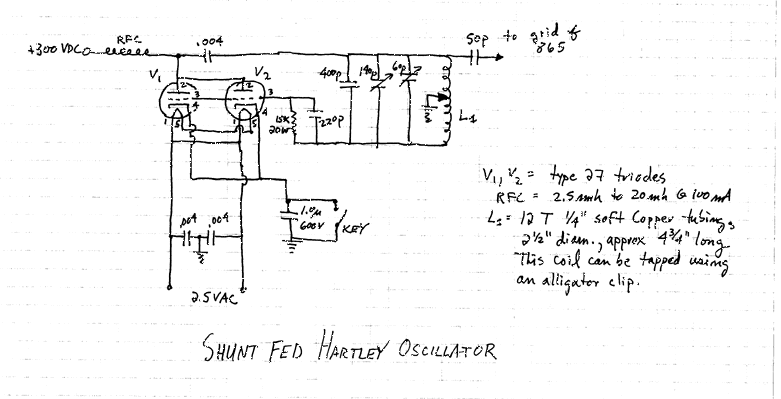
Such a transmitter would readily lend itself to a parallel arrangement of two or more triodes, such as the 27 or the 45 and would develop good power levels inexpensively.
ABØCW has designed a Hartley oscillator using a pair of 27's in parallel and uses them to drive a small amplifier. As described on his website, the oscillator would make a fine stand-alone transmitter with a simple link-coupling antenna circuit.
 |
| Courtesy: ABØCW |
You can find a list of '29-style related building links, as well as a gallery of transmitters constructed by others, at the bottom of my TNT web page here.
And....circuit ideas, help with parts and lots of BK-chat can always be found at the Yahoo AWAGroup where the focus is mainly on building and operating.
Steve McDonald, VE7SL, is a regular contributor to AmateurRadio.com and writes from British Columbia, Canada. Contact him at [email protected].
LHS Episode #134: Boxers, For Sure
 In today’s episode, we have our final listener interview from the Hamvention 2014 Indiegogo campaign that actually ended back in February. Mike Maydaniuk, VA7XXM, was kind enough to donate to our Hamvention ambitions, and now comes on the show to share with us his thoughts on Linux, amateur radio, life, and some random silliness. Hope you enjoy, and please make sure to send us feedback, either via e-mail, social media or voice mail.
73 de The LHS Guys
Russ Woodman, K5TUX, co-hosts the Linux in the Ham Shack podcast which is available for download in both MP3 and OGG audio format. Contact him at [email protected].
Amateur Radio Newsline Report 1941 October 24 2014
- Hams in the Philippines to assist in Manila crime watch
- The Sun unleashes an X class flare on October 22
- China launches a ham radio payload to circle the moon
- CQ clarifies policy statement in regard to Crimea in contest scoring
- VA announces plans for its own High Frequency radio network
- Russia plans to launch newly designed smart mini satellites
- How to collect cosmic rays on a smart phone
Genesis Q5 1W QRP TX – not available?
I have been told that this 1W QRP TX from Australia, mentioned on the blog a few days ago, may no longer be available to order. I suggest you email the address on the Genesis website to see if it can be ordered. Certainly some of the SDR transceiver kits are only available in limited numbers. I am sorry if I got some hopes up only to be dashed.
See http://www.genesisradio.com.au/Q5/ . The website gives detailed schematics so you could always “roll your own”.

Roger Lapthorn, G3XBM, is a regular contributor to AmateurRadio.com and writes from Cambridge, England.
Will the latest Windows update kill your HT programming cable?

The interwebs are abuzz with reports that the latest Windows update is killing counterfeit FTDI chips. Future Technology Devices International (FTDI) — according to Wikipedia — “develops, manufactures, and supports devices and their related software drivers for converting RS-232 or TTL serial transmissions to USB signals, in order to allow support for legacy devices with modern computers.”
The latest Windows update includes a new driver that is apparently “bricking” the knock-off FTDI FT232 chips by programming the USB PID to zero. This causes the device containing the chip to become inaccessible on any operating system. After the PID reset, apparently the programming cable itself will be rendered inoperable even on a non-Windows computer running Mac OS or Linux.
What might you have around the shack that could contain a counterfeit FTDI chip? Well, lots of things including that cheap USB radio programming cable you picked up on eBay. It’s not yet clear whether the affected FTDI chips are in any widely distributed radio programming cables.
While many radio programming cables advertise that they contain genuine FTDI chips, a post earlier this year on Hackaday shows that it’s not always easy to tell a fake from the real thing. One difference, apparently, is that the markings are laser etched on the genuine chip are often just printed onto the fakes.
If you experience a “bricked” cable due to this update, please report your experience in the comments including any details about the cable you were using.
Matt Thomas, W1MST, is the managing editor of AmateurRadio.com. Contact him at [email protected].
Hunting For NDBs In CLE187
 |
| VR-266 Vancouver Int'l (50W) - heard as far east as NC |
These listening events serve several purposes. They:
- determine, worldwide, which beacons are actually in service and on-the-air so the online database can be kept up-to-date
- determine, worldwide, which beacons are out-of-service or have gone silent since the last CLE covering this range
- will indicate the state of propagation conditions at the various participant locations
- will give you an indication of how well your LF/MF receiving system is working
- give participants a fun yet challenging activity to keep their listening skills honed
Days: Friday 24th October - Monday 27th October
Times: Midday on Friday to Midday on Monday, your LOCAL time
QRG: Normal LF/MF frequencies (190 - 1740 kHz)
NDBs: Normal DX and 'HOME' ones (not DGPS, Navtex or Amateur)
DX:
Please try to log NDBs that are over 2,000 km / 1,250 miles from you.
If you have a wall map in your shack, you could draw a circle on it.
It will be accurate if it is a great circle map centred on your location.
(There are other easy and very good ways to find which NDBs qualify
for you - I will describe them in the Final Details email)
HOME:
Please also try to log NDBs in YOUR OWN radio country. For listeners
in AUS, CAN and USA, that means your State or Province.
It will be trivial for a few of us in tiny radio countries, very challenging
for a listener in, e.g., RUS (Eu). Most of us should have a fair list to
try for.
If we also mention any of our home regulars NOT heard, it will help
others to know about NDBs that are not currently active.
If you report on both parts, DX and HOME, I suggest you put them in
separate parts of your log. As usual, any UNIDs that you come across
will also be of interest - in a third part of your log.
Final details can be found at the NDB List website, and worldwide results, for every participant, will be posted here a few days after the event.
The very active Yahoo ndblist Group is a great place to learn more about the 'Art of NDB DXing' or to meet other listeners in your region. There is a lot of good information available there and new members are always very welcome.
If you are contemplating getting started on 630m, listening for NDBs is an excellent way to test out your receive capabilities as there are several NDBs located near this part of the spectrum.
You need not be an ndblist member to participate in the CLEs and all reports, no matter how small, are of much value to the organizers.
Reports may be sent to the ndblist or e-mailed to either myself or CLE co- ordinator, Brian Keyte (G3SIA). It was very exciting to see two new reporters to last month's event after reading about the CLE right here. Hopefully there will be more first-time reporters for upcoming CLE187.
Please...don't be shy and do give the CLE a try....then let us know what NDB's can be heard from your location! Your report can then be added to the worldwide database.
Steve McDonald, VE7SL, is a regular contributor to AmateurRadio.com and writes from British Columbia, Canada. Contact him at [email protected].
Genesis Q5 1W QRP kit from Australia
 |
| http://genesisradio.com.au/Q5/q5_1.jpg |
A trawl of the internet earlier found this kit, a 1W QRP transmitter for any band from 3.5MHz to 14MHz. It is available for S19.95 (US Dollars) + S9 (US Dollars) shipped anywhere worldwide. That seems pretty good value. Also on the website are SDR transceivers.
I last showed this particular kit on my blog 5 years ago.
See http://www.genesisradio.com.au/Q5/ for more details including how to order the various kits. Details on the page include parts lists, schematics and building details.
The are some pretty good SDR transceivers on this site.

Roger Lapthorn, G3XBM, is a regular contributor to AmateurRadio.com and writes from Cambridge, England.
 Ham Radio Deluxe |
 W5SWL Electronics |
 Ham Radio Prep |
 KB3IFH QSL Cards  Hip Ham Shirts  HamRadioAuctions HamRadioAuctions Reliance Antennas Reliance Antennas Enigma Shop Enigma Shop |  morseDX  Ni4L Antennas  R&L Electronics R&L Electronics antennas.us antennas.us QRV QRV |
- Matt W1MST, Managing Editor
