 |
 Waiting For The Magic
 18 December 2014 | by
  |
| Courtesy: http://www.noaa.gov/ |
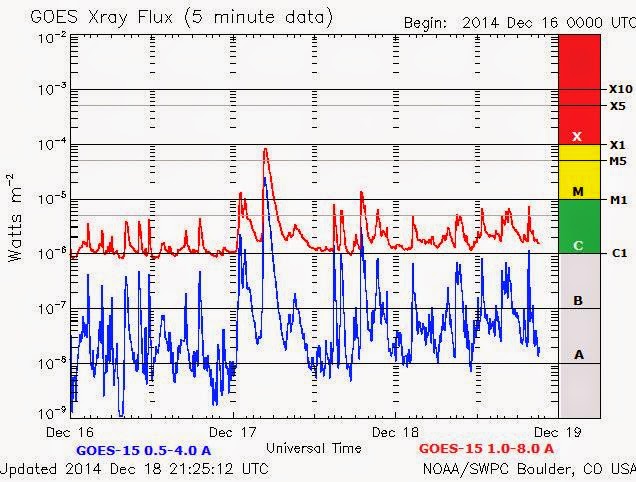
The last time the sun did this, at the end of November, I was able to work two stations in Florida on F2 during a short surge in the MUF that had been hovering in the 46-47MHz range. Maybe we'll all get lucky again soon if solar activity continues to climb.
 |
| Courtesy: http://www.noaa.gov/ |
Today's rise in the MUF was a disappointment as the highest I saw was about 43MHz, for a brief few moments. The MUF then dropped back below 37MHz but continued to surge into the high 39's.
This short video, made today at around noon, shows the MUF surging....the band full of signals one moment and then empty the next. The region between 10m and 6m is chalk-full of commercial FM activity (police, fire, utility, etc) and makes and excellent way of monitoring the trend in MUF growth...at times it seems that the F layer is alive and breathing as it trys, usually without success, to climb higher and higher. One of stations in the video appears to be from Maryland, on the typical E-W propagation path seen at this time of the year. My receiving antenna is my normal 4-el 6m Yagi, which must be horribly inefficient at this frequency yet...notice how strong signals can be when they are propagating right at the edge of the MUF:
Steve McDonald, VE7SL, is a regular contributor to AmateurRadio.com and writes from British Columbia, Canada. Contact him at [email protected].
IC7000 CAT control….flaky at best
I’ve just about had enough of rig CAT control with my IC7000. After buying 4 different CAT interfaces and attempting for numerous hours to get the things working, some of which do for a while, I’ve stripped away the (lack of) capability.
One of the more frustrating aspects of this hobby is that whilst some areas move on, some just relentlessly remain steady in the mediocre. The argument between serial and USB is about as dead as it can be but us with serial to USB converters get short shrift.
I like my IC7000. Its my main rig but when it comes to rig control with a PC then its been a complete disaster, working one minute then not, then back to working again. Oddly enough my IC703 before it wasn’t too bad but this one refuses to behave for any length of time.
The last straw was to plump for a complete reset, removing all my memories and leaving me with a blank rig and still no CAT control.
Anyone want to buy a partially used G4ZLP digimaster pro?
Alex Hill, G7KSE, is a regular contributor to AmateurRadio.com and writes from Cumbria, UK. Contact him at [email protected].
10m transceivers
Looking on the internet, there is a wide selection of 10m (28-29.7MHz) transceivers available. Many can be extended (illegally in the UK) to cover CB frequencies.
As an example, the Alinco DR135 is available for £144.99. I am sure shopping around will show that lower prices are possible. This rig was available (special offer) for less than £100 recently. At one time, single band 10m rigs were illegal in the UK. This is no longer the case and these rigs can be a low cost way of getting on this most interesting band.

Roger Lapthorn, G3XBM, is a regular contributor to AmateurRadio.com and writes from Cambridge, England.
1929 BK QSO Party Fun

 |
| Courtesy: http://www.spaceweatherlive.com |
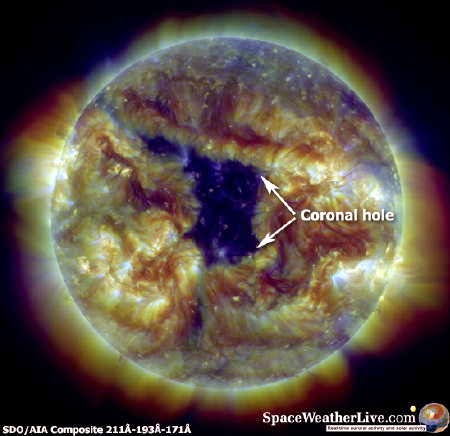
Not to disappoint, the usual BK winds came up, right on schedule as well, almost coincidental with the start of the Party. Thankfully, weekend number two saw no wind whatsoever....a rare event in December....but, from the sound of many other notes, I wasn't the only one having windy weather.
DE6 2317 40 N1BUG 568 449 TNT 29 10 PAUL ME
DE6 2322 40 WA1JAS 569 559 HART 29 8 MIKE ME
DE6 2347 40 W7LNG 567 578 TNT 29 6 BUD OR
DE6 2352 40 VE7BDQ 599 599 COLP 29 10 JOHN BC
DE7 0014 40 K7SF 578 579 TNT 29 10 STEVE OR
DE7 0105 40 NE1S 449 449 TNT 29 9 LARRY ME
DE7 0120 40 WB2AWQ 579 569 HART 29 10 HOWIE NV
DE7 0133 40 K4JYS 449 449 TNT 29 10 BILL NC
DE7 0145 40 WB8APR 559 449 MOPA 29 5 JOHN MI
DE12 2257 40 K0KP 579 559 HART 29 9 REX MN
DE6 0202 80 AB0CW 559 549 HART 29 5 MARK CO
DE6 0317 80 KK7UV 599 599 HART 28 9 STEVE MT
DE6 0329 80 KE0Z 559 559 HART 29 8 WILL SD
DE6 0356 80 N1BUG 449 559 TNT 29 10 PAUL ME
DE6 0403 80 KC9WYV 579 539 MOPA 29 9 JOE MN
DE6 0415 80 VE7BDQ 599 599 COLP 29 10 JOHN BC
DE6 0422 80 AA2YV 439 449 HART 29 10 BILL NY
DE6 0438 80 N8YE 559 569 TPTG 25 9 STEVE OH
DE6 0442 80 W7LNG 578 588 TNT 29 9 BUD OR
DE6 0524 80 K0KP 599 589 HART 29 9 REX MN
DE6 0530 80 W2ICE/0 579 339 COLP 29 10 SCOTT MN
DE6 0539 80 VE3AWA 578 339 TNT 29 10 LOU ON
DE6 0548 80 KI0DB 559 579 MOPA 29 10 MARK MN
DE6 1229 80 W0LGU 559 559 MOPA 29 9 TOM MN
DE6 1240 80 K0KCY 559 449 MOPA 29 10 TONY MN
DE12 0352 80 KB0ROB 569 569 MOPA 29 9 HAROLD MN
DE12 0427 80 W8KGI 559 448 MOPA 29 10 JIM NM
DE12 0440 80 W0VLZ 559 339 TNT 29 10 NIEL MN
DE12 0509 80 K4JYS 559 559 HART 29 15 BILL NC
DE12 0512 80 WB9WHG 569 449 MOPA 29 20 DAVE WI
DE12 0524 80 W0LS 599 579 HART 29 9 HARRY MN
DE12 0401 160 KK7UV 579 559 HART 28 10 STEVE MT
DE12 0539 160 VE7BDQ 599 599 COLP 29 10 JOHN BC
DE12 0542 160 W0LS 559 559 HART 29 9 HARRY
More information on '29 building may be found here in previous "'29-style blogs" and good project discussions always abound at the Yahoo "AWA Group" builder's site.
It's really not too early to start building for next year's BK!
Steve McDonald, VE7SL, is a regular contributor to AmateurRadio.com and writes from British Columbia, Canada. Contact him at [email protected].
Ultimate 3 WSPR (and other modes) beacon
The Ultimate3 QRSS/WSPR Transmitter Kit is the third version in the “Ultimate” QRSS/WSPR kit trilogy. It can produce QRSS, Hell, WSPR, Opera and PI4 slow-signal modes anywhere from audio to 10m and above. Plug-in LPF filters are available for all 12 HF/MF/LF bands.
The price is USD $29.00. To order please visit QRP Labs.
The Ultimate 3 is probably the lowest cost beacon available. I still have my unbuilt kit awaiting better health to build, although several kind folk have offered to build mine for me. Jay W5OLF kindly supplied me a 10m 500mW, single PCB, WSPR beacon (WSPR-AXE-CW) ready assembled and that has blown me away: it has been copied in every continent on 10m. The Ultimate 3 is the more flexible design but the WSPR-AXE-CW is an ideal tiny WSPR only beacon.
My Ultimate 3 kit was ordered with GPS, but it was supplied without this, but with an extra PCB – I think I got the wrong order. I really should write to Hans Summers, but I have been too unwell. For now, the kit remains unbuilt. I intend to build it when I am fitter and less clumsy, hopefully in 2015.

Roger Lapthorn, G3XBM, is a regular contributor to AmateurRadio.com and writes from Cambridge, England.
RSGB Volunteer 2015
 Its been quite some time since I have added anything to my blog, and indeed quiet some time since I’ve added any videos. Don’t worry though, everything is fine, I’ve just been really busy on other projects.
Radio and all radio related items has taken quite a large step back over the past 6 months, work commitments and other personal commitments have really swallowed up any spare minutes that I have.
However I have still kept up with the distance learning classes and also been involved in the upcoming Club Relay for 2015 (now 2016) for the RSGB. So its not all lost.
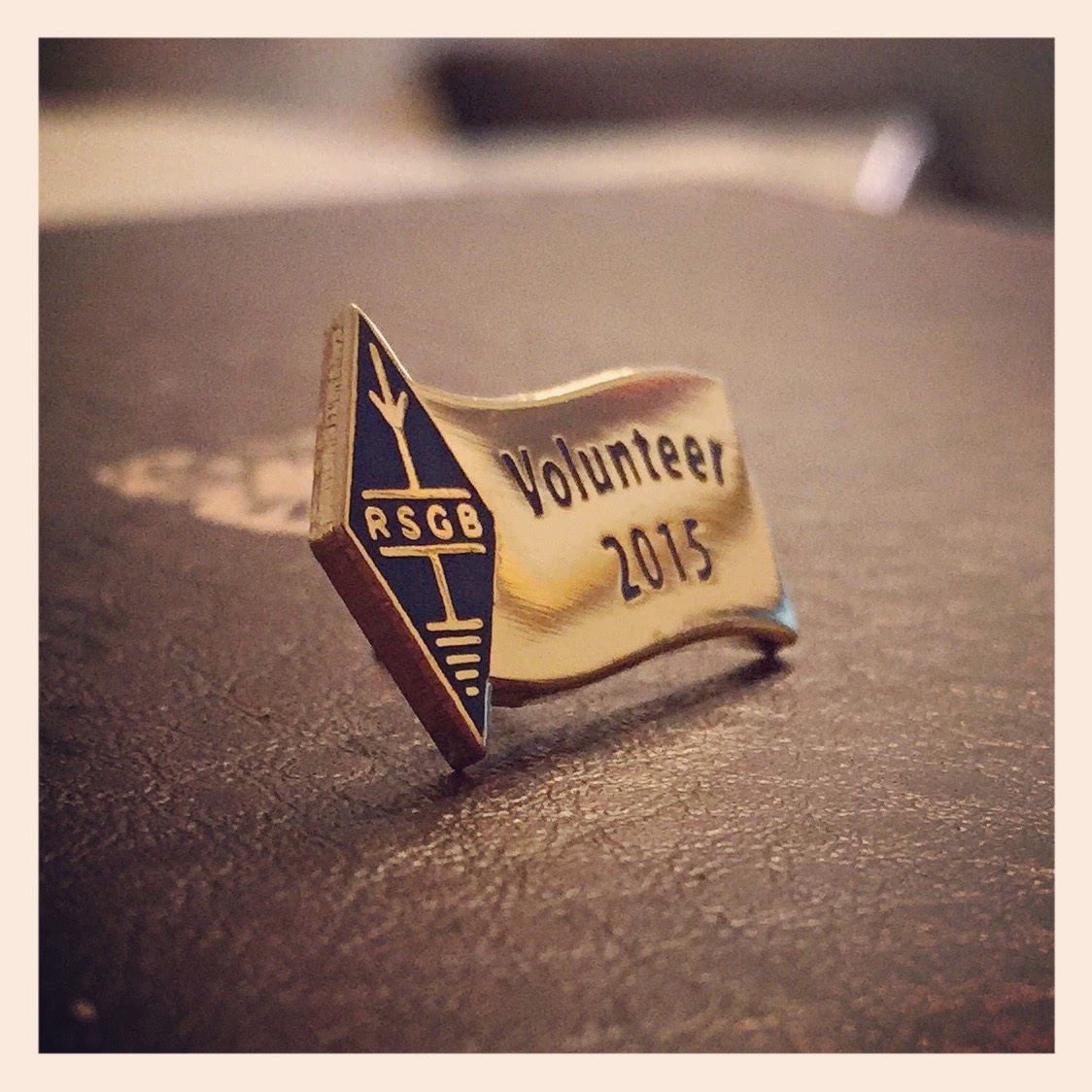
So what has prompted the sudden blog entry ? well I received this week a Volunteer 2015 badge for the RSGB for all the activities I have completed over the past 12 months. For which I’m very grateful for the recognition.
It got me thinking – how we take the RSGB for granted, and indeed watching other constantly belittle the society, how we should actually take a moment and celebrate the society and everything that it has accomplished over the past years.
I even wrote a quick entry on the RSGB unofficial Facebook page, which is often a melting pot full of moans and groans – and I added that we should all note down what makes up proud to be a member, and add an open thanks to things that the society has done for us.
A few liked the posting but even better quite a few agreed with my comments and also added what they are proud of and how the Society had helped them.
Its times like this that we really should step back form the immediate issues that we face in the hobby and remind ourselves – its just a hobby. We all volunteer, we all do out best, and we really should be grateful for what we have achieved.
This is likely to be the last post of 2014 – so until next year (and I promise not to leave it so long) have a very happy Christmas and happy new year.
Dan Trudgian, MØTGN, is a regular contributor to AmateurRadio.com and writes from Wiltshire, England. He's a radio nut, IT guru, general good guy and an all round good egg. Contact him him here.
RSGB Volunteer 2015
Its been quite some time since I have added anything to my blog, and indeed quiet some time since I’ve added any videos. Don’t worry though, everything is fine, I’ve just been really busy on other projects.
Radio and all radio related items has taken quite a large step back over the past 6 months, work commitments and other personal commitments have really swallowed up any spare minutes that I have.
However I have still kept up with the distance learning classes and also been involved in the upcoming Club Relay for 2015 (now 2016) for the RSGB. So its not all lost.
So what has prompted the sudden blog entry ? well I received this week a Volunteer 2015 badge for the RSGB for all the activities I have completed over the past 12 months. For which I’m very grateful for the recognition.
It got me thinking – how we take the RSGB for granted, and indeed watching other constantly belittle the society, how we should actually take a moment and celebrate the society and everything that it has accomplished over the past years.
I even wrote a quick entry on the RSGB unofficial Facebook page, which is often a melting pot full of moans and groans – and I added that we should all note down what makes up proud to be a member, and add an open thanks to things that the society has done for us.
A few liked the posting but even better quite a few agreed with my comments and also added what they are proud of and how the Society had helped them.
Its times like this that we really should step back form the immediate issues that we face in the hobby and remind ourselves – its just a hobby. We all volunteer, we all do out best, and we really should be grateful for what we have achieved.
This is likely to be the last post of 2014 – so until next year (and I promise not to leave it so long) have a very happy Christmas and happy new year.
Dan Trudgian, MØTGN, is a regular contributor to AmateurRadio.com and writes from Wiltshire, England. He's a radio nut, IT guru, general good guy and an all round good egg. Contact him him here.
 Ham Radio Deluxe |
 W5SWL Electronics |
 Ham Radio Prep |
 KB3IFH QSL Cards  Hip Ham Shirts  HamRadioAuctions HamRadioAuctions Reliance Antennas Reliance Antennas Enigma Shop Enigma Shop |  morseDX  Ni4L Antennas  R&L Electronics R&L Electronics antennas.us antennas.us QRV QRV |
- Matt W1MST, Managing Editor
