 |
 Bugs: My New Fascination
 13 January 2015 | by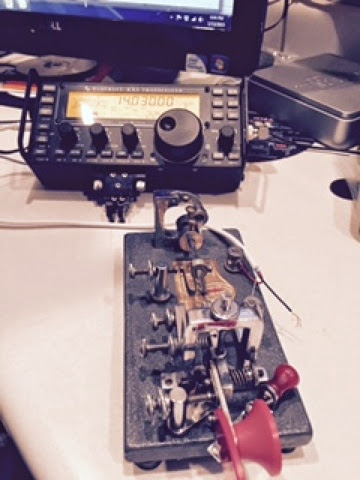
Mike Crownover, AD5A, is a regular contributor to AmateurRadio.com and writes from Texas, USA. Contact him at [email protected].
50 Years (and counting…)
Being a ham for 50 years could mean as little as remembering to renew a never-used license every 10 years (5 years in the early days), or as much as sitting at the top of the DX Honor Roll, being ARRL President, or winning DX contests with a huge multi-multi station.
Most of us who make it to 50 will be somewhere in between. A modest station, a few HT’s, maybe being a club officer for a few years. There’s a good chance that ham radio helped our career, and a fair chance that it established that career. We’ve had a lot of contacts, made some friends, and had fun. Our interest may have waxed and waned here and there. Maybe we specialized in one mode or activity, and maybe that shifted over the years. We may share the hobby with family, or we may be the odd duck. There’s a lot of room for variety.
I made it to 50 last Sunday, January 11. I count the time from my first log book entry as a Novice: January 11, 1965, on 40 meter cw as WN9NSO. I lost (misplaced, not “FCC-lost”) my original Novice license long ago, but I kept the logs. Those first few contacts were pretty rough. I don’t remember them specifically, but the logs bring back an image of a very nervous 15-year-old, trying to put all the practice to the test, and falling well short of perfection. But I got better.
I could write more about it, but these days I make TV shows about ham radio, so of course, on Sunday, I pushed record and talked about it. I had a guest – Rich Casey N5CSU – but I knew Rich as WA9LRI, and actually WN9LRI, the first time I talked to him. We followed each other thru ham interests in the Chicago area in the 60’s and 70’s, but were pretty much out of touch until a year or three ago. Rich posted some stuff on the ARRL PR Committee mailing list about the interest he’s had in ham radio on social media. We swapped email about doing a show on that, but it never hit the top of the list. Then, as I was preparing for my “Big 50” show, I was looking over those old logs. Up near the top was WN9LRI.
I figured I’d stone two birds with one show, and we’d talk nostalgia for maybe a half hour, then switch to social media. I’m not anti-Facebook, Twitter and the others (though I did spend some time being trendy about considering them a big waste of time). I have accounts on some of them, mostly to let people know when a new show has been uploaded to YouTube. But I don’t navigate them very well, and figured we could all stand to learn a little more about how to get something useful out of them.
The first hour passed, and we were still deep in history. So much for bookending this show with the old and the new. Rich was itching to see the Dallas/Green Bay playoff game, which started early in the second hour of our Skype chat (Rich moved to Dallas back in ’78, so he’s a Texan now…). I took pity on him (and you, the audience) at the end of the second hour, and stopped the music, with a promise to come back soon for another show on the social stuff.
The show’s been on-line for a few days now, and I’ve gotten some kind comments from viewers who’ve enjoyed our talk. Even if you really like it, you don’t have to watch it all at once. That’s what the pause button is for.
Gary Pearce, KN4AQ, is the host of HamRadioNow.tv. If you enjoy this and other HamRadioNow programs, help keep them 'on the air' with a contribution. Contact him at [email protected].
Follow The Sun!
 |
| Courtesy: http://www.swpc.noaa.gov/ |
Where do you get your propagation information?
If you're anything like the rest of us, you probably have two or three favorite sites that you visit to collect the latest data. The news of NOAA's new solar page has been making the e-mail rounds of late and just in case you've missed it....the "Space Weather Enthusiasts Dashboard" (and what ham isn't a 'space weather enthusiast'?) can be found here.
The new site provides an all-in-one viewing experience, with up-to-the-minute reports on such things as the 'K' index, dynamic solar images from various satellites and at various wavelengths, auroral conditions, CME impact predictions (dynamic), a TEC (Total Electron Count) map, sunspot and Solar Cycle activity graphs and more. I didn't see anything showing the daily solar flux numbers (SFI) but it may be there. There is now a growing belief that the SFI value is not that great an indicator of what will or won't be happening, radio-wise, especially when it comes to 50MHz.
Another feature that would be nice, is a display of the latest DST index. This number, based upon equatorial ring currents, is a valuable indicator for the trend in LF propagation. I use the Kyoto site, which provides a real time look at the numbers. Anything positive, or a positive-going trend, is always a good thing to see.
 |
| Courtesy: http://wdc.kugi.kyoto-u.ac.jp/ |
If you haven't checked these three sites out, have a look...they're well worth a bookmark and a daily visit ... and, you won't have to go to Hawaii to follow the sun.
Steve McDonald, VE7SL, is a regular contributor to AmateurRadio.com and writes from British Columbia, Canada. Contact him at [email protected].
This would be great!
From Jim Massara N2EST:
"Eric Nichols, KL7AJ, and I are pitching the idea of returning Gil's classic "Jeeves" character in new cartoons to the pages of QST as a Rip Van Winkle character -- the hobby's changed, but he hasn't. We think it would be a great way to celebrate the League's centennial by connecting the hobby's past to its future. If you like the idea, email QST managing editor Becky Schoenfeld, W1BXY at [email protected] and tell her so -- and share this post of a sample cartoon in as many places as possible."
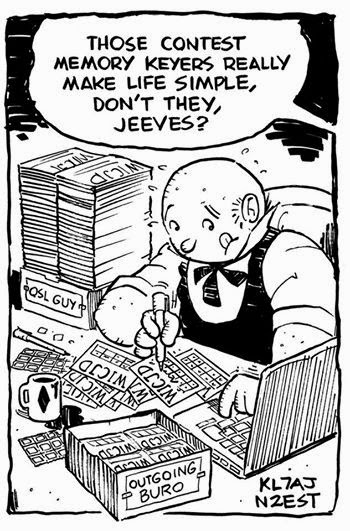
Jeff goes on to comment further:
"Fellow ham cartoonist/QSL artist Jim Massara N2EST and his partner in crime Eric Nichols KL7AJ are promoting the idea of a returning Gil Gildersleeve's Jeeves to the pages of QST. I think it would be swell to see Jeeves back where he belongs, trying to keep up like the rest of us geezers. It's a grand tradition. Many classic newspaper comics were carried on by other artists far far after the originals passed on. We grow up with cartoon characters like Jeeves, and they become little parts of of lives, and the continuity can be a small but real comfort."
Back to W2LJ - If I am not mistaken, 2015 is the Centennial of QST. I, for one, would love to see this. I am going to send Becky an enthusiastic e-mail. I hope you'll do the same.
72 de Larry W2LJ
QRP - When you care to send the very least!
Larry Makoski, W2LJ, is a regular contributor to AmateurRadio.com and writes from New Jersey, USA. Contact him at [email protected].
Following up

Mike Weir, VE9KK, is a regular contributor to AmateurRadio.com and writes from New Brunswick, Canada. Contact him at [email protected].
LIDS_CW
 Whilst twittering / tweeting / wasting time on twitter (delete as applicable) I came across a group @lids_cw . This is an informal twitter based group of CW and low impact data mode fans in the UK that seem to have their heads screwed on. The idea behind it is that the group encourages general radio chit chat then suckers you into having a go at CW.
Morse is not something I decided I wanted to do when I started out in radio, Hence the G7 callsign (For those unsure, G7’s in the 1990’s were VHF only because we couldn’t be bothered with CW. Hence the 19th Century rules at the time kept us away from HF as were weren’t proper or some such daftness). But over the years I’ve hankered after at least one QSO in CW. I’m only browsing, for research purposes, I wont be giving up VHF officer!
Sunday at 16:00hrs GMT see’s their net on 40m. I listened in and attempted to decode what was beeping through the speaker an got the occasional character. I cheated a bit and used HRD to decode some more of the text and fill in the gaps. It wasn’t until I let slip on Twitter I was listening in I heard my callsign being called by MW0IAN. Fortunately I had no way of returning the call (otherwise we might still be at it exchanging signal reports now!).
For those of us who struggle with CW but are too scared to admit it, there are others like you. For those of you who had the 5wpm RSGB cassette and never got further than ‘it’,’meant’,’mine’ and ‘nineteen’ but fancy spending hours listening to bleeps but secretly want to have a go. Watch out LIDS or Less Involved Data Society as it’s known will get you. Keyer at the ready for next Sunday. Snails will be faster.
Alex Hill, G7KSE, is a regular contributor to AmateurRadio.com and writes from Cumbria, UK. Contact him at [email protected].
AmateurLogic 74: Happy New Year

AmateurLogic.TV Episode 74 is now available for download.
Tommy Presents the IRCDDB Remote App to make D-Star easier, Shortwave Radio Shootout with Peter, George shops for Cool Stuff, and Chat Room fun.
The first episode of a great 2015.
1:05:28
George Thomas, W5JDX, is co-host of AmateurLogic.TV, an original amateur radio video program hosted by George Thomas (W5JDX), Tommy Martin (N5ZNO), Peter Berrett (VK3PB), and Emile Diodene (KE5QKR). Contact him at [email protected].
 Ham Radio Deluxe |
 W5SWL Electronics |
 Ham Radio Prep |
 KB3IFH QSL Cards  Hip Ham Shirts  HamRadioAuctions HamRadioAuctions Reliance Antennas Reliance Antennas Enigma Shop Enigma Shop |  morseDX  Ni4L Antennas  R&L Electronics R&L Electronics antennas.us antennas.us QRV QRV |
- Matt W1MST, Managing Editor
