 |
 LHS Episode #139: Daihatsu and Pretzels
 23 January 2015 | by
  This is the 139th installment of Linux in the Ham Shack. In this episode, your co-hosts have a rollicking good time while managing to discuss some important topics. Those topics include: using breathing as Morse Code, satellite communications with a handheld radio, Linux Mint, computer security, electric cars and much more. Thanks for listening, and please donate to our Hamvention Indiegogo campaign if you can.
Russ Woodman, K5TUX, co-hosts the Linux in the Ham Shack podcast which is available for download in both MP3 and OGG audio format. Contact him at [email protected].
Amateur Radio Newsline Report 1949 January 24 2015
- WE'RE BACK!
- Michigan gets its own PRB One antenna law
- A launch date for the Fox 1 hamsat is announced
- ARES called out in Ohio to assist after phone outage
- The flight of the V-K around-the-world floater balloon falls short of its round-the-world trip
- The K-one-N Nevassa Island DXpedition will be on the S-Oh 50 ham radio satellite
- And old Sol is at it again!
THIS WEEK'S NEWSCAST
March Issue of American Legion Magazine to Feature Amateur Radio
Hobby to get exposure to publication’s 2.3 million readers
The March 2015 edition of American Legion Magazine will include a feature article about the hobby of amateur radio. Written by best-selling author Don Keith N4KC, the article will tell readers of the publication how ham radio remains exciting, important, and relevant, even after one-hundred years of existence and so much technological change. It will also remind American Legion members about their organization’s own club—The American Legion Amateur Radio Club or TALARC—as well as how its members can get their licenses, establish club stations at more of the 14,000 posts around the country, and more. The Legion has an agreement with the Department of Homeland Security for assistance during emergencies and the article talks about how amateur radio meshes well with that effort.
American Legion Magazine is distributed to the veterans’ organization’s 2.3 million members as well as through other outlets. TALARC now has more than 2,000 members. Regular on-air nets are held for Legion members who are also hams. The club station, K9TAL at American Legion Headquarters in Indianapolis, Indiana, also hosts regular operating events.
To learn more about how the American Legion is integrating amateur radio into its organization and for its members, visit www.legion.org/hamradio.
The author of the article, Don Keith N4KC, is a best-selling writer with more than two dozen books published. His submarine thriller, FIRING POINT, co-written with former submarine captain George Wallace, is now in production as a major motion picture under the title HUNTER KILLER. He has written extensively about World War II history, submarines, college athletics, NASCAR racing, and broadcasting, including WIZARD OF THE WIND, a novel with a key character who is a ham. His next book, THE SHIP THAT WOULDN’T DIE, will be published by Penguin/NAL in April 2015. It tells the true story of a remarkable event during the Battle of the Coral Sea in 1942. Don has also published a book on his favorite hobby. RIDING THE SHORTWAVES: EXPLORING THE MAGIC OF AMATEUR RADIO explains to newcomers and old-timers alike how the hobby is even more dynamic today than when it was first introduced a century ago. All Don’s books are available wherever books are sold.
Don is an ARRL member, an Extra-class licensee, and has been a ham since 1961. He is very active on the air and operates most modes and bands. For more info on Don Keith N4KC visit www.donkeith.com or www.n4kc.com.
Don Keith, N4KC, is a regular contributor to AmateurRadio.com and writes from Alabama, USA. Contact him at [email protected].
A quick sprint
I was very time limited this evening, so I only spent a few minutes on the NAQCC cw sprint for January. I worked AA7VW Vern in Oregon, and KD3CA Don in Pennsylvania. My last two sprints had quite a few more contacts, but I also worked all two hours then. Work ran long, and then after a late dinner I found myself in the shack working on two fixit projects that I didn’t want to put off another day! I turned on the KX3 and listened to the melody of cw while soldering a new connector on a mic and fixing a fussy (but new) power supply. If you’re looking for a fun little contest, I’d recommend trying the NAQCC monthly sprints. Even if you’re not a member, you’re always welcome to join in.
Michael Brown, KG9DW, is a regular contributor to AmateurRadio.com and writes from Illinois, USA. Contact him at [email protected].
AM and UK Band Plans
Because of my poor voice (as a result of my cerebellum brain bleed) I tend to use digital techniques, like WSPR and JT65, but I still enjoy AM. Like many, I’ve worked transatlantic AMers on 29-29.1MHz with real QRP and simple antennas using AM. It makes a great change from SSB.
One could be forgiven for thinking AM is a dirty word at the RSGB. In UK Band Plans published in the February 2015 edition of RadCom, AM gets no mention on 28MHz and 50MHz and gets a (begrudging) comment as a footnote only in the 144MHz Band Plan when other modes get “centres of activity” mentions. AM is alive and well in the 29-29.1MHz sub-band. AM on the 144MHz (2m) band here in the UK can be found on and around 144.550MHz. There has been AM on 29-29.1MHz for years and years and years – in fact almost as long as I’ve been active on the air. Yes, this is in the all-mode section, but why not say this is the 28MHz (10m) AM sub-band? Also, why are 144MHz AM users asked to “consider adjacent channel activity”? AM should easily fit in 6kHz!!
Yet again, AM is being treated as a dirty and outdated mode. Here in the UK, ex-PMR AM rigs ripe for use on VHF can be picked up for virtually nothing and there is certainly room for AM on all bands from 28MHz upwards. AM has its enthusiasts on other bands too, but yet again the RSGB seems keen to kill off this mode. Why I wonder?
Allegedly, a RadCom article on digital TV in the 146-147MHz band was pulled last month at the last minute because “someone at the RSGB” thought it would not fit in the new band! Sometimes one wonders. Maybe the day when I only get SPRAT is closer than I thought? Thankfully, there are many good articles in RadCom.

Roger Lapthorn, G3XBM, is a regular contributor to AmateurRadio.com and writes from Cambridge, England.
Hunting For NDB’s In CLE190
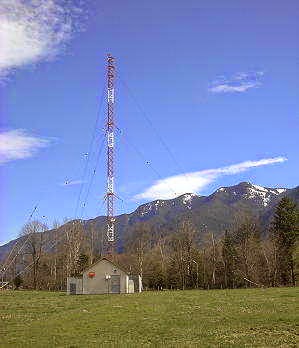 |
| LU-214KHz - Abbotsford, BC |
These listening events serve several purposes. They:
- determine, worldwide, which beacons are actually in service and on-the-air so the online database can be kept up-to-date
- determine, worldwide, which beacons are out-of-service or have gone silent since the last CLE covering this range
- will indicate the state of propagation conditions at the various participant locations
- will give you an indication of how well your LF/MF receiving system is working
- give participants a fun yet challenging activity to keep their listening skills honed
Our 190th Co-ordinated Listening Event is already less than a week away.
Do join in if you can. First-time CLE logs will also be very welcome.
Days: Fri. 23 - Mon. 26 January, Midday-Midday, your local time
Frequencies: NDBs from 190 - 239.9 kHz
PLUS Normal NDBs on 'half-way' frequencies nnn.5 kHz
(from 190.5 - 999.5 kHz)
Both halves are for everyone to try.
Away from Europe the frequencies below 240 kHz are mostly busy with
NDBs. In Europe there are very few but some DX ones might be heard
from North America and maybe a few other places.
The normal NDBs (no DGPS please) which have carriers on the 'half-way'
frequencies (e.g. 284.5 DY, 333.5 VOG, 359.5 CDN, 370.5 LB, 403.5 LNL)
are scattered across Europe but there are very few of them elsewhere.
Some 'hot spots' are ENG, FRA, ITA and XOE.
These half-frequencies give comfortable QRM-free listening and probably
some good catches as a result.
America has only one or two (e.g. 381.5 SJX) but East and West coasters
might hear some DX ones.
We last used these 'rules' for CLE174 in September 2013.
Good listening - enjoy the CLE
Brian
----------------------------------------------------------
From: Brian Keyte G3SIA ndbcle'at'gmail.com
Location: Surrey, SE England (CLE co-ordinator)
----------------------------------------------------------
(If you wish you could use any one remote receiver for your loggings,
stating the location and owner - with their permission if required.
A remote listener may NOT also use another receiver, local or remote,
to make further loggings for the same CLE).
Final details can be found at the NDB List website, and worldwide results, for every participant, will be posted there a few days after the event. If you are a member of the ndblist Group, results will also be e-mailed and posted there.
The very active Yahoo ndblist Group is a great place to learn more about the 'Art of NDB DXing' or to meet other listeners in your region. There is a lot of good information available there and new members are always very welcome.
If you are contemplating getting started on 630m, listening for NDBs is an excellent way to test out your receive capabilities as there are several NDBs located near this part of the spectrum.
You need not be an ndblist member to participate in the CLEs and all reports, no matter how small, are of much value to the organizers.
Reports may be sent to the ndblist or e-mailed to either myself or CLE co- ordinator, Brian Keyte (G3SIA), whose address appears above.
Please...do give the CLE a try....then let us know what NDB's can be heard from your location! Your report can then be added to the worldwide database to help keep it up-to-date.
Steve McDonald, VE7SL, is a regular contributor to AmateurRadio.com and writes from British Columbia, Canada. Contact him at [email protected].
Ring that school bell!
.jpg)
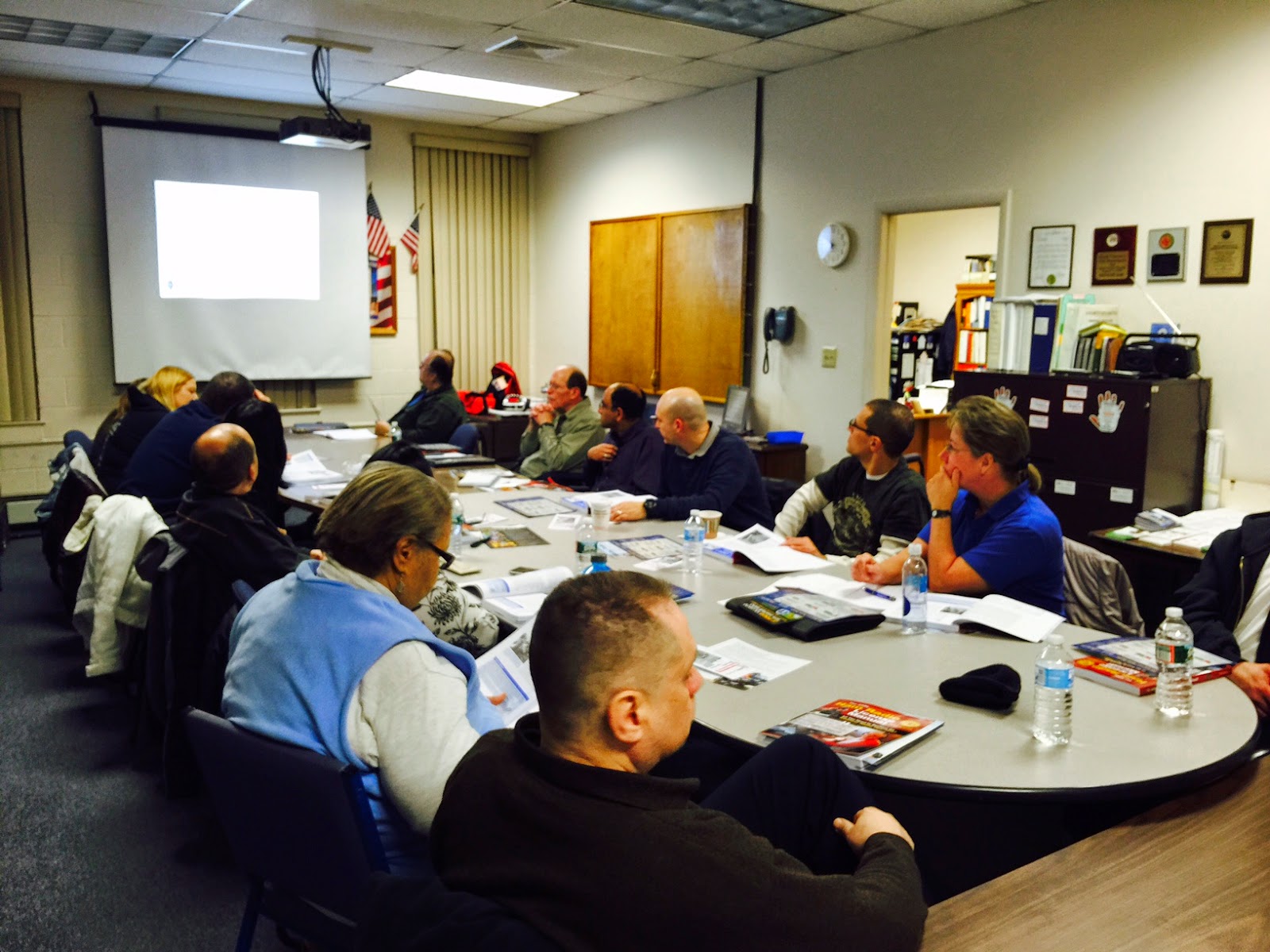
It's always fun and exciting to be with a group of people who show genuine interest in Amateur Radio, as was the case last night. All of these folks showed enthusiasm and curiosity and an eagerness to learn.
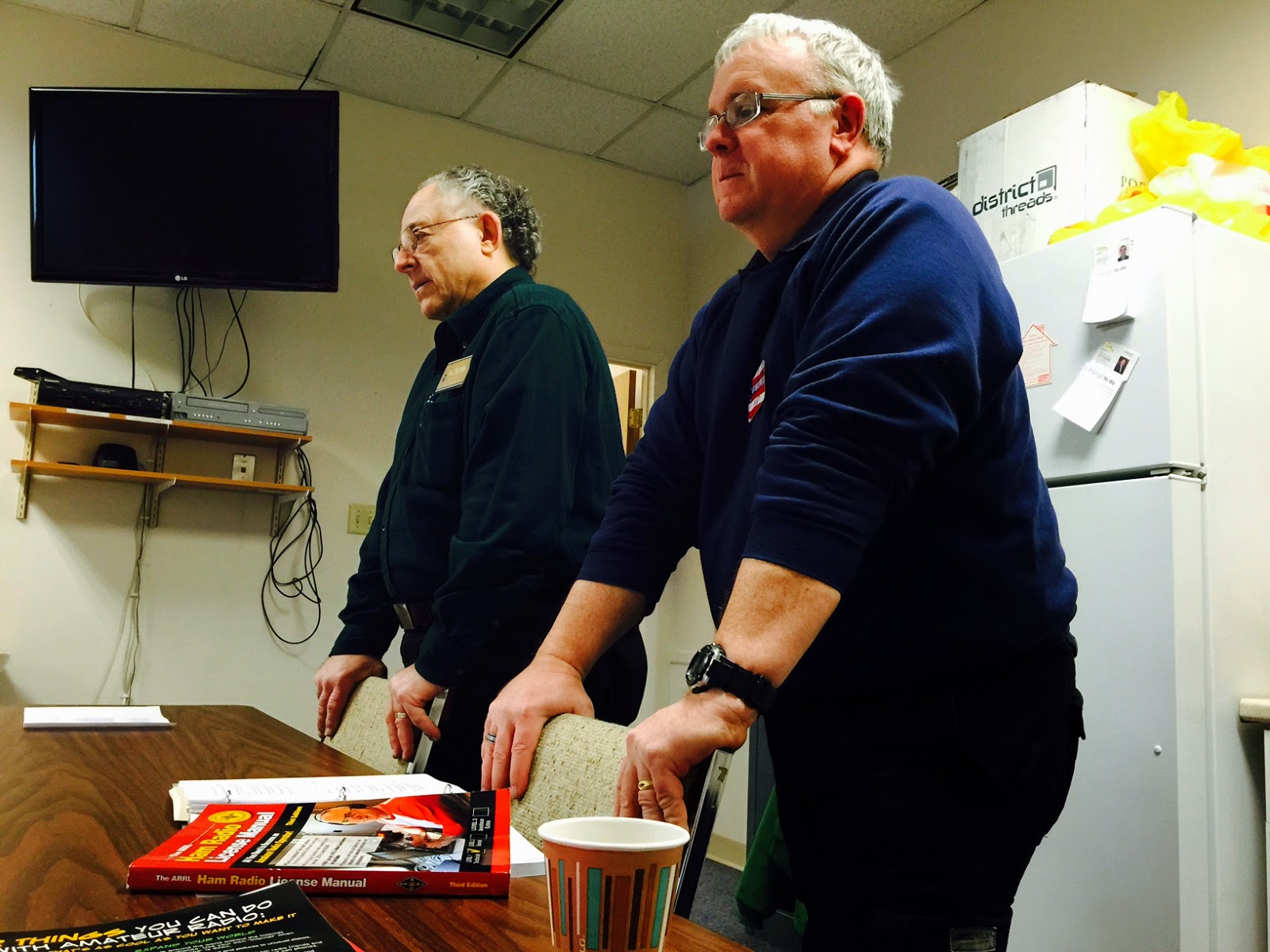
Notice the coffee cup - gotta have cup of coffee before class, after a long day at work!
We will become "buddies" over the course of the next seven Tuesday evenings, and hopefully after that, we will add more people to the ranks of Amateur Radio.
And if the teaching gig isn't enough, I was thinking of home brewing a magnetic loop this winter. My line of thinking is that I could build one for let's say 40-10 Meters. From what I understand they're not huge. Then, when it gets really frosty in the basement, I could just set the loop up on the main floor and operate temporarily from the dining room table or something like that. Just a thought, though, as funds are kinda tight. I have some spare coax (enough for a loop), and I think the only expense at this point would be the tuning capacitor. It doesn't need to be one of those expensive vacuum jobs, so maybe I can find something reasonable on eBay.
My inspiration for this has been Greg, N4KGL. I've been following his posts on Google+ and through his blog. He seems to be having so much success with his loop that it seems like a worthwhile endeavor. That, and the fact that I feel like building something.
72 de Larry W2LJ
QRP - When you care to send the very least!
Larry Makoski, W2LJ, is a regular contributor to AmateurRadio.com and writes from New Jersey, USA. Contact him at [email protected].
 Ham Radio Deluxe |
 W5SWL Electronics |
 Ham Radio Prep |
 KB3IFH QSL Cards  Hip Ham Shirts  HamRadioAuctions HamRadioAuctions Reliance Antennas Reliance Antennas Enigma Shop Enigma Shop |  morseDX  Ni4L Antennas  R&L Electronics R&L Electronics antennas.us antennas.us QRV QRV |
- Matt W1MST, Managing Editor
