 |
 Repairing a Kenwood TR9500, Part4
 3 February 2015 | by
 After making repairs to the microphone amplifier and the receiver pre-amplifier the rig seemed to be working fine, I'd even used it several times during the UKAC contests with some success.
The 70cm band is under used locally and activity seems largely restricted to repeaters. Due to it's vintage the TR9500 doesn't have CTCSS tones and so cannot be used to access repeaters without some modification and I've been looking at adding a CTCSS board.
In the meantime I really wanted to use the TR9500 a bit more and was hoping to make it part of a satellite station, the TR9500 acting as the UHF uplink transmitter (LSB) and the VHF 2m TR9000 as the downlink receiver (USB) for the AO73 (FUNCube-1) and other satellites.
The satellite portion of the band plan is at 435-438MHz and it was when setting this up I discovered the TR9500 neither received or transmitted in the upper part of the 70cm band (435-440MHz) below this everything was hunky-dory.
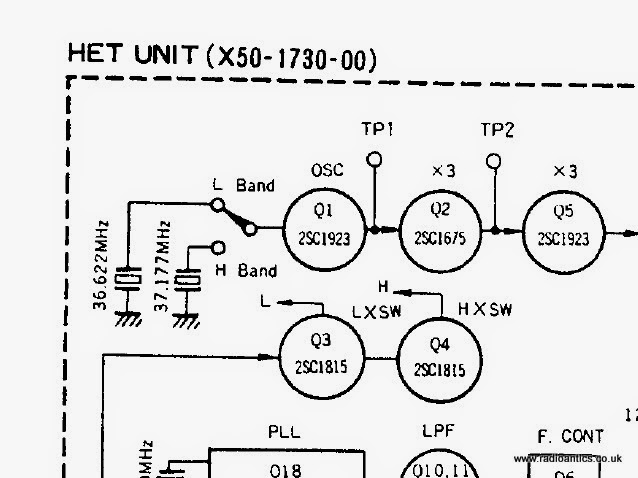
It hasn't taken long to locate the issue, the HET unit employs two crystals L33 (36.6222MHz), L34 (37.1777MHz) which are switched in to the oscillator Q1 depending on the selected frequency. L33 being referred to as low band, L34 as high band the switching occurring around 435MHz.
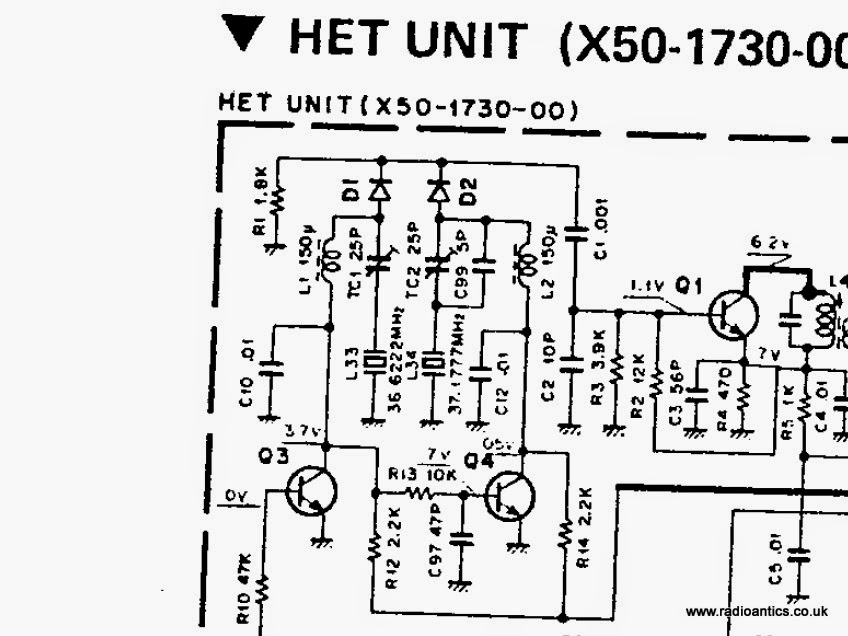
The switching HL signal (via R10) and transistors Q3/Q4 are working correctly it is just crystal L34 is not resonating. The surrounding diodes, capacitors, inductors and resistors all look fine, no obvious shorts or broken joints.
I have to do some more diagnostics to rule out any of the passive components but if it is the case that the crystal has failed then it may prove difficult to source an economical replacement.
Andrew Garratt, MØNRD, is a regular contributor to AmateurRadio.com and writes from East Midlands, England. Contact him at [email protected].
K1N is Busy
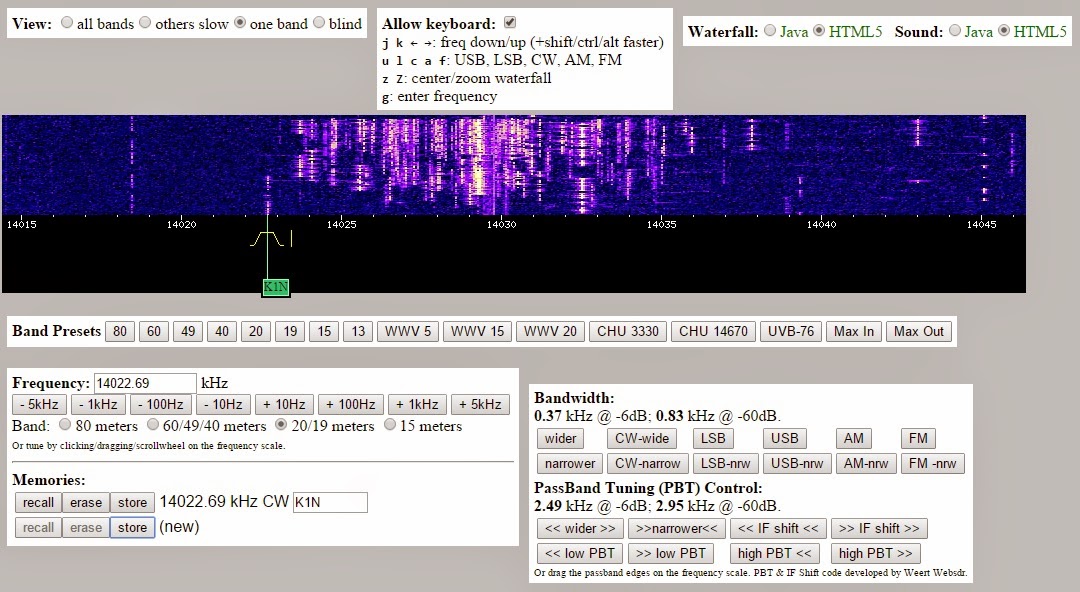
With my KX3 on the fritz (boxed up, ships out tomorrow) I won’t be able to join in on the fun in chasing K1N on Navassa Island. But I did manage to sneak in some time this evening on K2SDR’s internet enabled software defined radio station. Just listening to the CW pileup makes you wonder if you’ll ever be good enough to pick them out of the pile! Here’s a view of what 20M CW is like….K1N is the station on the left…the rest to the right are in the pile!
Michael Brown, KG9DW, is a regular contributor to AmateurRadio.com and writes from Illinois, USA. Contact him at [email protected].
70cm AM test with low cost modules
This evening I listened for G6ALB on 70cm. Andrew is 3km from me. We both have V2000 vertical co-linear antennas. He was using a very low cost SAW locked TX module, which produced as much FM as AM when modulated with an electret mic. The biggest problem was Andrew’s low power and low level of modulation. He needs more mic gain, more TX power (10dB more?) and some pre-emphasis on the audio. TX power today was very low milliwatts. From 433.925MHz up to at least 433.990MHz a lot of squeaks and whistles could be heard, presumably from more local ISM devices. I was receiving G6ALB using an FT817 at about RS41 on FM and weaker on AM. This very initial test produced results that were expected. To use a super-regen module on RX (the intention is a very simple AM voice transceiver) will require G6ALB to be considerably stronger than on these first tests.

Roger Lapthorn, G3XBM, is a regular contributor to AmateurRadio.com and writes from Cambridge, England.
Raspberry Pi 2 ordered
I was excited to see the Raspberry Pi 2 announced today
One is on the way. It will be interesting to see how it works out – particularly for some of the more heavy duty apps I have tried in the past such as FLDigi.
A new version of the OS compiled for the new processor is required and can be downloaded here
More news when it arrives!
Tim Kirby, G4VXE, is a regular contributor to AmateurRadio.com and writes from Oxfordshire, England. Contact him at [email protected].
Raspberry Pi 2 ordered
I was excited to see the Raspberry Pi 2 announced today
One is on the way. It will be interesting to see how it works out – particularly for some of the more heavy duty apps I have tried in the past such as FLDigi.
A new version of the OS compiled for the new processor is required and can be downloaded here
More news when it arrives!
Tim Kirby, G4VXE, is a regular contributor to AmateurRadio.com and writes from Oxfordshire, England. Contact him at [email protected].
A little DSTAR activity
I generally use for the gateway has been busy on ADS-B duty. Last weekend, I remembered
I could easily fire up Win-DV on the PC and use the DVAP with that.
A couple of nice QSOs this morning with that setup; John LA2QAA and Des G0RBD. Time to reinstate the Sunday morning DSTAR sessions as I do the chores around the house and garden.
Tim Kirby, G4VXE, is a regular contributor to AmateurRadio.com and writes from Oxfordshire, England. Contact him at [email protected].
A little DSTAR activity
I generally use for the gateway has been busy on ADS-B duty. Last weekend, I remembered
I could easily fire up Win-DV on the PC and use the DVAP with that.
A couple of nice QSOs this morning with that setup; John LA2QAA and Des G0RBD. Time to reinstate the Sunday morning DSTAR sessions as I do the chores around the house and garden.
Tim Kirby, G4VXE, is a regular contributor to AmateurRadio.com and writes from Oxfordshire, England. Contact him at [email protected].
 Ham Radio Deluxe |
 W5SWL Electronics |
 Ham Radio Prep |
 KB3IFH QSL Cards  Hip Ham Shirts  HamRadioAuctions HamRadioAuctions Reliance Antennas Reliance Antennas Enigma Shop Enigma Shop |  morseDX  Ni4L Antennas  R&L Electronics R&L Electronics antennas.us antennas.us QRV QRV |
- Matt W1MST, Managing Editor
