 |
 Receiving SSTV from the International Space Station
 1 February 2015 | by
 You might remember that before Christmas, I missed the opportunity to try receiving some SSTV pictures from the ISS. Although I missed it, I took the chance to get the SSTV program working with the FT-8900.
At the end of last week, I learned that there would be some more SSTV activity from the space station, so was keen to try it out.
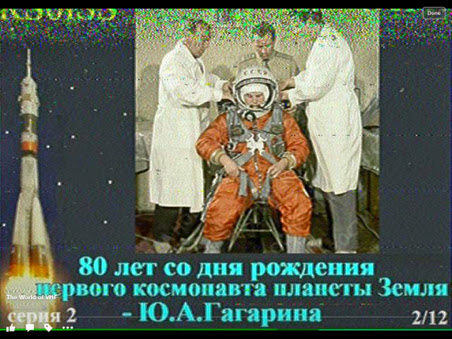
It worked really well. Some images were better than others and others were better than I expected them to be. A real surprise was a surprisingly good decode from a pass when the ISS was a modest 1 degree over the horizon.
The best images were from high elevation passes though. As ever the gear was simple, V2000 vertical, FT-8900 and MMSSTV on the PC.

Tim Kirby, G4VXE, is a regular contributor to AmateurRadio.com and writes from Oxfordshire, England. Contact him at [email protected].
Measuring The New Lenses

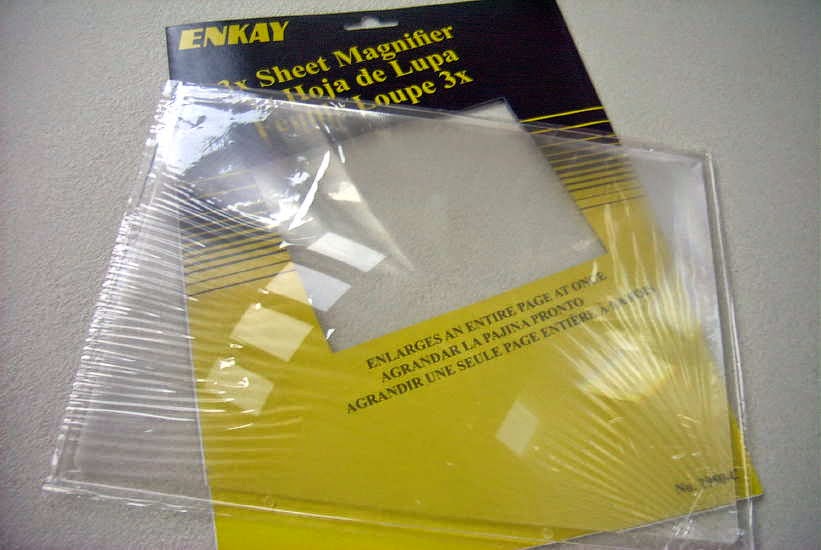
Yesterday I had the chance to have a closer look at the two lenses recently purchased for a new portable lightwave receiver. The initial testing procedure of the page-size fresnel (actual size is 200mm x 270mm) proved incorrect and required more space than the bench top could provide. Eventually the focal length was measured as ~ 368mm +/- for an f/d, or F number, of 1.36 ... a convenient value and much better than the 'other' common fresnel page reader focal length of ~ 600mm. This jibed nicely with the recommendations given in Clint's (KA7OEI) website optical information:
"For practical reasons, it is recommended that an optical system using Fresnel lenses be designed using lenses that have an F-number in the range of 0.5 to 1.5 - that is, around 1. Remember: The "F-number" is the focal length divided by the diameter of the lens, so for an F-number of unity or one, the diameter of the lens would be the same as its focal length."
The lens was able to bring a small LED flashlight (consisting of an array of 21 white LEDs) into surprisingly sharp focus although the shot below does not reflect that due to my camera's poor focus in the darkened room.
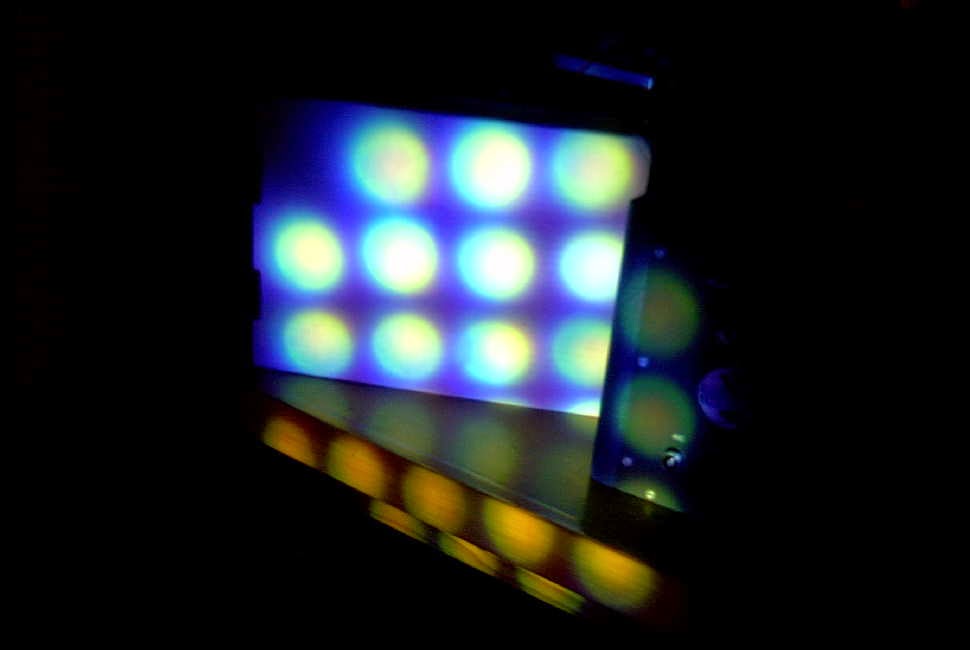
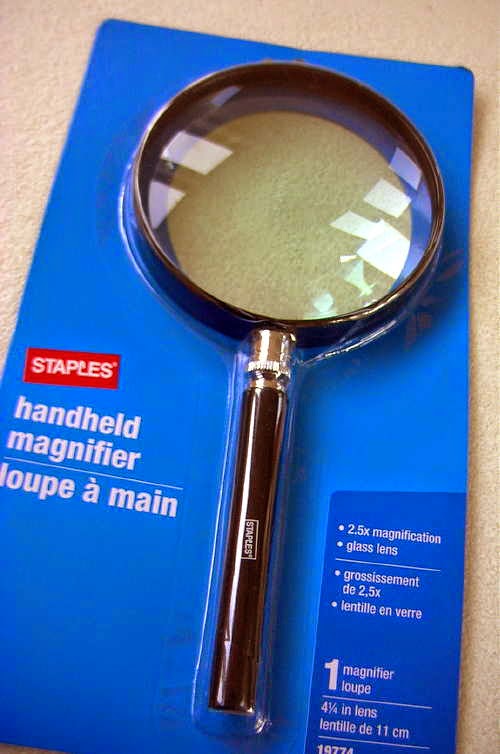
The glass 4.5" magnifying lens proved to have a focal point of 203mm for an F number of 1.8. This lense produced an even sharper image of the same light source and may be the best candidate for the portable receiver although the larger aperture of the fresnel might not be worth counting out at this point.
The fresnel may work well for a transmitter and will likely require a small (inexpensive) secondary focusing lens between the LED and the fresnel, in order to have the LED efficiently illuminate the fresnel. The secondary should effectively gather and focus as much of the emitted LED light to just within the boundaries of the fresnel without any wasted light energy being lost to spill-over at the edges.
It would be great to have a permanent lightwave 'beacon' that one could test various receiver lenses and combinations but at present there is very little activity here in VE7 land ... although that is changing, with the interest of another local, VE7IGH (Greg) near Vancouver and right across Georgia Strait from my location. Grant has already built a receiver and will soon start on transmitter construction ... way to go Greg!
Steve McDonald, VE7SL, is a regular contributor to AmateurRadio.com and writes from British Columbia, Canada. Contact him at [email protected].
Another G1KQH bargain
This came in from Steve, G1KQH, today. It is often cheaper to buy the completed, built modules from China than to buy the parts in the UK! What is the world coming to?
I bought 5 LM317s on PCB with heatsinks for a fiver:
Why bother building it any longer, that used to be half the fun! The heatsinks would of cost a Quid each over here, never mind the LM317 and the PCB with connectors..Happy days73 Steve G1KQH

Roger Lapthorn, G3XBM, is a regular contributor to AmateurRadio.com and writes from Cambridge, England.
Ham College episode 1

Ham College episode 1 is now available for download.
Ham College, the new show for those new to the hobby and those wishing to get into Amateur Radio.
In episode 1 we bring you some news, discuss what an ‘Elmer’ is, talk about early radio history, build a spark gap transmitter, present 10 more questions and answers from the Technical class question pool, and more.
Your excuses for not becoming a Ham have just expired.
1:15:46
George Thomas, W5JDX, is co-host of AmateurLogic.TV, an original amateur radio video program hosted by George Thomas (W5JDX), Tommy Martin (N5ZNO), Peter Berrett (VK3PB), and Emile Diodene (KE5QKR). Contact him at [email protected].
A chance to get some radio time in…….
 |
| Some radio time |
 |
| P3 external screen |
Mike Weir, VE9KK, is a regular contributor to AmateurRadio.com and writes from New Brunswick, Canada. Contact him at [email protected].
’29 MOPA / NLOS Lightwave Progress
 |
| Courtesy: http://www.arrl.org/ |
I've now completed a set of tank coils for the new'29 MOPA project. These were wound with 3/16" copper tubing which has become very difficult to source. Luckily, after much searching, I was fortunate enough to find several rolls locally at a very attractive price. Although I do see it quite often on e-bay, sellers either refuse to ship to Canada or their shipping charges are far too high to make it worthwhile. The larger 1/4" rolls are still readily available, but for any given inductance, will take up a lot more room on the breadboard if space is an issue.
These coils cover the amplifier tank, the Hartley oscillator's tank, and the antenna coupling link. Respectively, the coils measure 4.9uH, 4.0uH and 1.9uH.
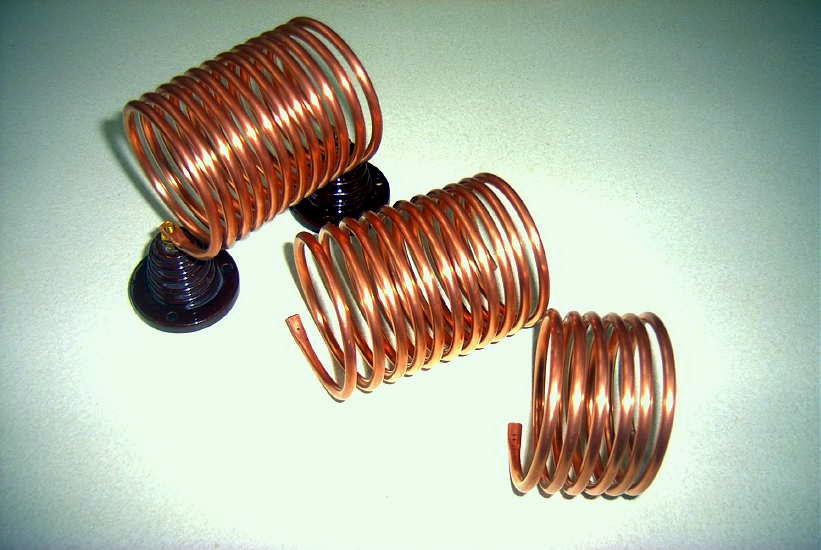
Winding these is always fun but the method used requires that the needed length be predetermined and cut from the roll beforehand. The first time I did this, when building my TNT transmitter, I learned the hard way to always add at least another foot to cover the additional length eaten-up by turn-spacing and for coil end flattening and mounting.
While visiting Vancouver for a few days I was able to find a couple of pieces needed for my non-line of sight (NLOS) lightwave experiments.
I purchased a nice 4.25" magnifier lens, with suitable focal length, as well as an inexpensive page-size fresnel magnifying lens. What is particularly pleasing is that the fresnel is a rigid lens, about 2 mm thick, unlike most page magnifiers that are thin and floppy. I have yet to test its blur circle or determine its focal length.
I plan to use one or the other of these lenses in a small, portable lightwave receiver module that I can carry to the other side of the island to listen for the main large transmitter, aimed slightly above the horizon, in beacon-mode. If the smaller fresnel does the job, it will be an inexpensive source for anyone else needing a simple lens for either transmitting or receiving.
If the deep-red light tests prove successful, I'll switch the system to IR light but at this stage I'm not sure how focusing and optimizing receivers and transmitters can be done with a light source that is essentially invisible? Perhaps using an IR source that is right on the edge of deep-red will still have enough visible light to allow finding the optimum focus more easily.
More information on NLOS experiments can be found in Yahoo's Optical DX Group as well is in G3XBM' s 481thz blogs.
As well, anyone in the Vancouver lower mainland (as far as the northern Sunshine Coast area) that might be considering lightwave ... I'd love to work you! Pretty well any high spot in this region is direct LOS for me.
Steve McDonald, VE7SL, is a regular contributor to AmateurRadio.com and writes from British Columbia, Canada. Contact him at [email protected].
The Spectrum Monitor — February, 2015

Stories you’ll find in our February, 2015 issue:
Monitoring the Russian Navy (Part 1)
By Tony Roper
In previous articles, military monitoring specialist, Tony Roper, took us inside NATO war games (TSM July 2014) and showed us how to monitor the Russian Air Force (TSM October 2014). In the first of a series, Tony turns his attention to the Russian navy and shows you how you can listen in CW and, amazingly, even track their positions.
The Amateur Radio Parity Act is Down, But Certainly Not Out!
By Richard Fisher KI6SN
The Amateur Radio Parity Act of 2014, proposed last June by U.S. Representative Adam Kinzinger (R-Illinois), never got out of the House Energy and Commerce Subcommittee on Communications and Technology. To paraphrase American author-humorist Mark Twain, the death of H.R. 4969, “is an exaggeration.” Proposed to protect radio amateurs and other communications hobbyists from private communities’ unreasonable antenna restrictions, it is expected to be back in play in the newly minted 114th Congress. Think of the legislation as merely hibernating.
Listening for WWII POWs
By Rich Post KB8TAD
It wasn’t the New Year’s Eve he had anticipated. Twenty-two year old Second Lieutenant George Klare was navigator on a B-17G bomber based in England. As part of the 418th squadron, he was at the navigator’s table reviewing the flight path of the bomber in the direction of Hamburg and its synthetic oil refineries, which were so vital to the German war machine during World War II. He had no idea that this might indeed be the last time he would see London during the war.
W9GRS: Middle School Amateur Radio Station Update
By Troy Simpson W9KVR
Teaching junior high science can never be accused of being boring, at least here in rural Illinois. Coming off what I would call a “rebuilding year,” in my last article, the 2014-2015 school year has seemed to hit its stride and halfway through we can say it has been a very eventful year! The school station W9GRS has settled into its new home in Room 115 with the sounds of PSK31 tones and voices often filling the air during the last class period of the day.
D-STAR – its History and its Future
By Cory GB Sickles WA3UVV
In 1999, about 10 years after the genesis of P25, the Japan Amateur Radio League (JARL) began developing a new standard for digital voice and data operation. Predominately funded by the Japanese government, in a similar – but different – way we might find a project funded by a grant allocation, the JARL committee’s work was released in 2001 and the Digital Smart Technologies for Amateur Radio—D-STAR was created. But why has the second oldest and first digital voice methodology created specifically for amateur radio taken so long to take hold and what is its future?
The Spectrum Monitor is available in PDF format which can be read on any desktop, laptop, iPad®, Kindle® Fire, or other device capable of opening a PDF file. Annual subscription (12 issues, beginning with the January 2015 issue) is $24. Individual monthly issues are available for $3 each.
Ken Reitz, KS4ZR, is publisher and managing editor of The Spectrum Monitor. Contact him at [email protected].
 Ham Radio Deluxe |
 W5SWL Electronics |
 Ham Radio Prep |
 KB3IFH QSL Cards  Hip Ham Shirts  HamRadioAuctions HamRadioAuctions Reliance Antennas Reliance Antennas Enigma Shop Enigma Shop |  morseDX  Ni4L Antennas  R&L Electronics R&L Electronics antennas.us antennas.us QRV QRV |
- Matt W1MST, Managing Editor
