 |
 The Spectrum Monitor — February, 2015
 30 January 2015 | by
Stories you’ll find in our February, 2015 issue:
Monitoring the Russian Navy (Part 1)
By Tony Roper
In previous articles, military monitoring specialist, Tony Roper, took us inside NATO war games (TSM July 2014) and showed us how to monitor the Russian Air Force (TSM October 2014). In the first of a series, Tony turns his attention to the Russian navy and shows you how you can listen in CW and, amazingly, even track their positions.
The Amateur Radio Parity Act is Down, But Certainly Not Out!
By Richard Fisher KI6SN
The Amateur Radio Parity Act of 2014, proposed last June by U.S. Representative Adam Kinzinger (R-Illinois), never got out of the House Energy and Commerce Subcommittee on Communications and Technology. To paraphrase American author-humorist Mark Twain, the death of H.R. 4969, “is an exaggeration.” Proposed to protect radio amateurs and other communications hobbyists from private communities’ unreasonable antenna restrictions, it is expected to be back in play in the newly minted 114th Congress. Think of the legislation as merely hibernating.
Listening for WWII POWs
By Rich Post KB8TAD
It wasn’t the New Year’s Eve he had anticipated. Twenty-two year old Second Lieutenant George Klare was navigator on a B-17G bomber based in England. As part of the 418th squadron, he was at the navigator’s table reviewing the flight path of the bomber in the direction of Hamburg and its synthetic oil refineries, which were so vital to the German war machine during World War II. He had no idea that this might indeed be the last time he would see London during the war.
W9GRS: Middle School Amateur Radio Station Update
By Troy Simpson W9KVR
Teaching junior high science can never be accused of being boring, at least here in rural Illinois. Coming off what I would call a “rebuilding year,” in my last article, the 2014-2015 school year has seemed to hit its stride and halfway through we can say it has been a very eventful year! The school station W9GRS has settled into its new home in Room 115 with the sounds of PSK31 tones and voices often filling the air during the last class period of the day.
D-STAR – its History and its Future
By Cory GB Sickles WA3UVV
In 1999, about 10 years after the genesis of P25, the Japan Amateur Radio League (JARL) began developing a new standard for digital voice and data operation. Predominately funded by the Japanese government, in a similar – but different – way we might find a project funded by a grant allocation, the JARL committee’s work was released in 2001 and the Digital Smart Technologies for Amateur Radio—D-STAR was created. But why has the second oldest and first digital voice methodology created specifically for amateur radio taken so long to take hold and what is its future?
The Spectrum Monitor is available in PDF format which can be read on any desktop, laptop, iPad®, Kindle® Fire, or other device capable of opening a PDF file. Annual subscription (12 issues, beginning with the January 2015 issue) is $24. Individual monthly issues are available for $3 each.
Ken Reitz, KS4ZR, is publisher and managing editor of The Spectrum Monitor. Contact him at [email protected].
Low cost kits
See http://www.aliexpress.com/store/331885 . This website has some very low cost rigs for sale. An example is a 40m Pixie at around $10 post free. You’d be hard pressed to buy the individual parts for less!
UPDATE 1430z: I have just ordered a 40m Pixie kit from them. Should be here in 2 to 3 weeks time. I hope I can manage to build it with my clumsy soldering currently.
UPDATE 2000z: G1KQH has found the same Pixie at an even better price:
Greetings RogerI could of saved you a fiver out of your pension but you had to rush in:73 Steve
http://www.g1kqh.talktalk.net/

Roger Lapthorn, G3XBM, is a regular contributor to AmateurRadio.com and writes from Cambridge, England.
Hardly any young people are becoming hams anymore
This is what Ed Muns, W0YK, said in an interview the other day, and goes on with “because they see this as kind of old school stuff.“
A year ago the ARRL web site said: “Amateur Radio showing steady growth in the US“. AH0A’s website with statistics over the US ham population backs this up with the curve shown here. Even in my local club we are now seeing young people signing up for licence classes.
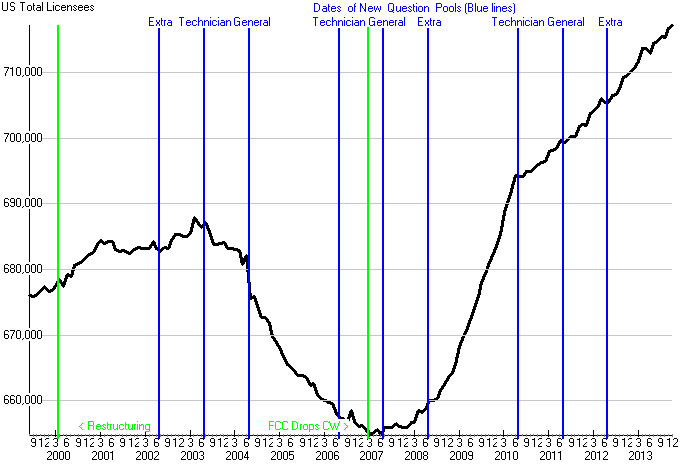
How different perspectives! How has an old radio amateur like W0YK come to believe in the myth of declining numbers of hams?
Sverre Holm, LA3ZA, is a regular contributor to AmateurRadio.com and writes from Norway. Contact him at [email protected].
Amateur Radio Newsline Report 1950 January 30 2015
- BULLETIN: FCC "Paperless" Amateur Radio license policy to take effect in February
- Radio politics in Thailand has ham radio caught in the middle
- Two more world-circling pico balloons are launched from Australia
- The ARRL announces some DXCC and VHF contest rules changes
- Ham radio featured on New York City “Save A Life” television program
- And this just in: scientists launch sounding rockets during surprise auroras over the Arctic
THIS WEEK'S NEWSCAST
YouKits 2015 TJ2B
YouKits Canada has announced the latest version of the TJ2B SSB handheld radio, that now also will provide cw mode after many requests from users of this radio.
The unit has also received some great reviews by the techs at ARRL test lab and have been published recently in QST.
Yimin strives to do his ultimate best with QC and trouble shooting as well as refunds and repairs. Not unusual for him to send a replacement radio before he has accepted the problem unit.
The HB line of radios has proven themselves over again in the field. many new projects are being developed by YouKits and we look forward to seeing these new items in the future.


http://www.youkits.com/#TJ2B_MK2_5_Band_SSB_Handheld_Transceiver
73 Fred Lesnick
VE3FAL
Fred Lesnick, VE3FAL, is a regular contributor to AmateurRadio.com and writes from Thunder Bay Ontario, Canada. Contact him at [email protected].
It’s been a while
I haven't run this piece in a long time. It's from my old webpage on how to adjust a bug:
Using a bug is a real fun part of using Morse Code. Adjusting one properly so that it works right for you and doesn't frustrate the heck out of you is easy; if you take your time and work methodically. Refer to the photo below for reference.
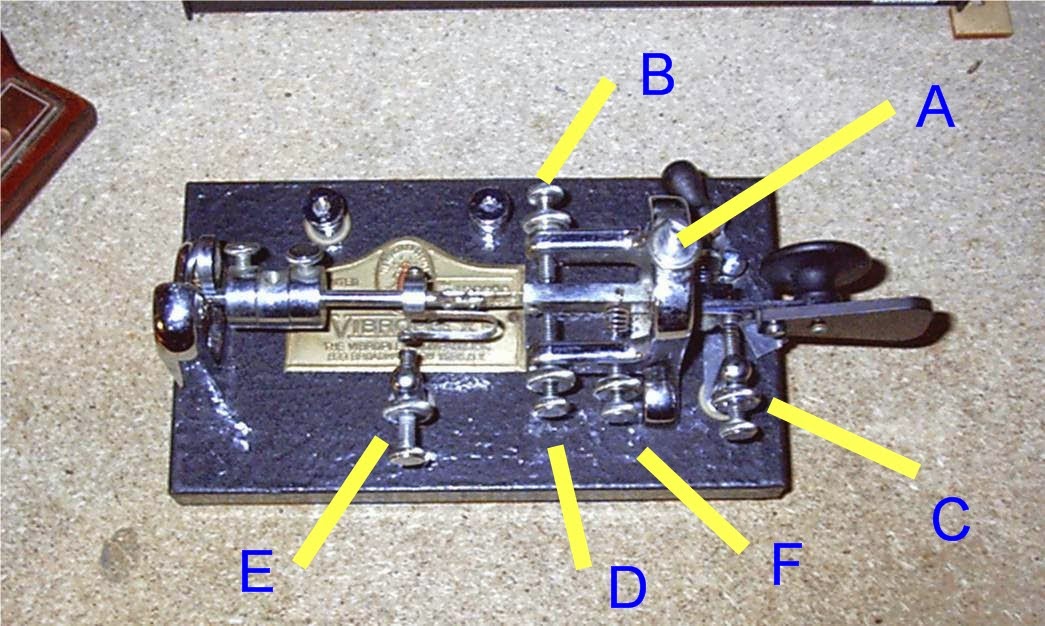
The first thing you do is to back off all the adjusting screws quite a bit. Not all the way; but far enough out so that everything is nowhere near being set. Once that's done you want to adjust the action of the pendulum. Unscrew "A" - this is the pivot point for the pendulum. Slowly tighten it. You'll know you have it adjusted correctly when the pendulum moves from side to side freely with no binding; but, at the same time, you can move the finger pieces up and down with your fingers and feel very little or no play.
The next thing you want to do is to adjust screw "B". Allow the pendulum to hit the damper. Screw in "B" to the point where you can either see or just perceive the pendulum has touched the damper. Stop there and secure the screw with the knurled lock nut. It is important not to move the pendulum too far away from the damper or else you will not be able to reliably stop your "dits".
The next thing you want to do is adjust the left trunnion screw - D. This will control the amount of side to side travel of the pendulum. For smooth code this gap should be very small. I take a piece of ordinary printer paper, fold it in half to double it and adjust the spacing so that the paper will just slip between the point of the screw and the pendulum. This results in a very small amount of side to side travel. The end result is a nice and clean transition between "dits" and "dahs". I do the same thing for the amount of spacing for the "dah" contact at C. I turn that trunnion screw in so that the paper slips in the gap easily with no binding, then I lock the set screw in place to keep the setting.
The next thing you want to do is adjust the "dits" making part of your bug. This is done by adjusting "E". When "E" is adjusted correctly, you should be able to swing the pendulum to make "dits"; and get 10 to 15 "dits" before the pendulum dampens out and comes to a rest.
"F" controls the tension of the "dit" action. I find it best to tension the spring about half way. Hopefully, if you follow this guide and play around a little bit and experiment, you will find the "sweet spot" that will allow you to send really glassy smooth Morse Code.
Sending with a Bug is just as much fun as sending with a keyer and paddles. However, sending with a Bug allows you to add a little personality. Listening to CW sent with a keyer sounds sterile compared to that sent with a Bug.
If you need to slow down the speed of your Bug to a point that's even slower than what you can get with the weight(s) positioned all the way to the end of the pendulum, then clip a clothes pin or a few alligator clips to the end of the pendulum. This will slow down a Bug to an effective speed as low as 13 words per minute or so.
In my opinion, you know that your bug is adjusted properly when you can send characters like X, Y, Q, C, F and L with little effort, and they sound good - or at least recognizable in my case!
Here's a great video that shows you how to do it, also:
72 de Larry W2LJ
QRP - When you care to send the very least!
Larry Makoski, W2LJ, is a regular contributor to AmateurRadio.com and writes from New Jersey, USA. Contact him at [email protected].
BFDs
Some things are BFDs and some things just aren’t. What are BFDs? Well, son, this video might help you out. BFDs would include passing healthcare legislation, your first kiss, discovering plutonium, or your parachute not opening. There are two news items in amateur radio right now that, despite all the hubbub, aren’t BFDs.
Remote operation from anywhere is now allowed for DXCC awards. ARRL will now allow contacts from remotely-operated stations to be submitted for DXCC awards, regardless of where the control point is located. This seems to be a BFD for many people because of instead of buying a multi-giga dollar megastation, which was the previously accepted way to buy your way to DXCC, today with modern technology and better living through chemistry you can rent a megastation with a credit card and operate it with your favorite computing device from the comfort of your meager home station, hotel room, or police station drunk tank. Why is it not a BFD? Remote operation contacts were allowed for DXCC credit before, the only thing that has changed is where the control point is allowed. The contact is still made over the air. This isn’t like Echolink computer-to-computer contacts. The remote station must be located within your home DXCC entity. If you still want to get your DXCC the old fashioned way, you can. DXCC is about personal achievement, and how you got it is a BFD to you, not anyone else.
The FCC will no longer issue paper licenses. Why is this not a BFD? There are several reasons. The online ULS record is considered your official credential. If you want a paper license, you can go to the ULS, download a PDF, and print it out. One can also request the FCC send them a paper copy. What is BFD is that the FCC will save $304K a year with this change.

Anthony, K3NG, is a regular contributor to AmateurRadio.com.
 Ham Radio Deluxe |
 W5SWL Electronics |
 Ham Radio Prep |
 KB3IFH QSL Cards  Hip Ham Shirts  HamRadioAuctions HamRadioAuctions Reliance Antennas Reliance Antennas Enigma Shop Enigma Shop |  morseDX  Ni4L Antennas  R&L Electronics R&L Electronics antennas.us antennas.us QRV QRV |
- Matt W1MST, Managing Editor
