 |
 Antenna testing is hard (II)
 28 February 2015 | by
 This article follows up on this one. The title could also be: doing measurements on hand held radios is hard. Actually, some measurements I did in the past might not be so accurate after all.
Measuring in dBm
If you measure in dBm, what I always did, you assume that the device at the other end is 50 Ohms, just like the manufacturer promises you in the specs. Slowly but surely we are finding out that this is not always the case. As a result I might have to switch to microvolt (µV), a method which doesn’t require a perfect 50 Ohms at the other end.
Can’t we just convert it? 0.5 µV @ 50 ohms = -113 dBm, a piece of cake, right? No. You must know the actual impedance of the receiver if you want to convert from dBm to µV. Erik PE1RQF did some measurements on a few hand held radios to find out the true impedance. The outcome was, well, a bit scary.

If a device is 50 Ohms, the SWR should be 1:1. Only a perfect dummy load and the Marconi RF generator are.
What this means for us
What this outcome basically means is that generating cold numbers on sensitivity and antenna performance are nice, but don’t tell the whole story, or could be misleading.
- Antennas which prove to be the best performers (RX/TX, VSWR), tested under optimal conditions, are not necessarily the best performers on a specific brand/model of hand held radio.
- There are antennas which aren’t 50 Ohms at all, but could very well outperform everything else on the market because your radio isn’t 50 Ohms either.
Do the test yourself
The best example I can give you is this one: take a Baofeng BF-666S, 777S or 888S, use the stock antenna, and make notes of the performance in the field. Try to hit repeaters which are barely in range. If you have a field strength meter, measure field strength when transmitting.
Remove the stock antenna and replace it by a Nagoya NA-701, NA-771, the $3.79 antenna, or the Baofeng UV-B5 antenna. I tried all of these; just pick whatever 3rd party antenna you have. Repeat the tests.
What happened here is that the short stock antenna was the best of the bunch, all 3rd party antennas had a negative influence on the performance of this specific Baofeng model. The same 3rd party antennas mentioned above did improve the performance of the Baofeng UV-5R, often by a wide margin.
Exception to the rules
The funny thing is that reception suffered greatly too. This is quite uncommon and a sign that hand held radios don’t follow the rules. For example, if you just want to receive on 20 meters and your dipole is 2×6 meters instead of 2×5 meters, you would never notice the difference. With your hand held radio however you will.


Hans, PD0AC, is a regular contributor to AmateurRadio.com and writes from Almere, The Netherlands. Contact him at [email protected].
Amateur Radio Weekly – Issue 50

Verizon issues furious response to FCC, in Morse code
Verizon wrote a press release in Morse code and set the date as “1934” to make the point that the FCC is taking us backward in time.
Ars Technica
No one in the shack as station logs 4200+ contacts in DX CW contest
The group of six operators operating as K3TN in the recent ARRL International DX Contest (CW) may have made Amateur Radio history by mounting the first completely remote-controlled multioperator contest effort.
ARRL
K1N interviewed by Mediterraneo DX Club
When you listened to us working North America, we could cruise right along at 300-350 Q’s/hour. When working Europe, we would be extremely lucky to see rates of 125 Q’s/hour.
Mediterraneo DX Club
Mobilinkd Bluetooth APRS TNC
With your radio, your Android phone and this TNC, you have everything you need to get started with APRS.
mobilinkd.com
QRadioPredict
QRadioPredict is experimental software for VHF-UHF propagation prediction and radio coverage analysis.
YO8RZZ
K1N’s final press release
The DX world is very complimentary of our results… 140,000 QSOs and over 30,000 uniques.
Southgate
Amateur Radio club “takes over” shortwave channel
When German national broadcaster the Deutsche Welle closed down a 500 kW shortwave broadcast transmitter near Munich, an entity headed and operated by hams applied for and was granted the vacant channel of 6070 kHz.
ARRL
NASA ringtones
Here’s a collection of NASA sounds from historic spaceflights and current missions. We have included both MP3 and M4R (iPhone) sound files to download.
NASA
How to
Field Day info “Dashboard” using N1MM Logger
The intent is to connect a computer or i-device to an HDTV and have a browser running full-screen showing current progress.
KN4QD
Minimalist VHF Software Defined Radio
I think the future of radio hardware is a piece of wire connected to a GPIO pin. The rest of the radio will be “gcc compilable” free software running on commodity CPU horsepower.
ROWETEL
Ford F-150 Ham Radio installation
After acquiring a Ford F-150 truck last year, I’ve been working on getting a ham radio installed in it. I used a Yaesu FT-8900 that does FM on 10m, 6m, 2m and 70cm.
AmateurRadio.com
Video
WRTC 2014 Documentary
World Radio Team Championship documentary.
WRTC
ISS SSTV in a Brazilian School
Paulo (PV8DX) turned the recent Slow Scan TV transmissions from the International Space Station (ISS) into an education outreach opportunity for amateur radio.
AMSAT UK
Amateur Radio Weekly is curated by Cale Mooth K4HCK. Sign up free to receive ham radio's most relevant news, projects, technology and events by e-mail each week at http://www.hamweekly.com.
BCB DX – Two New States
Being located on the eastern shoreline of Mayne Island, the direction towards all of the U.S.A. is over many miles of saltwater, so my main interest is in domestic / U.S.A. DX.
Wednesday evening netted two new states on the BCB ... Kansas and Indiana, for states #27 and #28 respectively, both heard on the Perseus SDR and my 10' x 20' amplified loop.
KWOD, on 1660KHz, identifying as "The Business Channel", was logged during a short top-of-the-hour fade-up at 0600z (10PM local time). Their night power is listed as 1,000 watts while their day power is 10,000 watts.
 |
| KWOD - Kansas courtesy: https://www.google.ca/maps |
 |
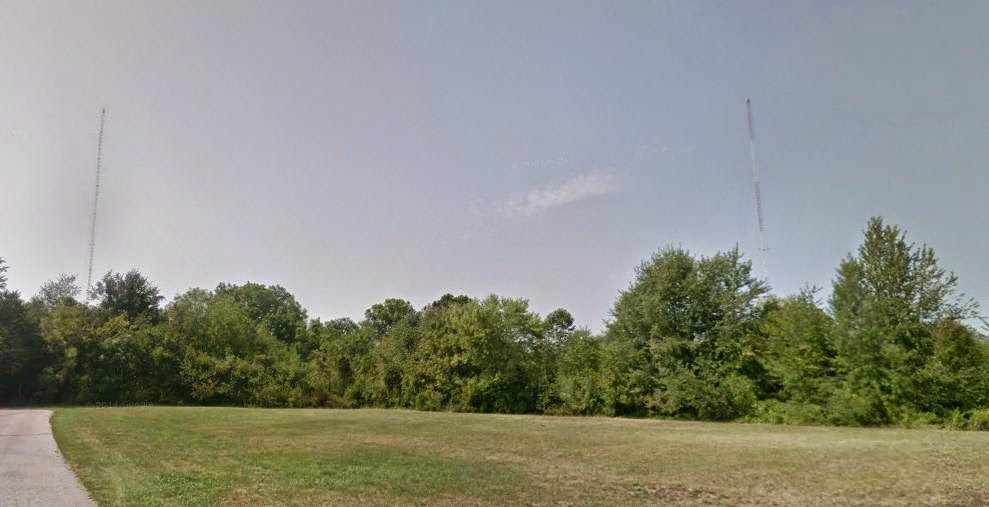
| KWOD Towers courtesy https://www.google.ca/maps |
The transmitter site is located in the middle of a quiet residential district of older homes ... on all four sides.
I shudder to think what RFI problems those living in the adjacent homes must suffer when they are on daytime power!
 |
| WSLM - Indiana courtesy :https://www.google.ca/maps |
Their phased antenna array puts their main lobes, due east and west, so evidently I was catching the northern edge of their pattern.
 |
| courtesy: https://www.google.ca/maps |
See what you can hear their during the short recording made of the "Country WSLM" weather report

I have yet to check last night's recordings to see if conditions have held-up for two night's running ... more later if so.
Steve McDonald, VE7SL, is a regular contributor to AmateurRadio.com and writes from British Columbia, Canada. Contact him at [email protected].
Frog 40m transceiver

This is the Pixie’s “big brother”. I have mentioned it before in this blog. It has more power than the Pixie and a better RX. Best of all it costs just over £15 built with free shipping from Hong Kong.

Roger Lapthorn, G3XBM, is a regular contributor to AmateurRadio.com and writes from Cambridge, England.
40m Pixie
Yesterday I found my rechargeable 12V battery and charged it up. I also checked the Pixie I built as a kit for dry joints and shorts. As all looks good, I hope to test this on the air over the weekend or early next week.
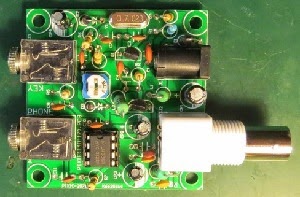
There are a couple of locals I’d like to test with initially, although I am expecting to suffer from AM breakthrough mainly from broadcast stations very close to our 40m band. Probably there would be less breakthrough in the daytime? My antenna is short and low on 40m (a Par triband end-fed covering 10m/20m/40m) so any contacts will be good!
I can test it first on a signal generator and then a power meter. If it works, I’d expect a sensitivity of around -100dBm and a power out of around 200mW on 40m. We’ll see. Even -80dBm and 100mW would be enough to work locals as long as AM breakthrough is at a manageable level.

Roger Lapthorn, G3XBM, is a regular contributor to AmateurRadio.com and writes from Cambridge, England.
Amateur Radio Weekly

I’m pleased to announce that beginning February 28th, Cale Mooth’s Amateur Radio Weekly will be available each Saturday morning on AmateurRadio.com.

Cale, KK4HSX
I began reading Cale’s (KK4HSX) newsletter a few weeks ago and was impressed by its style and organization. He does a tremendous job curating some of the best articles and posts from the week and puts them into his newsletter. I think you’ll find he has a real knack for finding the interesting stuff that might not otherwise make it onto your radar — without having to wade through lists of endless links.
If you’re already a subscriber to our daily Amateur Radio Newsletter, we’ll include a link each week to a post featuring the latest issue of Amateur Radio Weekly so you won’t miss it. You can also subscribe directly to his weekly e-mail newsletter by clicking here.
Thank you, Cale! We’re excited to read what you discover!
Matt Thomas, W1MST, is the managing editor of AmateurRadio.com. Contact him at [email protected].
The Spectrum Monitor — March, 2015

Stories you’ll find in our March, 2015 issue:
Catch the Action in the Air and On the Air
By Brian and Jo Marie Topolski
Once again, Brian and Jo Marie Topolski take us all to the air show with some dazzling photos and the inside scoop about what and where to listen when you take your scanner with you. Brian also has a salute to woman aviation pioneer, Julie Clark, a regular fixture at many air shows, and a look inside his own air show command post.
The Air Show Experience
By Kevin Burke
TSM air show regular contributor, Kevin Burke, shows us his own (and his son’s) photographic touch along with his own experiences at air shows. He also offers a photographic “Study in Blues” as well as a review of the Bearcat BC-125AT at an air show.
Now Try ‘Scanner-less’ Aviation Monitoring!
By Richard Fisher KI6SN
Want to catch all the aviation action but don’t have a scanner or live near an airport? Not to worry, says Richard Fisher, you can enjoy aviation monitoring to the fullest extent possible, and at no cost. Richard shows us how.
TSM Reviews: Teak Publishing’s 2015 Air Show Guide
By Ken Reitz KS4ZR
For many years, readers of Monitoring Times magazine came to rely on the expertise of its military communications columnist and MT assistant editor, Larry Van Horn N5FPW, to provide the very latest in frequencies used by all the top aviation demonstration teams at air shows across North America. And, even though MT closed its doors in December 2013, Larry has since continued to provide these frequencies in the form of an annual Air Show Guide in Kindle format. Here’s a review of his latest Air Show Guide.
TSM Air Show Schedule
US Navy Blue Angels; USAF Thunderbirds; Canadian Snowbirds; Breitling Jet Team; Raiders Flight Demo Team; GEICO Skytypers; Team Oracle’s Sean D. Tucker; John Klatt Air Shows, and Air Combat Command F-16 North American air show schedules.
Scanning America By Dan Veenaman
Hard-Learned Radio Civics Lesson in D.C.
Federal Wavelengths By Chris Parris
Flying with Federal Aviation
Utility Planet By Hugh Stegman NV6H
How to Hear HF Civil Aviation
Digital HF: Intercept and Analyze By Mike Chace-Ortiz AB1TZ/G6DHU
US Coast Guard, Customs & Border Patrol COTHEN Network
HF Utility Logs By Mike Chace-Ortiz and Hugh Stegman
Amateur Radio Insights By Kirk Kleinschmidt NT0Z
RFI Part 2: Finding, Fixing or Fleeing
Radio 101 By Ken Reitz KS4ZR
Intro to FTA Satellite and Advanced Cord-Cutting
Radio Propagation By Tomas Hood NW7US
Space Weather Terms
The World of Shortwave Listening By Keith Perron
Armed Forces Network Taiwan (AFNT)
The Shortwave Listener By Fred Waterer
World Languages via SW Radio Web Sites
Amateur Radio Satellites By Keith Baker KB1SF/VA3KSF
AMSATs: From OSCAR-1 to FOX-1A
The Longwave Zone By Kevin O’Hern Carey WB2QMY
Longwave: A Cradle for High-Tech
Adventures in Radio Restoration By Rich Post KB8TAD
The Admiral Bean-Counter Special: Part II
The Broadcast Tower By Doug Smith W9WI
What Happens to a Dead Radio Station?
Antenna Connections By Dan Farber AC0LW
Got a Match: Methods of Matching Coaxial Cable to Antennas
The Spectrum Monitor is available in PDF format which can be read on any desktop, laptop, iPad®, Kindle® Fire, or other device capable of opening a PDF file. Annual subscription (12 issues, beginning with the January 2015 issue) is $24. Individual monthly issues are available for $3 each.
Ken Reitz, KS4ZR, is publisher and managing editor of The Spectrum Monitor. Contact him at [email protected].
 Ham Radio Deluxe |
 W5SWL Electronics |
 Ham Radio Prep |
 KB3IFH QSL Cards  Hip Ham Shirts  HamRadioAuctions HamRadioAuctions Reliance Antennas Reliance Antennas Enigma Shop Enigma Shop |  morseDX  Ni4L Antennas  R&L Electronics R&L Electronics antennas.us antennas.us QRV QRV |
- Matt W1MST, Managing Editor
