 |
 Easy as Pi
 11 March 2015 | by
 Pi Day Special event station – N2RE Princeton, New Jersey
Larry Makoski, W2LJ, is a regular contributor to AmateurRadio.com and writes from New Jersey, USA. Contact him at [email protected].
Introducing a new author: John K3NXU
Most people know John K3NXU well as the busy bee who maintains Miklor.com. Starting today, John will be an author here too.
We have a long history of exchanging information behind the scenes, but in an informal way. No surprise here; our websites have a lot in common. We started to exchange more and more e-mails lately, talked to each other on the phone and concluded that a more official cooperation would be the next logical step.
So, there we are: Miklor.com and hamgear.wordpress.com are ‘tying the knot’. We hope (and expect) that this will benefit our readers. John’s first article, his take on the Anytone TERMN-8R, will be published later today.


Hans, PD0AC, is a regular contributor to AmateurRadio.com and writes from Almere, The Netherlands. Contact him at [email protected].
PRC-104 Pedestrian Mobile 03-09-2015
I was able to get outside Monday March 9th just after 1600z. I was on 18157.5 HFPack frequency using the PRC-104 with the PRC-74 antenna and a 10’7″ counterpoise. The PRc-104 runs 20 watts out on SSB. I also had the KY-116/U key on as well.
I called CQ a few times with no answers, then I heard Paul in CO. W0RW call me after seeing my posting on HFNow. He said my cw cq was a 559 and my SSB signal was a 3×3. We were able to work each other and complete a qso. Paul was a solid 5×9.
I then worked KBOSFP in MO. He was a 5×9 and I was a 5×5.
Then all the way over to Seattle Washington to Byron W7SWC also a 5×9 here in Thunder Bay and I was a 5×4, yet again another great qso.
One of the regulars from the Military Radio Net Paul WB4WCJ also was able to copy me and send me a report, Paul from South Carolina was a 5×5 and I was also a 5×5 but had some fading.
Then just before I was ready to pack things in on this 4c degree day with light snow falling I heard Greg N4KGL in Florida give me a call. Greg is a RaDAR member as well and was operating the AlexLoop with his KX3. He was a 5×5 and I was a 5×3 into Florida.
So it was a great Rapid Deployment Amateur Radio (RaDAR) session by far. I hope to work many more of you while I am portable. I am working on a few more backpack setups for my IC-703 and My KX3 as well.
Here is the link to the video of yesterdays outing.
Once again many thanks to all those who enjoy the hobby, HFNow and GORC for the groups to be able to post such outings. Those who listened but I was not able to work. Gurus and elmers like W0RW, WA3WSJ, wG0AT and others.
This is a great hobby and has so much to offer be it new or old technology, it all is fun and never gets boring.
72/73
Fred
VE3FAL
(The Ice Man)
Thunder Bay,ON EN58hh
Fred Lesnick, VE3FAL, is a regular contributor to AmateurRadio.com and writes from Thunder Bay Ontario, Canada. Contact him at [email protected].
K1N – The ham stuff was easy
I’m not a big gun DXer at all. My HF station consists of a KX3 and a windom up 40 feet in the trees. But when Craig, K9CT and Jerry, WB9Z from the K1N Navassa Island DXpedition came to town I made sure to clear my calendar. I was fortunate enough to work them on ssb from KE9UA’s house and then again on CW with 10W when my replacement KX3 arrived. Meeting them in person was a treat, and hearing about their adventure was inspiring.
Michael Brown, KG9DW, is a regular contributor to AmateurRadio.com and writes from Illinois, USA. Contact him at [email protected].
My New Station
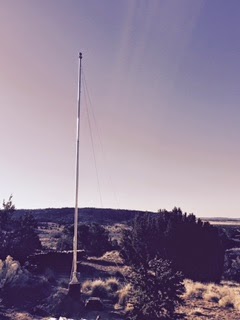
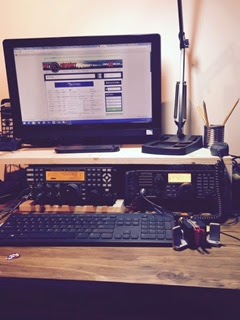
So with the help of Hector, XE2K, I am now able to work HF from here in a couple of ways. The first challenge was the antenna. While there is strict prohibitions against transmitting antennas, there is nothing prohibiting flagpoles. So I got permission to put up a flagpole. The flagpole I bought was from ZeroFive antennas. I bought the 20 ft. version. which is resonant on 20m with no tuning. I am using 16 43ft. radials However, I also put a SGC remote tuner at the base, which tunes all bands from 10m - 30m. Hector, who is very good at expanding the capabilities of any antenna, suggested we add a radiating wire to the mix. So we cut a 43 ft. piece of wire, attached it to the flag fastener and hoisted it to the top of the pole and tied off the end, in an inverted V configuration. the two antennas now are resonant, with the tuner, 10m - 80m. While it's not optimum, it is functional and now I'm on the air. In the photo below you can see the flagpole and the wire that makes 40m and 80m possible.
Mike Crownover, AD5A, is a regular contributor to AmateurRadio.com and writes from Texas, USA. Contact him at [email protected].
My New Station
So with the help of Hector, XE2K, I am now able to work HF from here in a couple of ways. The first challenge was the antenna. While there is strict prohibitions against transmitting antennas, there is nothing prohibiting flagpoles. So I got permission to put up a flagpole. The flagpole I bought was from ZeroFive antennas. I bought the 20 ft. version. which is resonant on 20m with no tuning. I am using 16 43ft. radials However, I also put a SGC remote tuner at the base, which tunes all bands from 10m - 30m. Hector, who is very good at expanding the capabilities of any antenna, suggested we add a radiating wire to the mix. So we cut a 43 ft. piece of wire, attached it to the flag fastener and hoisted it to the top of the pole and tied off the end, in an inverted V configuration. the two antennas now are resonant, with the tuner, 10m - 80m. While it's not optimum, it is functional and now I'm on the air. In the photo below you can see the flagpole and the wire that makes 40m and 80m possible.
Mike Crownover, AD5A, is a regular contributor to AmateurRadio.com and writes from Texas, USA. Contact him at [email protected].
Operating /P for the 432MHz UKAC tonight
I have a small Moonraker 7-element ZL-Special on the main antenna mast, purchased originally for monitoring satellites and was pressed into service for SSB when I got licensed. It has never wowed me performance wise and I have been intending to replace it for quite a while but since I only use it one day a month it hasn't been a priority. So the mast came down last night and I removed it so I can take it out with me to operate portable from some higher ground tonight.
 |
| Using the 2m delta beam in June 2014 |
Last year I had a go at operating portable from the car and posted a write-up. It is my intention to repeat this exercise but with the 70cm antenna on top of my 'painters pole' mast. I have serviced the antenna and fitted a new short run of quality coax and spent a far amount of time with the AW07A analyser adjusting the antenna's tuning capacitor and have got the VSWR right down to 1.1:1 on 432.200MHz so things should be optimal.
I am looking forward to this evening, hoping it pays some dividends.
As I mentioned the 24 hour March 144/432MHz VHF Championship contest took place last weekend. I took part to give away some points just grabbing a few short sessions with the radio. I concentrated on the 2m band due to my issues on 70cm.
In my AW07A analyser review I mentioned some issues with my 2m LFA YAGI, thankfully these have been resolved. The use of some wire wool to remove some corrosion and a hacksaw to take 10mm from the long elements of the loop allowed the end elements to 'trombone' in sufficiently to get the antenna resonant and the VSWR is down to 1.2:1 on 144.300Mhz.
I only made 18 contacts, but was happy with the distances achieved with 30W, getting a lot further south than I normally do, given I am 18m ASL. There was also some local wideband noise (I captured a screenshot on the SDR) and the conditions gave some interesting fading.
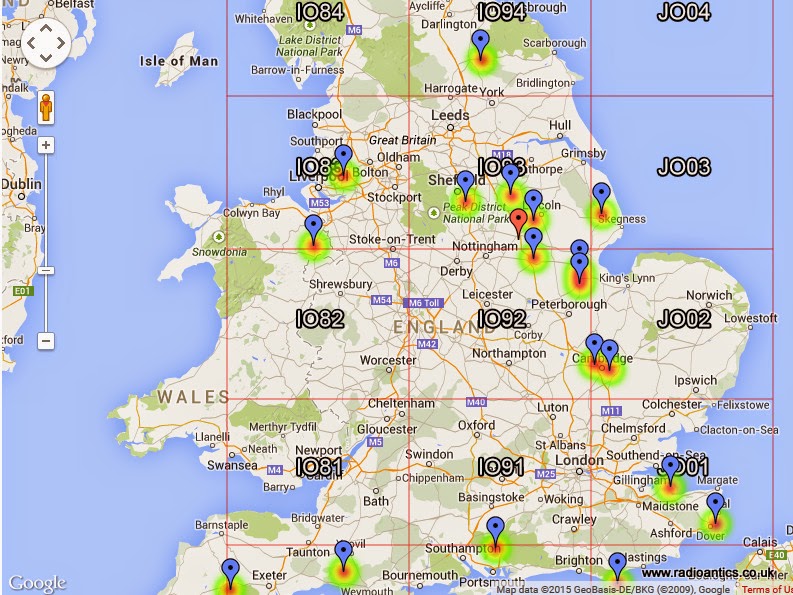 | |
| M0NRD QSO map March 144 VHF |
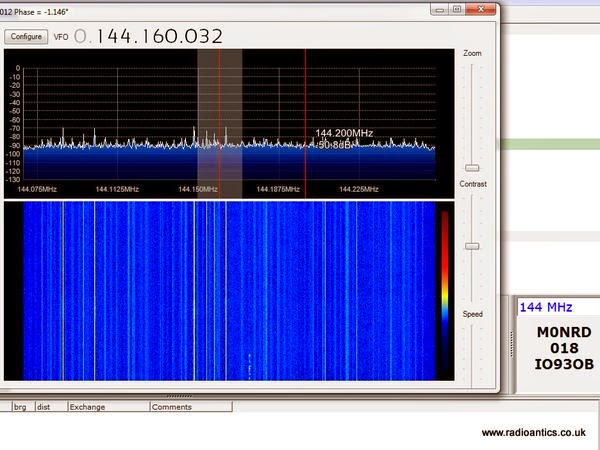 |
| Noise across the band |
Andrew Garratt, MØNRD, is a regular contributor to AmateurRadio.com and writes from East Midlands, England. Contact him at [email protected].
 Ham Radio Deluxe |
 W5SWL Electronics |
 Ham Radio Prep |
 KB3IFH QSL Cards  Hip Ham Shirts  HamRadioAuctions HamRadioAuctions Reliance Antennas Reliance Antennas Enigma Shop Enigma Shop |  morseDX  Ni4L Antennas  R&L Electronics R&L Electronics antennas.us antennas.us QRV QRV |
- Matt W1MST, Managing Editor
