 |
 AmateurLogic 76, live Friday night
 5 March 2015 | by
 We will be producing episode 76 of AmateurLogic This Friday night, March 6th at 7:00 CST, 0100 UTC.
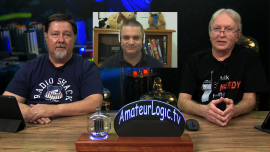
You can watch us shoot it live at www.live.amateurlogic.tv, or download the edited version a couple of days later.
George Thomas, W5JDX, is co-host of AmateurLogic.TV, an original amateur radio video program hosted by George Thomas (W5JDX), Tommy Martin (N5ZNO), Peter Berrett (VK3PB), and Emile Diodene (KE5QKR). Contact him at [email protected].
HamRadioNow: Digial Voice is EXPLODING! (Click Bait #2?)
First, I apologize for this cut-and-paste from QRZ.com. I won’t usually do that, but I spent a lot of time writing this, and I want to spread it around. They moderate, I’ve been “pre-approved” here on AR.com, so you’ll see it first. So I guess I “cut and pasted” from here to there. OK, I can live with that…
HamRadioNow Episode 193: DV is Exploding
David Rowe VK5DGR updates CODEC2 and FreeDV,
introduces a FreeDV “Speaker-Mic”, and is developing a
disruptive DV system for VHF/UHF
David Rowe VK5DGR is the ham who developed CODEC2*, and CODEC2 changes everything. So, is this a click-bait title, or a valid prediction?
In this program, David talks to me about the SM-1000 “speaker-mic”, a little box he’s developed to let hams use FreeDV digital voice without a computer. The box does all the processing and has all the input/output connections, so you can run digital voice over your SSB radio with no computer attached. The SM-1000 will be available soon for about $200.
We also talk about improvements to FreeDV and CODEC2 that David expects will make digital voice work as well as, and maybe a little better than SSB with weak signals or noisy HF conditions. Today, SSB can be copied below the level that a DV signal drops out, but it’s somewhat rough listening. Yesterday, you needed a lot more signal for DV. Tomorrow: parity with SSB, or maybe advantage: DV. Yes, there are plenty of issues left. Voice quality (many hams don’t like the ‘robotic’ sound or the fidelity). Contest/DX pileups. David readily admits that SSB has been around for so long on HF because it works great in that hostile environment. He sees it as a challenge.
Finally, David tells me about a VHF/UHF project he’s working that, at my first look, has the potential to disrupt everything in repeaters. It won’t happen overnight, and given ham’s investment in analog FM and even the newer DV modes from D-STAR to DMR and Fusion, it might not really happen at all. But here’s what David is aiming at:
- Signal to Noise that’s better than FM by 10 dB
- 5 kHz bandwidth
- TDMA “time-slice” modulation that will allow for “on-channel” repeaters.
By “on-channel” I mean repeaters that don’t need an “input” channel. As David described it, the repeater receives you for about 40 milliseconds, then retransmits what it just received. When you’re transmitting, your radio transmits for the 40 ms that the repeater is receiving, then stops while the repeater transmits. When you’re receiving, the software smooths it all out so it sounds like a continuous transmission. David didn’t say this, but I suppose it would allow you to monitor your signal thru the repeater in real time. This also means that a repeater works without a duplexer, and without some of the shielding needed to allow a high-power transmitter to operate right next to a sensitive receiver.
The disruptive part, though, is the 5 kHz bandwidth and no separate receive frequency. Cheaper, better repeaters that use far less spectrum will allow for dozens more repeaters to go unused everywhere. OK, that’s a snarky reference to the common complaint about unused repeaters in ham radio, but in commercial and public safety, where spectrum is in extreme demand, it really could change everything. And they have money.
David says that he needs to develop hardware for this because current hardware won’t handle the DV signal to make this work. His time-frame for a working prototype: end of this year. And his vision is a repeater that’s as simple as “an HT you stick up on the hill.” You might want something a bit more robust for your full-time repeater, but for fast emergency use… wow. On the other hand, I can see every DV mobile and HT having a “repeater” mode built-in. I see equal potential for utility and chaos on our VHF/UHF bands! Would we be up to the challenge?
Yes, DMR/MotoTRBO uses TDMA. They don’t use it for on-channel repeaters. They use it to allow two simultaneous conversations to occupy a single RF channel, but it still needs an input and an output frequency (and a duplexer), and occupies 12.5 kHz of RF bandwidth.
So, watch the show, and see the future…
*CODEC2 is the open-source software that digitizes speech into a very narrow, or slow, stream of data. The result: a highly useful, if a bit “robotic” sounding version of your voice that can be sent over a typical SSB transmitter, but using about half the RF bandwidth of typical SSB speech (2.5 kHz for SSB, 1.2 kHz for the DV). David’s been working on it for about 5 years, and he’s far from done. It works very well today. It’ll work even better tomorrow. Did I mention it’s open-source? Yes, there are proprietary codecs that do this. The AMBE codecs used by D-STAR, DMR and Fusion are the most common today. Is CODEC2 better? I’ll leave the technical arguments to those with the chops to make them. None of them are done. They’re all being improved. CODEC2 is free, and the hardware that uses it, typically SDR like FlexRadio, can be updated as new versions are released.
Links:
David’s Blog (details on FreeDV/CODEC2 development):
http://www.rowetel.com/blog/
Interview with David on “Linux in the Ham Shack”
http://lhspodcast.info/2015/01/lhs-episode-138-being-david-rowe/
David’s 2011 talk on CODEC2 at the ARRL/TAPR DCC:
http://youtu.be/bLb7stxOqmI
The 2011 DCC’s banquet talk – “The Village Telco” – David’s project to provide extremely low cost telephone service in East Timore, Africa.
http://youtu.be/1H1OVH1FwTQ
Gary Pearce, KN4AQ, is the host of HamRadioNow.tv. If you enjoy this and other HamRadioNow programs, help keep them 'on the air' with a contribution. Contact him at [email protected].
More Low Noise Vertical Info
The first video shows phasing against local IBOC crud.
The second video shows the phaser in use to knock down the sideband hash from a strong local (KOA) signal, 25 miles away.
For those that like to DX in real time (unlike those using SDR overnight samplings), the phaser has much to offer.
The one being used in the videos is the Quantum Phaser and more information about it may be found here.
More on phasers next time.
Steve McDonald, VE7SL, is a regular contributor to AmateurRadio.com and writes from British Columbia, Canada. Contact him at [email protected].
HackRF on Sky Loop Antenna and Talented Balun
Todd Harrison, KF7NBI, is a regular contributor to AmateurRadio.com and writes from Arizona, USA.
UK Activity Contests
Every Tuesday evening the RSGB organises a VHF/UHF activity contest. I have just in time submitted my entry for the low power section of last Tuesday evenings 50MHz contest. With just 3 QSOs logged there is no way on this earth that I’ll be anywhere but near the bottom! Having a V2000 omni vertical antenna, 5W, and a stroke damaged voice is no way to enter a 50MHz, UK based, contest! The V2000 and even 2.5W is great in the Es season (I work most that is around), but it is far from ideal working inter-G on 6m SSB.
Tonight is the 144MHz (2m) March leg of the UKAC. My small 3el beam should turn again now (manually) so I’ll see how long my voice holds out. 45 minutes to 60 minutes is usually my limit. Last week I was on very little time. My best DX seems to be around 200km with 5W on 2m in “normal” conditions.
At this time of the year there are fewer portable stations active but activity (SSB and CW) is usually very high so this is a good opportunity to work some new squares. People have been very friendly. If in the UK or nearby join the fun 2000-2230z on 2m. I usually go QRT by 2100z because of the strain on my voice.
Just checked where I sit in the Jan 2015 AL section of the 50MHz UKAC. You guessed? Bottom! Well someone has to be!

Roger Lapthorn, G3XBM, is a regular contributor to AmateurRadio.com and writes from Cambridge, England.
What happens to your gear when you die?
How’s that for a title? I’m helping a widow sell her late husband’s ham gear. Things are going quickly as a local ham bought most of the newer gear based on recent sale prices from eBay and the QRZ.com swapmeet forum. Had she not reached out to the local club, it’s likely she would have sold thousands of dollars of gear at a yard sale for pennies, or simply sent it to recycling.
This got me to thinking…does my wife know who to call to dispose of my gear should something happen to me? While probably not high on the things to do list if I pass suddenly, it sure would be a good idea to have a list of hams I trust in a folder for her.
There are some great hams out there – I met another one over email this week who spends hundreds of dollars a year to provide data services for other hams. But there are also crooks and thieves that would rob a widow blind. Do your significant other a favor…leave behind a list of hams you trust.
Michael Brown, KG9DW, is a regular contributor to AmateurRadio.com and writes from Illinois, USA. Contact him at [email protected].
Icom IC-7100 firmware update E3
Icom Inc. has published firmware update E3 for the IC-7100 on their global website. This new firmware has been designed to improve RX audio quality.
The following firmware have been updated:
• CPU M to Version 1.04
• DSP I to Version 1.02
 The new firmware can be downloaded here.


Hans, PD0AC, is a regular contributor to AmateurRadio.com and writes from Almere, The Netherlands. Contact him at [email protected].
 Ham Radio Deluxe |
 W5SWL Electronics |
 Ham Radio Prep |
 KB3IFH QSL Cards  Hip Ham Shirts  HamRadioAuctions HamRadioAuctions Reliance Antennas Reliance Antennas Enigma Shop Enigma Shop |  morseDX  Ni4L Antennas  R&L Electronics R&L Electronics antennas.us antennas.us QRV QRV |
- Matt W1MST, Managing Editor
