Review Anytone TERMN-8R

by John K3NXU

The Buzz
The recent entry of the Anytone 8R series has raised some eyebrows lately.  Here, we are going to take a look at the TERMN-8R (aka terminator). First, this is definitely not a rebranding of an old design, but a fresh set of features not usually found in one model.

Features such as a Bi-Directional Cross Band Repeat function, Pre-programmed Weather Channels with Alert Tone, and 2TONE and 5TONE squelch and Paging for the EMS and Fire services, and the Part 90, 95A, 95J certifications for Commercial, GMRS and MURS in the US.
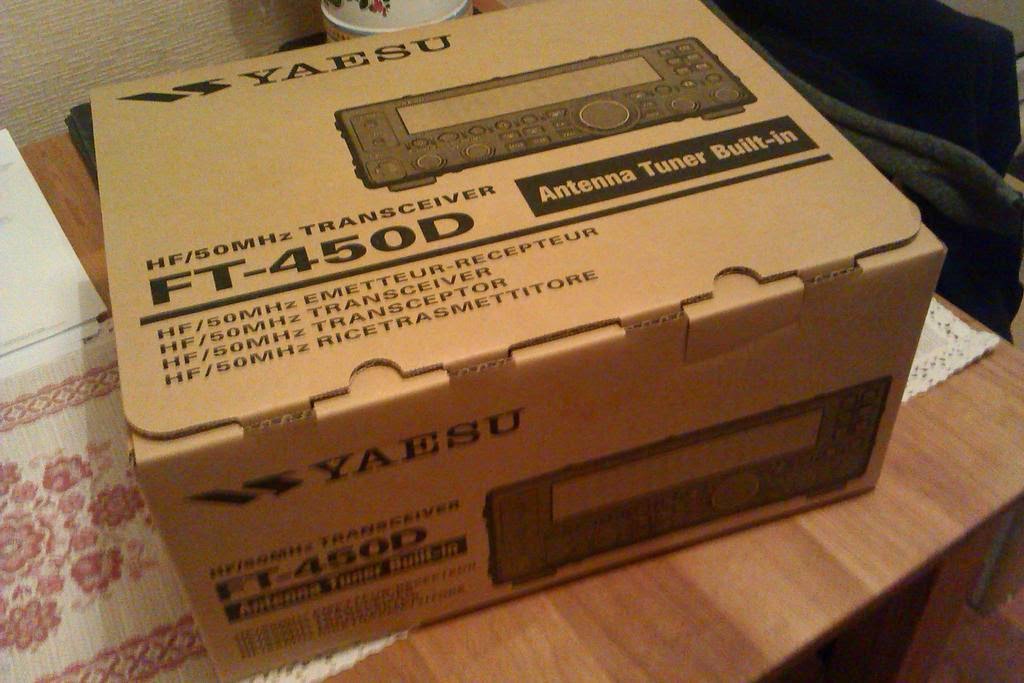
 TERMN-8R box
What’s in the BOX
A nicely written and illustrated 104 page English manual, belt clip, lanyard, Earpiece/Microphone, 7.25 inch (18cm) flexible antenna and hefty 2200mAh 7.4V battery with charger.

I noticed the side of the 2200mAh had a small charging jack. When I checked the AnytoneTech accessories page, I found that a 12V mobile charger is available for on the road charging.

First Impression

After inserting the battery, you immediately notice the overall weight and feel of the radio. It has a solid feel and fits my large hand nicely.

The top of the radio has the traditional Volume/PowerOn switch and Channel Selector. The left side has the PTT switch and well as two programmable function switches. The right has a 2 pin ‘K2′ Kenwood, Anytone, Wouxun, Baofeng style connector, meaning most available accessories will be totally compatible.

My prior Anytones have somewhat of a concave keypad. I found the button access much easier. The keypad numbers and definitions both light up making manual programming a bit easier.

Transmitter
The TERMN-8R transmitter has 3 power levels. For Normal operation, the power levels can be changed from the keypad. In the GMRS and MURS mode, the power levels are fixed. My Over the Air contacts have received excellent quality and level reports.
Power Levels clock in as follows:
VHF – 5.6W,  2.4W,  1.2W
UHF – 4.5W, 2.25W, 1.25W
GMRS – 4.15W
MURS – 1.95W

Dual Receivers
The TERMN-8R has Dual Receivers that function over six bands: VHF, UHF, Aviation Band (108-136MHz), Shortwave (AM 2.3 – 30MHz), AM Broadcast (520-1710kHz) and FM Broadcast (64-108MHz).  Both the FM Broadcast Band and expanded Aviation Band include 100 memory channels each and can be used with Fast Scan (see below)

Dual Receivers allow for receiving two signals simultaneously, rather than just sampling for activity. This is important if the sub-channel is set for Weather Alerts (1050Hz) or EMS / EmComm Services Alerts or Paging. It also provides for bi-directional Cross Band repeating.

To eliminate side channel interference, the radio’s receiver reverts to true Narrow band when selected.

GMRS and MURS operation (FCC part 95A / 95J certified)
This TERMN-8R can be switched to operate on any of three modes. GMRS, MURS or Commercial/Normal. To eliminate the possibility of being on the wrong band, a Key Press at PowerOn selects either GMRS or MURS mode. The channel frequencies are hard coded in the firmware as well as their power levels, but allow for CTCSS/DCS tones can be added/changed via the keypad.

Commercial Application (FCC Part 90 certified)
For Commercial, Fire, EMS and EmComm use, the TERMN-8R is fully certificated with 2.5kHz steps, and software which prevents Field Programming.

Cross-Band Repeater
This function allows retransmitting a VHF signal to UHF (or UHF to VHF).  To test, I set the main channel to a local VHF repeater, and the sub-channel to a UHF simplex channel, then activated the Repeat function.  Audio reports both to and from the repeater were excellent.

In this mode, both receivers are active simultaneously. The first active receive signal takes repeat priority. When that signal drops, both receivers return to active standby.

Aviation Band
I had a chance to play with the Air Band receiver that covers the entire 108 to 136MHz. Up to 100 channels can be stored and either individually selected or scanned. I entered 10 of the most used frequencies in the area, then activated the scan mode. When a signal is found, the receiver paused for 5 seconds, then returned to the scan mode. The scanning process can easily be stopped by pressing one key.

Another nice feature is Fast Scan. This increases the radios scanning rate to 10 channels per second. Three time faster than my Baofengs. Especially nice when scanning stored Air Band frequencies.

Even if your not close to an airport, keep in mind that an aircraft running 10W and flying at 20,000 ft has a range of approximately 170 miles.

Shortwave Bands (AM)
For those enjoying the Shortwave bands, there is AM coverage from 2.3 to 30MHz.  You can enter a frequency directly, then enter the scan mode if desired.  Even with the supplied antenna, I was quite pleased with what was received.  Attaching the radio to a full size outside antenna connects the SWL to the rest of the world.

NOAA Weather Alert
The seven US NOAA weather alert frequencies are preprogrammed into the radio. There are 3 options to choose from. ON, OFF and ALERT. When WX Alert is chosen, the NOAA weather channel remains silent in the background until the 1050Hz emergency tone signal is received. This is especially useful in areas where severe weather conditions are prominent.

Dual PTT Capability / Programmable Function Keys
There are two PF keys below the PTT switch. Either can be programmed to function as a sub-channel (lower display) PTT button, while the PTT switch activates the upper channel.

The PF keys can also be used to select your choice of:
– Battery Voltage display
– Frequency display
– Tone Calling (DTMF/5TONE/2TONE/MSK)
– FHSS (Frequency Hopping)
– Tone Pulse (1750, 1450, 1000 or 2100Hz)
– Alarm Button
– Dual PTT
– MONI (Squelch off)

Channel Banks
The radio supports 200 channels and 10 memory banks. Group 0 contains all channels entered into the transceiver. Banks 1 > 9 can be assigned up to 32 channels each.

I found a nice added feature that isn’t on my 3318UV-A. If I want to remove a channel from a particular bank, I can dial in the channel, press two keys, turn the knob and it’s gone. Eliminates the need to me to use the computer to delete the bad ones.

2-TONE Sequential Paging
This is extremely useful for the EMS user. I personally have used 2-tone pagers in the past (Motorola and Plectron). It’s nice to know that I can now monitor local EMS channels with one radio. The advantage of the TERMN-8R’s dual receiver is the pager tone will come through, even if the other receiver is active.

Pager-ChEditDetailed instructions on how to set up the 2-tone and 5-tone paging system can be found here.

Software
The OEM software is relatively easy to follow, and with a little practice, easy to navigate. Some areas may be a bit tricky, and I’ll try to address those area in the Miklor FAQ section.  CHIRP developers are aware of the new Anytone 8R series, but it takes time to reverse engineer the software.

As always, it is recommended to get a quality programming cable so you spend more time talking on the radio and less time loading special drivers to your PC. I personally use an FTDI cable that is Plug ‘n Play with no driver issues.

Upgradeable Firmware
The TERMN-8R has Upgradeable Firmware. If features are added in the future, your radio is not becoming obsolete. The firmware can be updated by an authorized dealer so you will always be able to  have the latest version available to you.

IMHO
I think the developers of the Anytone TERMN-8R outdid themselves on this one. The inclusion of the:
– Certified GMRS, MURS and Commercial in one radio
– Cross Band Repeater
– Two internal receivers
– Upgradeable Firmware
– 6 Band capability
– 200 channels/10 Banks
– Dual PTT
– 2TONE / 5TONE / MSK Messaging
– Stun / Kill capability
makes this one of the most versatile radios on the market.

Comparison
For a feature comparison between this model and the others in the 8R series, you can follow this LINK.

Price: $138.89 (Amazon)
More Information: Anytone Tech, Miklor.com


Hans, PD0AC, is a regular contributor to AmateurRadio.com and writes from Almere, The Netherlands. Contact him at [email protected].

If you think today’s pile ups are a zoo – just wait!

As the Brooklyn Dodger fans used to day, "Wait till next year!"


72 de Larry W2LJ
QRP - When you care to send the very least!


Larry Makoski, W2LJ, is a regular contributor to AmateurRadio.com and writes from New Jersey, USA. Contact him at [email protected].

Understanding IP Ratings (Ingress Protection) – IP53 vs IP55 vs IP67

Courtesy of Wireless Telecom Group, Inc.

Courtesy of Wireless Telecom Group, Inc.

Have you ever seen “IP55” or something similar written on the specs of a mobile or handheld radio? Do you know what it means?

“IP” stands for “Ingress Protection” and is a standard promulgated by the International Electrotechnical Commission. It allows you to quantify somewhat nebulous marketing terms like “waterproof,” “water resistant,” “dust resistant,” etc.

The chart above shows how to easily read an IP rating code. The first number denotes the protection against solid objects (think a finger, paperclip through a ventilation hole, or even dust). The second number denotes the liquid protection which can include direct sprays under pressure or even total immersion.

One of the more common ratings we see in portable radios is “IP55” which means that it’s protected against “dust…” and “low pressure jets of water….” Some models like the Wouxun KG-UV3D, KG-UV6D, and KG-UV8D all claim this rating. Other models such as the new AnyTone Tech TERMN-8R claim an “IP53” rating which provides equal dust protection but slightly less water protection. For other radios it’s hard to find an IP rating at all. For example, the Baofeng UV-5R is listed as “IP54” on some Chinese websites but the reliability of that is unknown.

Some uses such as firefighting or military require higher standards because of more extreme environments. For example, Kenwood and Motorola both offer fully submersible models with a rating of “IP67” (dust-tight and immersion to 1m). Ed at Import Communications just announced an upcoming release of the Anytone AT-3140UV which also claims a rating of “IP67.”

Keep in mind that some manufacturers “self-certify” their products rather than submitting them to an outside testing firm. You’ll see specs like “meets IP55 rating” which doesn’t tell you anything about who really did the testing — or whether it actually meets the rating. Caveat emptor!


Matt Thomas, W1MST, is the managing editor of AmateurRadio.com. Contact him at [email protected].

Easy as Pi

The David Sarnoff Amateur Radio Club down in Princeton, NJ has been distributing the following announcement. They're a great bunch of guys who always put together a good QRP Field Day effort every year - so I am going to post this for them:

Pi Day Special event station – N2RE Princeton, New Jersey

The David Sarnoff Radio Club will host a special event station on March 14, 2105 in conjunction with the Princeton Pi Day & Einstein Birthday Party that will be held in Princeton New Jersey. Einstein's birthday was March 14th the numeric equivalent of Pi! Princeton, NJ celebrates the amazing coincidence like no other city on earth! DSRC will join in celebrating this occasion with an amateur radio special event station.

STATION: N2RE

DATE: Saturday, 3.14.15 -THE REAL PI DAY & EINSTEIN'S BIRTHDAY

TIME: 1300 UTC to 1900UTC (9am EDT to 3pm EDT) 

FREQUENCIES: 14.314 MHz, 21.314 MHz, 28.314 MHz USB
                          Also 40m, VHF/UHF simplex as well as CW stations may be operating

To receive a special event QSL card send a self-addressed stamped business envelope along with your QSO information (call sign, state abbreviation, band, UTC time of contact) to:
Bob Uhrik - WA2BSP
104 Knoll Way
Rocky Hill, NJ 08553-1013


My only chance will probably be UHF/VHF as they're so close to me, but you might want to unleash your inner Mathematician and give it a go. 

72 de Larry W2LJ
QRP - When you care to send the very least!

Larry Makoski, W2LJ, is a regular contributor to AmateurRadio.com and writes from New Jersey, USA. Contact him at [email protected].

Introducing a new author: John K3NXU

Most people know John K3NXU well as the busy bee who maintains Miklor.com. Starting today, John will be an author here too.

We have a long history of exchanging information behind the scenes, but in an informal way. No surprise here; our websites have a lot in common. We started to exchange more and more e-mails lately, talked to each other on the phone and concluded that a more official cooperation would be the next logical step.

So, there we are: Miklor.com and hamgear.wordpress.com are ‘tying the knot’. We hope (and expect) that this will benefit our readers. John’s first article, his take on the Anytone TERMN-8R, will be published later today.


Hans, PD0AC, is a regular contributor to AmateurRadio.com and writes from Almere, The Netherlands. Contact him at [email protected].

PRC-104 Pedestrian Mobile 03-09-2015

I was able to get outside Monday March 9th just after 1600z. I was on 18157.5 HFPack frequency using the PRC-104 with the PRC-74 antenna and a 10’7″ counterpoise. The PRc-104 runs 20 watts out on SSB. I also had the KY-116/U key on as well.

I called CQ a few times with no answers, then I heard Paul in CO. W0RW call me after seeing my posting on HFNow. He said my cw cq was a 559 and my SSB signal was a 3×3. We were able to work each other and complete a qso. Paul was a solid 5×9.

I then worked KBOSFP in MO. He was a 5×9 and I was a 5×5.

Then all the way over to Seattle Washington to Byron W7SWC also a 5×9 here in Thunder Bay and I was a 5×4, yet again another great qso.

One of the regulars from the Military Radio Net Paul WB4WCJ also was able to copy me and send me a report, Paul from South Carolina was a 5×5 and I was also a 5×5 but had some fading.

Then just before I was ready to pack things in on this 4c degree day with light snow falling I heard Greg N4KGL in Florida give me a call. Greg is a RaDAR member as well and was operating the AlexLoop with his KX3. He was a 5×5 and I was a 5×3 into Florida.

So it was a great Rapid Deployment Amateur Radio (RaDAR) session by far. I hope to work many more of you while I am portable. I am working on a few more backpack setups for my IC-703 and My KX3 as well.

Here is the link to the video of yesterdays outing.


Once again many thanks to all those who enjoy the hobby, HFNow and GORC for the groups to be able to post such outings. Those who listened but I was not able to work. Gurus and elmers like W0RW, WA3WSJ, wG0AT and others.

This is a great hobby and has so much to offer be it new or old technology, it all is fun and never gets boring.

72/73

Fred

VE3FAL

(The Ice Man)

Thunder Bay,ON EN58hh


Fred Lesnick, VE3FAL, is a regular contributor to AmateurRadio.com and writes from Thunder Bay Ontario, Canada. Contact him at [email protected].

K1N – The ham stuff was easy

I’m not a big gun DXer at all. My HF station consists of a KX3 and a windom up 40 feet in the trees. But when Craig, K9CT and Jerry, WB9Z from the K1N Navassa Island DXpedition came to town I made sure to clear my calendar. I was fortunate enough to work them on ssb from KE9UA’s house and then again on CW with 10W when my replacement KX3 arrived. Meeting them in person was a treat, and hearing about their adventure was inspiring.

There were just under 40 hams in attendance at the local steakhouse in Normal, IL last night, ready to swap stories and hear all about K1N. I knew we were in for fun when Craig started the evening with audio from their side of the pile-up. I’d listened to some audio from DXpeditions before…but nothing like this. It was just a wall of noise…and every once and a while a few letters could be heard. CW was just as bad – like a continuous tone with a few blips – nothing sounded like letters to me. 
Craig and Jerry talked about how they would look for any kind of opening between QSOs to begin working stations. Knowing that the pileup would soon begin, they were careful to pick big swaths of open space. In the end, it didn’t matter – the pileup would start up 5kc, then jump to 10, 20 and finally all the way to the band edge. 
What was clear from listening to the audio was that a DX chaser should find a quiet space and stay there while the operator scanned over them for stations. While not quite as bad as the lottery, if both you and the operator are moving, it’s a bit harder for things to line up. 
One of the hams asked about DQRM. Jerry and Craig laughed in unison – they clearly enjoyed thwarting those that dared cause problems. K1N was known to use some unique ideas, both in technology and in operator prowess. In the end, it was clear to them when they were being jammed by the changes that occurred in the pile (silence when there shouldn’t be silence) and by changes on their spectrum displays (panadapters). 
Antennas were hung from the old lighthouse, and some SteppIR beams were on short tower sections. Coax everywhere, a unique homebrew coax patch panel, and Elecraft radios rounded out the technical side of the operation.
But what was most interesting for me and for most everyone else at the dinner was the logistics. After all of the talk about radios and antennas, the ham stuff was easy. There were years of lobbying, $304,000USD up front before anyone set foot on the island, and then all of this came together in under 3 months after they received authorization. And then add in a Bell 212 (like a Huey) helicopter, and a yacht and a dingy in the bay for transportation. Plan A didn’t work…Plan B kinda worked…and Plan C was executed. 
Everything hauled in had to be hauled out. Few warm meals…air temperatures at 117F. No drinking water was found on the island – It’s just a bunch of bird droppings and coral. The operators were not alone….there were 5 armed USFWS officers there for protection. There were Haitian and Cuban fishermen in the bay and scaling the 30 foot cliffs to wander the island. 
In the end, the results were phenomenal: 140,000 QSOs; Craig said that if they would have stayed two more weeks the pileups would still have been there. And their goals? Mostly all met – they wanted at least 100,000 QSOs, maximize ATNO contacts, plan the bands, create great memories, have fun, and be flexible.
If you’re thinking you want to be an operator, take a look at what the DXpedition was looking for in their volunteers: High QSO rates, a sense of humor, tri-lingual (CW, SSB, RTTY), good listening skills, team players, and multiple skills – just being a radio guy wasn’t enough. 
If you’re like me, you’re probably hungry for more information. Jerry shot some really neat video using a GoPro camera, and I’d expect to see a few more presentations from the operators in the coming months. These guys were in it for fun, and through all of the sweat and hard work they found time to help others. Those Haitian and Cuban fisherman were left with gas cans, MREs, clothes – even Craig’s hat. The pilots, while paid, lived a very modest life. They were rewarded with two prized positions – the microwave and ice machine.
I’ve already got the fixed and rotary wing pilot experiences, firefighting abilities, project management skills – and a sense of humor! One day I plan to get my CW skills up to the level where I would be a valuable DXpedition member. One day….hopefully soon!

Michael Brown, KG9DW, is a regular contributor to AmateurRadio.com and writes from Illinois, USA. Contact him at [email protected].

Subscribe FREE to AmateurRadio.com's
Amateur Radio Newsletter

 
We never share your e-mail address.


Do you like to write?
Interesting project to share?
Helpful tips and ideas for other hams?

Submit an article and we will review it for publication on AmateurRadio.com!

Have a ham radio product or service?
Consider advertising on our site.

Are you a reporter covering ham radio?
Find ham radio experts for your story.

How to Set Up a Ham Radio Blog
Get started in less than 15 minutes!


  • Matt W1MST, Managing Editor