 |
 A beauty of a crystal radio
 15 April 2015 | by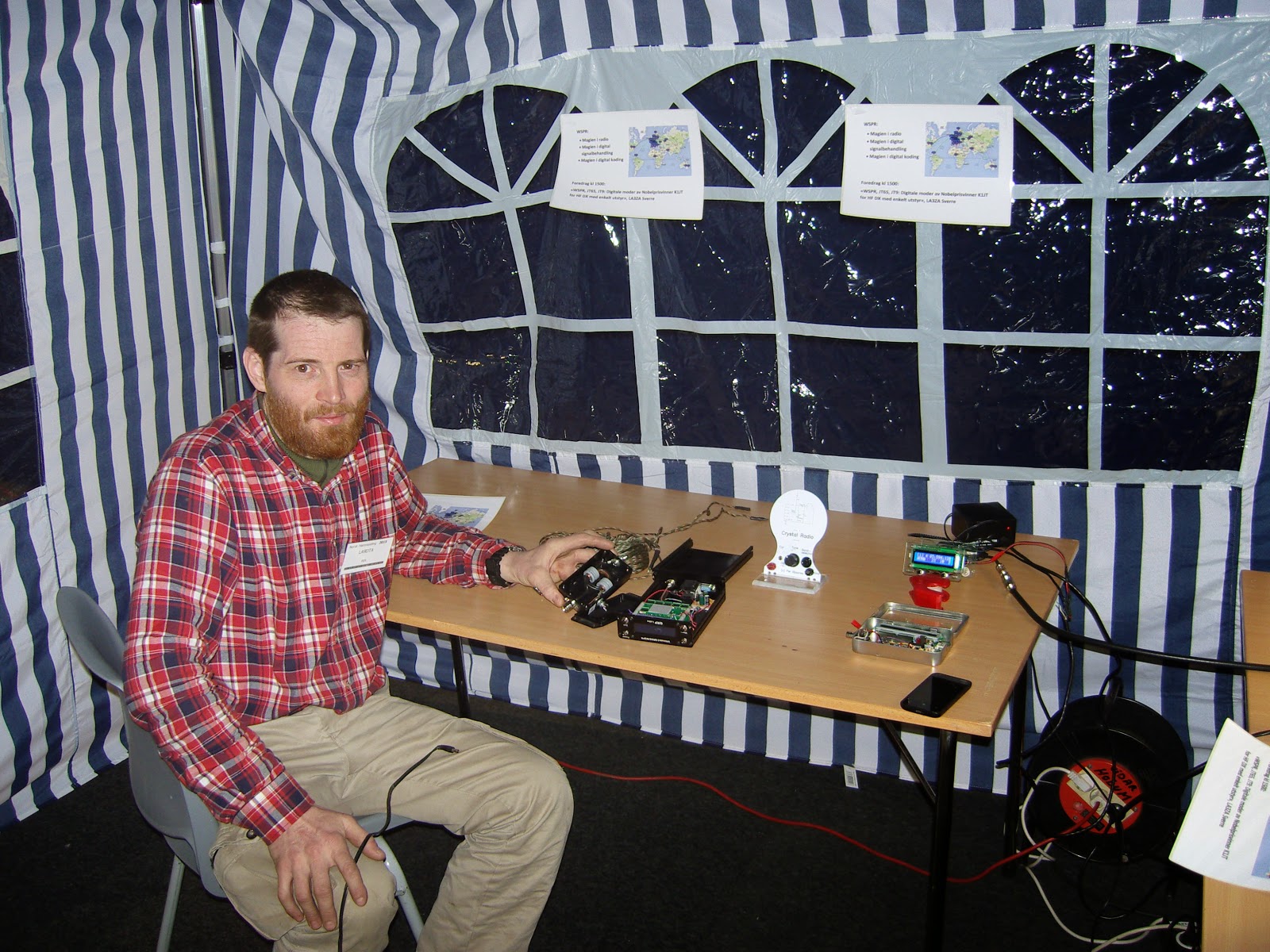
This past weekend during Hammeeting – the largest Ham rally in Norway – I met Per LA9DTA.
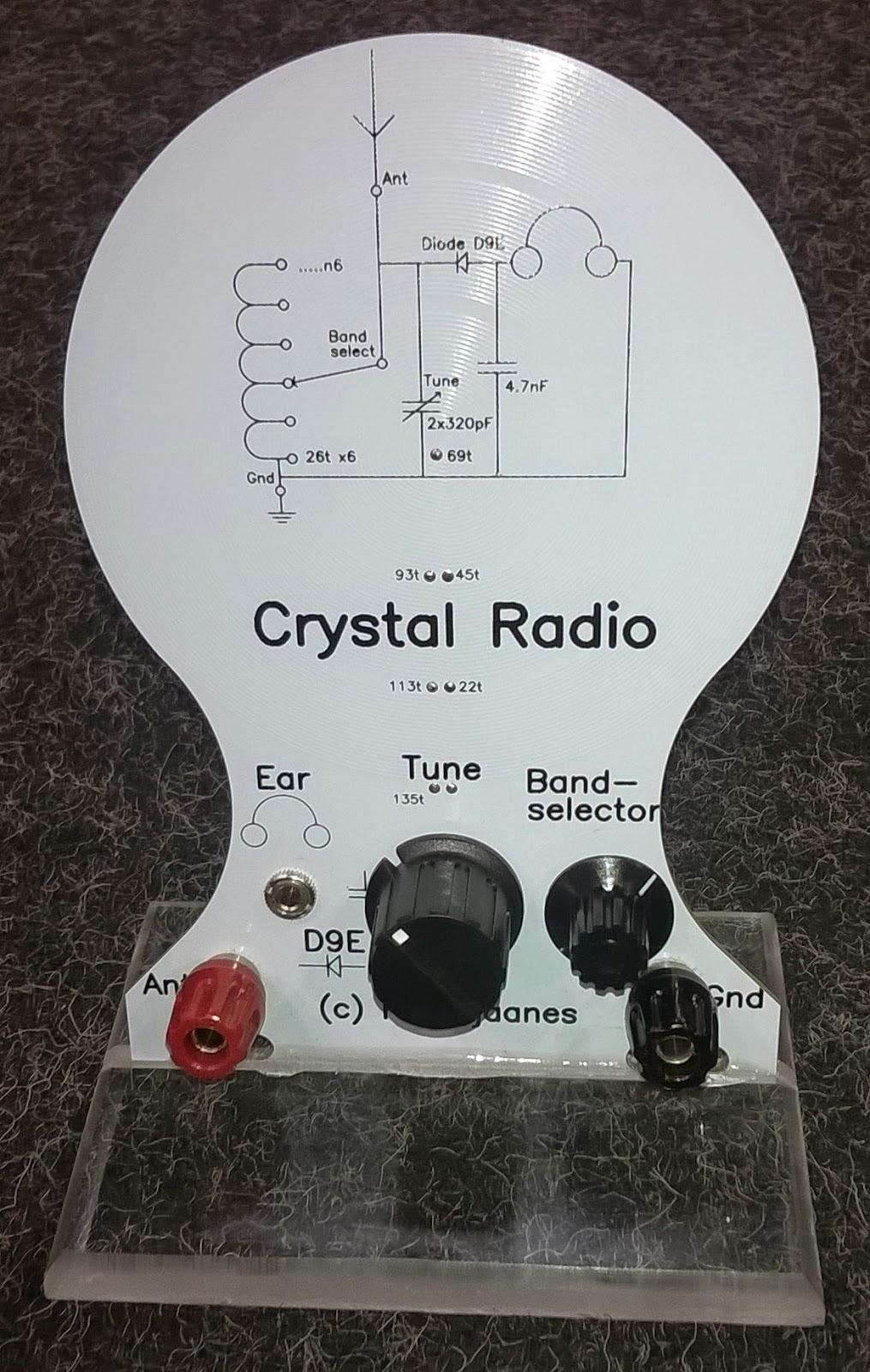
He showed me his beautiful crystal radio. It can be seen in the center of the table, with some close-ups below. The design has a printed coil and the whole design is made on a PCB which was shaped as shown in the image. It has a bandswitch and a Soviet low forward voltage Ge diode.
I fell for his design, but with the lack of longwave and medium wave transmitters here I am not sure if I would have much use for it. That is unless I set up one of my transmitter projects to support a radio like this.
 |  |
Sverre Holm, LA3ZA, is a regular contributor to AmateurRadio.com and writes from Norway. Contact him at [email protected].
A beauty of a crystal radio
This past weekend during Hammeeting – the largest Ham rally in Norway – I met Per LA9DTA.
He showed me his beautiful crystal radio. It can be seen in the center of the table, with some close-ups below. The design has a printed coil and the whole design is made on a PCB which was shaped as shown in the image. It has a bandswitch and a Ge diode.
I fell for his design, but with the lack of longwave and medium wave transmitters here I am not sure if I would have much use for it. That is unless I set up one of my transmitter projects to support a radio like this.
| |
Sverre Holm, LA3ZA, is a regular contributor to AmateurRadio.com and writes from Norway. Contact him at [email protected].
Watch stunning highlights, last 5 years of the Sun
We rely on the Sun for HF radio communication propagation. For the last five years, we have an amazing front-row seat: the SDO spacecraft. Here is a video with highlights of the last five years of solar activity as seen by NASA and the SDO AIA spacecraft. This is worth seeing on a larger monitor, so try to view it full screen on something larger than your palm. The music is pretty good too. It is worth the 20-some minutes of stunning viewing. Be sure to share!
Enjoy!
Details:
This video features stunning clips of the Sun, captured by SDO from each of the five years since SDO’s deployment in 2010. In this movie, watch giant clouds of solar material hurled out into space, the dance of giant loops hovering in the corona, and huge sunspots growing and shrinking on the Sun’s surface.
April 21, 2015 marks the five-year anniversary of the Solar Dynamics Observatory (SDO) First Light press conference, where NASA revealed the first images taken by the spacecraft. Since then, SDO has captured amazingly stunning super-high-definition images in multiple wavelengths, revealing new science, and captivating views.
February 11, 2015 marks five years in space for NASA’s Solar Dynamics Observatory, which provides incredibly detailed images of the whole Sun 24 hours a day. February 11, 2010, was the day on which NASA launched an unprecedented solar observatory into space. The Solar Dynamics Observatory (SDO) flew up on an Atlas V rocket, carrying instruments that scientists hoped would revolutionize observations of the Sun.
Capturing an image more than once per second, SDO has provided an unprecedentedly clear picture of how massive explosions on the Sun grow and erupt. The imagery is also captivating, allowing one to watch the constant ballet of solar material through the sun’s atmosphere, the corona.
The imagery in this “highlight reel” provide us with examples of the kind of data that SDO provides to scientists. By watching the sun in different wavelengths (and therefore different temperatures, each “seen” at a particular wavelength that is invisible to the unaided eye) scientists can watch how material courses through the corona. SDO captures images of the Sun in 10 different wavelengths, each of which helps highlight a different temperature of solar material. Different temperatures can, in turn, show specific structures on the Sun such as solar flares or coronal loops, and help reveal what causes eruptions on the Sun, what heats the Sun’s atmosphere up to 1,000 times hotter than its surface, and why the Sun’s magnetic fields are constantly on the move.
Coronal loops are streams of solar material traveling up and down looping magnetic field lines). Solar flares are bursts of light, energy and X-rays. They can occur by themselves or can be accompanied by what’s called a coronal mass ejection, or CME, in which a giant cloud of solar material erupts off the Sun, achieves escape velocity and heads off into space.
This movie shows examples of x-ray flares, coronal mass ejections, prominence eruptions when masses of solar material leap off the Sun, much like CMEs. The movie also shows sunspot groups on the solar surface. One of these sunspot groups, a magnetically strong and complex region appearing in mid-January 2014, was one of the largest in nine years as well as a torrent of intense solar flares. In this case, the Sun produced only flares and no CMEs, which, while not unheard of, is somewhat unusual for flares of that size. Scientists are looking at that data now to see if they can determine what circumstances might have led to flares eruptions alone.
Scientists study these images to better understand the complex electromagnetic system causing the constant movement on the sun, which can ultimately have an effect closer to Earth, too: Flares and another type of solar explosion called coronal mass ejections can sometimes disrupt technology in space as well as on Earth (disrupting shortwave communication, stressing power grids, and more). Additionally, studying our closest star is one way of learning about other stars in the galaxy.
Goddard built, operates and manages the SDO spacecraft for NASA’s Science Mission Directorate in Washington, D.C. SDO is the first mission of NASA’s Living with a Star Program. The program’s goal is to develop the scientific understanding necessary to address those aspects of the sun-Earth system that directly affect our lives and society.
Please visit my channel on YouTube, and subscribe ( https://YouTube.com/NW7US ).
— Twitter: https://Twitter.com/NW7US
— Facebook: https://www.facebook.com/spacewx.hfradio
— Web: http://SunSpotWatch.com
( Data feed Twitter https://Twitter.com/hfradiospacewx )
Credits:
Music Via YouTube “Free-for-use” Creation Tools
Video clips of the Sun are from NASA’s Goddard Space Flight Center/SDO which are in the Public Domain
By the way, this is an example of what I am trying to produce on a more regular basis, once I launch the space weather YouTube channel that I have started. If you wish to help, here is the GoFundMe link: http://www.gofundme.com/sswchnl
Visit, subscribe: NW7US Radio Communications and Propagation YouTube Channel
Latest ARRL Band Plan Updates Proposed
 |
| courtesy: http://www.arrl.org/bandplan |
As is often the case, it appears that CW will suffer once again. Of particular interest is the widening of the 40m band plan for digital modes at the expense of the ever-shrinking CW segments.
Those of you that have been haunting 40m CW for some time will well-remember that 7040kHz was once the watering-hole for most QRP and ragchew CW activity. Several years ago, this section of the band became flooded with RTTY and other data modes that made a pleasant CW QSO much harder to come by. CW ragchewers and newcomers then found solace in the region above 7100, near the old Novice band. Over time, the RTTY and digital-moders have gradually moved into this region as well and now the ARRL wants to make it official.
A look at the 40m plan (above) is somewhat misleading as everyone that operates on 40m CW knows that the 7025-7080 'CW' segment is already dominated by digital activity ... most of us know what it is like to have a bone-crushing digital station suddenly open up on top of the frequency with seemingly no regard for the CW stations already there. It would appear that there will now be not much room for the casual CW operator to call home ... no watering hole frequency around which to congregate as in the past.
Many might say that this is all for the better and that CW has passed its 'best-before' date while others would see it as another nail in CW's coffin.
The proposed changes have spawned numerous discussions on various e-mail reflectors. One of the more interesting comments on the plan was posted by 'wireless-girl' (Janis, AB2RA) and may be read here.
Changes for several HF bands are proposed so if 40m is not one of your main interests, maybe your favorite band will be adversely affected as well.
Whatever your opinion is, the ARRL would like membership input and have published an online-form for you to fill in and make your wishes known.
The comment deadline is April 19, 2015 after which the HF Band Planning Committee will prepare its final report. If you are an ARRL member, please take a couple of minutes to fill-out their questionnaire.
Steve McDonald, VE7SL, is a regular contributor to AmateurRadio.com and writes from British Columbia, Canada. Contact him at [email protected].
The W6FSM Bug Roundup!
Sponsoring the event is the Samuel F. Morse Amateur Radio Club (W6SFM) of Sacramento, CA. Detailed information may be found at their website, located here.
The club page describes the event as :
"a special time to bring bug operators together on the air. In the same spirit as ARRL's Straight Key Night, participants are encouraged to make simple, conversational, “chewing-the-fat” QSOs using their bug type key. This is an opportunity to exercise, share and exhibit your personalized fist. This is NOT a contest. Call "CQ BR" so folks know you are a Bug Roundup Participant."
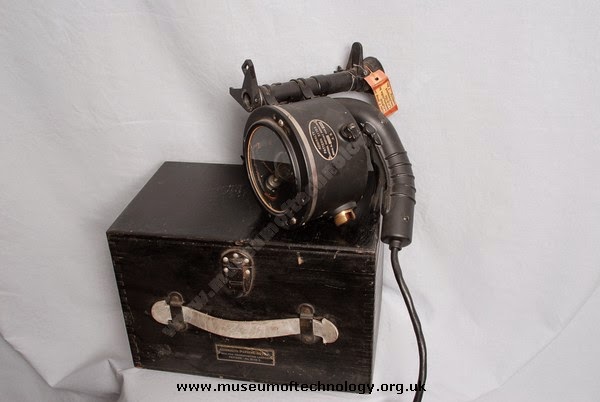
You may have guessed by now that I love CW and always have, since learning the 'code' as an eleven-year old in Scouts! Our Scoutmaster had procured several sets of beautiful boxed Aldis signalling lamps, the same as shown below:
 |
| Image Courtesy: http://www.museumoftechnology.org.uk |
Our leader worked in the Marine Building, the tallest building at the time, in downtown Vancouver.
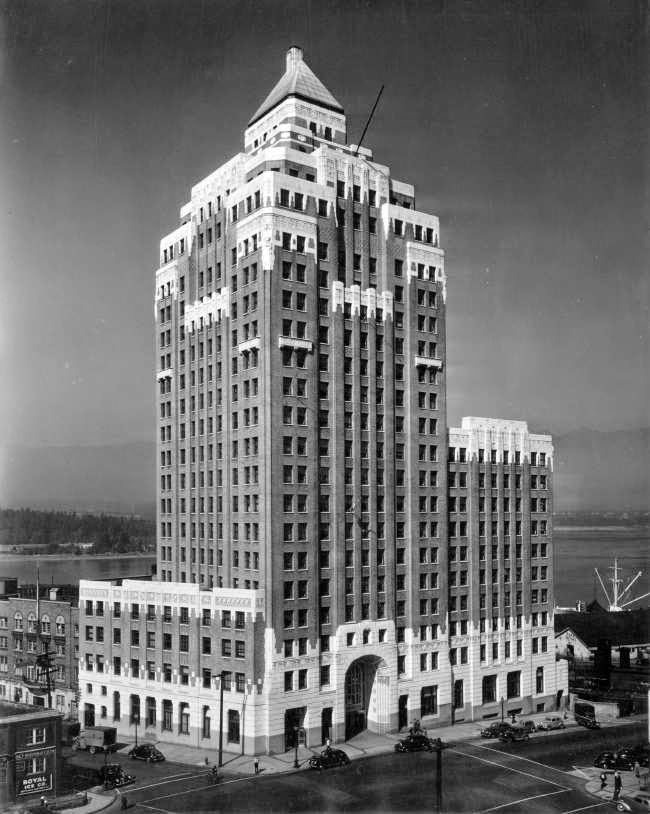 |
| Marine Building circa 1947. Courtesy: http://searcharchives.vancouver.ca/ |
It's nice to see events like this and the ARRL's "Straight Key Night" along with clubs like the, "SKCC" , "FISTS", "FOC" and "The CW Operators' Club", all doing their best to keep CW alive.
Hopefully you will have some time to play in the coming "BR".
Steve McDonald, VE7SL, is a regular contributor to AmateurRadio.com and writes from British Columbia, Canada. Contact him at [email protected].
Weekly Propagation Summary – 2015 Apr 13 16:10 UTC
Here is this week’s space weather and geophysical report, issued 2015 Apr 13 0314 UTC.
Highlights of Solar and Geomagnetic Activity
06 – 12 April 2015
Solar activity was at low to moderate levels throughout the period.
Region 2320 (S12, L=211, class/area=Dac/180 on 07 Apr) produced an
M1/1b flare at 1443 UTC on 08 April and Region 2321 (N13, L=094,
class/area=Ekc/610 on 12 Apr) produced a long-duration M1/Sf flare
at 0950 UTC on 12 April, which were the largest events of the
period. In addition to the R1 (Minor) radio blackouts, Regions 2320
and 2321 produced numerous low to mid-level C-class flares
throughout the week and were the most productive active regions of
the period. A coronal mass ejection (CME) associated with the M1/Sf
flare from Region 2321 was first observed in SOHO/LASCO C2
coronagraph imagery at 0948 UTC on 12 April, but was directed well
east of the Sun-Earth line.
Region 2320 produced a C3/1f flare at 1906 UTC on 06 April, with
associated Type-II and Type-IV radio emissions, which resulted in a
CME that was visible in coronagraph imagery beginning at 1936 UTC on
06 April. This CME impacted Earth early on 10 April, causing periods
of moderate geomagnetic storms. See "Geomag" portion below
for further information.
Toward the end of the period, Region 2320 produced a C6/Sf flare at
2329 UTC on 12 April with associated Type-II radio emissions. A
subsequent coronal mass ejection (CME) was first visible in
SOHO/LASCO C2 coronagraph imagery at 12/2348 UTC but analysis is
ongoing to determine if this event has an Earth-directed component.
No proton events were observed at geosynchronous orbit.
The greater than 2 MeV electron flux at geosynchronous orbit reached
moderate levels on 06-09 April and at normal levels for the
remainder of the period.
Geomagnetic field activity was at quiet to unsettled levels for
06-09 April under a nominal solar wind regime. The 06 April CME
impacted Earth just after 0000 UTC on 10 April, enhancing the
geomagnetic field. As the 06 April CME passed the Earth, 10 April
began with periods of G1 (Minor) geomagnetic storm conditions
between 0000-0300 UTC and 0600-0900 UTC and an isolated period of G2
(Moderate) geomagnetic storm period between 10/0300-0600 UTC. Active
conditions were observed between 10/0900-1500 UTC with quiet to
unsettled levels observed over the remainder of 10 April. Active
conditions were observed once again for the first half of 11 April
as residual CME effects continued to subside but the latter half of
11 April was quiet to unsettled. Quiet conditions were observed on
12 April.
Forecast of Solar and Geomagnetic Activity
13 April – 09 May 2015
Solar activity is likely to be at moderate (R1-R2/Minor-Moderate)
levels throughout the period, with the exception of 25-26 April, due
to the flare potential of Regions 2320 (S12, L=211) and 2321 (N13,
L=094).
No proton events are expected at geosynchronous orbit, barring any
significant flare activity.
The greater than 2 MeV electron flux at geosynchronous orbit is
expected to reach high levels on 21-24 April and 04-09 May, moderate
levels on 17-20, 25-28 April, and 01-03 May, and normal levels for
the remainder of the period.
Geomagnetic field activity is expected to be at G1 (Minor)
geomagnetic storm levels on 17 and 30 April with active conditions
expected for 16, 25, 29 April and 01 May, all due to coronal hole
high speed stream effects. Quiet to unsettled field activity
expected for the remainder of the period.
Don’t forget to visit our live space weather and radio propagation web site, at: http://SunSpotWatch.com/
Live Aurora mapping is at http://aurora.sunspotwatch.com/
If you are on Twitter, please follow these two users:
+ https://Twitter.com/NW7US
+ https://Twitter.com/hfradiospacewx
Get the space weather and radio propagation self-study course, today. Visit http://nw7us.us/swc for the latest sale and for more information!
We’re on Facebook: http://NW7US.us/swhfr
Visit, subscribe: NW7US Radio Communications and Propagation YouTube Channel
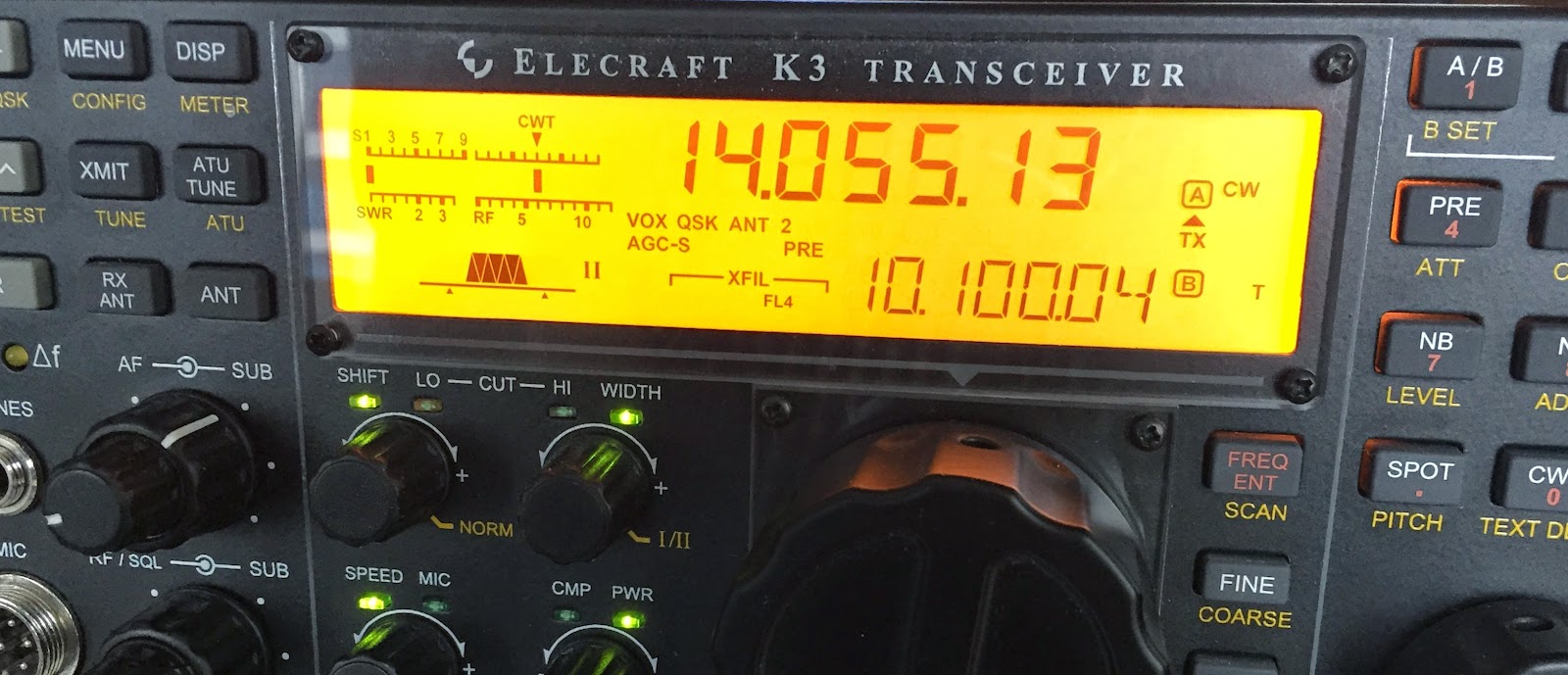
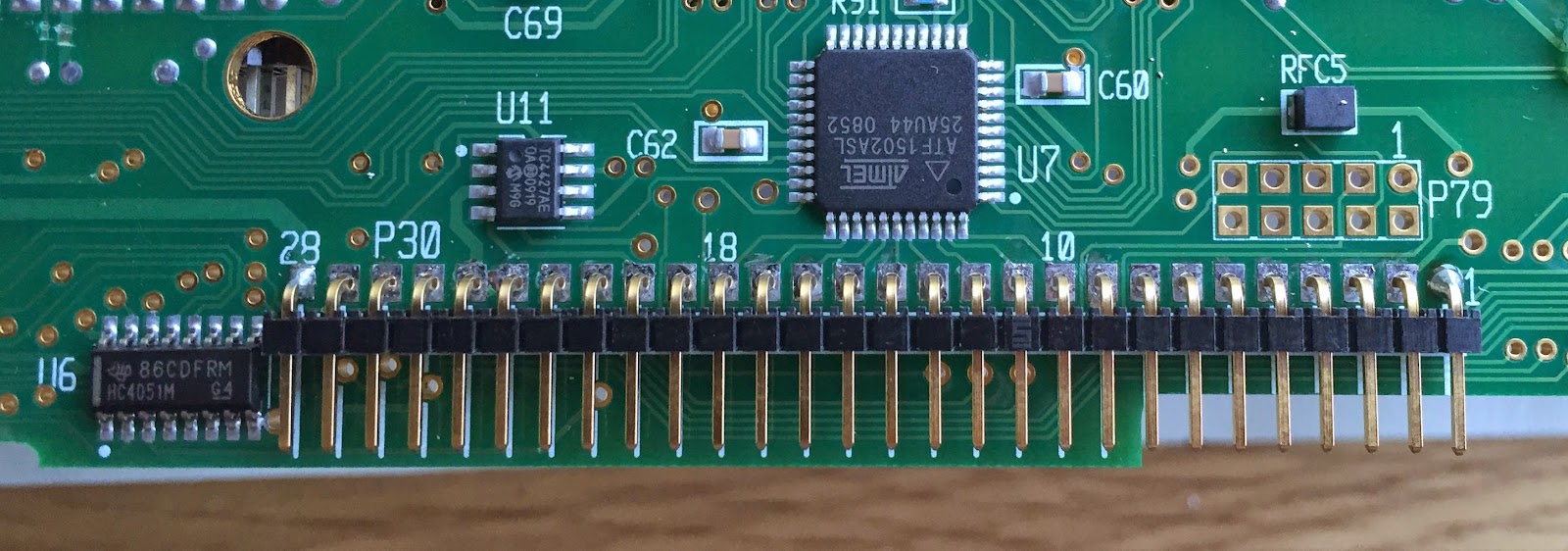
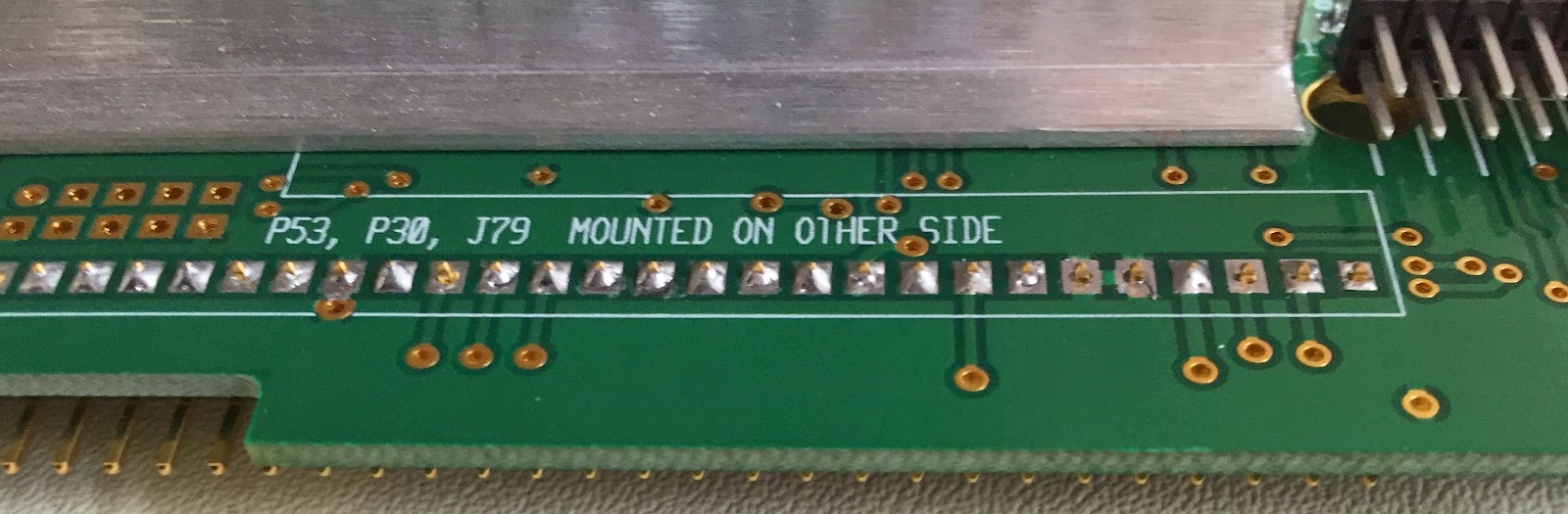
Elecraft surgery part 3 of 3
 |
| Back to life again |
 |
| Soldering end pins |
 |
| Imports of checking both sides of board |
 |
| Flossing tool used to clean board |
 |
| New header lines up with front board. |
Mike Weir, VE9KK, is a regular contributor to AmateurRadio.com and writes from New Brunswick, Canada. Contact him at [email protected].
 Ham Radio Deluxe |
 W5SWL Electronics |
 Ham Radio Prep |
 KB3IFH QSL Cards  Hip Ham Shirts  HamRadioAuctions HamRadioAuctions Reliance Antennas Reliance Antennas Enigma Shop Enigma Shop |  morseDX  Ni4L Antennas  R&L Electronics R&L Electronics antennas.us antennas.us QRV QRV |
- Matt W1MST, Managing Editor
