 |
 First 475 kHz WSPR decoding
 29 April 2015 | by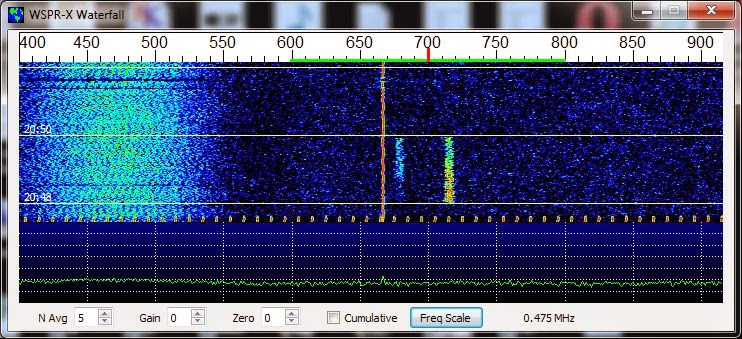
Tonight I made the first successful decoding of WSPR on the 630 m band. What inspired me was all the talk on the Elecraft reflector on the new synthesizer which in addition to having less phase noise, also allows the K3 to go below 500 kHz. I don’t have that synthesizer, but the discussion reminded me of the low frequency converter I built many years ago. It converts 0-1 MHz to 14-15 MHz. Using the KXV3 transverter interface of the K3 it was easy to interface and get up and running.
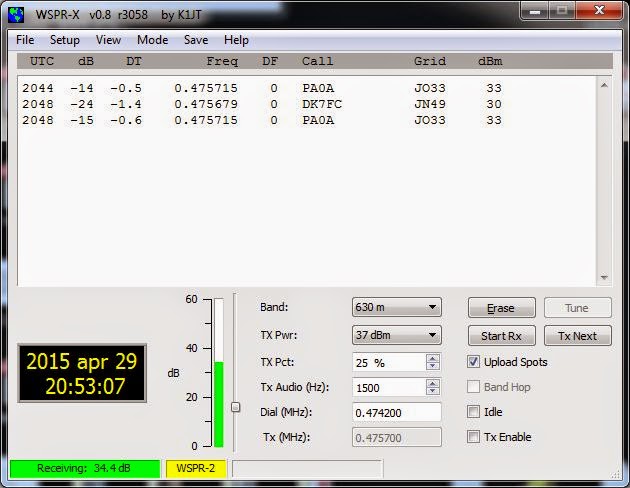
The first signals I decoded are shown in the water fall above, and their origin in Germany and the Netherlands is shown in the next figure.
According to WSPRnet, PA0A’s 2 Watt transmitter is 784 km away from me, and DK7FC’s 1 Watt is 1164 km away.
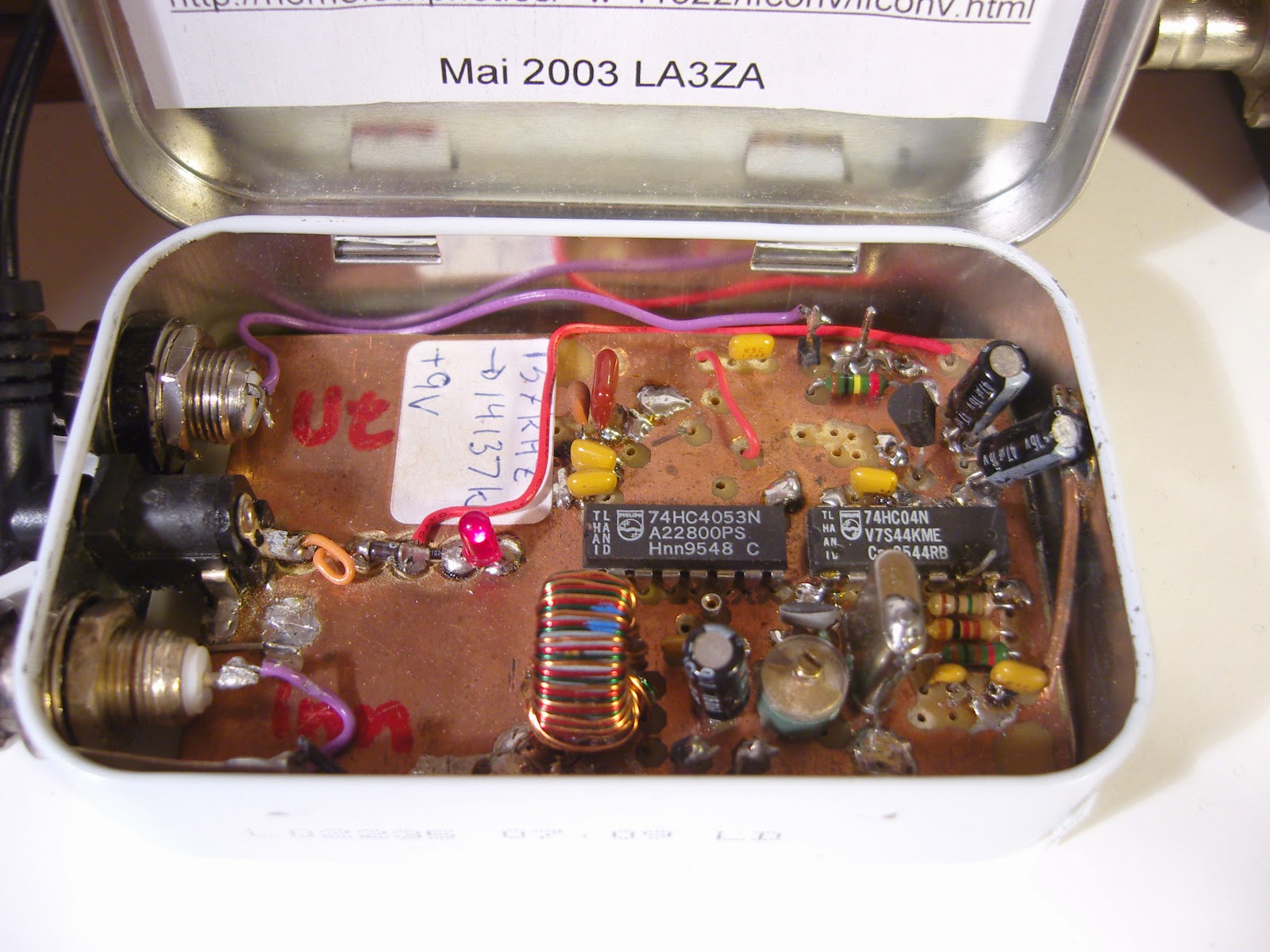
The converter is based on a 74HC4053 switch used as a mixer with a 74HC04 for a 14 MHz oscillator. It is based on SM6LKM’s design, but with a different oscillator frequency and a simplified output filter. It is one of many small projects that I have built in Altoids tins. The antenna used was my trusty old 80 meter horizontal loop with a 4:1 Elecraft balun.
Perhaps the next step is to finish the 475 kHz filter of my Ultimate 3 WSPR transmitter and see if others can receive me? That is going to be more of a challenge antenna-wise.
Sverre Holm, LA3ZA, is a regular contributor to AmateurRadio.com and writes from Norway. Contact him at [email protected].
The Spectrum Monitor — May, 2015

Stories you’ll find in our May, 2015 issue:
DIY: The Home-Brewer’s Primer
By Richard Fisher KI6SN
Building transmitters, shortwave receivers, antennas and station accessories is an art dating to the late 19th Century—the earliest days of radio. Almost every radio operator of the era was a builder, because commercially made radio gear was either nonexistent or, at the least, quite expensive. The term “home-brewer,” those who toiled at the workbench in order to tune in shortwave or get on the ham bands, would become a badge of honor and part of the lexicon of amateur radio. Home-brewing radio equipment is as vital to today’s radio amateurs as ever!
The Newcomers Net: Bringing together Newbies and Old-Timers
By Robert Gulley AK3Q
Like so many things in life, amateur radio is caught just as much as it is taught. Elmers (amateur radio mentors) and Newcomers really do feed off of each other, and excitement tends to generate more excitement. Whether it is trying new things or rediscovering long-lost passions, both newbies and old-timers alike grow from their shared experiences. Robert writes about the second anniversary of The Newcomers and Elmers Net, a weekly, on-air meeting of the OH-KY-IN Amateur Radio Society, geared toward pairing newcomers to the hobby with Elmers willing to offer them advice and the benefit of their experience. What they’ve done can be applied nationwide.
Digitally Speaking: Digital Voice on 220 MHz?
By Cory GB Sickles WA3UVV
Our amateur radio allocation at 222-225 MHz is among those that have been left out of the “Digital Voice Club.” As this is a band exclusive to the Americas, manufacturers are less inclined to invest in producing gear than for UHF. Currency fluctuations and lowered levels of interest limit the potential payoff for commercially produced gear. Cory ponders the question, “What will it take to get digital voice on 220 MHz?”
Southern Amateur Radio Hospitality: N4H and WA4USN Special Event Station
By Ron Walsh VE3GO
Canadian TSM Maritime Monitoring columnist, Ron Walsh, encounters “southern hospitality amateur radio” when he signs up to help man WA4USN aboard the US Navy battleship, the USS North Carolina, based in Wilmington, North Carolina and N4H near the site in South Carolina where the Civil War-era submarine, H. L. Hunley, sank after having been the first such vessel to sink another ship, the USS Housatonic, in battle. Ron had the opportunity to study US Naval history and operate two special event stations during his annual southern winter holiday.
TSM Reviews: TitanSDR
By Thomas Witherspoon K4SWL
After discovering the power of software-defined radios (SDRs) a few years ago, Thomas has been hooked, and now does 95 percent of his home listening and monitoring via various SDRs in his collection. In this issue he turns his attention to a newly released military-grade SDR called the TitanSDR. He’s impressed with its performance, but will this super-sophisticated SDR live up to its military budget price tag?
Scanning America By Dan Veenaman
Allentown, PA, FCC Field Offices and Dayton
Federal Wavelengths By Chris Parris
GAO Report on CBP Radio System Problems
Utility Planet By Hugh Stegman NV6H
U.S. Veterans Department Signs HF Contract
Digital HF: Intercept and Analyze By Mike Chace-Ortiz AB1TZ/G6DHU
Decoding Russian MFA and Intelligence Signals
HF Utility Logs By Mike Chace-Ortiz and Hugh Stegman
Amateur Radio Insights By Kirk Kleinschmidt NT0Z
A Tale of Antennas and Instrumentation
Radio 101 By Ken Reitz KS4ZR
Training your Replacement
Radio Propagation By Tomas Hood NW7US
Sporadic-E—The Magical Summertime Sizzle
The World of Shortwave Listening
By Jeff White, General Manager WRMI and Chairman HFCC
Shortwave Broadcasters Descend Upon Oman: The A15 High Frequency Coordination Conference in Muscat
The Shortwave Listener By Fred Waterer
Monitoring International News via Shortwave
Amateur Radio Astronomy By Stan Nelson KB5VL
Detecting Meteor Activity with Digital TV Carriers
The Longwave Zone By Kevin O’Hern Carey WB2QMY
More on Natural Radio
Adventures in Radio Restoration By Rich Post KB8TAD
Powering the “Real McCoy” 75 watt Novice transmitter
The Broadcast Tower By Doug Smith W9WI
The Big Get-Together
Antenna Connections By Dan Farber AC0LW
Houston, We have a Downlink: Spacecraft Antennas
The Spectrum Monitor is available in PDF format which can be read on any desktop, laptop, iPad®, Kindle® Fire, or other device capable of opening a PDF file. Annual subscription (12 issues, beginning with the January 2015 issue) is $24. Individual monthly issues are available for $3 each.
Ken Reitz, KS4ZR, is publisher and managing editor of The Spectrum Monitor. Contact him at [email protected].
Ham College episode 4

Ham College episode 4 is now available for download.
Ham College, the new show for those new to the hobby and those wishing to get into Amateur Radio.
In episode 4 we talk about batteries, experiment with lemons, copper, and zinc plus more questions and answers from the Technical class question pool.
54:34
George Thomas, W5JDX, is co-host of AmateurLogic.TV, an original amateur radio video program hosted by George Thomas (W5JDX), Tommy Martin (N5ZNO), Peter Berrett (VK3PB), and Emile Diodene (KE5QKR). Contact him at [email protected].
Hams doing what they do best
4/27/2015
As the death toll climbs in the wake of the devastating magnitude 7.9 earthquake in Nepal, rescue and recovery work is continuing, and Amateur Radio volunteers have been a part of it. The earthquake — said to be the worst in Nepal in 80 years — hit an area between the capital city of Kathmandu and the city of Pokhara. An emergency net had been running around the clock on 20 meters with Jayu Bhide, VU2JAU, as net control station and other stations in India participating. Bhide is the Amateur Radio Society of India National Coordinator for Disaster Communication.
The Nepal disaster has claimed more than 3200 lives and wreaked widespread damage. Many others are missing or have been injured. Hospitals have been flooded with those who suffered serious injuries in the earthquake. Persistent aftershocks continue to terrorize those who managed to escape harm. On Mount Everest an avalanche devastated base camp, and at least 100 climbers were stranded on the mountain. Several mountaineers were reported among the dead.
Hams in India have been among the most active responders. Parts of eastern India also suffered earthquake damage. Within Nepal, members of the Nepal Amateur Radio Society are reported to be active on HF emergency nets as well as on VHF/UHF to handle local traffic.
“The situation in Nepal is getting worse, as tremors continue to strike every hour at a magnitude of 4.7,” Bhide said. The government of Nepal has asked all people to stay out of buildings, as damage is expected to increase. Due to the conditions, emergency communication with 9N1 stations came to a standstill; no communication was possible overnight as the earthquake demolished the building where emergency communication gear was installed.”
He said Satish Kharel, 9N1AA, and his daughter Tej, 9N1DX, were able to return to the air this morning. Both are in Kathmandu. 9N1AA has said he’s operating low power with the help of solar power and coordinating with the Nepal police in Kathmandu. Suresh Upreti, 9N1HA, has been assisting with emergency communication as well. Internet service has been spotty in Nepal at best. So far, there has been no cross-border movement of either radio equipment and radio amateurs.
Sanjeeb Panday, 9N1SP, has indicated that he will be on 21.360 MHz at 1645 UTC, and radio amateurs not involved in the disaster response should avoid this frequency. 9N1SP has intermittent Internet service. He has said that propagation on 20 meters, where an initial emergency net was established was poor, but he has been in contact on 15 meters with Tim McFadden, KB2RLB/T6TM, a Military Auxiliary Radio System (MARS) member in Afghanistan.
Ironically, McFadden, Kharel, Panday, and others took part in MARS exercises in 2013 and 2014 in which the emergency scenario was an earthquake in Nepal. Army MARS Program Officer Paul English, WD8DBY, said the response to this earthquake followed the procedures trained during those earlier exercises. McFadden had been scanning International Amateur Radio Union (IARU) Global Emergency Center of Activity (GECOA) frequencies for stations in Nepal. GECOA frequencies were established as places to pass emergency traffic. Worldwide GECOA frequencies are 21.360 MHz, 18.160 MHz, 14.300 MHz, 7.240 MHz, 7.060 MHz, 3.985 MHz, and 3.750 MHz.
Nepal’s first Amateur Radio repeater, set up in 2012 by the National Society for Earthquake Technology (NSET), and at least a dozen ham in various locations were reported on VHF. The 9N1KS repeater (434.500 MHz in/145.000 MHz out) is on the NSET headquarters building on the outskirts of Kathmandu. A drill conducted in 2012 indicated good coverage of the Kathmandu Valley.
The US chapter of the Computer Association of Nepal provided technical and financial assistance for the repeater and supplied equipment to use it. The repeater has a battery back-up power source.
The NGO “Humanity Road” is maintaining an updated summary of damage as well as of immediate needs.
“Hams from India and other countries have set an example to provide essential communication during disasters,” Bhida said. “The coordination and cooperation have also demonstrated [there is] one world, one language.” — Thanks to Jayu Bhide, VU2JAU; Jim Linton, VK3PC; Tim McFadden, T6TM; Lloyd Colston, KC5FM; US Army MARS, and others

04/28/2015
Hams in Nepal, already in limited supply, continue to turn out to aid in the ongoing recovery from the April 25 earthquake that struck the Himalayan nation. Radio amateurs in neighboring India are also pitching in, and at least two groups of hams from Gujarat, India, are planning to travel to Nepal and set up stations “at critical places,” said Amateur Radio Society of India (ARSI) National Disaster Coordinator Jayu Bhide, VU2JAU. He is planning to set up HF and VHF stations at Gorakhpur, on the India-Nepal border. Joining him will be Ananda Majumdar, VU2AGJ, and Sandip Baruah, VU2MUE.
"Nepal hams are facing a hard situation,” said Bhide, who has been among the net control stations for an HF net initiated in the wake of the disaster.
The Indian hams traveling to Nepal may not be permitted to operate once they arrive, however. In an e-mail to members, ARSI President Gopal Madhavan, VU2GMN, said that Satish Kharel, 9N1AA, confirmed that “individual operators from other countries are not permitted to operate in Nepal, even during the emergency, unless they are part of a government team.” Madhavan said he was issuing the alert for the benefit of anyone planning to cross into Nepal from India and operate there.
Bhide said more Nepalese hams not formerly involved with the disaster response have since joined their Amateur Radio colleagues to volunteer communication support.
One major effort on the part of rescue teams is attempting to locate the missing, as well as to recover quake victims buried beneath debris. More than 4000 people died as a result of the earthquake and subsequent aftershocks. The disaster also has stranded many people, as roads were cut off by landslides and damage.
Earlier today, Sanjeeb Panday, 9N1SP, received support from three other Nepalese Amateur Radio operators — Ajay Bhattarai, 9N1AJ; Aayush Kumar Chaudhary, 9N1AY, and Sudarshan Sharma, 9N1SH. “Dr Sanjeeb and his team continue to operate HF radio out of a local University in Kathmandu, according to a report forwarded to ARRL by Army MARS Director of Operations Paul English, WD8DBY. “Dr Panday and his team were able to send HF radio slow-scan images of the disaster via Amateur Radio to the Army MARS operator in Afghanistan,” English said. The images subsequently were posted to the US Pacific Command response coordination portal, APAN. Tim McFadden, KB2RLB/T6TM, a Military Auxiliary Radio System (MARS) member in Afghanistan, has been monitoring the emergency traffic. Ironically, McFadden, Kharel, Panday, and others took part in MARS exercises in 2013 and 2014 in which the emergency scenario was an earthquake in Nepal. English said the response to this earthquake followed the procedures used for training during those earlier exercises.
The earthquake — said to be the worst in Nepal in 80 years — hit an area between the capital city of Kathmandu and the city of Pokhara. An emergency net has been running around the clock on HF. Members of the Nepal Amateur Radio Society were reported to be active on HF emergency nets as well as on VHF/UHF to handle local traffic.
And then there's this from the Free Press Journal:
307 from Maha rescued
— By | Apr 29, 2015 12:01 amAnother case of Amateur Radio coming into significance "When All Else Fails". If you're not familiar with formal message handling, at the very least, I would advise listening to one of your local VHF/UHF traffic nets. Become familiar with the procedures and formats used for passing third party traffic. The experience you gain via NTS would become very handy should you ever find yourself in a bona fide emergency communications event. Inquire with your local municipal governing body to find out if there's a CERT team set up in your town. If not, perhaps you can meet with the local Director of Emergency Management and discuss the possibility of starting one up.
It's better to be prepared and not needed than to be needed and not be prepared, and not knowing what to do.
72 de Larry W2LJ
QRP - When you care to send the very least!
Larry Makoski, W2LJ, is a regular contributor to AmateurRadio.com and writes from New Jersey, USA. Contact him at [email protected].
CLE 193 Results
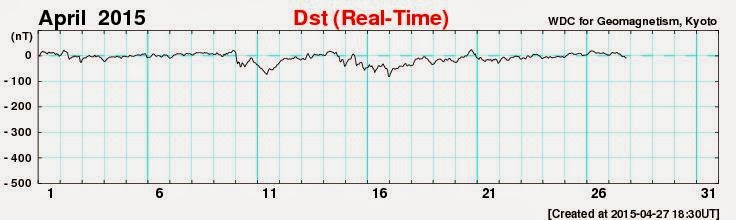 |
| http://wdc.kugi.kyoto-u.ac.jp/dst_realtime/presentmonth/index.html |
DD UTC kHz Call mi Location
-----------------------------------------
27 09:00 400 TRX 1572 Trenton Municipal Apt, MO, USA
25 07:00 400 QQ 97 Comox, BC, CAN
26 10:00 400 PPI 1449 Hopey - Cottage Grove-St Paul, MN, USA
25 09:00 400 FN 1071 COLLN - Fort Collins, CO, USA
27 09:00 400 ENS 1230 Ensenada Apt, MEX
25 07:00 400 CKN 1220 Crookston, MN, USA
26 10:00 400 AHQ 1396 Wahoo, NE, USA
25 07:00 401 YPO 1644 Peawanuck Apt, ON, CAN
25 07:00 402 M3 649 Kindersley Apt, SK, CAN
25 07:00 402 L4 888 Nipawin, SK, CAN
27 07:00 403 AZC 971 Colorado City Municipal Apt, AZ, USA
25 07:00 404 OLF 809 Wolf Point - L M Clayton Apt, MT, USA
25 07:00 404 MOG 495 Montegue, CA, USA
25 12:00 404 GCR 1185 Glacier River - Cordova Apt, ALS
25 07:00 405 9G 429 Sundre Municipal Apt, AB, CAN
25 07:00 405 2K 538 Camrose, AB, CAN
25 07:00 406 YLJ 725 Meadow Lake, SK, CAN
27 08:00 407 CHD 1230 Chandler, AZ, USA
27 09:00 407 PLT 1352 Platte Center - Columbus, NE, USA
27 07:00 407 HRU 1485 Herington, KS, USA
26 10:00 407 CO 1157 PETEY - Fountain, CO, USA
25 07:00 408 Z7 440 Claresholm, AB, CAN
25 07:00 408 MW 221 PELLY - Moses Lake, WA, USA
26 11:00 408 JDM 1270 Wheatfield - Colby, KS, USA
25 07:00 410 GDV 860 Glendive - Dawson Comm Apt, MT, USA
26 10:00 410 EGQ 1419 Emmetsburg, IA, USA
26 10:00 410 DAO 1371 Dragoo - Sierra Vista Muni Apt, AZ, USA
25 07:00 410 6Z 781 La Loche, SK, CAN
25 11:00 411 SDA 1466 Shenandoah Municipal Apt, IA, USA
26 11:00 411 ILI 1459 Iliamna Apt, ALS
25 07:00 412 1W 996 Sandy Bay, SK, CAN
25 07:00 413 YHD 1361 Dryden Regional, ON, CAN
25 07:00 414 YZK 186 Harper Ranch, BC, CAN
26 10:00 414 SU 1372 SALIX - Salix, IA, USA
25 07:00 414 LYI 357 Libby, MT, USA
25 12:00 414 IME 754 Mount Edgecumbe - Sitka Apt, ALS
26 10:00 414 GRN 1094 Gordon, NE, USA
27 09:00 414 8M 640 Elk Point Municipal Apt, AB, CAN
25 07:00 415 CBC 3129 Cayman Brac - West End, CYM
26 10:00 416 LB 1228 PANBE - North Platte, NE, USA
25 09:00 417 IY 1508 CHUKK - Floyd, IA, USA
27 07:00 418 CW 2029 MOSSY - Moss Bluff, LA, USA
26 09:00 419 RYS 1975 'Grosse Ile' Detroit / Grosse Ile, MI, USA
As usual, the equipment used was the Perseus SDR along with my 10' x 20' loop and Wellbrook preamp.
Steve McDonald, VE7SL, is a regular contributor to AmateurRadio.com and writes from British Columbia, Canada. Contact him at [email protected].
An FM pileup
Last night was a big drill night for us on the Heyworth fire department. We have a large gas terminal located in our fire district. A pipeline runs to a tank farm where fuel products are stored and then loaded onto semi-trailers for transportation to other storage areas, gas stations, or private tanks. We had the terminal owners and three other mutual aid departments participating in the drill.
Communications is almost always a problem when you get that many people on scene. Radio communications become clogged as 10 apparatus arrive on scene. “Where do you want us? Send me this….Can you go here?” These message repeat over and over, all the while the firefighters performing work are unable to get back to command. Why is this a problem? Because everyone wants to hear all traffic, we stay on ONE frequency. You’ve got 10 trucks and 25+ people all trying to talk on one VHF FM analog frequency.
If only more of our members were hams, maybe we wouldn’t have to discuss why talking over other transmissions doesn’t work. Or why putting 25 people on a single channel is not a good idea if we expect two-way communications between more than 5 of them! Nothing like a good ‘ole FM pileup to make you want to smack your head against the wall. If nothing else, maybe the single command officer trying to work the pileup WHILE managing the event would realize that we need to work differently.
Michael Brown, KG9DW, is a regular contributor to AmateurRadio.com and writes from Illinois, USA. Contact him at [email protected].
Weekly Propagation Summary – 2015 Apr 27 16:10 UTC

Here is this week’s space weather and geophysical report, issued 2015 Apr 27 0348 UTC.
Highlights of Solar and Geomagnetic Activity
20 – 26 April 2015
Solar activity was at low to high levels throughout the period.
Region 2322 (N11, L=116, class/area=Dac/60 on 21 April) grew and
intensified as it rotated to the western limb; producing numerous
low level C-class flares and five moderate level M-class flares on
21 April. Region 2322 also produced the largest flare of the period,
an impulsive M4/Sf at 22/1545 UTC. Region 2322 continued to produce
C-class and M-class flares until it rotated beyond the western limb
by 24 April, including a long-duration M1 flare at 23/1007 UTC with
an associated Type-II radio sweep and coronal mass ejection (CME)
from the western limb as observed in SOHO/LASCO C2 imagery. The CME
was not Earth-directed.
Regions 2325 (N05, L=050, class/area=Cai/220 on 19 April) and 2326
(N20, L=086, class/area=Cao/80 on 23 April) were the other most
prolific flare producers during the period. Region 2325 produced an
M1 flare at 21/2201 UTC and Region 2326 produced numerous C-class
X-ray flares with the most notable being a C7 flare at 23/1203 UTC.
Both flares were very impulsive and did not have any observed
optical flares nor notable radio signatures.
No proton events were observed at geosynchronous orbit.
The greater than 2 MeV electron flux at geosynchronous orbit was at
moderate to high levels during the week; reaching high levels on
20-21 April and 24 April with a peak flux of 2,620 pfu on 20 April.
Geomagnetic field activity was at quiet to unsettled levels on 20
April as Earth was in a background ambient solar wind environment.
On 21 April, Earth came under the influence of an isolated positive
coronal hole high speed stream (CH HSS) and solar wind speeds
increased to over 600 km/s as measured at the ACE satellite. This CH
HSS produced occasional periods of active levels of geomagnetic
activity from 21-24 April. The CH HSS rotated out of a geo-effective
alignment by midday on 24 April and the winds decreased to mainly
nominal solar wind conditions of about 375 km/s, returning Earth to
quiet to unsettled geomagnetic conditions.
During the week, ACE solar wind parameters measured a high wind
speed of 628 km/s on 21/0632 UTC and a low wind speed of 291 km/s on
26/1123 UTC. Total field (Bt) ranged from about 1 to 14 nT, while
the Bz component varied between +12 to -7 nT. The phi angle was
generally in a positive (away from the Sun) orientation with a short
period of negative (towards the Sun) sector to begin the week.
Forecast of Solar and Geomagnetic Activity
27 April – 23 May 2015
Solar activity is expected to be at very low to low levels through
03 May due to the low number of complex active regions. Solar
activity levels are expected to increase to low levels; with a
slight chance for moderate (R1-R2/minor-moderate) levels beginning
04 May with the return of Region 2322 (N11, L=116) and remain at low
levels, but increase to a chance for moderate (R1-R2/minor-moderate)
levels beginning 07 May as Region 2326 (N20, L=086) also rotates
back onto the disc. Solar activity level is expected to decrease
back to very low to low levels with the departure of Regions 2322
and 2326 beginning 17 May.
No proton events are expected at geosynchronous orbit.
The greater than 2 MeV electron flux at geosynchronous orbit is
expected to be at normal to moderate levels from 27 April-06 May,
normal levels from 07-12 May, moderate to high levels from 13-14
May, high levels from 15-18 May, moderate levels from 19-20 May, and
moderate to high levels from 21-23 May.
Geomagnetic field activity is expected to be at quiet levels from
27-28 April and increase to quiet to unsettled levels beginning 29
April due to CH HSS effects. Field activity is expected to begin
decreasing by 02 May, with overall quiet levels likely from 03-10
May. Field activity is expected to increase to unsettled to active
levels beginning late on 11 May and likely reaching active levels on
12-13 May due to CH HSS effects. Field activity is expected to
decrease to unsettled to active levels by 14 May as CH HSS effects
begin to wane; and return to quiet to unsettled conditions from
15-17 May. Field conditions are expected to increase to unsettled to
active levels on 18 May due to a CH HSS and return to quiet to
unsettled conditions as the CH HSS rotates out of a geo-effective
position by 21 May, and remain at quiet levels for the remainder of
the outlook period.
Don’t forget to visit our live space weather and radio propagation web site, at: http://SunSpotWatch.com/
Live Aurora mapping is at http://aurora.sunspotwatch.com/
If you are on Twitter, please follow these two users:
+ https://Twitter.com/NW7US
+ https://Twitter.com/hfradiospacewx
Get the space weather and radio propagation self-study course, today. Visit http://nw7us.us/swc for the latest sale and for more information!
We’re on Facebook: http://NW7US.us/swhfr
Visit, subscribe: NW7US Radio Communications and Propagation YouTube Channel
 Ham Radio Deluxe |
 W5SWL Electronics |
 Ham Radio Prep |
 KB3IFH QSL Cards  Hip Ham Shirts  HamRadioAuctions HamRadioAuctions Reliance Antennas Reliance Antennas Enigma Shop Enigma Shop |  morseDX  Ni4L Antennas  R&L Electronics R&L Electronics antennas.us antennas.us QRV QRV |
- Matt W1MST, Managing Editor
