 |
 Persistent Cycle 24
 18 April 2015 | by
  |
| courtesy: http://sdo.gsfc.nasa.gov/ |
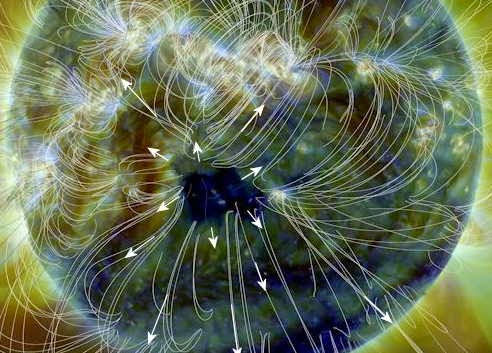
Our Sun's latest rotation is showing several new large sunspot groupings, all very capable of unleashing a new round of solar flares and associated disruption ... if nothing else, Cycle 24 is persistent!
 |
| courtesy: http://sdo.gsfc.nasa.gov/data/ |
 |
| courtesy: http://www.swpc.noaa.gov/ |

The software gurus at NOAA have been busy once again, this time revamping several of their visual models to an 'animated' mode. The Ovation Auroral map is particularly interesting when run in this mode as it shows the auroral field's activity visually over the past 24 hours. The display gives one a new appreciation for the dynamics of such large scale events:
 |
| courtesy: http://www.swpc.noaa.gov/communities/radio-communications |
 |
| courtesy: http://www.dxmaps.com/ |
Steve McDonald, VE7SL, is a regular contributor to AmateurRadio.com and writes from British Columbia, Canada. Contact him at [email protected].
Talking Back To Home
Having an EchoIRLP node here at home allows me the option of communicating with the XYL (who holds a Tech license) when I am on the road. I found this very useful when I was stationed in Korea. With the time difference, the end of my day was the beginning of hers. I could check APRS to see when she started her morning commute and then connect to my home node. This allowed me to check in with her as well as saying “Hi” to the kids.
With the Summer Trip, the XYL will not be with us the whole time. Therefore, IRLP may well offer a solution.
Time change will not be a significant factor – which means the best times to schedule IRLP QSOs with the XYL would be during the commute times. That should work fairly well because I do not plan to be on the road either too early in the morning or much past the late afternoon.
What is the availability of IRLP nodes along the route I am taking and will they be near our overnight stops? Enter the ARRL’s Repeater Directory. I remember my dad almost always having the shirt-pocket version of this directory by his easy chair along with his HT and a mechanical pencil that he used to make notes. I have consistently followed his lead, although I usually keep a copy in my truck as I am not too much of an HT guy. Another difference is my excitement about the Desktop Edition of the Repeater Directory. I find the shirt pocket edition way too tiny and difficult to use. The Desktop Edition is the Business Class of directories…. spacious, roomy, and comfortable.
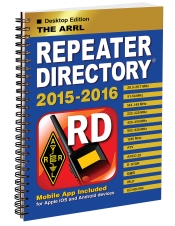
I took advantage of ARRL’s birthday coupon to purchase the 2015-2016 directory and am using that to start my IRLP node research. Without digging up my maps and looking too much at the surrounding areas, here is what I found:
Sioux Falls, SD, IRLP Node #7346, 444.2, 82.5
Gillette, WY, IRLP Node #3307, 449.75, 123
Cody, WY, IRLP Node #7194, 146.85, 103.5
Great Falls, MT, IRLP #7908, 147.3
Great Falls, MT, IRLP #5670, 147.36, 100
Bozeman, MT, IRLP #3692, 448.35, 100
Billings, MT, IRLP #3398, 449.75, 100
What I will probably do is use my home node to connect to these nodes to see if they are in operation and get an idea as to what their coverage areas are.
Scott Hedberg, NØZB, is a regular contributor to AmateurRadio.com and writes from Kansas, USA. Contact him at [email protected].
Amateur Radio Weekly – Issue 57

Navy once wanted the world’s largest antenna in Wisconsin
In the 1960s, US Navy officials concocted an ambitious plan: they wanted to bury a gigantic grid of cables under roughly 41 percent of the state of Wisconsin in order to turn its bedrock into the world’s largest radio antenna.
Vox
FCC proposes to make past Ham address information private
The FCC is seeking comments on a Notice of Proposed Rule Making (NPRM) in WT Docket 15-81 that would restrict routine public inspection of an Amateur Radio licensee’s address history.
ARRL
Norway: first country to shut down FM analog radio
Within two years from now, the shutdown of national FM-networks begins in Norway.
The SWLing Post
ADIF to map Amateur Ham Radio contacts
This web application will read in a ham radio ADIF file and map contacts on a Google map.
K2DSL
Best Android Morse (CW) apps
Determined to finally master the skill, I’m using Android tutors to practice where and when I can.
M0SPN
Using WebSDRs worldwide for the ISS
Martin Ehrenfried G8JNJ describes how he uses WebSDRs to listen to ISS transmissions on 145.800 and 145.825 MHz. The SUWS SDR at Farnham can even receive the 143.625 MHz ISS comms channel.
AMSAT UK
How to
DIY open source reflow oven
Turn a household toaster oven into a soldering reflow oven for surface mount components.
Make:
Video
SSTV images from the International Space Station
I used my Arrow Antenna dual band J-Pole antenna, FT-817, Signalink USB interface and MMSSTV software.
K7AGE
Slow Scan TV in 1973
On a 1973 Israeli TV show, Aaron 4X1AG (ex 4Z4AG) demonstrated amateur radio Slow Scan Television (SSTV), which in the pre-PC era was displayed using a long persistence tube.
Southgate
Podcasts
Fo Time! The Other Ham Radio Podcast
Fo Time is a new podcast, aimed at the ‘younger’ Ham Operator and those interested in learning more about the hobby.
Fo Time!
QSO Today Podcast
I hope that you will sign up and join me for my weekly exploration of ham radio, my QSO, with these accomplished ham radio operators.
QSO Today Podcast
Amateur Radio Weekly is curated by Cale Mooth K4HCK. Sign up free to receive ham radio's most relevant news, projects, technology and events by e-mail each week at http://www.hamweekly.com.
Amateur Radio Newsline Report 1961 April 17 2015
- IARU Monitoring Service identifies new intruders into the ham radio bands
- Geomagnetic storm sparks auroras over Canada and the United States
- Australia may soon take ham radio into space
- Unlicensed broadcaster in Kentucky hit with a $15,000 fine
- What causes the worst interference to ham radio
THIS WEEK'S NEWSCAST
Script
Audio
Loop motors
Magnetic loop antennas can be very effective, small, antennas. They work well and are ideal for modes like WSPR, JT65, JT9-1 and PSK31 where frequencies don’t have to be moved much. Their main disadvantage is they are narrow-band so require retuning if moving very far in frequency and they are directional.
As ever, Steve G1KQH has been tracking down bargains – in this case motors that could be used to either tune or rotate loops.

Roger Lapthorn, G3XBM, is a regular contributor to AmateurRadio.com and writes from Cambridge, England.
Capturing our spirit
The devil is in the details and some might complain that some of the details in this commercial are not paid attention to - no call signs for instance. And some of the concepts are a bit stretched - did he buy that amplifier himself? But the basics are sound, and I think this little boy, Sam, captures our Amateur Radio spirit to a "T". At least I think so. What do you think?
Larry Makoski, W2LJ, is a regular contributor to AmateurRadio.com and writes from New Jersey, USA. Contact him at [email protected].
The Lonely 49 Meter Canadians
Apparently there is still activity coming from CKZU (6160KHz), CKZN (also on 6160KHz), CFVP (6030KHz) and CFRX (6070KHz). These are all low-powered (100-1000W) relays of local AM station content and make for interesting DX targets for listeners.
The nearest to me, CKZU, is directly across Georgia Straight and line-of-sight from me. It relays the local AM-band powerhouse, CBU-690. Needless to say its signal is very strong.
 |
| courtesy: https://maps.google.ca/ |
With its antenna system located on the mudflats of Richmond (Steveston), near Vancouver, it should get out pretty well despite its 500W power limit.
 | |||||
| courtesy: https://maps.google.ca/ |
The antenna system, I am told, consists of a four pole (wood) support for a two-element wire beam of sorts ... one element being the dipole driven-element and the other a reflector. From the looks of the orientation I would say that it is beaming south-east towards the central USA.
Are you able to here CKZU on 6160 from your location? Its overwhelming strength here blocks any chance for me to hear its east-coast cousin, CKZN in St. John's, Newfoundland, rebroadcasting local CBN. If you are in the eastern half of the continent, perhaps you are able to here CKZN's 300W signal?
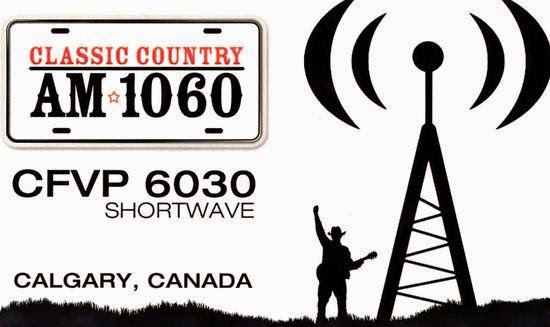
CFVP is in Calgary and relays local CKMX on 6030 at just 100W. I can hear a carrier there in the daytime but long before my local sunset the frequency becomes dominated by Radio Marti (in Spanish) from Florida ... perhaps you can do better from your location.
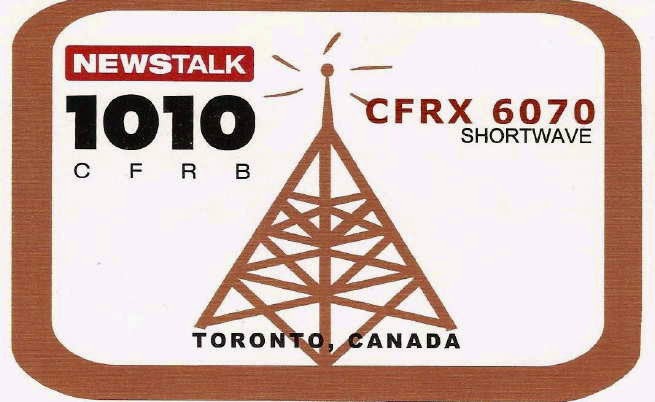
Lastly is CFRX, relaying CFRB from the city of Toronto, on 6070. This gets out well and is heard here even before local sunset at 1000W.
It appears that most of these stations have, at one time or another, been slated for decommissioning, and have only been saved by the dedication of station engineers who basically maintain these on their own time, with station owners paying the rent and electricity bills.
Please let me know if you are able to hear any of the 'lonely' Canadians on 49 meters.
Steve McDonald, VE7SL, is a regular contributor to AmateurRadio.com and writes from British Columbia, Canada. Contact him at [email protected].
 Ham Radio Deluxe |
 W5SWL Electronics |
 Ham Radio Prep |
 KB3IFH QSL Cards  Hip Ham Shirts  HamRadioAuctions HamRadioAuctions Reliance Antennas Reliance Antennas Enigma Shop Enigma Shop |  morseDX  Ni4L Antennas  R&L Electronics R&L Electronics antennas.us antennas.us QRV QRV |
- Matt W1MST, Managing Editor
