 |
 Miscelleneous Radio Stuff
 7 May 2015 | by
 As I have blogged in the past, I have a QTH is Santa Fe, NM. From there I have done the majority of my SOTA expeditions. There is a great ham radio community there and an even better SOTA community. Including myself, there are four hams who have earned SOTA Mountain Goat status in the Santa Fe areas and soon to be five. So we have a lot of fun in the mountains of New Mexico. To bring some organization to that group, we have formed the New Mexico Mountain Goat club to promote efficiently summit radio operations. This week the club call was finally issued, NM5MG. So listen for this call around Memorial Day weekend (end of May).
I have built my first stealth antenna with help from AD6D, in the form of a flagpole, at my Santa Fe QTH. The 20 ft. flagpole from ZeroFive antennas works great. I've installed an LDG tuner at the base to get the antenna resonant 10 -20m and added a piece of wire, attached to the flag fastener and raised to the top, in an inverted L configuration to get tuned resonance on 40m and 80m. No doubt it is a compromise, but I'm on the air and can work a lot of stuff.
I will be travelling to Dayton for the first time in 15+ years. I am looking forward to seeing old friends there. My focus in ham radio has matured a lot since the last time I was there, so looking forward to the flea market.
I am also working on perfecting remote operation of my home QTH station in Boerne, TX. Early results are encouraging. I just to need to tweak a few things and get comfortable with the process.
Hopefully next time, I can write some specifics about these projects.
Mike Crownover, AD5A, is a regular contributor to AmateurRadio.com and writes from Texas, USA. Contact him at [email protected].
Possibilities
I am hoping this makes for good band conditions during lunchtime today. Hopefully, I'll jump on somewhere around 1745 UTC for about an hour.
Amateur Radio is so much like fishing. The possibilities abound, and you rarely know what you're going to get. I don't get how anyone could not like this hobby. Even when I get skunked, I may be disappointed, but I never have a bad time.
To turn a phrase, "A bad day at Amateur Radio is better than a good day at ...... (you fill in the blank)".
I'll update this later to let you know how it went.
Lunchtime Post Mortem:
The weather was indeed beautiful, the band conditions were "meh". Signals were non-existent on 10 and 12 Meters, sparse on 15 Meters and most plentiful on 17 Meters (which has become a favorite band).
I worked YN5SU in Nicaragua and OT4A in Belgium, and that was it. I called CQ for a bit and had no takers. But I was getting out, according to RBN:
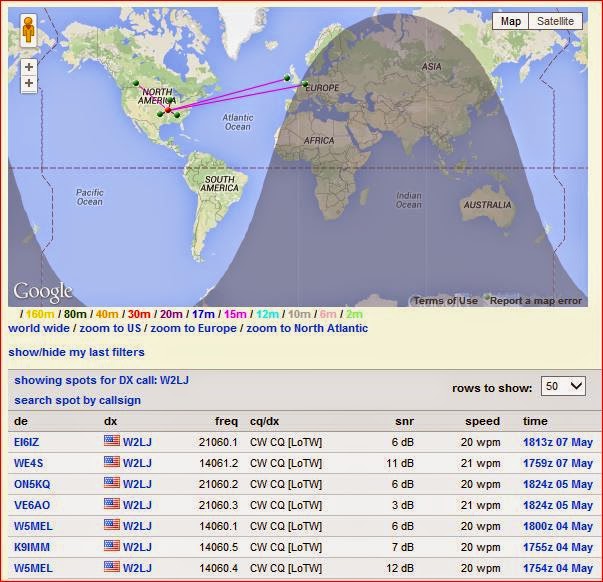
I have no idea, however, why RBN has my location as somewhere in the vicinity of Missouri.
72 de Larry W2LJ
QRP - When you care to send the very least!
Larry Makoski, W2LJ, is a regular contributor to AmateurRadio.com and writes from New Jersey, USA. Contact him at [email protected].
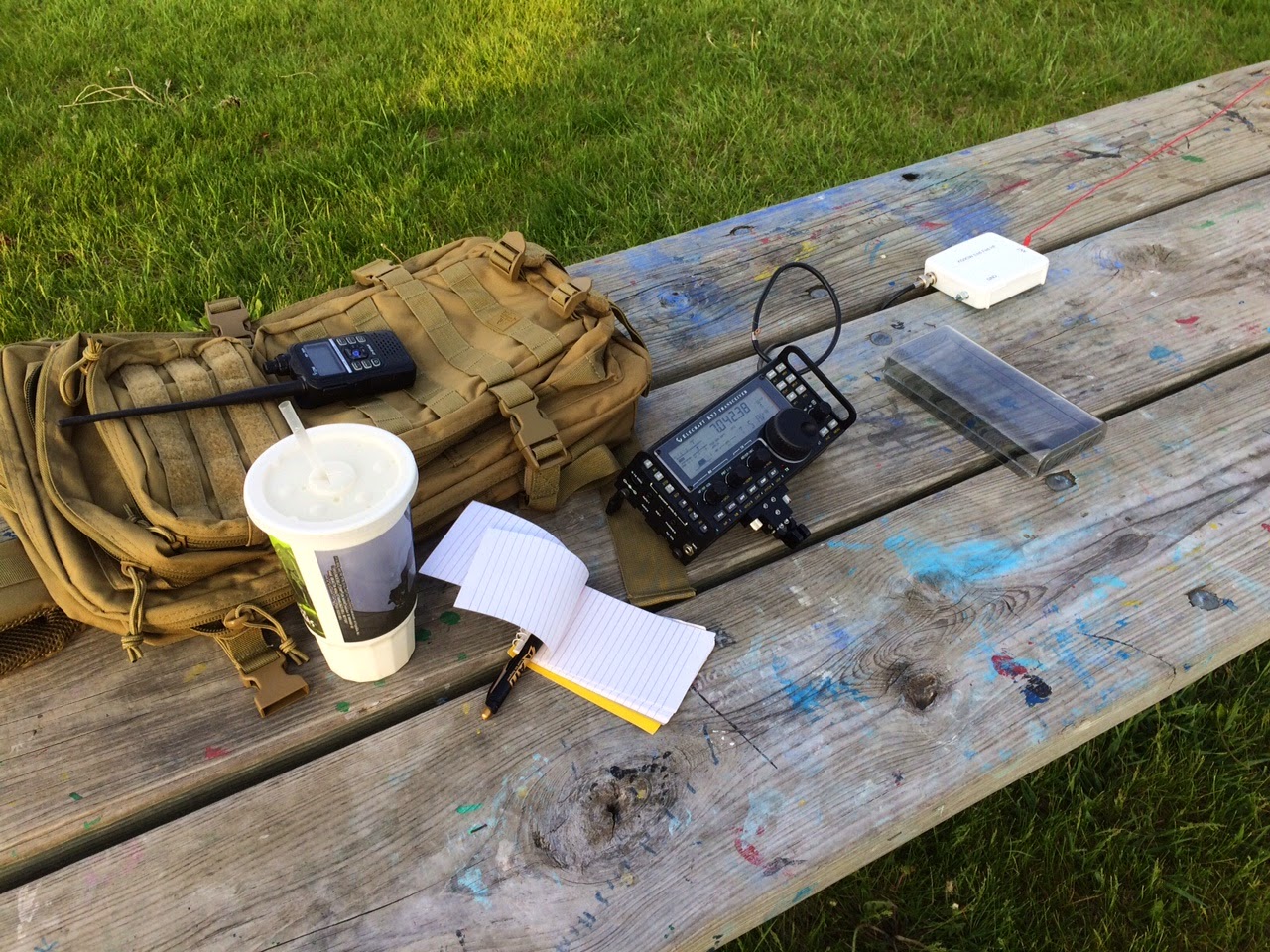
Skunked at the park
Michael Brown, KG9DW, is a regular contributor to AmateurRadio.com and writes from Illinois, USA. Contact him at [email protected].
10m antennas
As you will have noticed by now, 10m is one of my favourite bands. Although quiet at many times in the solar cycle it always comes to life with Es from late April until September. Alert 10m operators will sniff out Es at other times too, but there may be long periods of noise, as on 6m. WSPR is an ideal mode when the band may otherwise seem quiet. It is good for local nattering at any time and F2 N-S DX is often there even at solar minima. Antennas for the band are small and easy to make such as the design on my website for a 10m halo. See https://sites.google.com/site/g3xbmqrp3/ .
A video of K7AGE making a dipole for 10m is available at YouTube. See https://youtu.be/84F4UgSWmQo. In this video, Randy is making a dipole for the USA technician’s band, so to cover the main SSB band (28.4 to 28.6MHz) you will need to make the wire slightly shorter. In my experience if you cut the wires for the centre of the band it will still have a pretty low SWR at the band edges. Even a very simple ATU will bring the SWR down to 1:1, although unless your rig has a problem with a mismatch of around 1.8:1, I would not bother, as the difference in radiated power is negligible (fraction of an S-point).
Because of the short wavelength, 10m antennas don’t have to be that high to be effective. When the band is in good shape, worldwide DX can be had with simple wire antennas and low power. It is a rewarding band. What is more, 10m multi-mode transceivers can be bought at low cost. In summary, 10m is unique: low cost transceivers, simple antennas and good DX potential.

Roger Lapthorn, G3XBM, is a regular contributor to AmateurRadio.com and writes from Cambridge, England.
Belcom LS-707 70cm multi-mode rig
A radio amateur in Nottingham,Vic G0RVA, recently bought one of these Belcom rigs. It appears to be an all-mode 70cm rig, although I am not familiar with this unit.
I know Belcom did a 2m version (the famous Liner-2, which I did once own) and a similar version for 70cm. The Liner-2 was a modification of their 10m version, which I don’t think was ever sold in the UK. Inside Vic’s rig was what looked like a canned preamp with the marking “AngleLinear” but again I am not familiar with this unit. Angle Linear appear to be based in the USA http://anglelinear.com/ .
In its day, the 2m Liner-2 transformed 2m. It was a synthesised SSB rig and was frequently pushed too hard so that splatter was a problem. I was amazed how far I could work on 2m SSB with 10W pep. From Cambridge I could work stations that would have been impossible on FM or AM. I found I could work 200-300km with a simple antenna under ANY conditions.
Many were critical of these early Belcom transceivers, but I enjoyed my Liner-2 as did many others. Later I bought an ICOM IC202 which was a better radio, but with less ERP. The IC202 had a mock military style, that really was not too clever.
The “coming of age” of 2m SSB marked the change from “tuning high to low” to single frequency working. Sadly, there is far less activity on 2m SSB outside of contests so people think VHF is only really any good for local QSOs. With 10W SSB, or even less, it is possible to work a long way on VHF irrespective of conditions. From my current QTH, I think 200km is reachable with 5W pep and a 3 el beam on 2m. It is not that different on 70cm where I use 5W pep and a 5 el beam. Both my beams are hand rotated.

Roger Lapthorn, G3XBM, is a regular contributor to AmateurRadio.com and writes from Cambridge, England.
A 49m Bandscan
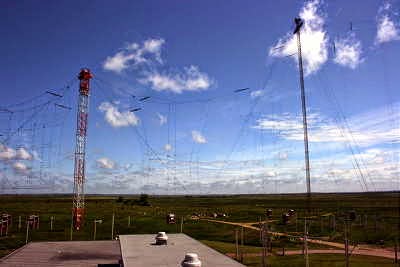
As indicated in an earlier blog, a planned scan of the 49m band was made a few nights ago ... one at 0400Z (10PM local) and another at 1200Z (5AM local). Both had a decidedly different flavor. Frankly I was surprised at the number of broadcasters and especially the number from Asia, China mainly, heard in the morning scan. One information source I found indicates that most of the strong shortwave signals from China are more designed for jamming than for program content.
My initial impression was that many of the more interesting low power targets from Central / South America and Africa may be a thing of the past but I may be wrong. The 'news' page, of the World Wide DX Club, seems to indicate that there are still lots of juicy targets out there if you are willing to put in the time to look for them, as many seem interested in doing. There also seems to be a larger variety of DX targets available in the higher bands such as 25m and 31m.
For the most part, these broadcasters don't fool around with QRP, and their signals are pretty dominant. Conditions of late have not favored Europe or Africa so there may be more activity from these regions than I think.
The following stations were logged with the Perseus SDR along and the 10'x20' loop / Wellbrook preamp, looping E-W, at 0400Z:
5810 EWTN (inSpan) Vandiver, Alabama 500kw
5830 WTWW (rel) Lebanon, TN 100kw
5850 Sun Power Radio (RMI) Okeechobee, FL 100kw
5890 WWCR (rel) Nashville, TN 100kw
5910 NHK Radio Japan Issoudun, France 100kw
5920 WHRI (rel) s/off Cypress Creek, SC 250kw
5920 Radio Romania Galbeni 300kw
5935 WWCR (rel) Nashville, TN 100kw
5970 Radio Italia (in Portuguese) Belo Horizonte, Brazil 10kw
5980 Channel Africa s/off Meyerton, SA 250kw
5985 NHK World Radio Japan (in Span) Okeechobee, FL 100kw
6000 Radio Habana Cuba Titan Quivican 250kw
6020 Radio Gaucha s/off Porto Alegre, Brazil 10kw
6030 Radio Marti Greenville, NC 250kw
6040 Radio RB2 (in Portuguese) Curibata, PR 10kw
6050 unid / weak
6060 Radio Habana Cuba La Habana 100kw
6070 CFRX Toronto, ON 1kw
6090 Caribbean Beacon (rel) Anguilla 100kw
6125 Deutsche Welle s/off Manama, Bahrain 250kw
6160 CKZU Vancouver, BC 500w
6165 Radio Habana Cuba La Habana 100kw
6175 Voice of Vietnam Cypress Creek, SC 250kw
6180 Radio Nacional Brazilia Brasilia 250kw
6185 XEPPM Radio Educacion Mexico City 1kw
These stations were logged at 1200Z, using the same system:
5830 WTWW Tennessee 250kw
5875 BBC Nakhon Sawan (Thailand) 250kw
5915 China Radio Int'l Hohhot 100kw
5925 Voice of Vietnam 2 Hanoi 50kw
5935 PBS Xizang Lhasa-Baiding 100kw //6110
5955 China Radio Int'l Beijing 150kw
5970 PBS Gannan Hezuo 15kw
5975 CNR 8 Beijing 100kw
5985 Myanmar Radio Yangon 25kw
5990 unid China Radio Int'l same interval sig as 5915
5995 Taiwan Xing Xing Kuanyin sign-on 10kw
6000 CNR 1 Beijing 100kw
6003 VOH Korea (S) 100kw
6015 KBS Hanminjok Bangsung 1 Hwaseong (S. Korea) 100kw
6020 weak / poss Radio Victoria Lima with time pips 3kw
6030 CNR 1 Beijing 100kw
6040 weak w/eastern music/ poss Air Jeypore India 50kw
6050 weak / poss RTM Malaysia 10kw
6055 weak w/continuous music / unid
6060 Radio Argentina Exterior General Pacheco 100kw
6065 CNR 2 Beijing 150kw
6070 Voice of Korea / in Japanese Kanggye 10kw
6080 PBS Hulun Buir Hailar (Mongolia) 10kw
6090 NHK World Radio Japan Ibaragi-Koga-Yamata 300kw
6095 KBS World Radio Kimjae (S.Korea) 250kw
6100 Radio Serbia Bijeljina 250kw
6105 Radio Taiwan Int'l Kouhu 100kw
6110 Voice of America / chinese Udon Thani (Thailand) 250kw
6110 PBS Xizang Lhasa-Baiding 100kw //5935
6115 Voice of Strait Fuzhou (PRC) 50kw
6125 CNR 1 Beijing 100kw
6155 CNR 2 Beijing 150kw
6160 CKZU Vancouver 500w / relay CBU AM
6165 Voice of Vietnam 4 Hanoi 50kw
6175 CNR 1 Beijing 100kw
6180 CNR unid but time pips match other CNRs
6180 Radio Taiwan Woofferton 250kw
6195 BBC Kranji (Singapore) 125kw
6200 Voice of Jinling Manjing (Singapore) 100kw
6280.14 Unid with music / poss SOH Xi Wang Zhi Sheng Tanshui (Taiwan) 100 watts
6365 Hand sent keyer CW with callups 7CJ 7CB 7FB QTC into nr/ltr groups
6389 similar to above but nr/ltr groups
6400 Pyongyang Kanggye (N. Korea) 50kw
6501 USCG NMO Honolulu with wx bdcst
6518 Voice of the People Kyonggi-do-Koyang (S. Korea) 50kw
6518 N. Korean jammer Kujang 250kw
6600 Voice of the People Kyonggi-do-Koyang (S. Korea) 50kw
6600 N. Korean jammer Kujang 250kw
6679 Honolulu Radio w/ aviation Volmet
6754 Trenton Volmet wx bdcst
The number of broadcasters using remote sites is also surprising. It seems that the relaying of program content for others is big business and for many countries, much cheaper than running their own 250kw stations.
Some links that I have found very useful for identifying SW BC stations:
http://www.geocities.jp/binewsjp/ic/bia15.txt
http://www.short-wave.info/
http://www.shortwaveschedule.com/
Steve McDonald, VE7SL, is a regular contributor to AmateurRadio.com and writes from British Columbia, Canada. Contact him at [email protected].
TX Factor Episode 8 Has Been Elected!
Oh, there’s also a chance to win a FUNcube Dongle Pro+ courtesy of its inventor Howard Long in our next free-to-enter draw.
Suddenly, the prospect of a hung parliament is not such a bad result after all: there’s always amateur radio and TX Factor to take your mind off the gloom!
Nick Bennett 2EØFGQ co-hosts TX Factor with Bob McCreadie GØFGX and Mike Marsh G1IAR. Contact the team at [email protected]
 Ham Radio Deluxe |
 W5SWL Electronics |
 Ham Radio Prep |
 KB3IFH QSL Cards  Hip Ham Shirts  HamRadioAuctions HamRadioAuctions Reliance Antennas Reliance Antennas Enigma Shop Enigma Shop |  morseDX  Ni4L Antennas  R&L Electronics R&L Electronics antennas.us antennas.us QRV QRV |
- Matt W1MST, Managing Editor
