 |
 Ultimate software is up to date
 7 May 2015 | by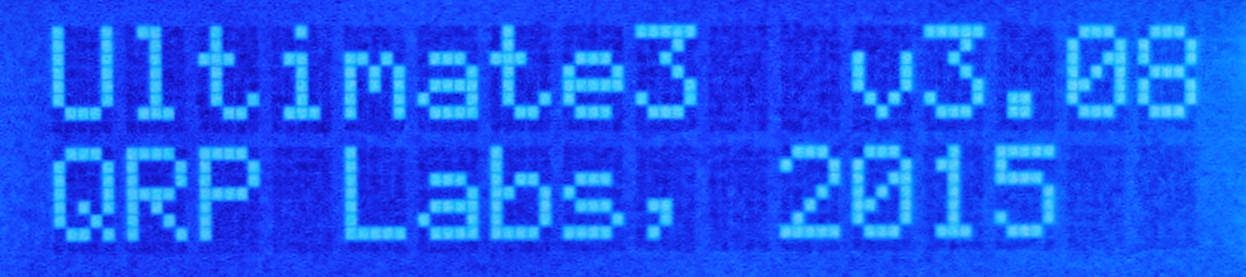
As I have mentioned several times on this blog, I have thoroughly enjoyed WSPR modes ever since Hans, G0UPL came out with the first Ultimate QRSS/WSPR kit.

That means that I have three different versions of the kit. Since Hans has kept on updating the software and even published the compiled versions, it is also possible to upgrade even the old ones.

I have done that and the displays here show the Ultimate 3, the Ultimate 2, and the Ultimate 1 with the latest software.
It is possible to upgrade the chips in-circuit, but I found that it is simpler to remove the chip temporarily from the socket and move it to a simple veroboard with crystal oscillator components. It is connected to my Ebay version of the USBtinyISP.

Sverre Holm, LA3ZA, is a regular contributor to AmateurRadio.com and writes from Norway. Contact him at [email protected].
Miscelleneous Radio Stuff
As I have blogged in the past, I have a QTH is Santa Fe, NM. From there I have done the majority of my SOTA expeditions. There is a great ham radio community there and an even better SOTA community. Including myself, there are four hams who have earned SOTA Mountain Goat status in the Santa Fe areas and soon to be five. So we have a lot of fun in the mountains of New Mexico. To bring some organization to that group, we have formed the New Mexico Mountain Goat club to promote efficiently summit radio operations. This week the club call was finally issued, NM5MG. So listen for this call around Memorial Day weekend (end of May).
I have built my first stealth antenna with help from AD6D, in the form of a flagpole, at my Santa Fe QTH. The 20 ft. flagpole from ZeroFive antennas works great. I've installed an LDG tuner at the base to get the antenna resonant 10 -20m and added a piece of wire, attached to the flag fastener and raised to the top, in an inverted L configuration to get tuned resonance on 40m and 80m. No doubt it is a compromise, but I'm on the air and can work a lot of stuff.
I will be travelling to Dayton for the first time in 15+ years. I am looking forward to seeing old friends there. My focus in ham radio has matured a lot since the last time I was there, so looking forward to the flea market.
I am also working on perfecting remote operation of my home QTH station in Boerne, TX. Early results are encouraging. I just to need to tweak a few things and get comfortable with the process.
Hopefully next time, I can write some specifics about these projects.
Mike Crownover, AD5A, is a regular contributor to AmateurRadio.com and writes from Texas, USA. Contact him at [email protected].
Miscelleneous Radio Stuff
As I have blogged in the past, I have a QTH is Santa Fe, NM. From there I have done the majority of my SOTA expeditions. There is a great ham radio community there and an even better SOTA community. Including myself, there are four hams who have earned SOTA Mountain Goat status in the Santa Fe areas and soon to be five. So we have a lot of fun in the mountains of New Mexico. To bring some organization to that group, we have formed the New Mexico Mountain Goat club to promote efficiently summit radio operations. This week the club call was finally issued, NM5MG. So listen for this call around Memorial Day weekend (end of May).
I have built my first stealth antenna with help from AD6D, in the form of a flagpole, at my Santa Fe QTH. The 20 ft. flagpole from ZeroFive antennas works great. I've installed an LDG tuner at the base to get the antenna resonant 10 -20m and added a piece of wire, attached to the flag fastener and raised to the top, in an inverted L configuration to get tuned resonance on 40m and 80m. No doubt it is a compromise, but I'm on the air and can work a lot of stuff.
I will be travelling to Dayton for the first time in 15+ years. I am looking forward to seeing old friends there. My focus in ham radio has matured a lot since the last time I was there, so looking forward to the flea market.
I am also working on perfecting remote operation of my home QTH station in Boerne, TX. Early results are encouraging. I just to need to tweak a few things and get comfortable with the process.
Hopefully next time, I can write some specifics about these projects.
Mike Crownover, AD5A, is a regular contributor to AmateurRadio.com and writes from Texas, USA. Contact him at [email protected].
Possibilities
I am hoping this makes for good band conditions during lunchtime today. Hopefully, I'll jump on somewhere around 1745 UTC for about an hour.
Amateur Radio is so much like fishing. The possibilities abound, and you rarely know what you're going to get. I don't get how anyone could not like this hobby. Even when I get skunked, I may be disappointed, but I never have a bad time.
To turn a phrase, "A bad day at Amateur Radio is better than a good day at ...... (you fill in the blank)".
I'll update this later to let you know how it went.
Lunchtime Post Mortem:
The weather was indeed beautiful, the band conditions were "meh". Signals were non-existent on 10 and 12 Meters, sparse on 15 Meters and most plentiful on 17 Meters (which has become a favorite band).
I worked YN5SU in Nicaragua and OT4A in Belgium, and that was it. I called CQ for a bit and had no takers. But I was getting out, according to RBN:
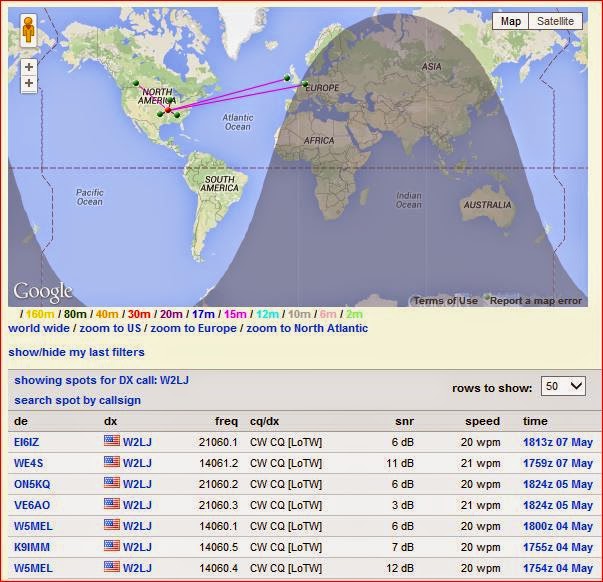
I have no idea, however, why RBN has my location as somewhere in the vicinity of Missouri.
72 de Larry W2LJ
QRP - When you care to send the very least!
Larry Makoski, W2LJ, is a regular contributor to AmateurRadio.com and writes from New Jersey, USA. Contact him at [email protected].
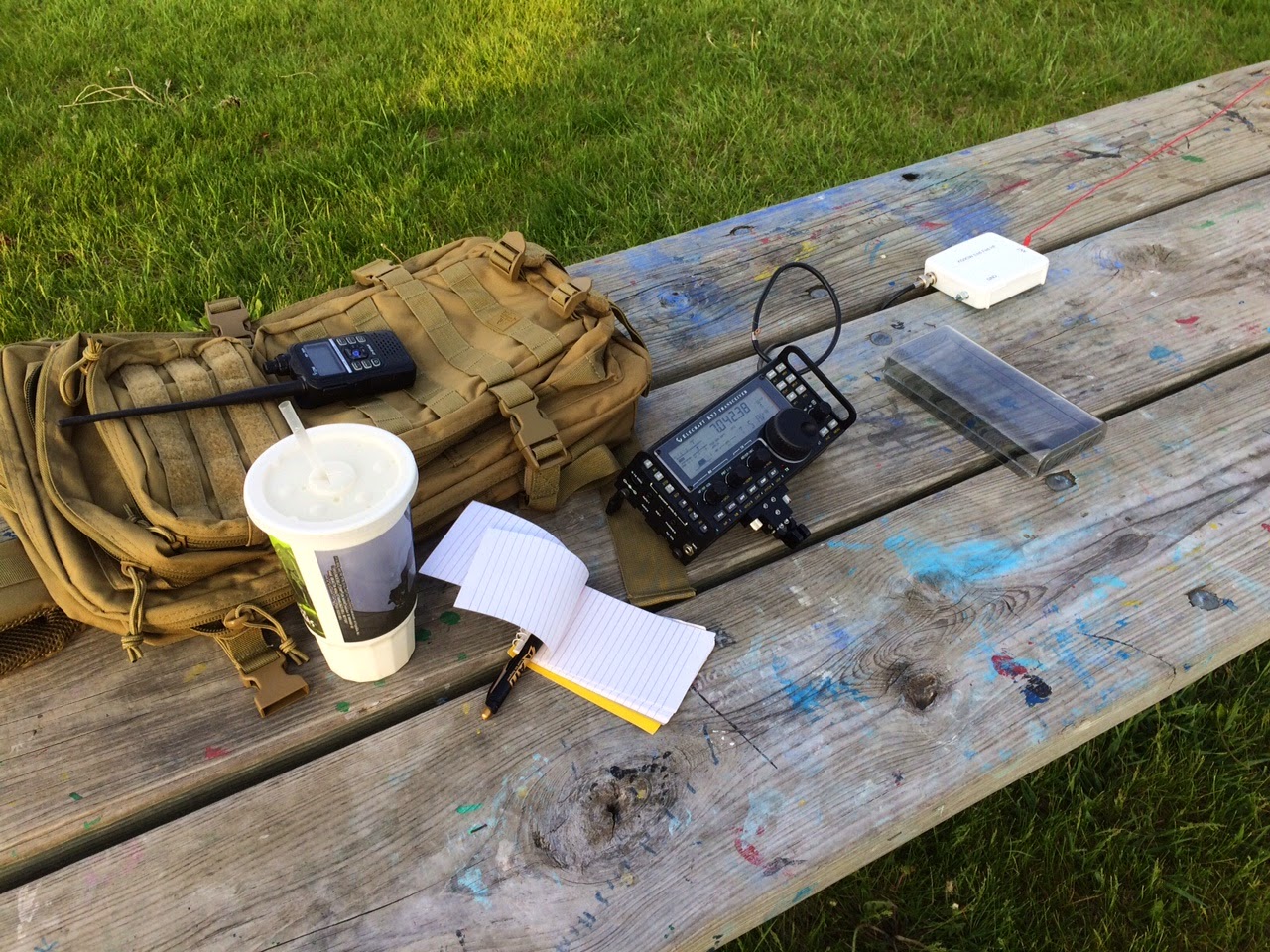
Skunked at the park
Michael Brown, KG9DW, is a regular contributor to AmateurRadio.com and writes from Illinois, USA. Contact him at [email protected].
10m antennas
As you will have noticed by now, 10m is one of my favourite bands. Although quiet at many times in the solar cycle it always comes to life with Es from late April until September. Alert 10m operators will sniff out Es at other times too, but there may be long periods of noise, as on 6m. WSPR is an ideal mode when the band may otherwise seem quiet. It is good for local nattering at any time and F2 N-S DX is often there even at solar minima. Antennas for the band are small and easy to make such as the design on my website for a 10m halo. See https://sites.google.com/site/g3xbmqrp3/ .
A video of K7AGE making a dipole for 10m is available at YouTube. See https://youtu.be/84F4UgSWmQo. In this video, Randy is making a dipole for the USA technician’s band, so to cover the main SSB band (28.4 to 28.6MHz) you will need to make the wire slightly shorter. In my experience if you cut the wires for the centre of the band it will still have a pretty low SWR at the band edges. Even a very simple ATU will bring the SWR down to 1:1, although unless your rig has a problem with a mismatch of around 1.8:1, I would not bother, as the difference in radiated power is negligible (fraction of an S-point).
Because of the short wavelength, 10m antennas don’t have to be that high to be effective. When the band is in good shape, worldwide DX can be had with simple wire antennas and low power. It is a rewarding band. What is more, 10m multi-mode transceivers can be bought at low cost. In summary, 10m is unique: low cost transceivers, simple antennas and good DX potential.

Roger Lapthorn, G3XBM, is a regular contributor to AmateurRadio.com and writes from Cambridge, England.
Belcom LS-707 70cm multi-mode rig
A radio amateur in Nottingham,Vic G0RVA, recently bought one of these Belcom rigs. It appears to be an all-mode 70cm rig, although I am not familiar with this unit.
I know Belcom did a 2m version (the famous Liner-2, which I did once own) and a similar version for 70cm. The Liner-2 was a modification of their 10m version, which I don’t think was ever sold in the UK. Inside Vic’s rig was what looked like a canned preamp with the marking “AngleLinear” but again I am not familiar with this unit. Angle Linear appear to be based in the USA http://anglelinear.com/ .
In its day, the 2m Liner-2 transformed 2m. It was a synthesised SSB rig and was frequently pushed too hard so that splatter was a problem. I was amazed how far I could work on 2m SSB with 10W pep. From Cambridge I could work stations that would have been impossible on FM or AM. I found I could work 200-300km with a simple antenna under ANY conditions.
Many were critical of these early Belcom transceivers, but I enjoyed my Liner-2 as did many others. Later I bought an ICOM IC202 which was a better radio, but with less ERP. The IC202 had a mock military style, that really was not too clever.
The “coming of age” of 2m SSB marked the change from “tuning high to low” to single frequency working. Sadly, there is far less activity on 2m SSB outside of contests so people think VHF is only really any good for local QSOs. With 10W SSB, or even less, it is possible to work a long way on VHF irrespective of conditions. From my current QTH, I think 200km is reachable with 5W pep and a 3 el beam on 2m. It is not that different on 70cm where I use 5W pep and a 5 el beam. Both my beams are hand rotated.

Roger Lapthorn, G3XBM, is a regular contributor to AmateurRadio.com and writes from Cambridge, England.
 Ham Radio Deluxe |
 W5SWL Electronics |
 Ham Radio Prep |
 KB3IFH QSL Cards  Hip Ham Shirts  HamRadioAuctions HamRadioAuctions Reliance Antennas Reliance Antennas Enigma Shop Enigma Shop |  morseDX  Ni4L Antennas  R&L Electronics R&L Electronics antennas.us antennas.us QRV QRV |
- Matt W1MST, Managing Editor
