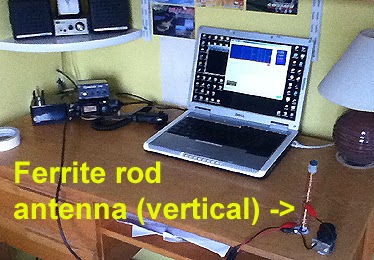
Ferrite rod transmitting antennas?

OK, I only tried this with WSPR and with low power, but at my old QTH I had a good deal of success using a small ferrite rod as a TX antenna on some HF bands. As long as the ferrite is not in saturation there is no good reason why it should not work. Most problems will occur if the antenna is driven with too much power.

See the link for more details. I have no idea about this ferrite rod’s properties but I think it was a fairly standard piece of ferrite rod and nothing too special at all.

Since being in hospital for 3.5 months and moving QTH I have not been able to find the ferrite rod to repeat the tests. My wife moved most of my stuff and it is probably deep in a box somewhere! At some point I guess it will just turn up.

See https://sites.google.com/site/g3xbmqrp3/antennas/ferrite_tx .


Roger Lapthorn, G3XBM, is a regular contributor to AmateurRadio.com and writes from Cambridge, England.

Dayton Finale
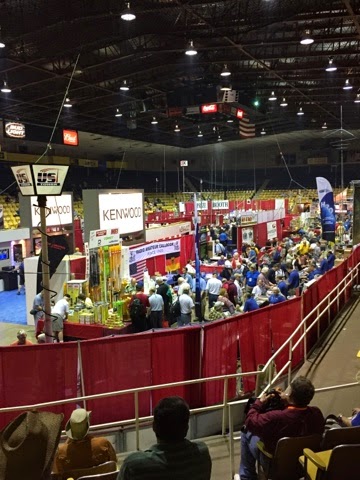
Dayton Hamvention 2015 is over for me. I have a plane to catch Sunday morning so I made my final rounds through Hara Arena just before 5:00 pm. I will be back, good Lord willing and the creek don't rise. It was a good time and I now have lots of ideas of things to do in and around the shack.


Below is a picture of the new K3S. There are some significant differences that I'm sure will be documented soon. Some of the differences will be mods that can be applied to current K3's, other changes will not. Only minor changes to the appearance of the radio

                                   K3S

There are always new things to discover and I came across a neat product for portable QRP practioners. One of the processes to getting efficient in portable QRP operation is to try to figure out a reasonable antenna configuration. Enter PackTenna, www.packtenna.com .


The product is a prepackaged antenna system, including the telescoping 32 ft. pole. The antenna is an innovative design that allows you to configure the antenna as a dipole or a vertical. Check it out.

                                             PackTenna

Finally, I didn't get away without a couple of catches of my own. I found a Navy Flameproof straight-key and a 100 year  commemorative version of the Vibroplex Original semi-automatic key. Both are seen below.


So another Dayton experience in the books, can't wait to go again.

Mike Crownover, AD5A, is a regular contributor to AmateurRadio.com and writes from Texas, USA. Contact him at [email protected].

Dayton Finale

Dayton Hamvention 2015 is over for me. I have a plane to catch Sunday morning so I made my final rounds through Hara Arena just before 5:00 pm. I will be back, good Lord willing and the creek don't rise. It was a good time and I now have lots of ideas of things to do in and around the shack.


Below is a picture of the new K3S. There are some significant differences that I'm sure will be documented soon. Some of the differences will be mods that can be applied to current K3's, other changes will not. Only minor changes to the appearance of the radio

                                   K3S

There are always new things to discover and I came across a neat product for portable QRP practioners. One of the processes to getting efficient in portable QRP operation is to try to figure out a reasonable antenna configuration. Enter PackTenna, www.packtenna.com .


The product is a prepackaged antenna system, including the telescoping 32 ft. pole. The antenna is an innovative design that allows you to configure the antenna as a dipole or a vertical. Check it out.

                                             PackTenna

Finally, I didn't get away without a couple of catches of my own. I found a Navy Flameproof straight-key and a 100 year  commemorative version of the Vibroplex Original semi-automatic key. Both are seen below.


So another Dayton experience in the books, can't wait to go again.

Mike Crownover, AD5A, is a regular contributor to AmateurRadio.com and writes from Texas, USA. Contact him at [email protected].

Using Remote SDR’s
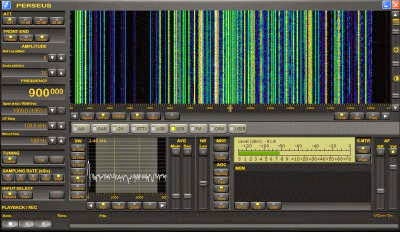
A recent post to Yahoo's Perseus SDR Group posed some interesting questions.

Lasse, SM5GLC, operates an online remote Perseus and made the following comments:

Over the past few weeks/months I have see some "power-users" on my Perseus server... and my plan was to dissect the server log to investigate the usage percentage of my server... and found that already in May the log is 240 kb and growing fast. It seems impossible to analzye by hand.

Now I do notice one user, not too far away (only some 200 miles or so), seems to spend 2-3 hours per day using my server. Mostly just use all allotted time and then get back on asap. I know my antenna is nothing to write home about and the performance is mediocre if any... so this makes me wonder. What on earth do this user do with all the time??

Do others see similar behaviour??

By browsing the log it seems most, user time,70-80 per cent, are from Russia. Most others stay only for a very short period of time, up to a few minutes.

Has anyone tried to hack a script that would automatize the log analysis?? 
A few Q's that I do have are:
Is the server abused by some?
What is the optimal allowed time? and then the drop-out time?
What usage load would be best to shoot for??


Don, VE6JY, a long-time remote owner added:

I notice similar patterns here.  Obviously some are listening to a single frequency for the entire time, others stop by for a few seconds to see if a certain target is being propagated.  And then some just tune around and see what there is to hear and see. And I'm sure some fall asleep until it times out. These are all things I have done when I am using the remote side.  One thing we need to remember, an antenna that is mediocre to one person may be a window to the world for someone living in the urban noise jungle.  And consider this - if there were enough remotes to choose from, scattered all over the globe,  even a poor antenna would cover their locals and fill in the gap.  Unfortunately, the number of remotes seem to be dwindling, esp here in N AM.  Maybe summer coming and lightning season but still, even this winter, choices were fairly meagre. 


I'm not too concerned about the usage aspect - it's not a big drain on my internet and I see enough different names, many of whom I know personally who use it so I think most get a fair chance to see if whatever signal they're looking for makes it to my part of Alberta.  Both of mine are set to 62 mins on with the minimum 2 minute reconnect time.

The only "abuse" if it really is, I see sometimes is from the amateur radio side, people wanting to hear a station better in order to work a rare one or have an unfair advantage in a contest. What does annoy me is users who can't be bothered to put in their proper name or callsign or even a lat/long. And then there's a few servers that get the lat/long wrong or reversed so they wind up in a rare portion of the world and for a moment we all get excited!!

Both operators raise some interesting questions!

If you have used a remote SDR or do so with some regularity, how did you find the experience? What types of things did you listen or look for? How much time would you typically spend on the site? What do you think the limits on time should be?

I have used a remote once or twice in the past, to listen for my Tri-Tet-Ten's chirpy, low power signal, and found it very useful but I've never used one for general listening.

What are your experiences?

Steve McDonald, VE7SL, is a regular contributor to AmateurRadio.com and writes from British Columbia, Canada. Contact him at [email protected].

W5KUB Live Coverage – Hamvention 2015


Matt Thomas, W1MST, is the managing editor of AmateurRadio.com. Contact him at [email protected].

Live From Dayton
I am taking a break at the Dayton Hamvention to capture a few thoughts. This is the first time I've been to Dayton since the late '90's. The good news and bad news is that not much has changed. The good news is that all the cool stuff is here.Yesterday I got a look at the new K3S that Elecraft announced and all the other new toys and old ones are here. It is Ham Radio Heaven from that perspective.

The gatherings around town are still a highlight. The social aspect of Dayton is always a plus, getting to hang out with your "on-air" buddies in person and getting together with people of common interests

So what is the bad news? Hara Arena was in bad need of a facelift in the late 90's and I can't tell that anything has been improved. Even a light rain brings out the buckets, inside, to catch the leaking water. The Flea Market area has crumbling asphalt, to the extent of being dangerous in places. Although it's early on Saturday, the crowds seem much smaller.

I was able to mix in a little SOTA fun while here. The highest point in Ohio is about an hour north of Dayton in Belle Fountain, OH. So I ventured up to there to activate a summit in a new association and get 4 points. 

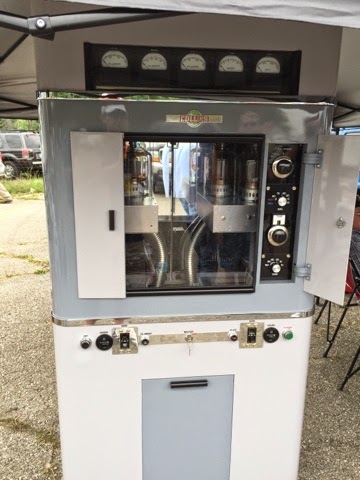
                  A Collins Amplifier


                  Activating Campbell Hill

I will try to take a few more pictures to day.

Mike Crownover, AD5A, is a regular contributor to AmateurRadio.com and writes from Texas, USA. Contact him at [email protected].

Live From Dayton

I am taking a break at the Dayton Hamvention to capture a few thoughts. This is the first time I've been to Dayton since the late '90's. The good news and bad news is that not much has changed. The good news is that all the cool stuff is here.Yesterday I got a look at the new K3S that Elecraft announced and all the other new toys and old ones are here. It is Ham Radio Heaven from that perspective.

The gatherings around town are still a highlight. The social aspect of Dayton is always a plus, getting to hang out with your "on-air" buddies in person and getting together with people of common interests

So what is the bad news? Hara Arena was in bad need of a facelift in the late 90's and I can't tell that anything has been improved. Even a light rain brings out the buckets, inside, to catch the leaking water. The Flea Market area has crumbling asphalt, to the extent of being dangerous in places. Although it's early on Saturday, the crowds seem much smaller.

I was able to mix in a little SOTA fun while here. The highest point in Ohio is about an hour north of Dayton in Belle Fountain, OH. So I ventured up to there to activate a summit in a new association and get 4 points. 

                  A Collins Amplifier


                  Activating Campbell Hill

I will try to take a few more pictures to day.

Mike Crownover, AD5A, is a regular contributor to AmateurRadio.com and writes from Texas, USA. Contact him at [email protected].

Subscribe FREE to AmateurRadio.com's
Amateur Radio Newsletter

 
We never share your e-mail address.


Do you like to write?
Interesting project to share?
Helpful tips and ideas for other hams?

Submit an article and we will review it for publication on AmateurRadio.com!

Have a ham radio product or service?
Consider advertising on our site.

Are you a reporter covering ham radio?
Find ham radio experts for your story.

How to Set Up a Ham Radio Blog
Get started in less than 15 minutes!


  • Matt W1MST, Managing Editor