 |
 Can I Use My Ham Radio on Public Safety Frequencies? Updated
 22 May 2015 | by
 This is an update to one of my most popular posts.
 We have quite a few licensed radio amateurs that are members of public safety agencies, including fire departments, law enforcement agencies and search and rescue. Since they are authorized users of those public safety channels, they often ask this question:
Can I use my VHF/UHF ham radio on the fire, police or SAR channel?
It is widely known that many amateur radios can be modified to transmit outside the ham bands. The answer to this question used to be that amateur radio equipment cannot be used legally on public safety channels because it is not approved for use under Part 90 of the FCC Rules. (Part 90 covers the Private Land Mobile Radio Services.) The only option was to buy a commercial radio with Part 90 approval and a frequency range that covered the desired amateur band. Some commercial radios tune easily to the adjacent ham band but some do not. The commercial gear is usually two to three times as expensive as the amateur gear, and just as important, does not have the features and controls that ham operators expect. Usually, the commercial radios do not have a VFO and are completely channelized, typically changeable only with the required programming software.
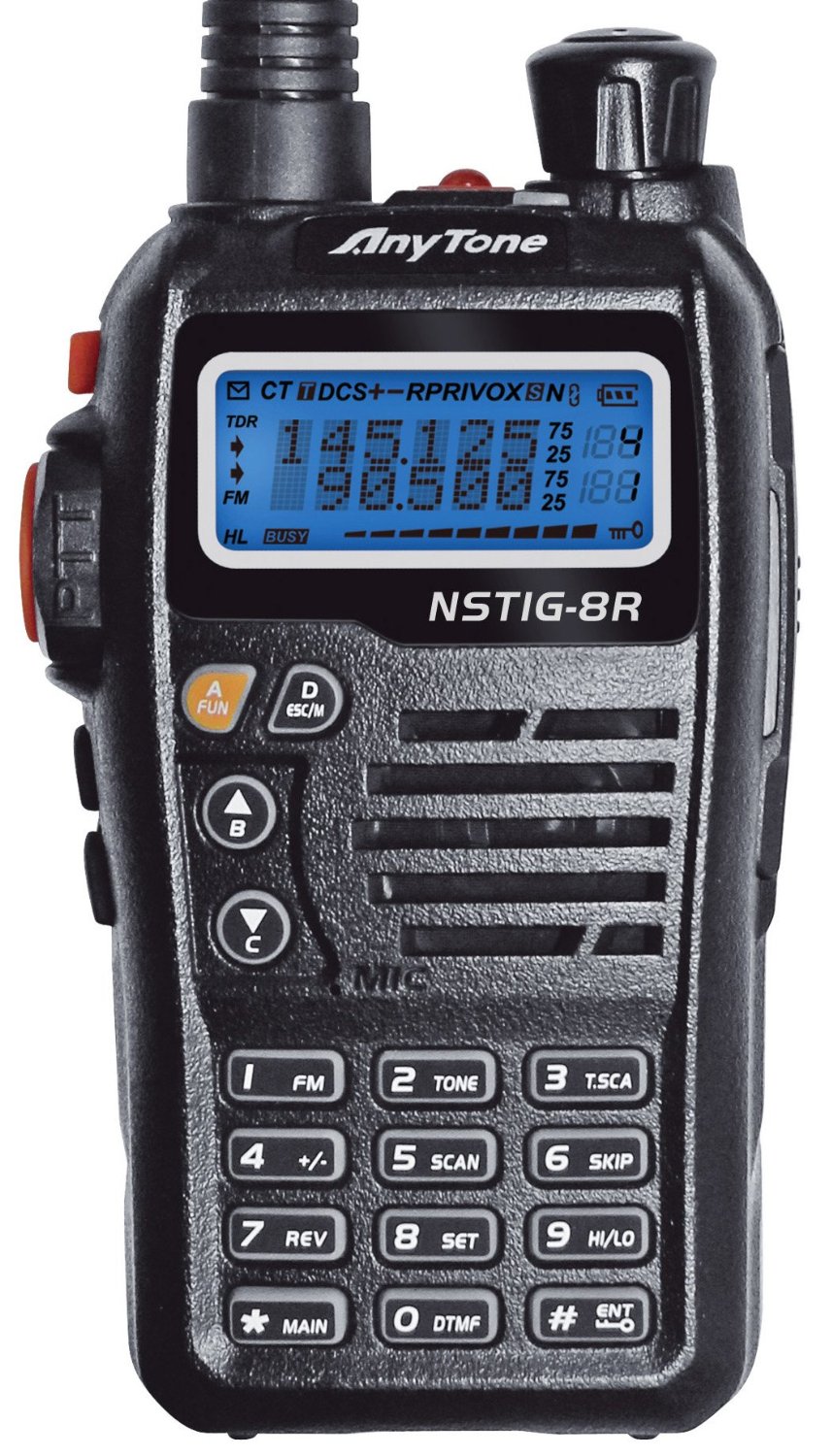
The situation has changed dramatically in the past few years. Several wireless manufacturers in China (Wouxun, Baofeng, Anytone, etc.) have introduced low cost handheld transceivers into the US amateur market that are approved for Part 90 use. These radios offer keypad frequency entry and all of the usual features of a ham radio. It seems that these radios are a viable option for dual use: public safety and amateur radio, with some caveats.
New radios are being introduced frequently, so I won’t try to list them here. However, you might want to do a search on Wouxun, Baofeng and Anytone for the latest models. I will highlight the Anytone NSTIG-8R radio which I have been using. It seems to be a well-designed but still affordable (<$75) handheld radio. See the review by PD0AC.
Some Things to Consider When Buying These Radios
- The manufacturers offer several different radios under the same model number. Also, they are improving the radios every few months with firmware changes and feature updates. This causes confusion in the marketplace, so buy carefully.
- Make sure the vendor selling the radio indicates that the radio is approved for Part 90 use. I have seen some radios show up in the US without an FCC Part 90 label.
- Make sure the radio is specified to tune to the channels that you need.
- The 2.5-kHz tuning step is required for some public safety channels. For example, a 5-kHz frequency step can be used to select frequencies such as 155.1600 MHz and 154.2650 MHz. However, a 2.5 kHz step size is needed to select frequencies such as 155.7525 MHz. There are a number of Public Safety Interoperability Channels that require the 2.5-kHz step (e.g., VCALL10 155.7525 MHz, VCALL11 151.1375 MHz, VFIRE24 154.2725). The best thing to do for public safety use is to get a radio that tunes the 2.5-kHz steps.
- Many of these radios have two frequencies in the display, but only have one receiver, which scans back and forth between the two selected frequencies. This can be confusing when the radio locks onto a signal on one of the frequencies and ignores the other. Read the radio specifications carefully.
Recommendation
There are a number of reasonably good radios out there from various manufacturers. My favorite right now is the Anytone NSTIG-8R but I also like the Wouxun KG-UV6D. The Baofeng UV-5R continues to be popular in the amateur community as the low cost leader. However if you show up at an incident with the Baofeng, your fellow first responders will think it is a toy. Which leads to a really important point: the established commercial radio manufacturers such as Motorola, Vertex, etc. build very rugged radios. They are made for frequent, heavy use by people whose main job is putting out fires, rescuing people in trouble and dealing with criminals. These low cost radios from China are not in the same league. However, they can still serve in a less demanding physical environment while covering the Amateur Radio Service (FCC Part 97) and the Private Land Mobile Radio Services (FCC Part 90).
73, Bob K0NR
The post Can I Use My Ham Radio on Public Safety Frequencies? Updated appeared first on The KØNR Radio Site.
Bob Witte, KØNR, is a regular contributor to AmateurRadio.com and writes from Colorado, USA. Contact him at [email protected].
Hunting For NDBs In CLE194
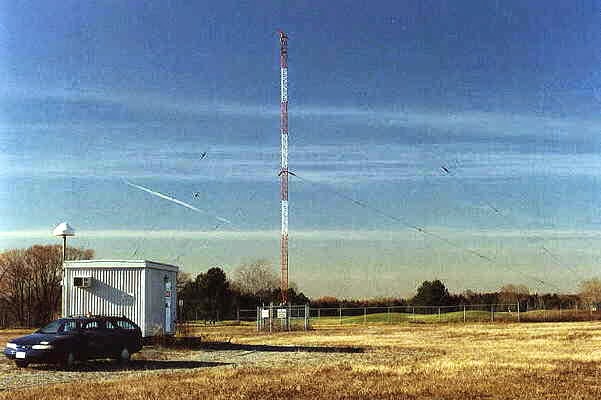 |
| OO-390 kHz courtesy: ve3gop.com |
It's CLE time once again! For you low-frequency buffs, another challenge awaits. This month's frequency range covers the high end, 385.0 - 399.9 kHz. A list of all of the North American targets in this range can be found in the RNA database, while targets for European DXers will be found here... specify the frequency range wanted and check 'show all results'.
An excellent target for North Americans is little 'OO' on 390kHz. It gets out well at just 7.5watts and was heard here on Mayne Island earlier this year.
From CLE coordinator Brian Keyte (G3SIA) comes the following reminder:
Hi all,
Have you tried one of our Co-ordinated Listening Events yet?
CLEs are NOT contests - they allow us to share the same listening
challenge and in the process to learn more about our great hobby.
Short logs or long ones, everyone who enjoys taking part is a winner!
Since early in 2001 over 250 different NDB List members have taken
part in a CLE for the first time - and over four in every five came back
for more.
Fourteen members have come back over 100 times, 44 over 50 times.
End of the Commercial!
Our 194th CLE is almost here:
Days: Friday 22 May - Monday 25 May
Times: Start and end at midday LOCAL TIME
Range: 385.0 - 399.9 kHz
Just log all the NDBs that you can identify with their nominal (listed)
frequencies in the range - it includes 385 kHz, but not 400 kHz -
plus any UNIDs that you come across there.
Please send your CLE log in a plain text email if possible (not in
an attachment) and to the List, not direct to me.
Show on each line of your log:
# The Date (e.g. 2015-05-dd or just the day-of-the-month, dd)
# The Time in UTC (the day changes at 00:00 UTC).
# kHz - the beacon's nominal published frequency, if known.
# The Call Ident.
Show those main items FIRST - any other details such as location,
distance, offsets, etc., go LATER in the same line (or in footnotes).
Please always include your own location and brief details of the
equipment that you were using.
It is important to put 'CLE194' at the start of the email subject.
If you send any interim logs, please also send a 'Final' (complete)
log showing all your loggings for the event.
I will send the usual 'Any More Logs?' email at about 1700 UTC on
Tuesday so that you can check that your log has been found OK.
It is a good idea to meet that deadline if you can, but make sure that
your log has arrived on the list by 0800 UTC on Wednesday at the
very latest. The combined results should be completed on that day.
You can find full information by going to the CLE Information Page
http://www.ndblist.info/cle.htm It also has a link to the seeklists
for this Event at REU/RNA/RWW.
Good listening
Brian
----------------------------------------------------------
From: Brian Keyte G3SIA ndbcle'at'gmail.com
Location: Surrey, SE England (CLE co-ordinator)
----------------------------------------------------------
( If you would like to listen remotely you could use any one remote
receiver, such as http://websdr.ewi.utwente.nl:8901/ for your
loggings, stating its location and owner and with their permission
if required. A remote listener may NOT also use another receiver,
local or remote, to make further loggings for the same CLE )
These listening events serve several purposes. They:
- determine, worldwide, which beacons are actually in service and on-the-air so the online database can be kept up-to-date
- determine, worldwide, which beacons are out-of-service or have gone silent since the last CLE covering this range
- will indicate the state of propagation conditions at the various participant locations
- will give you an indication of how well your LF/MF receiving system is working
- give participants a fun yet challenging activity to keep their listening skills honed
Final details can be found at the NDB List website, and worldwide results, for every participant, will be posted there a few days after the event. If you are a member of the ndblist Group, results will also be e-mailed and posted there.
The very active Yahoo ndblist Group is a great place to learn more about the 'Art of NDB DXing' or to meet other listeners in your region. There is a lot of good information available there and new members are always very welcome.
If you are contemplating getting started on 630m, listening for NDBs is an excellent way to test out your receive capabilities as there are several NDBs located near this part of the spectrum.
You need not be an ndblist member to participate in the CLEs and all reports, no matter how small, are of much value to the organizers. 'First-time' logs are always VERY welcome!
Reports may be sent to the ndblist or e-mailed to either myself or CLE co- ordinator, Brian Keyte (G3SIA), whose address appears above.
Please...do give the CLE a try....then let us know what NDB's can be heard from your location! Your report can then be added to the worldwide database to help keep it up-to-date.
Steve McDonald, VE7SL, is a regular contributor to AmateurRadio.com and writes from British Columbia, Canada. Contact him at [email protected].
Some great news
My initial reactions were thus:
1) Wow! It's great to hear from John.
2) John's writing again - fantastic!
3) I know diddly squat about motorcycling.
4) This ties into QRP, so how can this be a bad thing?
5) Even though #3 is true, #4 is also true, so maybe I can learn something here.
6) Boy, it's good to have John back again.
So even if you're like me (and don't know squat about motorcycling), you do know about QRP and you do like the way John writes - it's still a win/win situation. AND if you DO know about motorcycling, then you've really hit pay dirt! (Win/win/win).
I have added John's new blog to the blog roll on the right, and the hyperlink above will take you right there. Please take the time to read his work, and if you like what you're reading - let him know. We bloggers appreciate the feedback and love hearing from you, good, bad or indifferent. Just do ME a favor and tell him W2LJ sent you.
72 de Larry W2LJ
QRP - When you care to send the very least!
Larry Makoski, W2LJ, is a regular contributor to AmateurRadio.com and writes from New Jersey, USA. Contact him at [email protected].
160m indoor loft antenna
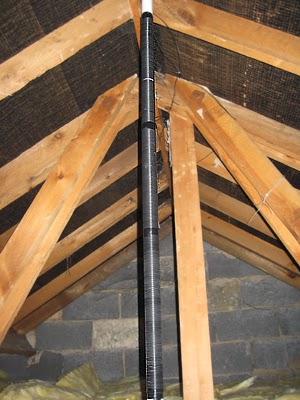
Some years ago G6ALB and I wanted a simple talkback link that we could use when co-operating on experiments. We were 3km apart with Andrew being in the next village. We immediately thought about simple AM rigs for topband (160m).
As I had no 160m antenna, I built the design linked here. This antenna works well with best WSPR spots being over 1000km.
We decided that topband was too noisy for our simple AM rigs for our intended purpose. The noise floor at both our locations is very high on 160m. I have since moved QTH but we are still thinking about this link. We are now 3.3km apart. Probably 6m would be a better choice as less noisy and we both have vertical antennas.
See https://sites.google.com/site/g3xbmqrp3/antennas/160m_loft_ant .

Roger Lapthorn, G3XBM, is a regular contributor to AmateurRadio.com and writes from Cambridge, England.
Skeeter Hunt 2015

Yes! There will be a Skeeter Hunt in 2015. It will be held on Sunday, August 9th. Skeeter numbers will be issued starting on the "First Day of Summer", which will be Sunday June 21st - the weekend before Field Day.
There is one major rule change for this year - there will be no extra bonus points for working DX stations this year. As many of you know, the Skeeter Hunt seems to always coincide with the "Work All Germany" contest, and in years past, working a DX station was worth 3 points. Several Skeeters in the Mid-West and on the West coast pointed out that this is an unfair advantage to East coast Skeeters. After considering it, I have come to agree with this, and have eliminated that extra DX bonus. The playing field will be much more equal this year.
The Bonus word for this year is "CULICIDAE", which is the Latin word for the family of insects that mosquitoes belong to. Work enough call signs that include those letters and you can garner yourself another 100 points. There's an "L" in there and I will be happy to be the official "L" provider for the Hunt. Hi! (I think Don K3RLL among others, will also be happy to give away "L"s, too.)
I am having a bit of trouble with the QSL.NET webpage, so for all the details of this year's Skeeter Hunt, you can go to my Skeeter Hunt page of this blog - http://w2lj.blogspot.com/p/njqrp-skeeter-hunt.html.
I am hoping to have the QSL.NET problems ironed away by this weekend, but then again, you never know.
72 de Larry w2LJ
QRP - When you care to send the very least!
Larry Makoski, W2LJ, is a regular contributor to AmateurRadio.com and writes from New Jersey, USA. Contact him at [email protected].
Amateur VLF DXing
Operating an amateur station at VLF is a very specialised area of experimentation. There are basically 2 different threads (1) earth-mode or utilities assisted earth-mode with propagation mainly along or close to roads and (2) radiated DXing in which a VLF signal is actually radiated and propagated to great distances. With (1) I have managed 6km with QRSS3 with 5W from a TDA2003 audio IC at 8.97kHz. Earth-mode gear can be low powered and simple to build.
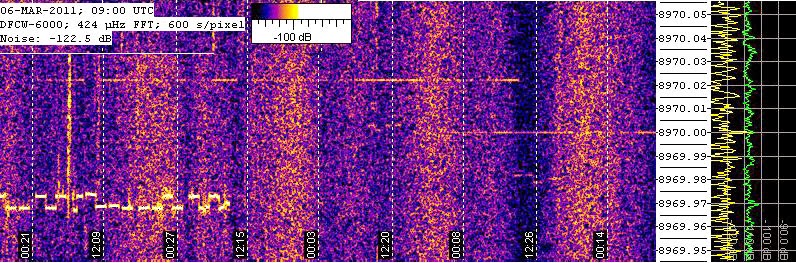 |
| VLF amateur signals |
With (2) the Atlantic Ocean has now been crossed, i.e. quite remarkable distances with amateur powers and antennas. Usually very large loading coils are needed and making these can be “challenging”. As high voltages are likely, great care is needed. Of course, most DXing is done with very long stable transmissions in very narrow bandwidths. Most amateur VLF gear is home made with free PC software to allow signals to be seen. Casual listening is not effective. Most operation is now around 8.300kHz as this is unallocated in many countries.
News of VLF activity may be found at https://sites.google.com/site/sub9khz/ .

Roger Lapthorn, G3XBM, is a regular contributor to AmateurRadio.com and writes from Cambridge, England.
AmateurLogic 78: Live from Dayton Hamvention 2015

AmateurLogic.TV Episode 78 is now available for download.
Join George, Tommy, Ray and a host of special guests at Dayton Hamvention 2015. Shot in front of a live audience at the Icom booth.
1:54:27
George Thomas, W5JDX, is co-host of AmateurLogic.TV, an original amateur radio video program hosted by George Thomas (W5JDX), Tommy Martin (N5ZNO), Peter Berrett (VK3PB), and Emile Diodene (KE5QKR). Contact him at [email protected].
 Ham Radio Deluxe |
 W5SWL Electronics |
 Ham Radio Prep |
 KB3IFH QSL Cards  Hip Ham Shirts  HamRadioAuctions HamRadioAuctions Reliance Antennas Reliance Antennas Enigma Shop Enigma Shop |  morseDX  Ni4L Antennas  R&L Electronics R&L Electronics antennas.us antennas.us QRV QRV |
- Matt W1MST, Managing Editor
