 |
 Three Common Mistakes When Using Metric Units
 17 May 2015 | by
  A while back, I had someone point out a few errors I made concerning the use of metric units. This caused me to review the SI system to make sure I had it correct. (I am sure I’ll continue to screw up a few things but, hey, life is a journey.)
The International System of Units, universally abbreviated SI (from the French Le Système International d’Unités), is the modern metric system of measurement. For a thorough treatment of the topic, take a look at the National Institute of Standards and Technology (NIST) publication: Guide for the Use of the International System of Units (SI). A shorter and easier-to-read document was written by Charles Poynton: Writing SI units and symbols.
But more to the point, here are three common mistakes I often see occurring in ham radio literature:
- Using mHz instead of MHz to indicate megahertz (one million hertz). Upper case M indicates mega, while lower case m indicates milli (one thousandth). In ham radio usage, we rarely speak of frequencies in mHz. Note that I wrote mega with a lower case m even though the abbreviation has a upper case M. The unit of hertz is with a lower case h but when abbreviated as Hz, it should be upper case.
- Using KHz or khz instead of kHz to indicate kilohertz (one thousand hertz). Lower case k should be used for kilo but upper case H is used for hertz. It is common to see upper case K used to indicate 1024 in digital systems.
- Using M instead of m to indicate the unit of meter. The proper way to refer to the wavelength of the 144 MHz ham band is 2m, not 2M. Similarly, the abbreviation for kilometers is km, not kM or KM. The abbreviation for centimeter is cm.
Units that are based on a person’s name use an upper case letter in the abbreviation. For example, ampere, volt, watt and hertz are abbreviated as A, V, W and Hz respectively. When the unit is spelled out, it is left lower case (go figure).
While the world does keep on turning when we make these mistakes, accuracy and understanding is improved by proper usage. Did I miss any other common SI errors?
73, Bob K0NR
The post Three Common Mistakes When Using Metric Units appeared first on The KØNR Radio Site.
Bob Witte, KØNR, is a regular contributor to AmateurRadio.com and writes from Colorado, USA. Contact him at [email protected].
Ferrite rod transmitting antennas?
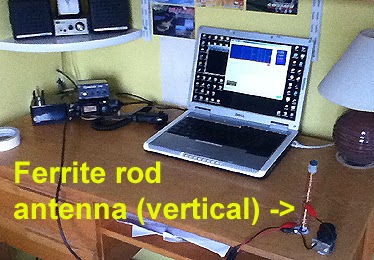
OK, I only tried this with WSPR and with low power, but at my old QTH I had a good deal of success using a small ferrite rod as a TX antenna on some HF bands. As long as the ferrite is not in saturation there is no good reason why it should not work. Most problems will occur if the antenna is driven with too much power.
See the link for more details. I have no idea about this ferrite rod’s properties but I think it was a fairly standard piece of ferrite rod and nothing too special at all.
Since being in hospital for 3.5 months and moving QTH I have not been able to find the ferrite rod to repeat the tests. My wife moved most of my stuff and it is probably deep in a box somewhere! At some point I guess it will just turn up.
See https://sites.google.com/site/g3xbmqrp3/antennas/ferrite_tx .

Roger Lapthorn, G3XBM, is a regular contributor to AmateurRadio.com and writes from Cambridge, England.
Dayton Finale



Mike Crownover, AD5A, is a regular contributor to AmateurRadio.com and writes from Texas, USA. Contact him at [email protected].
Dayton Finale
Mike Crownover, AD5A, is a regular contributor to AmateurRadio.com and writes from Texas, USA. Contact him at [email protected].
Using Remote SDR’s
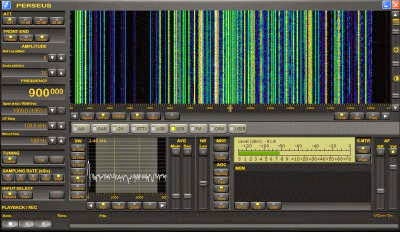 A recent post to Yahoo's Perseus SDR Group posed some interesting questions.
Lasse, SM5GLC, operates an online remote Perseus and made the following comments:
Over the past few weeks/months I have see some "power-users" on my Perseus server... and my plan was to dissect the server log to investigate the usage percentage of my server... and found that already in May the log is 240 kb and growing fast. It seems impossible to analzye by hand.
Now I do notice one user, not too far away (only some 200 miles or so), seems to spend 2-3 hours per day using my server. Mostly just use all allotted time and then get back on asap. I know my antenna is nothing to write home about and the performance is mediocre if any... so this makes me wonder. What on earth do this user do with all the time??
Do others see similar behaviour??
By browsing the log it seems most, user time,70-80 per cent, are from Russia. Most others stay only for a very short period of time, up to a few minutes.
Has anyone tried to hack a script that would automatize the log analysis??
A few Q's that I do have are:
Is the server abused by some?
What is the optimal allowed time? and then the drop-out time?
What usage load would be best to shoot for??
Don, VE6JY, a long-time remote owner added:
Both operators raise some interesting questions!
If you have used a remote SDR or do so with some regularity, how did you find the experience? What types of things did you listen or look for? How much time would you typically spend on the site? What do you think the limits on time should be?
I have used a remote once or twice in the past, to listen for my Tri-Tet-Ten's chirpy, low power signal, and found it very useful but I've never used one for general listening.
What are your experiences?
Steve McDonald, VE7SL, is a regular contributor to AmateurRadio.com and writes from British Columbia, Canada. Contact him at [email protected].
W5KUB Live Coverage – Hamvention 2015
Matt Thomas, W1MST, is the managing editor of AmateurRadio.com. Contact him at [email protected].
Live From Dayton

Mike Crownover, AD5A, is a regular contributor to AmateurRadio.com and writes from Texas, USA. Contact him at [email protected].
 Ham Radio Deluxe |
 W5SWL Electronics |
 Ham Radio Prep |
 KB3IFH QSL Cards  Hip Ham Shirts  HamRadioAuctions HamRadioAuctions Reliance Antennas Reliance Antennas Enigma Shop Enigma Shop |  morseDX  Ni4L Antennas  R&L Electronics R&L Electronics antennas.us antennas.us QRV QRV |
- Matt W1MST, Managing Editor
