 |
 Dayton 2015 – Part 1 of ?
 17 May 2015 | by
 I made the trek again to Dayton this year, my second pilgrimage to the largest amateur radio event on this side of the planet. Realizing there are several other blogs, podcasts, and Internet broadcast shows covering Dayton, I will attempt to limit my observations to those you likely won’t see elsewhere.

The Hara Arena we all know and love continues to be, well, Hara Arena. The good news is renovations are in the works. A Hamvention official told me it’s for real and probably a three to four year project. Yaaaaaay!
Tower Girl, Back at Dayton!
The differences between the Yaesu, Icom, Kenwood, and Elecraft booths were quite notable. Yaesu was giving away hats and entering people for prizes drawings. They often had a line extending well out into the concession area and their System Fusion hats were worn by hamfest goers everywhere. They had employees stationed at each area of the booth and the booth had a continual number of visitors. I stopped by and looked at HTs and a friendly Yaesu employee helped me out.

Yaesu’s New FT2DR HT
Icom’s booth was smaller, but was more high tech and hip-looking. It was more crowded due to its small size. Icom was generating a good deal of interest, with visitors often extending out into the aisle area. Icom should really get a bigger booth next year.

Icom’s Tower Motif Booth
Elecraft’s booth was very busy, as usual, and was well staffed. They even had volunteers staffing the booth. It was difficult to make your way into their booth to see the rigs on display, it was that crowded. A table on the end had three order takers. Even one of the founders of the business was busying taking orders. It goes without saying, but Elecraft essentially has a money-printing machine that is running full tilt with no signs of stopping.

The Kenwood Booth
Kenwood’s booth was well built and arguably the most spacious, but it was the least visited. There was much whitespace on the walls. I looked at their three HTs on display and I couldn’t get any of them to power up. I looked around thinking maybe someone would notice me and assist. Behind one podium there were two Kenwood employees talking to each other. Behind the other podium the two Kenwood employees were talking with visitors, one employee chomping down a candy bar. No one was out walking in the open booth area, and no one helped me. This seemed to be the general state of the Kenwood booth each time I walked by. It’s like no one is really trying and the goal was merely to show up, which they did. Being a long time Kenwood fan, this really troubles me.
In regards to equipment, two notable announcements were the Elecraft K3S and perhaps the Flex Radio Meastro. The Elecraft K3S is essentially an update to the now-discontinued K3. The buzz on the street is that it’s a performance upgrade, mainly to get the platform back up to the top of the performance charts. Several current K3 owners and recent orderers are reportedly a bit miffed, which is to be expected. The Flex Radio Maestro is a hardware frontend / remote dashboard unit for the Flex radio 6000 series. Yaesu did not announce an FT-817 replacement, which salespeople in the booth sheepishly acknowledged. Yaesu was pushing System Fusion like mad. Icom had a separate D-STAR booth that was educational and impressive. Kenwood…?
Hiberling was there with their rig you can’t afford. DZ Kits had an interesting booth with their rigs scattered about, many with the covers off and in various states of assembly or disassembly. There were several (many?) little DSP rig companies, so many that it’s difficult to differentiate them. I wonder how many are selling sufficient numbers of rigs to state financially afloat.

Icom’s Rig You Can’t Afford

Yaesu’s Rig You Might Be Able to Afford
The flea market had the usual wares, but it’s shrinking. The parking lot continues to evolve from asphalt to black sand. I recognized several items for sale that I saw last year at stands. Folks, if you’re bringing the same stuff back to Dayton each year, it’s probably overpriced. I don’t care if it was $10K thirty years ago, you’re not going to get $300 for a solid brass ship compass or a gas mask.

Need a 25 Watt Laser for your World Domination Plan?

Deals You Can’t Refuse
On four occasions I walked up to flea market stands where gruff-looking, optimism-challenged OFs were talking about politics and one where the single digit IQ attendee was complaining about people speaking Spanish. I guess if your junk isn’t selling and you’re bored with amateur radio it’s difficult to be positive and talk about the hobby or something other than politics. I wish these people would just stay home rather than putting their mantras on display at the Hamvention. Attendees who agree with this OF mindset can get their fill by listening to broadcast AM radio, and those who don’t didn’t come to a hamfest be schooled in political drivel. But I digress.

Got Mics?
It was nice to see a few unattended flea market tables with “pay what you want” and honor system payment boxes. Perhaps the Hamvention could increase flea market occupancy by offering free spots to sellers doing all “pay what you want”, unattended, or all free giveaway tables. What extra amateur radio stuff I have I would rather give away than sit behind a table for two days, only to garner a few bucks selling half of it and taking the rest home.
The Hamvention appears to be continuing to pursue a Maker theme, but there is a dearth of Maker content and products for sale. I don’t fault the Hamvention team for this, and applaud their efforts. I think it’s going in the right direction and is going to be crucial to keeping the Hamvention, and other hamfests, sustainable into the future. (More about this in a future article.) Rather than just write or complain about this, I am plan to make an effort to help. I’m going to write a proposal for an Arduino forum and a related activity. If you’re interested in presenting or participating, send me an email ([email protected]).
More about Dayton 2015 in the next article…

Anthony, K3NG, is a regular contributor to AmateurRadio.com.
Thanks Comet and SWODXA!
Friday night at the Dayton DX Dinner I won in a drawing this wonderful antenna analyzer from Comet, the CAA-500. It features a measurement range of 1.8 to 500 Mhz and displays SWR and impedance. It is powered with five AA batteries or an external 8 to 16 volt DC supply can be used.

Thanks Comet and SouthWest Ohio DX Association! This will really come in handy considering I’m in a new QTH and I’m in the process of putting up antennas and reassembling the radio artisan shack. I couldn’t have asked for a more useful measurement tool.
(I am back home and I have several reports from Dayton to post in the next few days. Stay on frequency…)

Anthony, K3NG, is a regular contributor to AmateurRadio.com.
Series Eight Episode Ten – Battery Technology (16 May 2015)
In this episode, Martin M1MRB / W9ICQ is joined by Ed Durrant DD5LP, Martin Rothwell M0SGL and Chris Howard M0TCH to discuss the latest Amateur / Ham Radio news. Colin M6BOY rounds up the news in brief, and this episodes feature is - Battery Technology
- 70 MHz Access for German Radio Hams
- RadCom Plus - New Amateur / Ham Radio Magazine Launched
- Radio to Smartphone revolution
- Reduced Bandwidth TVGB6SRF - Eastbourne Rally Special Event Station
- New North Texas Section Manager
- UK Amateur / Ham Radio Licence Statistics
- Amateur Radio Resources and Downloads
Colin Butler, M6BOY, is the host of the ICQ Podcast, a weekly radio show about Amateur Radio. Contact him at [email protected].
Series Eight Episode Ten – Battery Technology (16 May 2015)
In this episode, Martin M1MRB / W9ICQ is joined by Ed Durrant DD5LP, Martin Rothwell M0SGL and Chris Howard M0TCH to discuss the latest Amateur / Ham Radio news. Colin M6BOY rounds up the news in brief, and this episodes feature is - Battery Technology
- 70 MHz Access for German Radio Hams
- RadCom Plus - New Amateur / Ham Radio Magazine Launched
- Radio to Smartphone revolution
- Reduced Bandwidth TVGB6SRF - Eastbourne Rally Special Event Station
- New North Texas Section Manager
- UK Amateur / Ham Radio Licence Statistics
- Amateur Radio Resources and Downloads
Colin Butler, M6BOY, is the host of the ICQ Podcast, a weekly radio show about Amateur Radio. Contact him at [email protected].
Three Common Mistakes When Using Metric Units
 A while back, I had someone point out a few errors I made concerning the use of metric units. This caused me to review the SI system to make sure I had it correct. (I am sure I’ll continue to screw up a few things but, hey, life is a journey.)
The International System of Units, universally abbreviated SI (from the French Le Système International d’Unités), is the modern metric system of measurement. For a thorough treatment of the topic, take a look at the National Institute of Standards and Technology (NIST) publication: Guide for the Use of the International System of Units (SI). A shorter and easier-to-read document was written by Charles Poynton: Writing SI units and symbols.
But more to the point, here are three common mistakes I often see occurring in ham radio literature:
- Using mHz instead of MHz to indicate megahertz (one million hertz). Upper case M indicates mega, while lower case m indicates milli (one thousandth). In ham radio usage, we rarely speak of frequencies in mHz. Note that I wrote mega with a lower case m even though the abbreviation has a upper case M. The unit of hertz is with a lower case h but when abbreviated as Hz, it should be upper case.
- Using KHz or khz instead of kHz to indicate kilohertz (one thousand hertz). Lower case k should be used for kilo but upper case H is used for hertz. It is common to see upper case K used to indicate 1024 in digital systems.
- Using M instead of m to indicate the unit of meter. The proper way to refer to the wavelength of the 144 MHz ham band is 2m, not 2M. Similarly, the abbreviation for kilometers is km, not kM or KM. The abbreviation for centimeter is cm.
Units that are based on a person’s name use an upper case letter in the abbreviation. For example, ampere, volt, watt and hertz are abbreviated as A, V, W and Hz respectively. When the unit is spelled out, it is left lower case (go figure).
While the world does keep on turning when we make these mistakes, accuracy and understanding is improved by proper usage. Did I miss any other common SI errors?
73, Bob K0NR
The post Three Common Mistakes When Using Metric Units appeared first on The KØNR Radio Site.
Bob Witte, KØNR, is a regular contributor to AmateurRadio.com and writes from Colorado, USA. Contact him at [email protected].
Ferrite rod transmitting antennas?
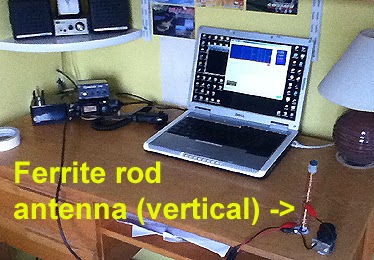
OK, I only tried this with WSPR and with low power, but at my old QTH I had a good deal of success using a small ferrite rod as a TX antenna on some HF bands. As long as the ferrite is not in saturation there is no good reason why it should not work. Most problems will occur if the antenna is driven with too much power.
See the link for more details. I have no idea about this ferrite rod’s properties but I think it was a fairly standard piece of ferrite rod and nothing too special at all.
Since being in hospital for 3.5 months and moving QTH I have not been able to find the ferrite rod to repeat the tests. My wife moved most of my stuff and it is probably deep in a box somewhere! At some point I guess it will just turn up.
See https://sites.google.com/site/g3xbmqrp3/antennas/ferrite_tx .

Roger Lapthorn, G3XBM, is a regular contributor to AmateurRadio.com and writes from Cambridge, England.
Dayton Finale


Mike Crownover, AD5A, is a regular contributor to AmateurRadio.com and writes from Texas, USA. Contact him at [email protected].
 Ham Radio Deluxe |
 W5SWL Electronics |
 Ham Radio Prep |
 KB3IFH QSL Cards  Hip Ham Shirts  HamRadioAuctions HamRadioAuctions Reliance Antennas Reliance Antennas Enigma Shop Enigma Shop |  morseDX  Ni4L Antennas  R&L Electronics R&L Electronics antennas.us antennas.us QRV QRV |
- Matt W1MST, Managing Editor
