 |
 Amateur Radio Weekly – Issue 62
 30 May 2015 | by
Still amazes me
It still amazes me that 5 Watts of RF energy can span the globe. To quote my son Joey, “What sorcery is this?”
W2LJ
Radio Contest? Why?
The basic objective of most radio contests is to make as many radio contacts as possible. This is influenced by the scoring method used for the contest.
Ham Radio School
Interview: KGB spy who relied on numbers stations
Jack Barsky held a job at some of the top corporations in the U.S. and lived a seemingly normal life — all while spying for the Soviet Union
60 Minutes
Les Paul’s pirate radio station in Queens
Not only did he build the first solid body electric guitar and invent multi-track recording but he was responsible for creating a pirate radio station in Queens in the 30s.
glasscapsule
Radio call saves SOTA climber following fall
A Littleton, Colorado, radio amateur and mountaineer was happy to have his hand-held transceiver along on May 17 after he slipped and fell from an icy ledge in Berthoud Pass while snowshoeing.
ARRL
29 MHz – the forgotten frequency for amateur radio satellites
Hans van de Groenendaaal ZS6AKV writes in the EngineerIT magazine about the potential for 29 MHz as a satellite uplink band.
AMSAT UK
Photos from the Voice of America Museum
Immediately after packing up our table at the Dayton Hamvention, my buddies Eric (WD8RIF), Miles (KD8KNC), and I made the 30 minute journey to Bethany, Ohio, to visit the VOA Bethany museum.
The SWLing Post
Video
Elecraft K3S Transceiver demo
First details of the new K3S transceiver, presented by Peter Waters G3OJV.
Waters & Stanton
How to wind a toroid inductor
The real trick is often how to hold the toroid core while doing the winding of the wire.
W2AEW
How to
3D print: 3 element 2m (145 MHz) ultra portable yagi
MakerBotThingiverse
Using the Raspberry Pi as an RTL-SDR streaming server
Do you have an unused Raspberry Pi lying around your bench somewhere and just can’t figure out what to do with it? You could build a wireless RTL-SDR streaming server.
/dev/thrash
WsprryPi: Raspberry Pi WSPR transmitter
The I/O pins provide access to a clock signal and it is possible to modulate this clock signal via software.
Gerolf Ziegenhain
Amateur Radio Weekly is curated by Cale Mooth K4HCK. Sign up free to receive ham radio's most relevant news, projects, technology and events by e-mail each week at http://www.hamweekly.com.
Big wheel antenna
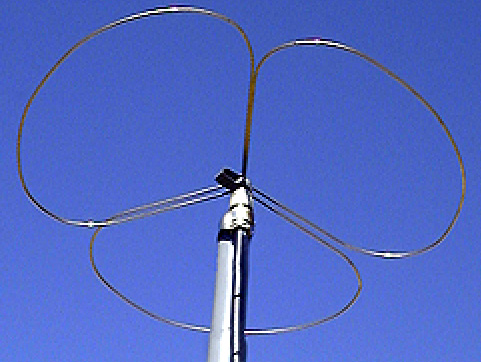 |
| Big Wheel for 2m |
A good 2m antenna for horizontal polarisation is the big wheel. Quite a few beacons use these as they require no rotator and a couple of these stacked give about 5dBd gain horizontally. So, these would be ideal for fixed station use. They would suit me well for UKAC 2m contests and general 2m SSB/CW use. I know that my 3 el, hand rotated, beam has about the same gain. One big wheel alone is better than a halo, but two suitably phased would be better than a small beam.
Roger Lapthorn, G3XBM, is a regular contributor to AmateurRadio.com and writes from Cambridge, England.
49’er & Fake Transistors
 A recent posting to Yahoo's 'GQRP' reflector spurred discussion of the growing number of fake transistors being seen on e-bay. A builder enquired about the low efficiency noted in his recently built Chinese '49er' kit.
I recently bought one of the Chinese Forty-9er transceiver kits off ebay and on receive it works well. It certainly transmits, but the power is down to 800mW and the driver transistor is getting very hot. I'm not expecting a lot of power from it, but power claims are 1.8W to 3W. I'm more concerned about the hot driver transistor. The following link shows the circuit diagram.
http://www.ebay.com/itm/DIY-kits-Frog-Sounds-HAM-Radio-QRP1-8W-CW-Transceiver-Receiver-7-023MHz-/121507448525
I've checked for spurious oscillation (a problem I've had before), but can find nothing. Does anyone have any ideas for why the transistor is getting hot?
It was suggested that the transistor in the PA may not be up to specs and even be a 'fake' as these types are commonly noted on e-bay, selling for prices that are too good to be true.
The problem was eventually sorted out by exchanging transistors:
Firstly, thanks for all your help. Initially, I replaced the Chinese PA transistor with a BD139 and that increased power output to 1.2W and reduced the heating of the driver. Key down and it took perhaps 20s to get "finger hot", rather than 10s. Tonight I changed the driver transistor to a 2N3904 as used in the original Forty-9er and the driver heating seems to have gone away. A small heatsink on the PA transistor allows it to run at 1.4W output for 30s of keydown without any drop in power or the heatsink getting any more than warm.
Thanks for all your help and I hope this helps someone else.
A search of Youtube videos shows several builders that have split some of the RF devices open in order to compare die sizes of suspected fakes with the real thing:
Earl Andrews, VE3GTC, has gone to considerable effort to test and compare many of his transistor purchases and indicates that there are a lot of devices coming out of China that are outright fakes and have no hope of meeting the specs that you might expect. His interesting website has a lot of details about testing as well as a very comprehensive 'for sale' list of reliable devices. Earl also suggests using caution when buying e-bay Chinese electrolytics as his measurements of ESR values indicate that many do not pass specs.
If you have purchased fakes or have found a Chinese source of the real thing, please let us know ... I'm sure there are plenty of dealers selling the real thing out there.
Steve McDonald, VE7SL, is a regular contributor to AmateurRadio.com and writes from British Columbia, Canada. Contact him at [email protected].
User Hostile! Radios that you love to hate!

Three band HT Radio, 2 Meters, 70 CM and 6 Meters
“I hate this radio”
Have you ever said this?
I certainly have. Some radios are a joy to use. They are intuitive, easy to use and you don’t ‘NEED THE MANUAL’ every time you want to change something!
HT’s seem to be the most ‘user hostile’ radios available to hams. I know! All HT radios should have certain things, VFO, on off knob/button, volume control and keypad, and in my opinion, they should not be so difficult to use that you need to read the manual every time you want to do, what should be a simple task; change CTCSS tone of a repeater, for example!
When HT’s were reduced in size, they became more complicated to use. Menu systems were instituted. They were further reduced in size and menus were multi-layered! How many times have I yelled at my HT after holding button a for 1 second, then within 4 seconds, tried to press button 2, for 1 second but no more than 2.5 seconds, while doing 3 pirouette turns on my left foot, only then, can I use my radio. That same button has 3 functions now a days. Press it once for one thing, press it again within a specified number of seconds and you get another function. Press and hold it and you get yet another option.
Enter the English Translation, manual! Poorly translated from Japanese, but at least its in English! (With many pertinent things omitted!)
Why do manuals go to great lengths to tell you in great detail everything that you ‘don’t want to know’ and will most likely never use or use very seldom?
But tell you want you NEED TO KNOW, naw! Tell you how to ‘undo’ something? That would make it too easy!
Actually, I really like this VX5-R HT from Yaesu. It’s a love/hate relationship, however! So very handy, it fits in the palm of my hand, has lots of memories, and many many nice features. Accessing those features is not always easy, especially without the manual right in front of you. If you ever push the wrong button, and send it into ‘never-never-land’, its hard to un-do what you just did! One thing that was left out of the VX 5 is a memory clear feature! That omission makes life with this radio difficult at best!
You cannot return a designated memory channel to its ‘no data’ state. The only thing you can do from the radio itself is to overwrite that particular memory with another frequency!

2 Meter IC V8000
I’m not picking only on Yaesu!
This Icom V 8000 is the most ‘User Hostile’ radio that I have ever owned.
Not only is it difficult to use, but it has problems as well. The mic is notorious for a mechanical problem with the PTT button, and the external speaker jack does not work well. Unfortunately, the external speaker jack is where you have to plug the programming cable in to program the radio. The Icom program for doing this is also ‘user hostile’ BTW!
Editing and Cloning Software RT Systems I bought software and cable from RT systems to program and manage the Icom T 70-A. The HT and its programming software arrived yesterday.

IC T 70 programming software and cable

Icom T70 A with spare battery, left, drop in charger, and speaker mic
The Icom T-70-A, is the replacement radio for the Yaesu VX 5
It will replace the VX5 as my ‘go to’ HT. Just last night, I picked up the Yaesu VX5 the wrong way, mashed some buttons on its face and sent it into never-never-land! Try as I may, I could not undo it with normal button press. Since the radio has an RT Systems program and cable on its way, I went nuclear, and reset the processor. Finally, the radio was operational once more. It needs programming of course but the display is no longer stuck!
It programmed the Icom T 70-A radio to my specifications with only a cursory reading of the manual. The radio is intuitive, easy to use and has some great features. RT Systems Programming Software and Cable

IC 7100 with Touch Paddles
Funny, I just installed an Icom 7100 mobile HF/VHF/UHF/MF radio in my truck. That radio was ‘done right’ by the manufacturer! Its easy to program and use, so there is no need to keep the manual handy for simple tasks. I run mobile CW/SSB and VHF repeaters with it. If there were any UHF in the area, I’d have that programmed in there too. Its a joy to use!
This photo shows the IC 7100 on a modified clip board held in place with bungee cords. So far, I have not seen the need for programming software. That said, there is an SD card on board this radio. It can save the settings to the SD card. I have not explored this avenue yet. It would be nice to keep a copy of the settings on an SD card and on my laptop for future use. Something unexpected can happen. Spare radio data would come in very handy then. Replacing all the settings would be very easy with the programming/clone software. RT systems sells that one too.
Do you have a radio that you love to hate?
Ernest Gregoire, AA1IK, is a regular contributor to AmateurRadio.com and writes from Florida, USA. Contact him at [email protected].
49m Canadians QSL’d
An e- mail report to long-time veri-signer and Ontario DX Association mainstay, Harold Sellers, brought a quick e-mail verification. I was hoping that CFVP would still be issuing a paper QSL but nowadays that is getting to be a rarer and rarer policy.
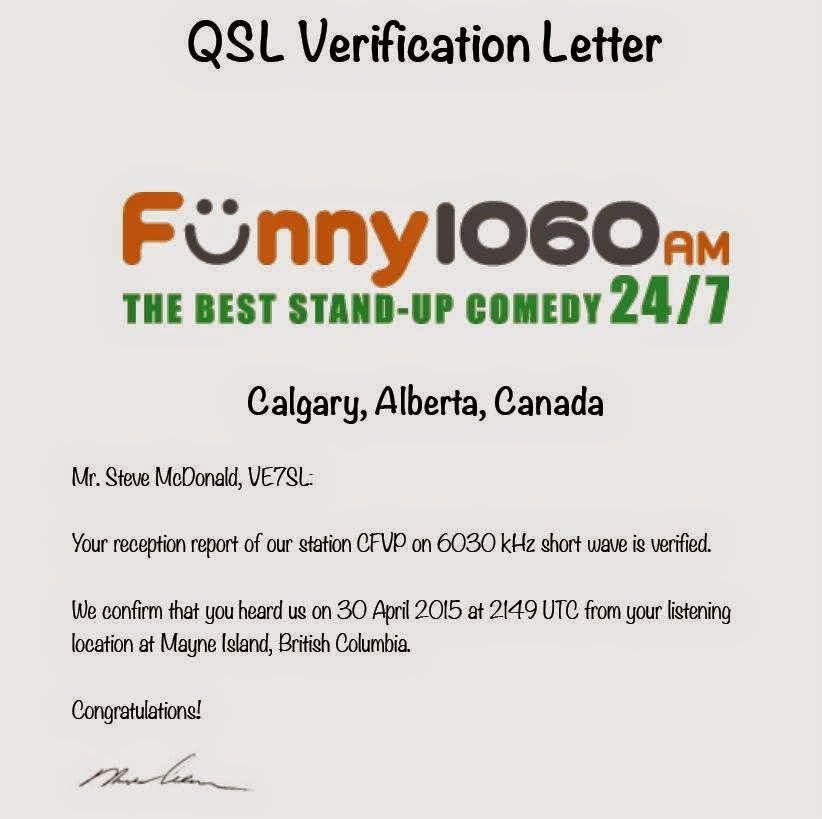
Harold also reports the following details about CFVP:
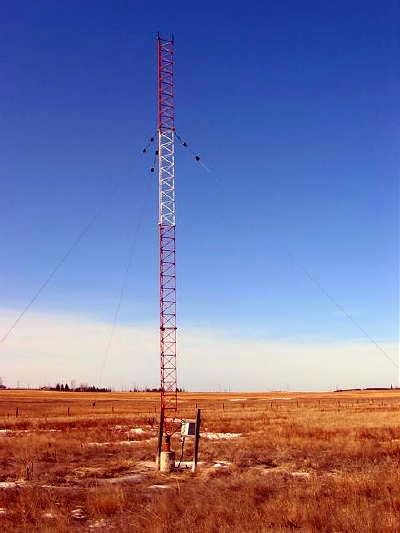 |
| CFVP Tower courtesy: Harold Sellers |
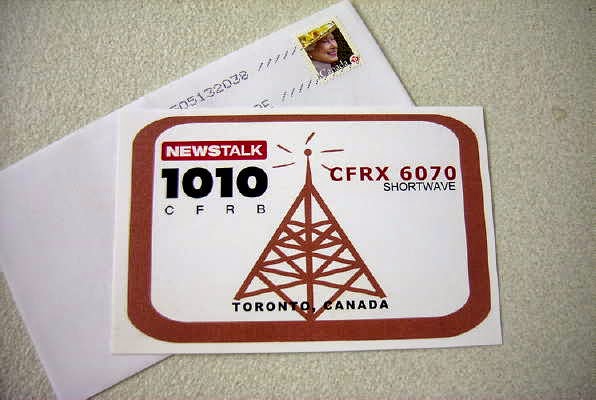
Steve reports that CFRX is simulcasting CFRB (1010kHz) using 1000 watts into an omnidirectional vertical antenna. They have received several reports from Europe over the many years that he has been sending verifications.
Now to tackle CKZU!
Steve McDonald, VE7SL, is a regular contributor to AmateurRadio.com and writes from British Columbia, Canada. Contact him at [email protected].
ID-880H in the jeep
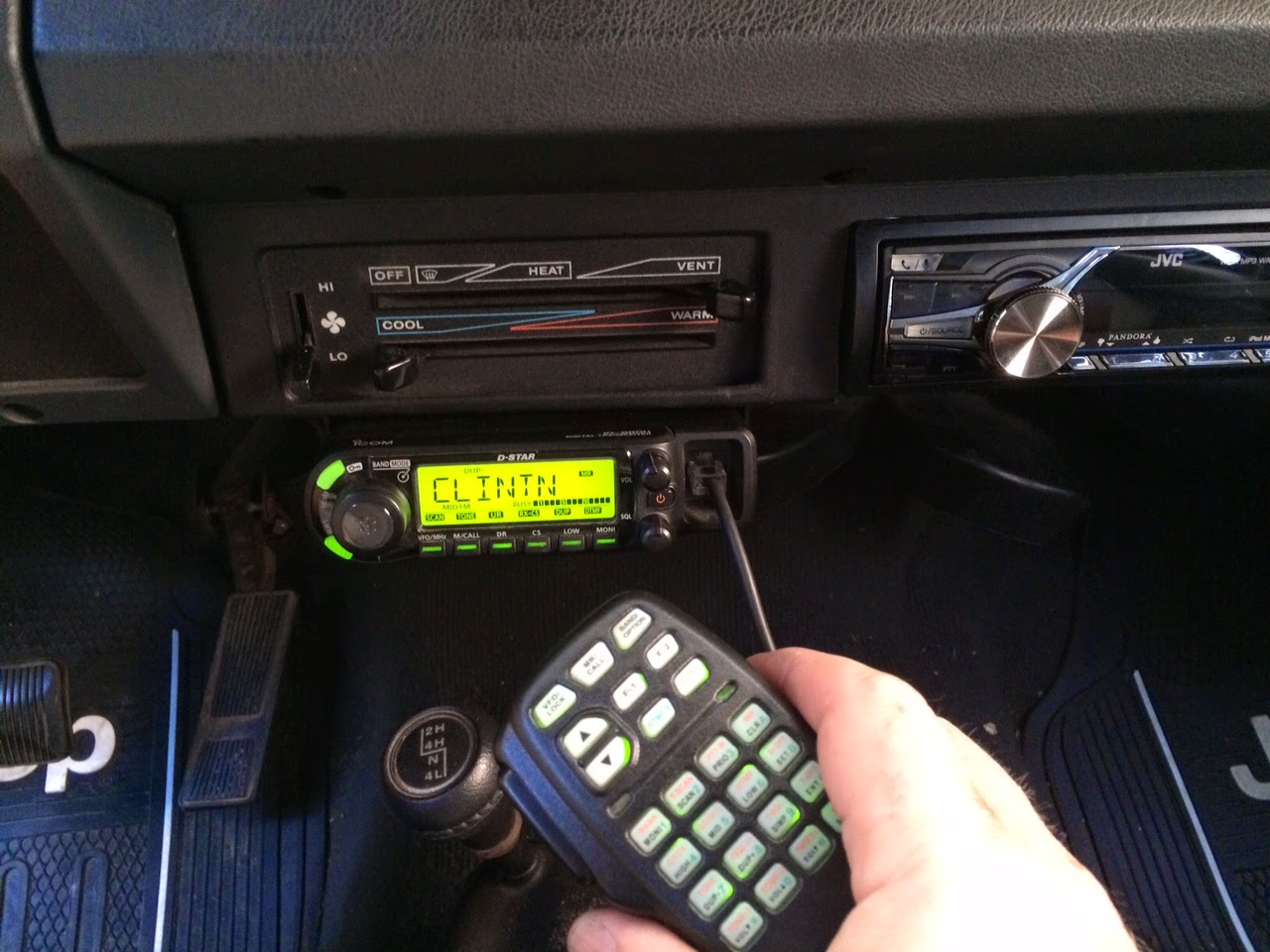
Michael Brown, KG9DW, is a regular contributor to AmateurRadio.com and writes from Illinois, USA. Contact him at [email protected].
ID-880H in the jeep
Michael Brown, KG9DW, is a regular contributor to AmateurRadio.com and writes from Illinois, USA. Contact him at [email protected].
 Ham Radio Deluxe |
 W5SWL Electronics |
 Ham Radio Prep |
 KB3IFH QSL Cards  Hip Ham Shirts  HamRadioAuctions HamRadioAuctions Reliance Antennas Reliance Antennas Enigma Shop Enigma Shop |  morseDX  Ni4L Antennas  R&L Electronics R&L Electronics antennas.us antennas.us QRV QRV |
- Matt W1MST, Managing Editor
