 |
 LDE’s – Really Long Ones!
 10 June 2015 | by
  |
| courtesy: https://openclipart.org |
Tommy happened upon the LDE when tuning around the band one December evening. He heard a weak, warbly ... "CQ CQ CQ de VE7BLF VE7BLF K". A chill went up his spine as he had actually called CQ about 30 minutes earlier, and was answered by a K7. Sure enough, the phantom LDE soon came back to the K7 while Tommy listened to himself send the report, name and his QTH information on the next transmission! Listening to his own signals, 30 minutes later, really shook my friend up as he had no idea what to make of the incident.
Over the next few weeks, Tommy heard several LDEs, some with separations as much as 3 or 4 days and during this time made several recordings of the events. He made a copy of the recordings for me to listen to and the sound of the signal really did send shivers up my back. It was tormented, warbly, with a bit of flutter and very weak. It sounded as though the signal had been ripped apart on a trip to hell and back, adding further to the mystery.
The LDEs stopped as quickly as they had begun and were never heard again but in the meantime, Tommy and I speculated on what might be the cause. Were they genuine LDEs? ... they certainly sounded as if they had been on a very long trip ... or was the explanation something far less sinister? We never did solve the mystery but I had suggested that one likely explanation might be a faulty (or normally operating) VCR, somewhere in the neighborhood. Someone that happened to record at around the same time that Tommy was operating and playing the program back when Tommy happened to be listening. It seemed a far-shot and one that we never tested, preferring to think of it as another one of the mysteries of radio. Unfortunately Tommy became an SK several years ago, never knowing the cause of his mystery signals.
During a recent discussion with Tony (VE7CNF) and Mark (VA7MM) about the newly imagined plasma tubes, the subject of their possible link to LDEs also emerged. I related the above story and Toby immediately went to work with his old VCR! In his own words:
Yes, old VHS recorders could cause long delay echoes. When Steve mentioned it, I had to try it. I attached a photo and some recordings.
I hooked up my old VHS recorder with BNC video and audio cables in and out. I pulled out the video cables a bit to disconnect the shields, so RF could leak into and out of the video ports. My IC7410 was connected to a dummy load and split, through a T connector, to a whip antenna on top of the VHS.Transmit power was 100W to the dummy load.
I transmitted while recording video. When I played it back I could hear the CW signal pretty much on frequency. I tried this at 1820 kHz and the signal had a lot of frequency flutter. At 3510 kHz the playback signal was stable enough for SSB.
So, RF leaking into and out of the video cables of a nearby VHS recorder could explain LDE's where the delay is hours or days.
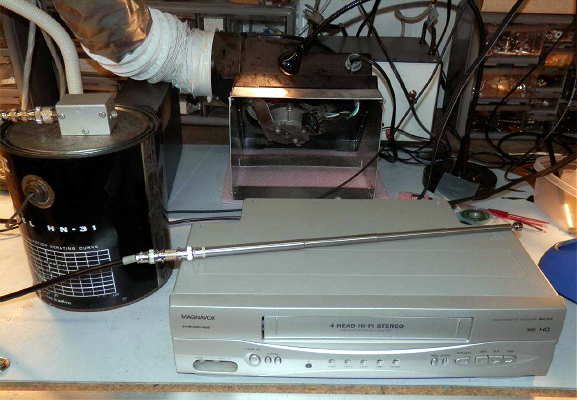
Mystery solved ... the signals that Toby reproduced had the exact same characteristics as I recall from Tommy's old tape recordings although his signals were much weaker, making them seem as if they had been on a very long journey.
Steve McDonald, VE7SL, is a regular contributor to AmateurRadio.com and writes from British Columbia, Canada. Contact him at [email protected].
Pye Telecom PF8

Some years ago I was professionally involved in the design of this innovative transceiver. I am sure I mentioned this on the blog not too long ago.
Some people managed to find rare examples on the secondhand market and converted them to 70cms use. They are hard to find as not that many were made.
See https://sites.google.com/site/g3xbmqrp3/vuhf/pf8 .

Roger Lapthorn, G3XBM, is a regular contributor to AmateurRadio.com and writes from Cambridge, England.
Portable Pains
Indeed during the last twelve months I have done some more portable operating, but while VHF/UHF have been rewarding HF portable has been a mixed bag with at best satisfactory results, but then the same can be said of operating HF from home.
This year I planned to again operate in the 2m UKAC Contest but rather than working from the comfort of the caravan I was going to work from some higher ground near the camp site. Unfortunately the weather was awful with very strong winds gusting upward of 50mph and driving rain, even working from the caravan was a no go.
So rather than enjoying this view with a microphone in hand...

... this was the how I spent the evening and as you can see Eddie was equally impressed.
When the wind and rain subsided toward the end of the week we did have some nice weather so I decided to try some HF. I had taken just the M0CVO Magitenna end-fed wire and using a 9m fibreglass pole I tried operating with it as a vertical and as a sloper both with and without counterpoises and despite receiving some very big S9+ signals on a number of bands seemed to be incapable of making myself heard, I did make a number of contacts but many reported weak signals and stood little chance of working many of the special event station pile-ups.
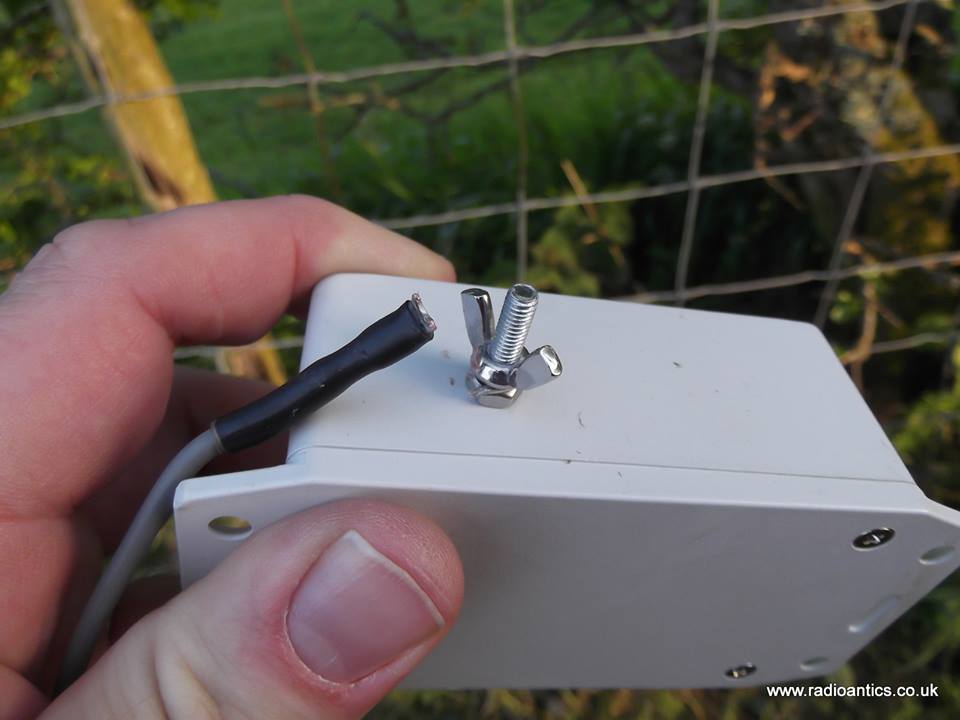
It wasn't helped that on the first day the radiating element connector broke, which necessitated cutting it off and stripping back the wire. I suppose in retrospect I should have been expected it as there is no strain relief on this wire, unlike the loops on the other antennas in the M0CVO range, I rectified this with a few cable ties.
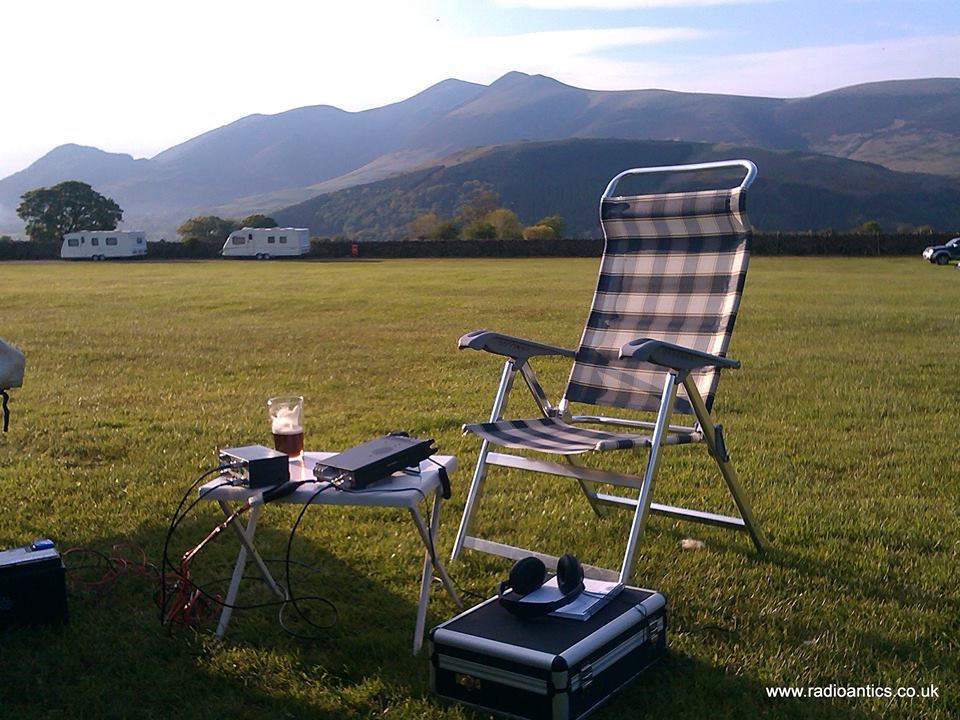
I was running the Yaesu FT857-D from a leisure battery and around 30W as I didn't wish to interfere with the TV reception as I knew most caravans would be using wide-band antenna amplifiers because of the poor coverage. Indeed the one time I did wind the power up to 100W one caravan mains breaker tripped out, it may have been coincidence but I didn't wish to put it to the test.
Despite the lack of performance it was great just sitting under the majestic Skiddaw and surrounding hills while I spent a few enjoyable hours operating. I even discovered one of my neighbours was also licensed, nice to meet you Joe (G4LIA)
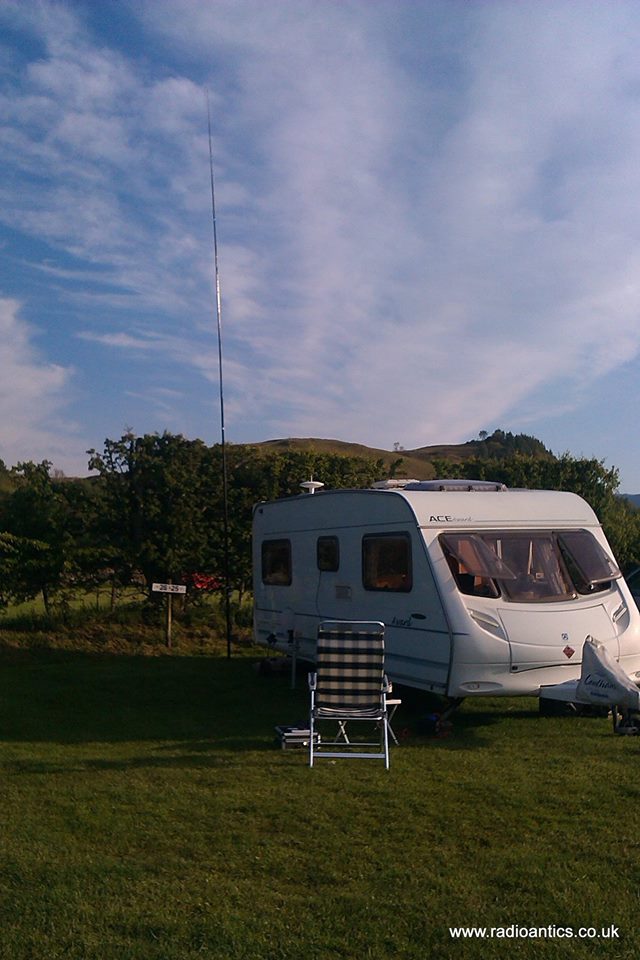
It was frustrating from a contact point of view and I willingly accept I could be a bad workman so don't wish to blame my tools but I think some serious rethinking on a portable HF antenna is needed. I am away to Scotland next month for a week on the Isle of Skye and a week on Islay, this time in rented cottages and am hoping to make a QSO with the South Kesteven ARS on the club night.
Anyway that all has to wait as the launch of Eggsplorer-1 HAB and the GB2EGG Special Event Station are rapidly approaching.
Andrew Garratt, MØNRD, is a regular contributor to AmateurRadio.com and writes from East Midlands, England. Contact him at [email protected].
VK3YE homebrew 7MHz SSB transceiver
Steve G1KQH (font, or is it fount (?) of all knowledge) sent me this link of the homebrew 7MHz SSB transceiver by VK3YE:
New Homebrew 7MHz QRP rig from VK3YE

Roger Lapthorn, G3XBM, is a regular contributor to AmateurRadio.com and writes from Cambridge, England.
UPDATE ON BILL PASTERNAK/STATUS OF NEWSLINE 6/8/15
UPDATE ON BILL PASTERNAK WA6ITF: Don Wilbanks AE5DW and I had a conference call with Bill Sunday evening (6/7/15). The good news is: Bill is not in the ICU; the bad news is he is in serious condition after being diagnosed with--as he termed it--”a broken back.” I take this to mean he has fractured at least one vertebrae. He is being treated for the pain associated with such an injury, and thus is not able to write (type), nor can he read for very long. He said it is also impossible for him to receive very many phone calls, so they must be kept to a minimum. Bill stated that for the immediate days ahead, his focus needs to be on the healing process, and improving his health, so that’s where his focus will be. He asked us to pass along his appreciation for all of the thoughts and prayers that have been sent out on his behalf. He also asserted that the Young Ham of the Year Award for 2015 will be awarded this year, with the recipient to be announced very soon. The YHOTY award ceremony takes place at the Huntsville (Alabama) Hamfest in mid-August.
Don and I also discussed with him the long-term future of the Amateur Radio Newsline, and what is needed to get it back into production. We hashed out some rough ideas, and have another conference call Monday evening to work out some more details. The Newsline team is more committed than ever to get production re-started as soon as possible.
Personally, I would like to thank all of those who answered my call for help with getting Newsline back up and running. I received many responses, and up to now, have not been able to reply to all of them. I will be doing so very soon, and we may be adding a few new voices to upcoming Newsline reports. If I haven’t contacted you yet, please be patient, as my full-time job as Program Director/Morning Drive Host of KTPK-FM/Topeka, KS is still requiring me to put in some long hours. I will reply to you all as soon as I can!
For now, please keep Bill in your thoughts and prayers, and keep watching arnewsline.org and the Amateur Radio Newsline Facebook page for further updates. Thanks, and ~73~ from Skeeter Nash N5ASH
Weekly Propagation Summary – 2015 Jun 08 16:10 UTC
Here is this week’s space weather and geophysical report, issued 2015 Jun 08 0221 UTC.
Highlights of Solar and Geomagnetic Activity 01 – 07 June 2015
Solar activity was low this period. Low to mid-level C-class flare activity dominated the period and Region 2361 (N16, L=105, class/area=Dai/110 on 06 Jun) was responsible for the bulk of the activity. Region 2361 produced a total of nine C-class flares throughout the week, the largest of which was C8/Sf flare at 0947 UTC on 04 Jun. Region 2360 (N15, L=132, class/area=Eac/140 on 07 Jun) grew in total sunspot count, area, and magnetic complexity late in the week but was only responsible for three low-level C-class flares this period. In addition to the low-level solar activity, multiple disappearing solar filaments and eruptive prominence liftoffs were observed throughout the week, but none resulted in Earth-directed coronal mass ejections.
No proton events were observed at geosynchronous orbit.
The greater than 2 MeV electron flux at geosynchronous orbit was at normal levels throughout the period.
Geomagnetic field activity was at quiet levels throughout the period under an ambient solar wind environment with unsettled levels observed early on 01 Jun and late on 07 Jun which were attributed to minor perturbations in the solar wind.
Forecast of Solar and Geomagnetic Activity 08 June – 04 July 2015
Solar activity is expected to be at low levels with a slight chance for M-class (R1-Minor) flare activity for 08-16 Jun due to the flare potential from Regions 2360 (N15, L=132), 2361 (N16, L=105), and 2362 (N07, L=100). As Regions 2360, 2361, and 2362 rotate off the visible disk, very low levels of solar activity are expected with a chance for C-class flare activity for 17 Jun-04 Jul.
No proton events are expected at geosynchronous orbit.
The greater than 2 MeV electron flux at geosynchronous orbit is anticipated to reach high levels on 10-14 Jun with moderate levels likely on 15-19 Jun in response to an enhanced solar wind environment caused by the influence of coronal hole high speed streams (CH HSSs). Normal levels are expected for the remainder of the period.
Geomagnetic field activity is expected to reach active levels on 08, 10 Jun with G1 (Minor) geomagnetic storm conditions anticipated on 09 Jun in response to a recurrent negative polarity CH HSS. Unsettled geomagnetic field conditions are expected on 11-12 Jun as CH HSS effects subside. A recurrent positive polarity CH HSS is expected to bring about isolated periods of unsettled conditions on 15 Jun. Generally quiet field conditions are expected for 16 Jun-03 Jul with unsettled levels likely again on 04 Jul due to a solar sector boundary crossing ahead of a negative polarity CH HSS.
Don’t forget to visit our live space weather and radio propagation web site, at: http://SunSpotWatch.com/
Live Aurora mapping is at http://aurora.sunspotwatch.com/
If you are on Twitter, please follow these two users: + https://Twitter.com/NW7US + https://Twitter.com/hfradiospacewx
Get the space weather and radio propagation self-study course, today. Visit http://nw7us.us/swc for the latest sale and for more information!
Check out the stunning view of our Sun in action, as seen during the last five years with the Solar Dynamics Observatory (SDO): https://www.youtube.com/watch?v=zXN-MdoGM9g
We’re on Facebook: http://NW7US.us/swhfr
Visit, subscribe: NW7US Radio Communications and Propagation YouTube Channel
CKZU – 6160 Close-Up
 |
| courtesy: googlemaps.ca |
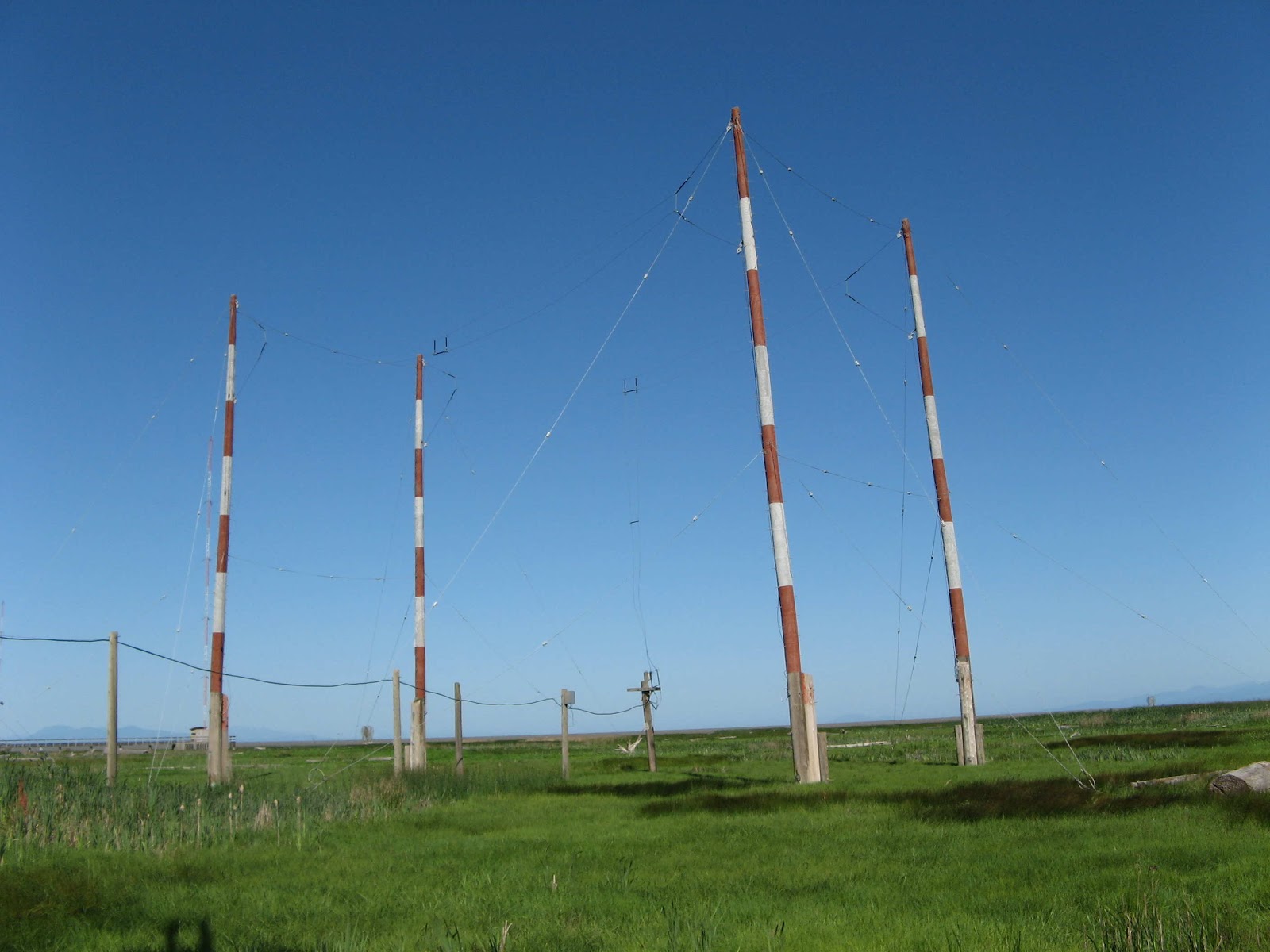
On a weekend bike ride along the West Richmond dyke, Mark (VA7MM) snapped this wonderful close-up view of the system:
 | ||||
| courtesy: VA7MM |
So the next time you are tuning around 40m, drop down a bit and see how their signal sounds at your location ... you may be pleasantly surprised.
Steve McDonald, VE7SL, is a regular contributor to AmateurRadio.com and writes from British Columbia, Canada. Contact him at [email protected].
 Ham Radio Deluxe |
 W5SWL Electronics |
 Ham Radio Prep |
 KB3IFH QSL Cards  Hip Ham Shirts  HamRadioAuctions HamRadioAuctions Reliance Antennas Reliance Antennas Enigma Shop Enigma Shop |  morseDX  Ni4L Antennas  R&L Electronics R&L Electronics antennas.us antennas.us QRV QRV |
- Matt W1MST, Managing Editor
