 |
 Another June VHF Contest In the Bag
 18 June 2015 | by
 Last weekend was the ARRL June VHF Contest, my favorite ham radio event of the year. For me, this is “vhf activity weekend” when all of the vhf radio enthusiasts come out to play on the bands above 50 MHz. The sporadic-e propagation that is (almost) always present during the contest means that 6 meters will be hopping.
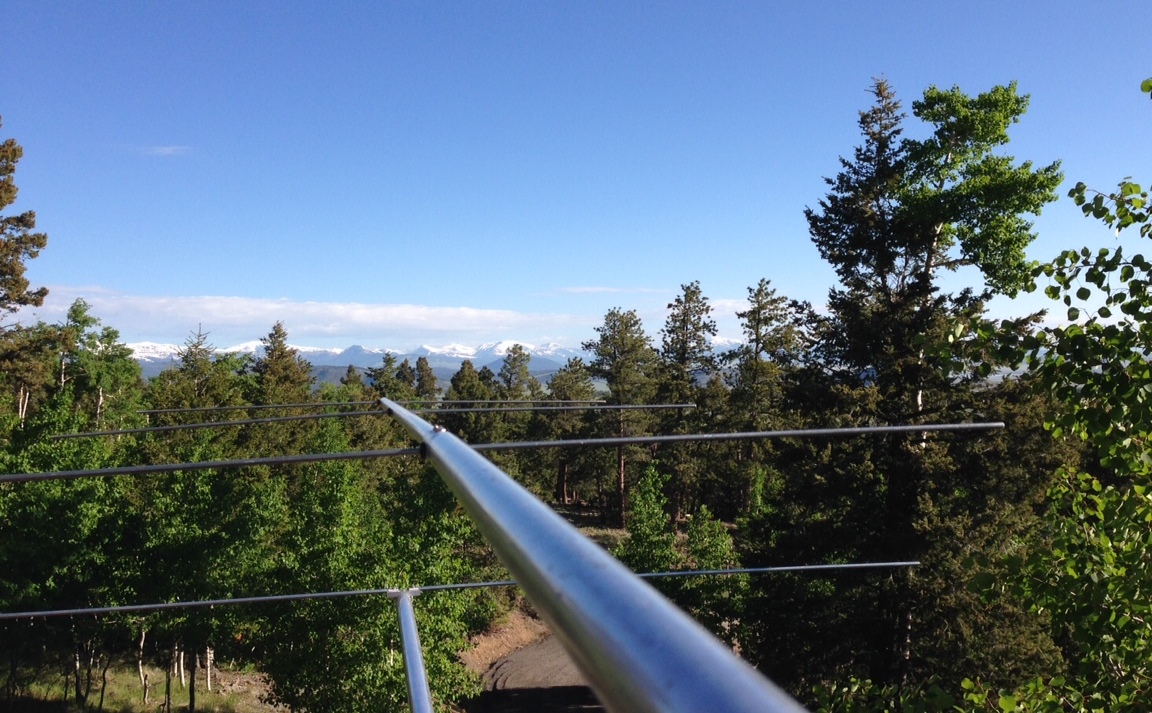 I entered in the 3-Band Single Operator category, using 6m, 2m and 70cm. My 6m rig is a Yaesu FT-950 driving a 6M5XHP Yagi antenna. For 2m and 70cm, I use a Yaesu FT-847 to drive a 2M9SSB Yagi on 2m and a similar Yagi for 70 cm. I set up portable masts at our cabin in DM78av, near Trout Creek Pass, Colorado (9600 feet).
This year, propagation seemed OK but not great. My score turned out to be about the same as last year with similar effort and same equipment, but down from previous years. 6m had sporadic-e openings very late both evenings, about the time I was ready to give up. Fortunately, I stuck with it and made quite a few contacts late into the evening.
The rovers kept things from getting too boring when 6m was not cooperating. Thanks to W3DHJ/R, ABØYM/R and WE7L/R for roving in eastern Colorado. WBØGAZ/R passed through South Park heading towards Denver and give me a few contacts. I also got a few contacts from KØCS/R and KØJJW/R. Thanks for roving!
Best DX was ZF1EJ in EK99, a new country for me on 6m.
73, Bob KØNR
K0NR June VHF Contest Summary:
 Band  QSOs  Mults
-------------------
    6:  190    83
    2:   30    13
  222:
  432:   11     6
-------------------
Total:  231    102  Total Score = 24,684
The post Another June VHF Contest In the Bag appeared first on The KØNR Radio Site.
Bob Witte, KØNR, is a regular contributor to AmateurRadio.com and writes from Colorado, USA. Contact him at [email protected].
Hunting For NDBs in CLE195
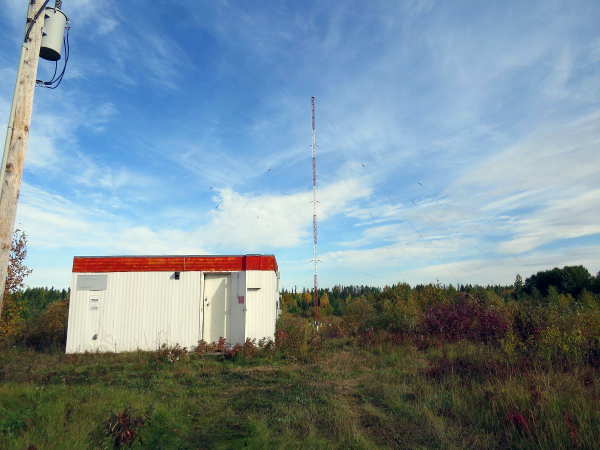 |
| 'YPM' - 274kHz courtesy: Alex - VE3GOP |
A list of all of the North American targets in this range can be found in the RNA database, while targets for European DXers will be found here... specify the frequency range wanted and check 'show all results'.
An excellent target for this CLE is 'YPM' in Pikangikum, Ontario, on 274kHz. Its 25 watts and big antenna are heard well throughout North America
From CLE coordinator Brian Keyte (G3SIA) comes the following reminder:
Have you tried one of our Co-ordinated Listening Events yet?
CLEs are NOT contests - they allow us to share the same listening
challenge and in the process to learn more about our great hobby.
Short logs or long ones, everyone who enjoys taking part is a winner!
Since early in 2001 over 250 different NDB List members have taken
part in a CLE for the first time - and over four in every five came back
for more.
Fourteen members have come back over 100 times, 44 over 50 times.
Our 195th Co-ordinated Listening Event, coming in a few days, will be
rather a challenge (we like those, don't we?)!
Days: Friday 19 June - Monday 22 June (a week early)
Times: Start and end at midday, your LOCAL time
Range: 270.0 - 319.9 kHz (NOT DGPS beacons)
Yes - it does include most of the DGPS frequencies, but it is 50 kHz wide,
about three times more than usual. We shall be listening only for the
'NORMAL' NDBs.
We last searched for NDBs on these frequencies in CLE180 (March 2014).
We shall all have at least one end of the range for some comfortable
listening, but the main challenge will be to find the Morse signals among
all the DGPS noises. REU and RNA show that, since the start of last year,
about 270 and 200 normal NDBs respectively have been reported there.
There are several to be heard by our members 'down under' as well.
Please look out for the 'Final Details', which as usual will follow about
two days before the start.
73
Brian
----------------------------------------------------------
From: Brian Keyte G3SIA ndbcle'at'gmail.com
Location: Surrey, SE England (CLE co-ordinator)
----------------------------------------------------------
These listening events serve several purposes. They:
- determine, worldwide, which beacons are actually in service and on-the-air so the online database can be kept up-to-date
- determine, worldwide, which beacons are out-of-service or have gone silent since the last CLE covering this range
- will indicate the state of propagation conditions at the various participant locations
- will give you an indication of how well your LF/MF receiving system is working
- give participants a fun yet challenging activity to keep their listening skills honed
Final details can be found at the NDB List website, and worldwide results, for every participant, will be posted there a few days after the event. If you are a member of the ndblist Group, results will also be e-mailed and posted there.
The very active Yahoo ndblist Group is a great place to learn more about the 'Art of NDB DXing' or to meet other listeners in your region. There is a lot of good information available there and new members are always very welcome.
If you are contemplating getting started on 630m, listening for NDBs is an excellent way to test out your receive capabilities as there are several NDBs located near this part of the spectrum.
You need not be an ndblist member to participate in the CLEs and all reports, no matter how small, are of much value to the organizers. 'First-time' logs are always VERY welcome!
Reports may be sent to the ndblist or e-mailed to either myself or CLE co- ordinator, Brian Keyte (G3SIA), whose address appears above.
Please...do give the CLE a try....then let us know what NDB's can be heard from your location! Your report can then be added to the worldwide database to help keep it up-to-date.
Steve McDonald, VE7SL, is a regular contributor to AmateurRadio.com and writes from British Columbia, Canada. Contact him at [email protected].
Are you ready?
Have you sent in your e-mail? I've gotten only a few, so far. You don't have to wait until Sunday to request a number - but that is the day when I will start posting them to the roster.
A word to all those who have already requested a Skeeter number - In addition to having your name and call posted on the Skeeter Hunt roster, you WILL receive a confirming e-mail from me with your number, some time on Sunday. If you have already applied and do not have your number by Monday morning, let me know! In fact, throughout this process, ALL applicants will receive a confirming e-mail which will include their Skeeter number.
Now.....here's my pledge to all of you who participate in the NJQRP Skeeter Hunt.
You go out of your way to join in on the fun. Some of you travel some distance to find the right spot - some of you operate from home or your back yards. But no matter where you operate from, you are the ones on the air, making the NJQRP Skeeter Hunt a success.
I will always do my level best to get your scores (and soapbox comments) posted in a timely manner. I can tell you right off the bat, that since log summaries are due two weeks after the event, you won't see anything for at least those first two weeks. But after that, I will get all that good stuff posted as fast as I can without sacrificing accuracy and completeness.
You, the participants, deserve as much. And if for some reason, I can't make this self imposed deadline, I'll communicate that to you and will let you all know so that you're not left in the dark, scratching your heads, wondering what's going on. You make the effort, you want to see how you did and how you stacked up amongst your peers. You want to see how that new rig or new antenna performed for you - I get that, and will do my best to let you see how it all panned out.
Certificates and plaques take a bit longer. But again, I will do my best to get those out within a couple months following the event. Just so you all know, Skeeter Hunt swag is available through CafePress. All proceeds go to help pay for paper, envelopes, ink, and postage.
72 de Larry W2LJ
QRP - When you care to send the very least!
Larry Makoski, W2LJ, is a regular contributor to AmateurRadio.com and writes from New Jersey, USA. Contact him at [email protected].
Weekly Propagation Summary – 2015 Jun 15 16:10 UTC
Here is this week’s space weather and geophysical report, issued 2015 Jun 15 0323 UTC.
Highlights of Solar and Geomagnetic Activity 08 – 14 June 2015
Solar activity ranged from very low to moderate levels (R1-minor) with very low activity observed on 08 June, low activity observed on 09, 10 and 12 June and moderate activity observed on 11, 13 and 14 June. A majority of the flare activity occurred from Regions 2360 (N15, L=129, class/area Eac/220 on 12 June) and 2367 (S20, L=001, class/area Ekc/340 on 14 June). Region 2367, the largest region on the disk, produced an M1 flare at 11/0855 UTC. This region exhibited steady growth since first rotating onto the disk on 10 June. Region 2360 produced an M1/Sf flare at 13/0729 UTC and an M2 flare at 14/0059 UTC while exiting the west limb on the 14th. Multiple filament eruptions and eruptive prominences were observed throughout the week, but none resulted in Earth-directed coronal mass ejections.
No proton events were observed at geosynchronous orbit.
The greater than 2 MeV electron flux at geosynchronous orbit was at normal levels on 08-09 June. High levels on 10-13 June and moderate levels on 14 June were observed in response to an enhanced solar wind environment caused by the influence of a negative polarity coronal high speed stream (CH HSS).
Geomagnetic field activity was at predominately quiet to active levels with isolated minor storm levels (G1-minor) observed on 08 and 14 June and an isolated major storm period (G2-moderate) observed on 08 June. The summary period began with unsettled to major storm levels as Earth was under the influence of a negative polarity CH HSS. Effects from the CH HSS persisted through midday on 11 June with quiet to active conditions. Quiet to unsettled conditions were observed for the remainder of 11 June through 13 June. The period ended on 14 June with a co-rotating interaction region in advance of a positive polarity CH HSS that affected Earth's geomagnetic field with unsettled to isolated minor storm periods.
Forecast of Solar and Geomagnetic Activity 15 June – 11 July 2015
Solar activity is expected to be at low levels with a slight chance for M-class (R1-minor) flare activity from 15-24 June from Region 2367 (S20, L=001). As region 2367 rotates off the disk, very low to low levels are expected on 25-26 June. Activity levels are expected to increase to low with a slight chance for M-class flare activity on 27 June – 11 July as old Region 2360 (N15, L=129) rotates back on to the visible disk.
No proton events are expected at geosynchronous orbit.
The greater than 2 MeV electron flux at geosynchronous orbit is anticipated to reach moderate to high levels on 15-19 Jun and 07-11 Jul in response to an enhanced solar wind environment caused by the influence of coronal hole high speed streams (CH HSSs). Normal levels are expected for the remainder of the outlook period.
Geomagnetic field activity is expected to reach unsettled to active levels on 15-16 Jun and 06-08 Jul with minor storm levels (G1-minor) anticipated on 05 Jul and 11 Jul in response to recurrent CH HSS effects. Generally quiet field conditions are expected for 17 Jun-04 Jul.
Don’t forget to visit our live space weather and radio propagation web site, at: http://SunSpotWatch.com/
Live Aurora mapping is at http://aurora.sunspotwatch.com/
If you are on Twitter, please follow these two users: + https://Twitter.com/NW7US + https://Twitter.com/hfradiospacewx
Get the space weather and radio propagation self-study course, today. Visit http://nw7us.us/swc for the latest sale and for more information!
Check out the stunning view of our Sun in action, as seen during the last five years with the Solar Dynamics Observatory (SDO): https://www.youtube.com/watch?v=zXN-MdoGM9g
We’re on Facebook: http://NW7US.us/swhfr
Visit, subscribe: NW7US Radio Communications and Propagation YouTube Channel
LHS Episode #148: Alligators Are Good Eatin’
 Welcome to Episode #148 of Linux in the Ham Shack! In this installment, your hosts discuss Art Bell and the radio of kooks everywhere, free newsletters, Linux terminal utilities, FreeDV, FlexRadio, loggers and a whole bunch more. Thanks for listening, and enjoy all the information we cram in your earholes.
73 de The LHS Guys
Russ Woodman, K5TUX, co-hosts the Linux in the Ham Shack podcast which is available for download in both MP3 and OGG audio format. Contact him at [email protected].
Fluorescent Light QRN

A recent posting on the ON4KST 6m Chat page brought up the question of QRN coming from fluorescent lighting.
Lefty, K1TOL, had a lot of QRN coming from his neighbour's garage, about 1,000 feet away. He solved the problem by changing the ballasts, purchased at Home Depot. This is the ballast that solved his problem, so if you are having similar difficulty, perhaps this will be of benefit.
Sometimes just changing to a different bulb type (manufacturer) will solve the problem as well but from what I have read, you get what you pay for and likely the bargain-bin bulbs are not the quietest.
Steve McDonald, VE7SL, is a regular contributor to AmateurRadio.com and writes from British Columbia, Canada. Contact him at [email protected].
Series Eight Episode Twelve – Running an Amateur / Ham Radio Special Event (14 June 2015)
In this episode, Martin M1MRB / W9ICQ is joined by Ed Durrant DD5LP ,Martin Rothwell M0SGL and Matthew Nassau 2E0MTT to discuss the latest Amateur / Ham Radio news. Colin M6BOY rounds up the news in brief, and this episodes feature is - Running a Special Event.
- Passing (SK) of Bill Pasternak WA6ITF
- New VK balloon Circumnavigates the Earth
- German Museum Joins Museums on the Air
- The Morse Mouse - Educational Fun with Ham Radio
- Britain's Pirate Radio Stations
- Tytera TYT MD-380 DMR handheld
- Radio Call Saves SOTA Climber
- Bletchley Honour for Morse Code Interceptor
- Australian Foundation Licence due for Review
- Lotto Grant to buy Radios for Blind
- Swedish 160m Proposal
Colin Butler, M6BOY, is the host of the ICQ Podcast, a weekly radio show about Amateur Radio. Contact him at [email protected].
 Ham Radio Deluxe |
 W5SWL Electronics |
 Ham Radio Prep |
 KB3IFH QSL Cards  Hip Ham Shirts  HamRadioAuctions HamRadioAuctions Reliance Antennas Reliance Antennas Enigma Shop Enigma Shop |  morseDX  Ni4L Antennas  R&L Electronics R&L Electronics antennas.us antennas.us QRV QRV |
- Matt W1MST, Managing Editor
