 |
 Big wheel antennas
 6 July 2015 | by
Next winter I want to replace my hand rotated beams for 70cm and 2m with a big wheel stack for either 2m or 70cm. I was going to erect a 2m big wheel stack (of 2) but looking at the logs it may better to erect one for 70cm which is the more interesting band.
2 big wheels, suitably stacked, should give about 5dBd gain horizontal and need no turning. This is not far off the gain from my 5el yagi in the best direction. Quite often I work stations off the direction of maximum gain. For my kind of operation (mainly UKAC contests and beacon monitoring) I think a big wheel is well suited.
70cm big wheel stacks are a lot smaller than the 2m versions. The stacking distance is smaller too. Commercial big wheels are available from Wimo in Germany.
See http://www.wimo.de/big-wheel-antennas_e.html .

Roger Lapthorn, G3XBM, is a regular contributor to AmateurRadio.com and writes from Cambridge, England.
Prepping for some more /p
I have made a linked dipole inspired by the ones sold by SOTAbeams, it is a simple inverted vee supported by a 9 meter fishing pole the wire elements are made of sections which are joined together depending on the band required. I have made a two band version, 20m/40m and it tuned nicely using the analyser.
As a backup I have also revisited the "Magitenna" which disappointed last time I tried to used it. Firstly I replaced the original wire which was too heavy for the low power I run and is very prone to kinking.
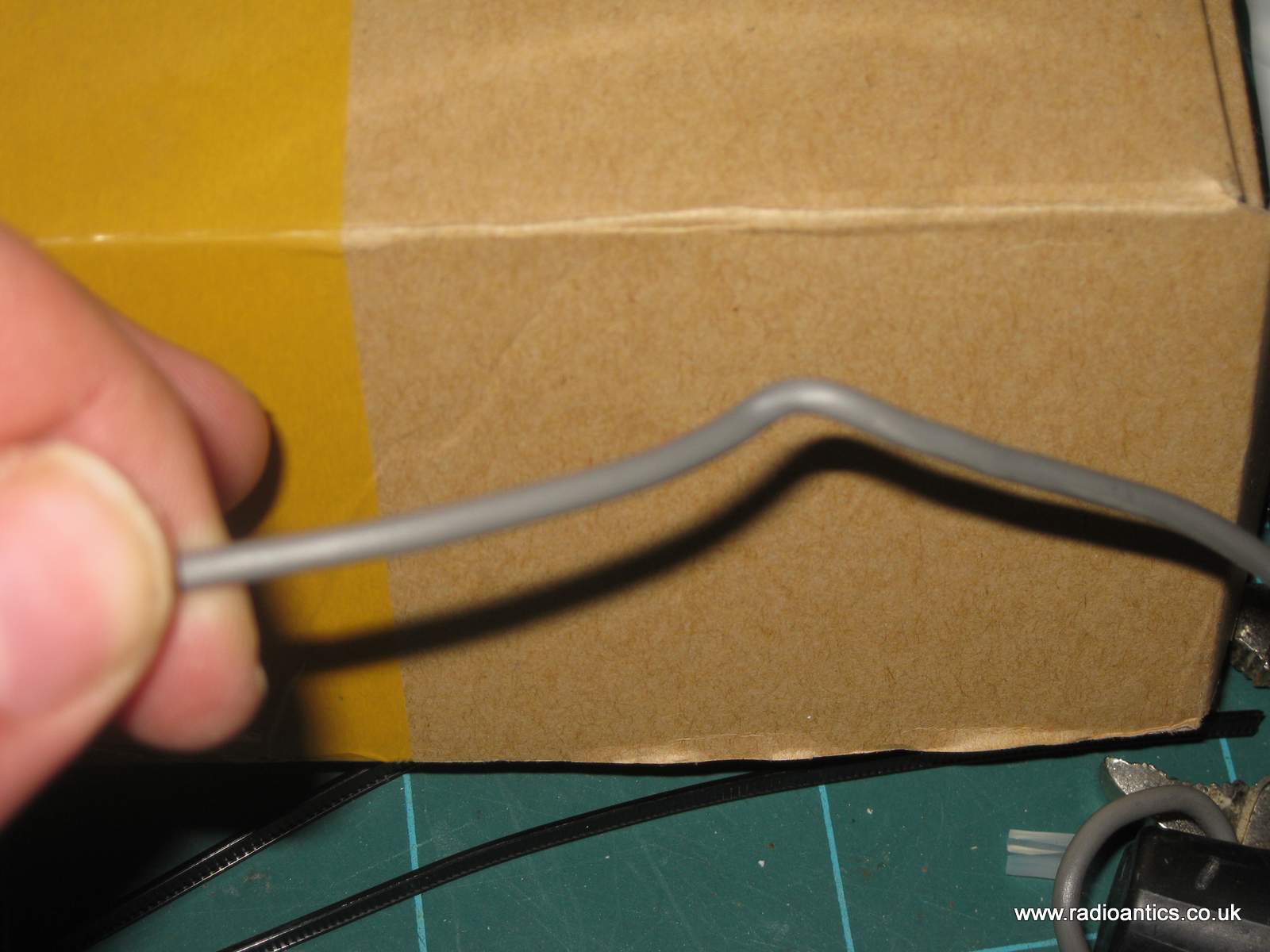
While doing this I discovered that the terminal post on "the special matching unit" was simply turning when I tried to tighten the wing nut. This pointed to a broken or at best poor internal connection and I was forced to open up plastic box to make a repair, sadly "forced" was the operative word.
One of the four screws was inexplicably super-glued in place and being cack-handed I soon ruined the head trying to remove it and had to drill it out. Once the screws were removed I then found the lid too was glued in place at several points and had to prise the lid off trying to minimise any damage in the process.
Given that nearly all other ham equipment I own is designed to be serviceable, including rigs worth several hundred pounds I found this annoying and unnecessary for a simple antenna, especially as the ethos is for amateurs to experiment and modify things. It certainly wasn't glued for weatherproofing as it would be have sealed all round, it could only have been to stop it being opened. I could understand this if it were protecting some patented, copyright design but it wasn't, behold the magic within the "special matching unit" nothing but a simple un-un which I suspected already.
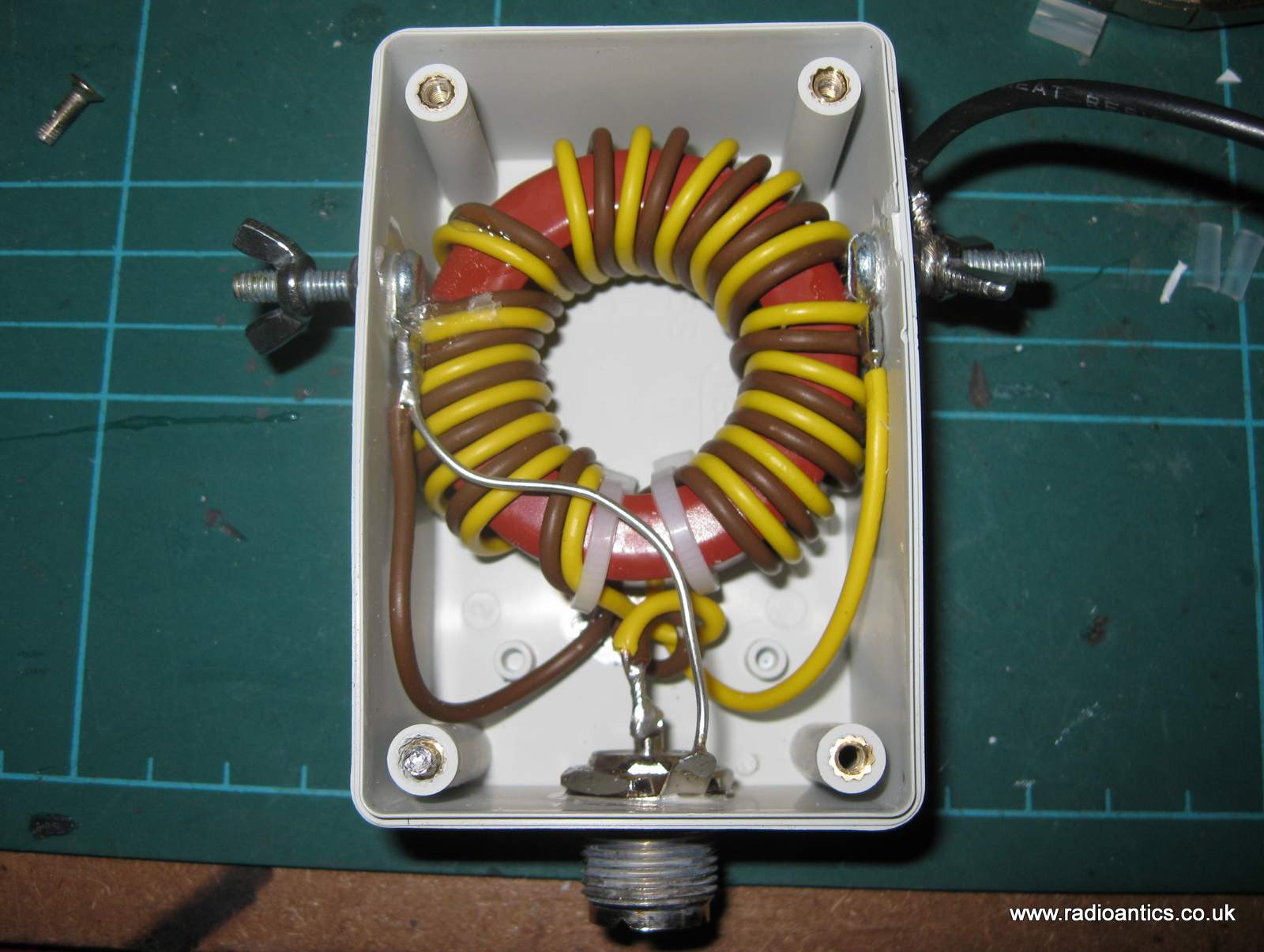
Anyway I was able to tighten up the simple screw and bolt and ironically I used some epoxy resin on the screw head to try to stop it coming loose again. Hopefully this loose terminal was the reason for the poor performance last time.
I am looking forward to having another go from operating in Scotland this year with some more experience I hope to improve on last years efforts
While tinkering in the shack I kept the FT857 on and tuned around looking to give points away for the VHF Field Day and made a number of decent DX contacts using just 30W

Andrew Garratt, MØNRD, is a regular contributor to AmateurRadio.com and writes from East Midlands, England. Contact him at [email protected].
Prepping for some more /p
I have made a linked dipole inspired by the ones sold by SOTAbeams, it is a simple inverted vee supported by a 9 meter fishing pole the wire elements are made of sections which are joined together depending on the band required. I have made a two band version, 20m/40m and it tuned nicely using the analyser.
As a backup I have also revisited the "Magitenna" which disappointed last time I tried to used it. Firstly I replaced the original wire which was too heavy for the low power I run and is very prone to kinking.
While doing this I discovered that the terminal post on "the special matching unit" was simply turning when I tried to tighten the wing nut. This pointed to a broken or at best poor internal connection and I was forced to open up plastic box to make a repair, sadly "forced" was the operative word.
One of the four screws was inexplicably super-glued in place and being cack-handed I soon ruined the head trying to remove it and had to drill it out. Once the screws were removed I then found the lid too was glued in place at several points and had to prise the lid off trying to minimise any damage in the process.
Given that nearly all other ham equipment I own is designed to be serviceable, including rigs worth several hundred pounds I found this annoying and unnecessary for a simple antenna, especially as the ethos is for amateurs to experiment and modify things. It certainly wasn't glued for weatherproofing as it would be have sealed all round, it could only have been to stop it being opened. I could understand this if it were protecting some patented, copyright design but it wasn't, behold the magic within the "special matching unit" nothing but a simple un-un which I suspected already.
Anyway I was able to tighten up the simple screw and bolt and ironically I used some epoxy resin on the screw head to try to stop it coming loose again. Hopefully this loose terminal was the reason for the poor performance last time.
I am looking forward to having another go from operating in Scotland this year with some more experience I hope to improve on last years efforts
While tinkering in the shack I kept the FT857 on and tuned around looking to give points away for the VHF Field Day and made a number of decent DX contacts using just 30W
Andrew Garratt, MØNRD, is a regular contributor to AmateurRadio.com and writes from East Midlands, England. Contact him at [email protected].
LF / MF – Time To File

The FCC is now officially inviting comment on its proposal to establish two new amateur bands ... the 2200m LF band (135.7kHz - 137.8kHz) and the 630m MF band (472 - 479kHz).
The detailed proposal was published in the Federal Registry on July 2, thus establishing the comment deadline as August 31st and a deadline of September 30th for 'comments on the comments'.
It is proposed that the Amateur Radio service would be 'secondary users' of this slice of the spectrum. Secondary users must not cause interference to the Primary users and also be willing to accept interference from the Primary users as conditions of operating. In reality, the only primary use of these bands in North America is for hydro distribution control (PLC) signals. Over several years of maximum ERP amateur experimental work, both here in Canada as well as in the U.S.A., there has been no documented interference to these signals nor have the well-shielded PLC signals been a problem for amateurs ... it seems that co-existence is readily attainable.
Whether you have operated on these bands or not (but especially if you have), I would urge you to file a comment expressing your opinions on any of the critical concerns (antenna height, power etc.) expressed by the FCC. All of these were listed in a previous three-part blog, starting here.
If you think that you might like to operate or experiment on either of these bands in the future, then just tell them that as well ... the more interest from the amateur radio world shown, the better.
For those of you that might think that this part of the spectrum has little to offer the amateur, I can assure you that such is not the case. Coast-to-coast propagation has been demonstrated on numerous occasions (on both bands). Both bands offer wide opportunities for experimental work dealing with antennas, modes and propagation as well as providing an abundance of homebrewing opportunities for builders.
Comments may be filed, identified by ET Docket No 15-99 (proceeding number), via the FCC Electronic Comment Filing System (ECFS). As well, you can read all of the comments that have been filed here.
U.S. amateurs have been waiting long enough (since 2007) for an opportunity to use these bands ... let's show the FCC that we really want them by filing your comments before August 31st!
Steve McDonald, VE7SL, is a regular contributor to AmateurRadio.com and writes from British Columbia, Canada. Contact him at [email protected].
VHF NFD 2015
The 2015 annual VHF national field day is now officially finished. So what’s the news?
 Firstly I managed so excellent DX from the comfort of my own shack.
DX you say?
Yep 3 countries
Wow(?)…well yes they were EI,GM and GW so not exactly a long way but DX none the less.
Uhh?
Well yes, if the bands are normally silent and there’s not a station to be heard then the end of the village is DX.
But if there’s a bit of activity as there was this weekend then its always nice to work a few stations in other countries. But what would be really nice is to hear this level of activity on the bands regularly, and there to be rag chewing alongside contesting.
The ‘official entry’ from Workington was camped up on Corney Fell. I arrived too late to help get set up due to domestic duties but the photo’s didn’t do the conditions justice. There was a good 30+ mph wind up there and that 2m antenna was flapping about a lot. Hence the extra guy .
The VHF bands are XYL friendly in my house as the antenna’s are smaller, can be overlooked (on occasion) and don’t warrant the usual response of ‘What the hell is that doing there?’ and ‘ How long do you intend on keeping that thing there?’ The answer to both of these questions is to mumble a bit and pretend to be busy doing something important.
So here’s a plea. Don’t make me take down this antenna, or worse still turn it vertically for FM. I’d quite like to work stations regularly on VHF SSB or even CW. Remember to switch the rig on, look for IO84 square and break the silence. A response to one contester today on 70cms was ‘That woke me up, I’ve been calling for 2 hours solidly and you’re the first one today’ isn’t good.
Alex Hill, G7KSE, is a regular contributor to AmateurRadio.com and writes from Cumbria, UK. Contact him at [email protected].
Field Day 2015
I haven't participated in Field Day for a couple of decades. This year I was invited to participate in the Field Day operation of W5YA. W5YA has won their entered category numerous times and has finished in the top 10 of all Field Day stations multiple times, operating QRP. Their success is directly correlated to meticulous planning and the excellent execution of that plan by the team of KT5X, K1JD, K5KM, NM5S, K7SO, K6XT, W0CCA and WD9FJL. The primary antennas are wire antennas strung in the trees at the Field Day site near Chama, NM.
My role this year was to fill in some shifts at the CW stations but primarily to supervise the operation of the GOTA (Get On The Air) station along with my son, Michael Jr., AB5EB. The GOTA station used my call, AD5A, as the GOTA station must operate under a different callsign than the primary Field Day station. The GOTA operators were my grandsons Reid, KF5GYE, age 14 and Boogie, KF5GYD, age 13. Both have their General tickets, but are not very active, which is a requirement of the GOTA station. My son and I would coach them during the event. Neither of my grandsons do CW, so we would be operating SSB, QRP. Not the easiest of assignments. Operating on a crowded band with beginner level operators is quite a learning experience for all involved. What was slightly frustrating in the first 12 hours was a delight in the last 12. Both boys learned a lot about operating QRP, proper procedures and amateur radio etiquette. In the final hours of the event, no coaching was needed. They learned to handle both calling CQ and answering stations in a pile-up. Overall a fantastic result, the boys finished with 158 SSB QSO's from the GOTA station using 5 watts from a KX3 and a wire in the trees.
The final tally hasn't been made yet, but the CW station contributed over 1,400 QSO.s with wire antenna's and 5 watts of power. A very cool accomplishment and a testament to what is possible with amateur radio. Teaching us those lessons and getting new hams involved is what Field Day is all about.
We camped in a tent for two nights so I got to enjoy my son and grandsons in a great outdoor radio experience. Below is a video of the two GOTA operators. KF5GYD is operating and KF5GYE is cooking. The video should give you a flavor of Field Day.
Mike Crownover, AD5A, is a regular contributor to AmateurRadio.com and writes from Texas, USA. Contact him at [email protected].
MacLoggerDX
 |
| The layout of MacLogger DX on my Mac |
I recently tweeted that I had dropped Ham Radio Deluxe in favour for MacLoggerDX. Amongst the re-tweets and comments i received, Danny (PA3DM) did mention that HRD is not just a logbook, but a full suite of digital modes, rotor and a rig control system. This I completely agree with, and my time using HRD was always a great experience and I would recommend the software to anyone.
My issue with HRD is this. I use a Mac. I transitioned from PC to Mac around 3 years ago, and have been using a Virtual PC to do my PC based tasks (including my day job) and this is the issue. HRD over a Virtual Machine, using RS-232 connectors is unpredictable, slow and frankly unusable. Its not the fault of HRD, nor is it the fault of the Virtual Machine, The RS-232 – USB connectors. It’s a combination of all the elements tethered together that makes the experience unusable.
So the solution ? well its not a solution to be fair. It’s a compromise. Its not HRD, its not an all in one solution, its a log book that can use the radios VFO, the rotor and DX cluster all together. That is basically what I used HRD for. And on the odd occasion I did venture into digital modes.
I will complete a review of MacLoggerDX in future posts, but for now I thought I would explain my rationale of making the switch. So far, so good.
Dan Trudgian, MØTGN, is a regular contributor to AmateurRadio.com and writes from Wiltshire, England. He's a radio nut, IT guru, general good guy and an all round good egg. Contact him him here.
 Ham Radio Deluxe |
 W5SWL Electronics |
 Ham Radio Prep |
 KB3IFH QSL Cards  Hip Ham Shirts  HamRadioAuctions HamRadioAuctions Reliance Antennas Reliance Antennas Enigma Shop Enigma Shop |  morseDX  Ni4L Antennas  R&L Electronics R&L Electronics antennas.us antennas.us QRV QRV |
- Matt W1MST, Managing Editor
