 |
 Field Day Memories
 28 June 2015 | by
 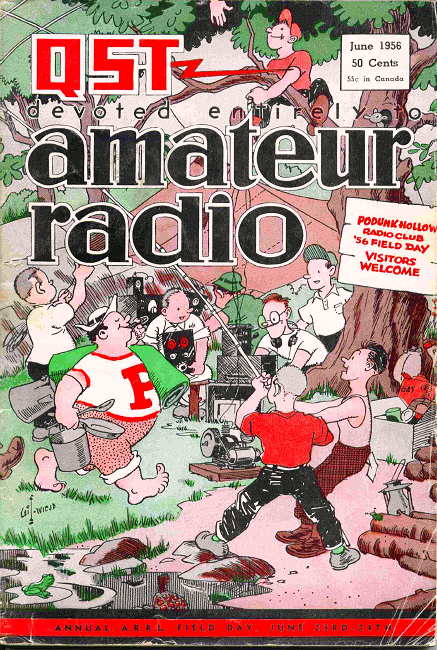 |
| courtesy: arrl.org |
Field Day always followed the end of school and the start of the summer holidays so it was always a weekend that I looked forward to, months in advance.
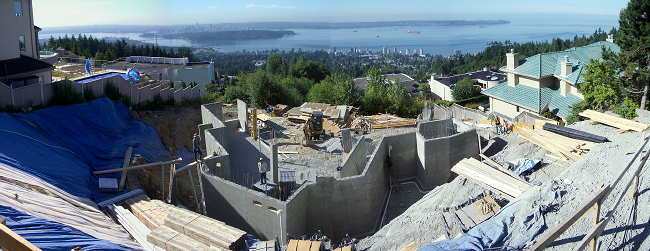
I always went out with the Vancouver Amateur Radio Club (VE7ARV) who used the same spot each year, just above the last street of homes high up on the slopes of West Vancouver ... it was at the base of Hollyburn Mountain and was a spectacular visual site, giving southerly views from east through west. At times it seemed like you could almost see California from up there ... it was a great spot for both HF and VHF. Our Field Day site has long been reclaimed by palatial-sized home in the prestigious 'British Properties' region of Vancouver's North Shore.
Sadly many of the organizers and operators that I remember from my youth are now long gone but they were an enthusiastic group of old-time hams that always had the time to make a young kid feel welcome and part of an important operation. Many of the same fellows were responsible for a lot of teens getting their ticket back in the late 50's and 60's. Tuesday nights were always spent in the basement 'classroom' of Hedley Rendell, VE7XW, who gave so much of his time to Elmering prospective hams as well as providing the trailored crank-up towers for our FD operations. He later established Rendell-Paret Electronics in partnership with Bill Paret, VE7AM, and the contents of Hedley's vast basement collection of parts was the beginning of a business that still flourishes to this day.
Field Day always had many high points for me. One of the best was being able to operate some top-notch equipment compared to my humble home station which consisted of an old Heathkit AT-1 and VF-1 VFO and then later, a much-used DX-35, purchased on one of the family's summer shopping trips to Seattle. In those days, the city was home to several ham radio shops and at least a dozen radio-surplus stores, all now long gone.
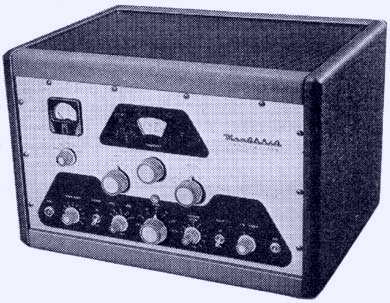
There were usually a couple of Collins 75A4's and later, state-of-the-art Drake 2B's. The Johnson Ranger was always reliable and such a pleasure to operate but there were always a few hundred-pound hernia-makers like the Heathkit DX-100's and the Johnson Viking II's that had to be lugged from back seats to tents every year. That's where us young guys came in handy.
VHF activity back then was mainly FM (at least in the Vancouver area) and every year we would manage to work down to the weekend hilltopers in Oregon, mainly due to our elevated location. 2m FM rigs in those days were all converted taxi rigs, mainly Motorola 5V's, run on their built-in DC vibrator supply or on a homebrewed power supply. There were at least a hundred guys on 147.33 FM, all with old taxi rigs and the frequency was busy 24/7 it seemed. These were the days before repeaters and working 50 miles was a real accomplishment.
I usually took the 40m CW shift and would operate all night. The band was always amazingly crowded with nothing but FD stations throughout the entire activity ... even the 40m phone band was plugged solid with AM action, all working the FD contest. I would never ever sleep at Field Day and would go home exhausted, usually sleeping an entire Monday, to recharge my battery ... fun days.
I haven't been out on Field Day since my late teens as other things in life became more important but I'll never forget those wonderful weekends and the great fun that was had, so many years ago
Steve McDonald, VE7SL, is a regular contributor to AmateurRadio.com and writes from British Columbia, Canada. Contact him at [email protected].
A new 40m DSB kit arrives on the QRP scene
The MDT DSB kit is manufactured by Ozqrp, capable of 2W PEP, it has a full swinging VFO 7.090MHz - 7.130MHz or 7.050MHz - 7.110MHz all for $80 (Aus) including case, less than £40 UK plus carriage, which worked out about $12.50 (Aus) posted to the UK when I quickly did a test and popped it into the shopping trolley.
Further details and manual from http://www.ozqrp.com/MDTindex.html
Steve, G1KQH, is a regular contributor to AmateurRadio.com and writes from England. Contact him at [email protected].
Series Eight Episode Fourteen – Friedrichshafen Review (28 June 2015)
In this episode of the ICQ Amateur / Ham radio Podcast, we start our review of the Ham Radio Friedrichshafen event.
Interviews with
- Paul Bigwood (G3WYW) from Yaesu discussing System Fusion - https://www.yaesu.com/
- Michael Zwingl (OE3MZC) from OEVSV discussing the groups proposal for a more modern radio operating system - http://www.oevsv.at
- Graham Summerfield from BHI - http://www.bhi-ltd.com
- World Radio Team Championship 2018 Announcement - http://www.wrtc2018.de/
- Gerald (K5SDR) from Flex makes a product development announcement - http://www.flexradio.com
Colin Butler, M6BOY, is the host of the ICQ Podcast, a weekly radio show about Amateur Radio. Contact him at [email protected].
Series Eight Episode Fourteen – Friedrichshafen Review (28 June 2015)
In this episode of the ICQ Amateur / Ham radio Podcast, we start our review of the Ham Radio Friedrichshafen event.
Interviews with
- Paul Bigwood (G3WYW) from Yaesu discussing System Fusion - https://www.yaesu.com/
- Michael Zwingl (OE3MZC) from OEVSV discussing the groups proposal for a more modern radio operating system - http://www.oevsv.at
- Graham Summerfield from BHI - http://www.bhi-ltd.com
- World Radio Team Championship 2018 Announcement - http://www.wrtc2018.de/
- Gerald (K5SDR) from Flex makes a product development announcement - http://www.flexradio.com
Colin Butler, M6BOY, is the host of the ICQ Podcast, a weekly radio show about Amateur Radio. Contact him at [email protected].
Yaesu rebate (UK/ Europe)
I see MLS is offering rebates on Yaesu gear for the next few weeks. The rebate on the FT817 is £36, making the effective retail price around £413. As far as I can see this is just a marketing ploy. A few years ago you could buy the FT817 for £349.
With the very good exchange rate currently I am surprised they don’t just slash the price and clear the shelves ready for the replacement. All development costs for the FT817 were recovered years ago, so the true retail price should be below £400. Yet again we are being taken for a ride I think.
The prices are as they are because we, Joe Public, is prepared to buy at these prices. My heart bleeds for all the poor dealers.

Roger Lapthorn, G3XBM, is a regular contributor to AmateurRadio.com and writes from Cambridge, England.
Amateur Radio Weekly – Field Day Issue

2015 Field Day locator
Field Day is June 27-28, 2015. This page is intended to show public Field Day sites that members of the public and media can visit.
ARRL
How do you choose where to go for Field Day?
The “get on the air” station is designed to get new hams and members of the general public on the air and let them make contacts.
KB6NU
Good operating habits on Field Day
Give a listen and notice how K5PO keeps the contacts short and to the point, clearly communicating using phonetics.
K0NR
Significant solar event may impact Field Day
SWPC has issued a Moderate (G2) geomagnetic storm watch for June 27 and 28. This is significantly weaker than the storm that peaked at Severe (G4) levels earlier this week.
Indiana Section ARES / NOAA
W1AW Field Day Bulletin schedule
All classes of Field Day stations can earn 100 bonus points for copying the special Field Day bulletin transmitted by W1AW.
ARRL
MF demonstration for ARRL Field Day 2015
Many of us that are active Part 5 stations on 630 meters are planning on repeating the Field day greeting event during ARRL Field Day.
NJDTechnologies
Field Day publicity
Club members attempting to tell what’s happening at their Field Day site need to avoid ham radio jargon. “Be ‘less hammy’ about it.”
ARRL
ISS voice contacts for Field Day 2015?
Possibly no FM voice contacts like we enjoyed last year for Field Day, but program Region 1 and Region 2/3, Packet, and SSTV and be ready–just in case!
Southgate
Camping and talking this weekend during Field Day
Hams, who set up radio stations outdoors and run them on generators, will try to contact as many stations as possible during a 24-hour period.
The Advertiser
Video
2014 Field Day
Contacts were of a secondary concern this year, as we all focused on experimentation with radios, power, and antennas.
KF7IJZ
Field Day from space
Astronaut Reid Wiseman (KF5LKT) describes his experience working Field Day from space.
AMSAT UK
2014 Field Day ISS contact
Surrey Amateur Radio Club makes contact with ISS during last year’s Field Day event.
YouTube
Amateur Radio Weekly is curated by Cale Mooth K4HCK. Sign up free to receive ham radio's most relevant news, projects, technology and events by e-mail each week at http://www.hamweekly.com.
Ham College episode 6
Ham College episode 6 is now available for download.
Ham College, the new show for those new to the hobby and those wishing to get into Amateur Radio.
In episode 6 we talk about and demonstrate diodes. More questions and answers from the Technical class question pool.
1:01:48
George Thomas, W5JDX, is co-host of AmateurLogic.TV, an original amateur radio video program hosted by George Thomas (W5JDX), Tommy Martin (N5ZNO), Peter Berrett (VK3PB), and Emile Diodene (KE5QKR). Contact him at [email protected].
 Ham Radio Deluxe |
 W5SWL Electronics |
 Ham Radio Prep |
 KB3IFH QSL Cards  Hip Ham Shirts  HamRadioAuctions HamRadioAuctions Reliance Antennas Reliance Antennas Enigma Shop Enigma Shop |  morseDX  Ni4L Antennas  R&L Electronics R&L Electronics antennas.us antennas.us QRV QRV |
- Matt W1MST, Managing Editor
